Tactical Data Link Market Summary
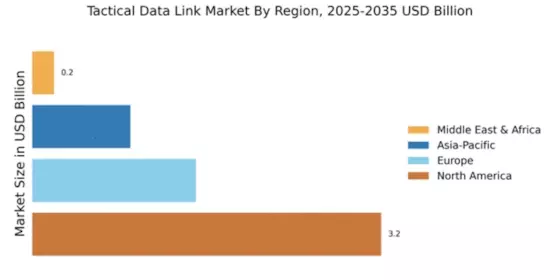
As per MRFR analysis, the Tactical Data Link Market Size was estimated at 5.8 USD Billion in 2024. The Tactical Data Link industry is projected to grow from 6.2 in 2025 to 10.8 by 2035, exhibiting a compound annual growth rate (CAGR) of 5.71% during the forecast period 2025 - 2035. North America holds the largest share of the global Tactical Data Link Market at approximately 37% (valued at ~USD 2.3 Billion in 2025), driven by extensive military investments, defense modernization programs, NATO interoperability requirements, and the presence of leading players including Raytheon Technologies, Northrop Grumman, and L3Harris Technologies. The United States is the leading country within North America, capturing approximately 33% of the global Tactical Data Link Market share (~USD 2.0 Billion in 2025), supported by its NATO membership allowing use of advanced Link 16 and Link 22 capabilities, the DoD's focus on Joint All-Domain Command and Control (JADC2), and continuous investment in network-enabled military systems. Military Operations dominate the Tactical Data Link Market as the largest application segment, accounting for approximately 45% of the global market share (~USD 2.8 Billion in 2025), driven by the increasing reliance on real-time tactical data sharing among allied forces for enhanced mission coordination, situational awareness, and interoperability in joint operations.
Key Market Trends & Highlights
The Tactical Data Link Market is poised for substantial growth driven by technological advancements and increasing interoperability demands.
- North America remains the largest market for Tactical Data Links, driven by extensive military investments and modernization efforts.
- The Asia-Pacific region is emerging as the fastest-growing market, fueled by rising defense budgets and regional security concerns.
- Military Operations continue to dominate the market, while the Intelligence Surveillance Reconnaissance segment is experiencing rapid growth due to evolving operational needs.
- Key market drivers include the growing demand for real-time data sharing and rising geopolitical tensions, which are shaping the future of Tactical Data Links.
Market Size & Forecast
| 2024 Market Size | 5.8 (USD Billion) |
| 2035 Market Size | 10.8 (USD Billion) |
| CAGR (2025 - 2035) | 5.71% |