×
Request Free Sample ×

Kindly complete the form below to receive a free sample of this Report

* Please use a valid business email

Leading companies partner with us for data-driven Insights

clients tt-cursor
Hero Background

Tactical Headset Market

ID: MRFR/AD/2552-CR
110 Pages
Sejal Akre
November 2022

Tactical Headset Market Research Report Information by Type (Personal Headsets and Mobility Platforms and Vehicle), Personal Headsets (Single Sided Headsets and Active Sound Protection Headsets), Active Sound Protection Headsets (In-Ear Sound Protection Headsets, Over-the-Ear Sound Protection Headsets), Technology (Wired and Wireless), Communication Mode (Single Mode and Dual Mode), Application (Military, Law Enforcement, Rescue/Disaster Recovery and Others) and Region Forecast Till 2035

Share:
Download PDF ×

We do not share your information with anyone. However, we may send you emails based on your report interest from time to time. You may contact us at any time to opt-out.

Tactical Headset Market Infographic
Purchase Options

Tactical Headset Market Summary

As per MRFR analysis, the Tactical Headset Market Size was estimated at 3.8 USD Million in 2024. The Tactical Headset industry is projected to grow from 4.0 in 2025 to 6.7 by 2035, exhibiting a compound annual growth rate (CAGR) of 5.29 during the forecast period 2025 - 2035.

Key Market Trends & Highlights

The Tactical Headset Market is experiencing robust growth driven by technological advancements and increasing demand for effective communication systems.

  • The market is witnessing a notable integration of smart technologies, enhancing functionality and user experience.
  • There is a growing emphasis on ergonomics and comfort, catering to prolonged usage in various operational environments.
  • Durability and environmental resistance are becoming critical factors, particularly in harsh operational conditions.
  • Rising demand for enhanced communication systems and increased investment in defense and security are key drivers propelling market expansion.

Market Size & Forecast

2024 Market Size 3.8 (USD Million)
2035 Market Size 6.7 (USD Million)
CAGR (2025 - 2035) 5.29%

Major Players

Harris Corporation (US), Thales Group (FR), BAE Systems (GB), Leonardo S.p.A. (IT), General Dynamics (US), L3Harris Technologies (US), Northrop Grumman (US), Rockwell Collins (US), Elbit Systems (IL), Rohde & Schwarz (DE)

Tactical Headset Market Trends

The Tactical Headset Market is currently experiencing a dynamic evolution, driven by advancements in technology and increasing demand for effective communication solutions in various sectors. Military and law enforcement agencies are particularly focused on enhancing operational efficiency through superior audio capabilities and noise cancellation features. As the need for seamless communication in high-stress environments grows, manufacturers are innovating to provide headsets that not only meet but exceed the expectations of end-users. This trend is further supported by the integration of smart technologies, which allow for real-time data sharing and situational awareness, thereby enhancing overall mission success. Moreover, the Tactical Headset Market is witnessing a shift towards lightweight and ergonomic designs, catering to the comfort and usability needs of personnel who require prolonged use of these devices. The emphasis on durability and resistance to environmental factors is also becoming increasingly prominent, as users operate in diverse and challenging conditions. As the market continues to expand, it appears that the focus will remain on developing headsets that combine advanced features with user-centric designs, ensuring that they are not only functional but also adaptable to the evolving demands of tactical operations.

Integration of Smart Technologies

The Tactical Headset Market is seeing a notable trend towards the incorporation of smart technologies. This includes features such as voice recognition, augmented reality, and connectivity with other devices. Such advancements facilitate enhanced communication and situational awareness, which are crucial in tactical environments.

Focus on Ergonomics and Comfort

There is a growing emphasis on ergonomic designs within the Tactical Headset Market. Manufacturers are prioritizing comfort to accommodate extended use, ensuring that headsets are lightweight and adjustable. This focus on user comfort is essential for personnel who operate in demanding conditions.

Durability and Environmental Resistance

The demand for durable headsets that can withstand harsh environments is increasing. The Tactical Headset Market is responding by developing products that are resistant to water, dust, and extreme temperatures. This trend reflects the necessity for reliable equipment in diverse operational scenarios.

Tactical Headset Market Drivers

Technological Advancements

Technological advancements play a crucial role in the expansion of the Global Tactical Headset Industry. Innovations in audio technology, noise cancellation, and wireless communication are enhancing the functionality of tactical headsets. For example, the integration of augmented reality features into headsets is becoming increasingly prevalent, allowing for real-time data sharing among military personnel. These advancements not only improve user experience but also increase the operational effectiveness of armed forces. As a result, the market is poised for a compound annual growth rate of 5.39% from 2025 to 2035, reflecting the growing demand for sophisticated tactical communication solutions.

Increased Military Spending

The Global Tactical Headset Industry is experiencing growth due to increased military spending across various nations. Governments are allocating larger budgets to enhance defense capabilities, which includes advanced communication systems. For instance, the U.S. Department of Defense has significantly increased its procurement budget for tactical equipment, including headsets, to improve operational efficiency. This trend is expected to contribute to the market's valuation of 2.55 USD Billion in 2024, with projections indicating a rise to 4.54 USD Billion by 2035. Such investments are likely to drive innovation and demand for high-quality tactical headsets.

Rising Demand from Law Enforcement

The Global Tactical Headset Industry is also witnessing rising demand from law enforcement agencies. As public safety concerns escalate, police and security forces are increasingly adopting tactical headsets for enhanced communication during operations. These headsets facilitate clear communication in high-stress environments, which is essential for effective coordination. Moreover, government initiatives aimed at modernizing law enforcement equipment are likely to further boost market growth. The increasing focus on public safety and crime prevention strategies suggests a robust market potential, contributing to the overall expansion of the tactical headset sector.

Increased Focus on Training and Simulation

An increased focus on training and simulation within military and law enforcement sectors is influencing the Global Tactical Headset Industry. Realistic training environments require effective communication tools, and tactical headsets are essential for simulating operational scenarios. The integration of headsets in training programs enhances the preparedness of personnel, ensuring they are equipped to handle real-world situations. As governments invest in advanced training methodologies, the demand for tactical headsets is expected to rise, further contributing to the market's growth trajectory. This trend underscores the importance of effective communication in operational readiness.

Growing Adoption of Personal Protective Equipment

The growing adoption of personal protective equipment (PPE) among military and law enforcement personnel is another driver for the Global Tactical Headset Industry. As safety regulations become more stringent, organizations are investing in comprehensive gear that includes tactical headsets. These headsets not only provide communication capabilities but also integrate with other protective gear, enhancing overall safety. The trend towards holistic protective solutions is likely to sustain market growth, as organizations prioritize the well-being of their personnel. This shift indicates a long-term commitment to equipping forces with advanced tactical communication tools.

Market Segment Insights

By Application: Communication (Largest) vs. Situational Awareness (Fastest-Growing)

In the Tactical Headset Market, the application segment is critical in determining user preferences and technology development. The primary values of this segment include Communication, Hearing Protection, Situational Awareness, and Data Transmission. Among these, Communication stands out as the largest segment, reflecting its vital role in facilitating efficient interaction among tactical teams. Situational Awareness is gaining traction, driven by advancements in technology that enhance the ability of users to remain alert to their surroundings while communicating effectively.

Communication (Dominant) vs. Situational Awareness (Emerging)

Communication is the dominant application in the Tactical Headset Market, emphasizing seamless interaction in high-stakes environments. It is designed to ensure that users can convey critical information instantly and without interference, making it vital for military and tactical operations. On the other hand, Situational Awareness is an emerging application that is rapidly gaining recognition. This application focuses on providing users with the ability to perceive environmental cues, enhancing their operational effectiveness. With features like ambient listening and sound localization, situational awareness technology helps users remain aware of their surroundings while still engaging in communication, making it increasingly popular in modern tactical scenarios.

By End Use: Military (Largest) vs. Law Enforcement (Fastest-Growing)

The Tactical Headset Market is witnessing a diverse distribution among its end use segments, primarily driven by military and law enforcement applications. Military usage accounts for a significant portion of the market share, attributed to the increasing defense budgets and the necessity for advanced communication systems in combat scenarios. Law enforcement, on the other hand, is steadily capturing market share as agencies prioritize modern technologies to enhance operational efficiency and officer safety.

Military (Dominant) vs. Law Enforcement (Emerging)

The military segment of the Tactical Headset Market remains the dominant force, characterized by its high demand for rugged and reliable communication devices that can withstand harsh environments. As militaries adopt innovative technologies, such as noise-cancellation and wireless capabilities, they enhance operational effectiveness in various terrains. In contrast, law enforcement is an emerging segment, rapidly adopting tactical headsets to improve communication during critical scenarios. This segment focuses on customizable features that cater to specific needs, such as discreet communication and increased situational awareness, reflecting a growing trend towards professional-grade equipment among police and security personnel.

By Technology: Active Noise Cancellation (Largest) vs. Wireless Connectivity (Fastest-Growing)

The Tactical Headset Market is characterized by a diverse range of technological advancements, with Active Noise Cancellation (ANC) securing a significant share among consumers. ANC technology enhances users' auditory experiences by eliminating background noise, making it a preferred choice for tactical operations. Following closely, Wireless Connectivity is gaining traction, leveraging the increasing demand for flexibility and mobility in tactical communications. This rising trend showcases a shift towards untethered systems that enhance operational efficiency. The growth trajectory for the Tactical Headset Market is being driven by various factors including technological advancements and the need for effective communication solutions in critical environments. Active Noise Cancellation continues to dominate due to its proven effectiveness in noisy settings, while Wireless Connectivity is expected to see rapid growth as users increasingly prioritize convenience and mobility. Furthermore, emerging technologies, such as Voice Recognition and Bone Conduction, are carving out their niches, indicating a robust demand for innovative solutions in the tactical headset landscape.

Technology: Active Noise Cancellation (Dominant) vs. Wireless Connectivity (Emerging)

Active Noise Cancellation (ANC) stands out as the dominant technology in the Tactical Headset Market, offering unparalleled sound isolation which is critical in high-noise environments. This tech not only enhances communication clarity but also increases operational effectiveness in the field. In contrast, Wireless Connectivity is an emerging trend that is rapidly gaining momentum due to its flexibility and convenience, allowing tactical operators to remain untethered while maintaining reliable communication. While ANC offers a more immersive experience, Wireless Connectivity caters to a new generation of operators seeking ease of use. Both technologies play a crucial role in enhancing the overall functionality of tactical headsets, with ANC providing a solid foundation, while Wireless Connectivity promises future growth potential.

By Form Factor: Over-Ear (Largest) vs. In-Ear (Fastest-Growing)

In the Tactical Headset Market, the Over-Ear segment dominates with the largest market share, characterized by its ability to provide superior sound isolation and comfort. This form factor is preferred by military personnel and law enforcement for its immersive audio experience and extended wear capabilities. In contrast, the In-Ear segment, while smaller in share, is gaining traction due to its portability and lightweight design, making it attractive for on-the-go tactical operations. The growth trends in this segment are driven by increasing demand for lightweight and comfortable devices that do not compromise on sound quality. The shifting focus towards mobility and ease of use, especially in urban operations, has led manufacturers to innovate and enhance the functionality of In-Ear headsets. As tactical applications evolve, the In-Ear segment is positioned for rapid growth, particularly among younger users who favor discreet and agile technologies.

Over-Ear (Dominant) vs. In-Ear (Emerging)

The Over-Ear headset segment is characterized by its robust design, offering significant ambient noise reduction, which is crucial in high-stakes situations. Military personnel often prefer these models for their comfort and durability during prolonged use. They are equipped with high-quality drivers that deliver exceptional audio fidelity, making them ideal for communication in the field. On the other hand, the In-Ear segment is emerging as a popular alternative due to its compactness and advanced features like wireless connectivity and noise cancellation. These headsets offer users flexibility and ease of movement, making them suitable for dynamic tactical scenarios. As preferences shift, In-Ear devices are increasingly being adopted, especially as technology improves their audio quality and reliability.

By User Type: Professional (Largest) vs. Industrial (Fastest-Growing)

The Tactical Headset Market is notably divided among four user types: Professional, Amateur, Industrial, and Commercial. Among these categories, the Professional segment occupies the largest share, driven predominantly by military and law enforcement applications. This segment benefits from advanced features and durability, catering to the rigorous demands of professionals in challenging environments. The Industrial segment, while smaller in market presence, is rapidly expanding, driven by improvements in technology and increasing adoption across manufacturing and logistics sectors, highlighting its potential for growth. In analyzing growth trends, the Industrial segment appears as the fastest-growing user type, fueled by the necessity for effective communication solutions in noisy environments. The rise in automation and robotics within production facilities contributes to this growth, as industries seek reliable headsets to ensure safety and efficiency. Meanwhile, the Professional segment continues to thrive due to innovations in sound quality and noise cancellation features, ensuring operators can maintain situational awareness while communicating effectively in the field.

User Type: Professional (Dominant) vs. Industrial (Emerging)

In the Tactical Headset Market, the Professional user type is undeniably dominant, characterized by its robust performance and reliability in critical operations such as military engagements and law enforcement duties. Professional tactical headsets are engineered with advanced noise-canceling technology and often include features such as enhanced audio clarity and durability to withstand challenging environments. On the other hand, the Industrial segment is emerging as a significant player. Industrial tactical headsets prioritize user comfort and extended wearability, catering to workers in manufacturing and logistics who operate in high-noise areas. As these headsets become more integrated with technologies like Bluetooth and smart communication systems, their market appeal continues to grow, solidifying their position as essential tools in workplace safety and communication.

Get more detailed insights about Tactical Headset Market

Regional Insights

North America : Market Leader in Tactical Headsets

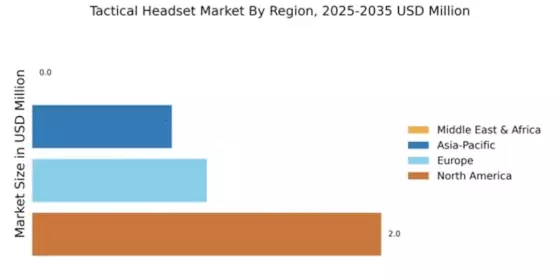
North America continues to lead the tactical headset market, holding a significant share of 2.0 in 2024. The growth is driven by increasing defense budgets, technological advancements, and a rising demand for enhanced communication systems among military and law enforcement agencies. Regulatory support for defense spending and modernization initiatives further catalyze market expansion. The United States is the primary contributor, with key players like Harris Corporation, L3Harris Technologies, and Northrop Grumman dominating the landscape. The competitive environment is characterized by continuous innovation and partnerships aimed at developing advanced communication solutions. The presence of established firms ensures a robust supply chain and technological expertise, solidifying North America's market position.

Europe : Emerging Tactical Solutions Hub

Europe's tactical headset market is evolving, with a market size of 1.0 in 2024. The region is witnessing increased investments in defense and security, driven by geopolitical tensions and the need for enhanced operational capabilities. Regulatory frameworks promoting interoperability and standardization are also key growth drivers, fostering demand for advanced communication systems. Leading countries such as the UK, France, and Germany are at the forefront, with companies like Thales Group and BAE Systems playing pivotal roles. The competitive landscape is marked by collaborations between defense contractors and technology firms, aiming to deliver innovative solutions tailored to military and law enforcement needs. This synergy is crucial for maintaining Europe's competitive edge in the tactical headset market.

Asia-Pacific : Growing Demand for Tactical Equipment

The Asia-Pacific tactical headset market is on the rise, with a market size of 0.8 in 2024. Factors such as increasing defense budgets, modernization of armed forces, and rising security concerns are driving demand for tactical communication solutions. Countries are focusing on enhancing their military capabilities, which is further supported by government initiatives and collaborations with technology providers. Key players in the region include companies like Elbit Systems and Rohde & Schwarz, which are expanding their presence through strategic partnerships and local manufacturing. Nations such as India, Japan, and Australia are leading the charge, investing in advanced technologies to improve operational efficiency. The competitive landscape is becoming increasingly dynamic as regional players seek to innovate and meet the growing demand for tactical headsets.

Middle East and Africa : Untapped Potential in Tactical Market

The Middle East and Africa region currently shows a nascent tactical headset market, with a size of 0.0 in 2024. However, the potential for growth is significant, driven by increasing security threats and military modernization efforts. Governments are beginning to recognize the importance of advanced communication systems, which could lead to future investments in tactical headsets. Regulatory frameworks are gradually evolving to support defense procurement and technology transfer. Countries like the UAE and South Africa are emerging as key players in the defense sector, with a focus on enhancing their military capabilities. The competitive landscape is still developing, with opportunities for international firms to enter the market and collaborate with local entities. As the region stabilizes, the demand for tactical headsets is expected to grow, presenting a promising avenue for investment.

Key Players and Competitive Insights

The Tactical Headset Market is currently characterized by a dynamic competitive landscape, driven by technological advancements and increasing demand for enhanced communication systems in military and law enforcement applications. Key players such as Harris Corporation (US), Thales Group (FR), and BAE Systems (GB) are strategically positioned to leverage innovation and partnerships to maintain their competitive edge. Harris Corporation (US) focuses on integrating advanced communication technologies into their headsets, while Thales Group (FR) emphasizes the development of lightweight, durable products tailored for extreme environments. BAE Systems (GB) is actively pursuing collaborations with defense agencies to enhance their product offerings, thereby shaping a competitive environment that prioritizes technological superiority and operational reliability.

In terms of business tactics, companies are increasingly localizing manufacturing to reduce costs and enhance supply chain efficiency. The market appears moderately fragmented, with several players vying for market share. The collective influence of these key players is significant, as they engage in strategic partnerships and mergers to consolidate their positions. This competitive structure fosters an environment where innovation and customer-centric solutions are paramount, allowing companies to differentiate themselves in a crowded marketplace.

In November 2025, Thales Group (FR) announced a partnership with a leading technology firm to develop next-generation augmented reality capabilities for their tactical headsets. This strategic move is likely to enhance the functionality of their products, enabling users to access real-time data and improve situational awareness in the field. Such advancements may position Thales as a frontrunner in the integration of augmented reality within tactical communication systems, potentially reshaping user expectations and operational effectiveness.

In October 2025, BAE Systems (GB) secured a contract with a European defense agency to supply advanced tactical headsets equipped with noise-cancellation technology. This contract not only underscores BAE's commitment to meeting the specific needs of military clients but also highlights the growing importance of sound quality in tactical communications. The successful execution of this contract could enhance BAE's reputation and market share in the tactical headset sector, reinforcing their strategic focus on customer collaboration and tailored solutions.

In September 2025, L3Harris Technologies (US) launched a new line of tactical headsets designed for interoperability with various communication systems. This initiative reflects L3Harris's strategy to address the diverse needs of military and law enforcement agencies, ensuring seamless integration across platforms. By prioritizing interoperability, L3Harris may strengthen its competitive position and appeal to a broader customer base, thereby enhancing its market presence.

As of December 2025, the Tactical Headset Market is witnessing trends such as digitalization, AI integration, and a growing emphasis on sustainability. Strategic alliances among key players are increasingly shaping the competitive landscape, fostering innovation and collaborative development. The shift from price-based competition to a focus on technological advancement and supply chain reliability is evident, suggesting that future differentiation will hinge on the ability to deliver cutting-edge solutions that meet evolving customer demands.

Key Companies in the Tactical Headset Market market include

Industry Developments

  • In June 2021, 3M PELTOR Communication Solutions introduces a new wireless tactical modular audio system. 3M PELTOR Tactical Modular Audio System (TMAS) is 3M’s newest generation of tactical communication and hearing protection, developed to help operators effectively communicate in dynamic acoustical environments.
  • In January 2021, NVISIO has acquired Racal Acoustics, a world-leading UK-based supplier of communication and hearing protection solutions. Racal Acoustics Ltd, a subsidiary of TransDigm Group Inc. prior to INVISIO’s acquisition, is a world-leading brand with a history of more than 100 years in the design, develop-ment and manufacture of communication and hearing protection systems, focused on audio ancillary equipment for the military, first responder and aviation sectors. The London-based business has 55 highly skilled employees and a global footprint.
  • In September 2021 Savox Communications has launched SAVOX Noise-COM 100 in-ear headset, thus expanding the Noise-COM Headsets product families. The SAVOX Noise-COM 100 inear headset offers discreet and lightweight hearing protection without compromising noise attenuation and sound quality. The in-ear headset is less obtrusive than over the ear headsets and fits better under all kinds of helmets. Due to its flexibility within usability, it is especially suitable for special forces and military alike.

Future Outlook

Tactical Headset Market Future Outlook

The Tactical Headset Market is projected to grow at a 5.29% CAGR from 2024 to 2035, driven by advancements in communication technology, increasing defense budgets, and rising demand for situational awareness.

New opportunities lie in:

  • Integration of augmented reality features for enhanced operational efficiency.
  • Development of lightweight, durable materials to improve user comfort and performance.
  • Expansion into civilian markets, such as security and emergency services, for diversified revenue streams.

By 2035, the Tactical Headset Market is expected to achieve robust growth, reflecting evolving technological demands.

Market Segmentation

Tactical Headset Market End Use Outlook

  • Military
  • Law Enforcement
  • Security Services
  • Aviation

Tactical Headset Market User Type Outlook

  • Professional
  • Amateur
  • Industrial
  • Commercial

Tactical Headset Market Technology Outlook

  • Active Noise Cancellation
  • Bone Conduction
  • Wireless Connectivity
  • Voice Recognition

Tactical Headset Market Application Outlook

  • Communication
  • Hearing Protection
  • Situational Awareness
  • Data Transmission

Tactical Headset Market Form Factor Outlook

  • Over-Ear
  • In-Ear
  • On-Ear
  • Headset with Microphone

Report Scope

MARKET SIZE 20243.8(USD Million)
MARKET SIZE 20254.0(USD Million)
MARKET SIZE 20356.7(USD Million)
COMPOUND ANNUAL GROWTH RATE (CAGR)5.29% (2024 - 2035)
REPORT COVERAGERevenue Forecast, Competitive Landscape, Growth Factors, and Trends
BASE YEAR2024
Market Forecast Period2025 - 2035
Historical Data2019 - 2024
Market Forecast UnitsUSD Million
Key Companies ProfiledHarris Corporation (US), Thales Group (FR), BAE Systems (GB), Leonardo S.p.A. (IT), General Dynamics (US), L3Harris Technologies (US), Northrop Grumman (US), Rockwell Collins (US), Elbit Systems (IL), Rohde & Schwarz (DE)
Segments CoveredApplication, End Use, Technology, Form Factor, User Type
Key Market OpportunitiesIntegration of advanced communication technologies enhances operational efficiency in the Tactical Headset Market.
Key Market DynamicsRising demand for advanced communication features drives innovation and competition in the Tactical Headset Market.
Countries CoveredNorth America, Europe, APAC, South America, MEA

Market Highlights

Author
Sejal Akre
Senior Research Analyst

She has over 5 years of rich experience, in market research and consulting providing valuable market insights to client. Hands on expertise in management consulting, and extensive knowledge in domain including ICT, Automotive & Transportation and Aerospace & Defense. She is skilled in Go-to market strategy, industry analysis, market sizing, in depth company profiling, competitive intelligence & benchmarking and value chain amongst others.

Leave a Comment

FAQs

How much is the Tactical Headset market?

The Tactical Headset market Communication Mode was valued at USD 2,548.68 Million in 2024.

What is the CAGR of the Tactical Headset Market in the upcoming period?

At 6.09% CAGR is expected to transform the market.

Which region is a major driver in the Tactical Headset market?

The North America regional market is projected to be the major driver of the market.

What segments are utilized for better understanding the Tactical Headset market?

The segments in the market are type, technology, communication mode and application

Who are the contenders in the Tactical Headset market?

The key contenders in the market are 3M Company, Bose Corporation, INVISIO, Safariland, Silynx, Vitavox (a division of Secomak Ltd)., Otto Communication, and David Clark Company.

Which Technology had the largest market share in the Tactical Headset market?

The Wireless Technology had the largest share in the market.

Download Free Sample

Kindly complete the form below to receive a free sample of this Report

Compare Licence

×
Features License Type
Single User Multiuser License Enterprise User
Price $4,950 $5,950 $7,250
Maximum User Access Limit 1 User Upto 10 Users Unrestricted Access Throughout the Organization
Free Customization
Direct Access to Analyst
Deliverable Format
Platform Access
Discount on Next Purchase 10% 15% 15%
Printable Versions