Download Free Sample
Kindly complete the form below to receive a free sample of this Report
Tax Compliance and Planning Services Market Research Report: Size, Share, Trend Analysis By Industry Outlook (Healthcare, Real Estate, Finance, Manufacturing) By Client Type Outlook (Individual Clients, Small Business Clients, Corporate Clients, Non-Profit Organizations) By Service Type Outlook (Tax Preparation Services, Tax Advisory Services, Tax Planning Services, Tax Audit Services) By Complexity Level Outlook (Simple Tax Returns, Moderate Tax Returns, Complex Tax Returns, International Tax Compliance) By Region (North America, Europe, APAC, South America, MEA) – Growth Outlook & Industry Forecast To 2035
As per MRFR analysis, the Tax Compliance and Planning Services was estimated at 30.5 USD Billion in 2024.5 USD Billion in 2024. The Tax Compliance and Planning Services industry is projected to grow from 31.61 USD Billion in 2025 to 45.2 USD Billion by 2035, exhibiting a compound annual growth rate (CAGR) of 3.64% during the forecast period 2025 - 2035.
The The Tax Compliance and Planning Services is experiencing a dynamic evolution driven by technological advancements and regulatory complexities. is experiencing a dynamic evolution driven by technological advancements and regulatory complexities.
| 2024 Market Size | 30.5 (USD Billion) |
| 2035 Market Size | 45.2 (USD Billion) |
| CAGR (2025 - 2035) | 3.64% |
The Tax Compliance and Planning Services Market is currently experiencing a dynamic evolution, driven by various factors that influence both individual and corporate tax obligations. As regulatory frameworks become increasingly complex, businesses and individuals alike are seeking expert guidance to navigate the intricacies of tax laws. This demand for specialized knowledge is fostering a competitive landscape where service providers are enhancing their offerings to meet diverse client needs. Furthermore, the integration of technology into tax services is reshaping traditional practices, allowing for more efficient compliance processes and strategic planning. The emphasis on digital solutions appears to be a key driver in attracting clients who value speed and accuracy in their tax-related activities. In addition to technological advancements, there is a growing awareness of the importance of proactive tax planning. Organizations are recognizing that effective tax strategies can lead to substantial savings and improved financial health. This shift towards a more strategic approach indicates a potential transformation in how tax services are perceived and utilized. As the Tax Compliance and Planning Services Market continues to evolve, it is likely that firms will increasingly focus on providing tailored solutions that align with the unique circumstances of their clients, thereby enhancing overall satisfaction and loyalty.
The incorporation of advanced technologies, such as artificial intelligence and data analytics, is revolutionizing the Tax Compliance and Planning Services Market. These innovations facilitate more accurate tax calculations and streamline compliance processes, enabling service providers to deliver enhanced value to their clients.
There is a noticeable shift towards proactive tax planning among businesses and individuals. This trend suggests that clients are increasingly seeking services that not only ensure compliance but also optimize their tax positions, potentially leading to significant financial benefits.
The ongoing evolution of tax regulations worldwide is creating a challenging environment for compliance. As laws become more intricate, the demand for expert guidance in navigating these complexities is likely to grow, positioning tax service providers as essential partners in financial planning.
In the Tax Compliance and Planning Services Market, Tax Preparation Services holds the largest market share among various service types. It remains the primary choice for individuals and businesses seeking to ensure accurate and timely filing of tax returns. Meanwhile, Tax Advisory Services has emerged as a significant player, demonstrating rapid growth due to an increasing demand for expert guidance amid complex tax regulations and the evolving financial landscape. Tax Planning Services and Tax Audit Services follow, focusing on strategic tax positions and compliance verification, respectively.
Tax Preparation Services (Dominant) vs. Tax Advisory Services (Emerging)
Tax Preparation Services is a well-established segment characterized by a substantial demand for traditional tax filing services. This segment appeals to a broad audience, including individuals and corporations, emphasizing accuracy and compliance with tax codes. Conversely, Tax Advisory Services represents the emerging trend within the market, driven by the need for personalized tax strategies and optimization. As businesses look to navigate complex tax implications, the expertise offered by advisory services becomes increasingly valuable. The demand for proactive tax management fuels growth in this segment, setting it apart as a crucial area of future expansion in tax compliance.
In the Tax Compliance and Planning Services Market, Individual Clients represent the largest segment, capturing a significant portion of overall market share. These clients typically include individuals seeking assistance with tax filings, tax strategy, and compliance services. Their consistent demand stems from the complexity of tax regulations and the desire for personalized service, thus making this segment a cornerstone of the market.
Individual Clients (Dominant) vs. Corporate Clients (Emerging)
Individual Clients are characterized by their need for tailored services that address unique tax situations, making them a dominant player in the Tax Compliance and Planning Services market. As they frequently seek advice related to personal income tax, estate planning, and deductions, this segment drives the demand for comprehensive and personalized services. In contrast, Corporate Clients, while emerging, are gaining traction rapidly due to increasing regulatory complexities and the growing need for comprehensive tax strategies. Corporations are now prioritizing tax compliance as a critical component of their financial planning, positioning them as a fast-growing segment seeking more advanced and strategic tax services.
The Tax Compliance and Planning Services market is segmented by complexity level, showcasing a diverse landscape of service offerings. Simple Tax Returns dominate the market, accounting for the largest share due to their straightforward nature and lower regulatory requirements. Moderate Tax Returns and Complex Tax Returns also hold significant positions, catering to businesses and individuals with varied needs, while International Tax Compliance is quickly gaining traction, attributed to the globalization of businesses and the increasing complexity of foreign tax regulations.
Simple Tax Returns (Dominant) vs. International Tax Compliance (Emerging)
Simple Tax Returns are characterized by their straightforward filing processes and minimal complexities, making them the most utilized service within the Tax Compliance and Planning Services Market. This segment primarily serves individual taxpayers and small businesses seeking affordable and efficient processing. In contrast, International Tax Compliance represents an emerging segment that addresses the complexities of navigating tax regulations across multiple jurisdictions, powered by the rapid expansion of global trade and investment. As companies scale internationally, they face heightened scrutiny and compliance requirements, leading to an increased demand for specialized services in this space.
In the Tax Compliance and Planning Services Market, the distribution of market share across the industry segments highlights healthcare as the largest contributor. This segment benefits from stringent regulations requiring meticulous tax planning and compliance as well as an increasing number of healthcare providers seeking professional assistance. On the other hand, the finance industry is rapidly gaining traction, driven by the need for robust tax strategies amidst an evolving regulatory landscape and heightened scrutiny from tax authorities.
Healthcare: Tax Compliance (Dominant) vs. Finance: Tax Planning (Emerging)
The healthcare segment remains dominant in the Tax Compliance and Planning Services Market due to its fundamental requirement for adherence to complex tax laws and regulations. Providers in this sector typically engage tax professionals to navigate the intricate web of tax implications associated with healthcare services, ensuring compliance and optimizing tax benefits. In contrast, the finance sector, while emerging, is quickly becoming a significant player with its demand for innovative tax planning services. With the growing complexity of financial transactions and increasing regulatory pressures, financial institutions are increasingly seeking tailored tax strategies to enhance efficiency and mitigate risks.
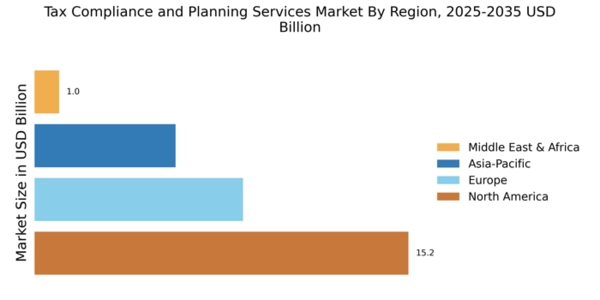
North America continues to lead the Tax Compliance and Planning Services market, holding a significant share of 15.25 in 2024. The region's growth is driven by a robust regulatory environment, increasing demand for compliance due to complex tax laws, and a growing emphasis on digital transformation in tax services. Companies are investing in technology to enhance efficiency and accuracy in tax planning and compliance. The competitive landscape is characterized by major players such as Deloitte, PwC, and EY, which dominate the market. The U.S. and Canada are the leading countries, with a high concentration of tax professionals and firms offering specialized services. The presence of these key players ensures a dynamic market, fostering innovation and improved service delivery.
Europe's Tax Compliance and Planning Services market is valued at 8.5, reflecting a growing demand for compliance solutions amid evolving regulations. The region is witnessing increased scrutiny from tax authorities, prompting businesses to seek expert guidance. The implementation of the EU's Anti-Tax Avoidance Directive and other regulations is driving demand for comprehensive tax planning services, ensuring compliance and minimizing risks. Leading countries in this market include the UK, Germany, and France, where firms are adapting to complex tax environments. Key players like PwC and EY are expanding their services to meet the needs of multinational corporations. The competitive landscape is marked by a mix of global firms and local specialists, enhancing service offerings and client engagement.
The Asia-Pacific region, with a market size of 5.75, is rapidly emerging in the Tax Compliance and Planning Services sector. The growth is fueled by increasing foreign investments, expanding economies, and a rising awareness of tax compliance among businesses. Governments are also enhancing regulatory frameworks to attract foreign investments, which in turn drives demand for tax planning services to navigate complex tax landscapes. Countries like China, India, and Australia are at the forefront of this growth, with a rising number of multinational corporations seeking local expertise. The competitive landscape features both global firms and local players, creating a diverse market. Key players such as KPMG and Deloitte are expanding their footprint to capture this growing demand, ensuring comprehensive service delivery.
The Middle East and Africa region, with a market size of 1.0, presents untapped opportunities in the Tax Compliance and Planning Services market. The growth is driven by increasing economic diversification efforts and the implementation of VAT in several countries, which has heightened the need for compliance services. Governments are focusing on enhancing tax systems to improve revenue collection, creating a favorable environment for tax service providers. Leading countries in this region include the UAE and South Africa, where there is a growing demand for professional tax services. The competitive landscape is evolving, with both international firms and local players vying for market share. Key players like BDO and Grant Thornton are establishing a presence to cater to the increasing demand for tax compliance and planning services.
The Tax Compliance and Planning Services Market is characterized by a dynamic competitive landscape, driven by the increasing complexity of tax regulations and the growing demand for compliance solutions. Major players such as Deloitte (US), PwC (GB), and EY (GB) are strategically positioned to leverage their extensive global networks and technological capabilities. Deloitte (US) focuses on digital transformation, enhancing its service delivery through advanced analytics and AI-driven solutions. Meanwhile, PwC (GB) emphasizes partnerships with fintech companies to integrate innovative technologies into its offerings, thereby improving client engagement and operational efficiency. EY (GB) has adopted a strategy centered on sustainability, aligning its services with clients' environmental goals, which appears to resonate well in the current market environment. Collectively, these strategies not only enhance their competitive positioning but also shape the overall market dynamics by fostering a culture of innovation and responsiveness to client needs.In terms of business tactics, companies are increasingly localizing their services to better cater to regional tax regulations and client preferences. This localization, coupled with supply chain optimization, allows firms to enhance their service delivery and responsiveness. The market structure is moderately fragmented, with a mix of large multinational firms and smaller regional players. The collective influence of key players, particularly those with strong technological capabilities, is reshaping the competitive landscape, pushing others to adapt or risk obsolescence.
In November Deloitte (US) announced a strategic partnership with a leading AI firm to develop a new suite of tax compliance tools aimed at automating complex tax calculations. This move is significant as it positions Deloitte at the forefront of technological innovation in tax services, potentially reducing compliance costs for clients and enhancing accuracy. The integration of AI into their offerings may also attract a broader client base seeking efficiency and reliability in tax compliance.
In October PwC (GB) launched a new digital platform designed to streamline tax planning processes for multinational corporations. This initiative is crucial as it addresses the growing need for real-time data analytics in tax decision-making, allowing clients to navigate the complexities of international tax regulations more effectively. By enhancing its digital capabilities, PwC is likely to strengthen its market position and improve client satisfaction.
In September EY (GB) expanded its sustainability-focused tax advisory services, responding to the increasing demand for environmentally responsible business practices. This expansion is indicative of a broader trend where firms are aligning their services with clients' sustainability goals, potentially leading to a competitive advantage in attracting environmentally conscious businesses. EY's proactive approach in this area may set a benchmark for others in the industry.
As of December the Tax Compliance and Planning Services Market is witnessing a pronounced shift towards digitalization, sustainability, and AI integration. Strategic alliances are becoming increasingly pivotal, enabling firms to enhance their service offerings and operational efficiencies. The competitive differentiation is likely to evolve from traditional price-based competition to a focus on innovation, technology, and supply chain reliability. Firms that can effectively leverage these trends will likely secure a more robust market position in the future.






The Tax Compliance and Planning Services Market is projected to grow at a 3.64% CAGR from 2025 to 2035, driven by regulatory changes, technological advancements, and increasing globalization.
New opportunities lie in:
By 2035, the market is expected to be robust, adapting to evolving regulatory landscapes and technological innovations.
| MARKET SIZE 2024 | 30.5(USD Billion) |
| MARKET SIZE 2025 | 31.61(USD Billion) |
| MARKET SIZE 2035 | 45.2(USD Billion) |
| COMPOUND ANNUAL GROWTH RATE (CAGR) | 3.64% (2025 - 2035) |
| REPORT COVERAGE | Revenue Forecast, Competitive Landscape, Growth Factors, and Trends |
| BASE YEAR | 2024 |
| Market Forecast Period | 2025 - 2035 |
| Historical Data | 2019 - 2024 |
| Market Forecast Units | USD Billion |
| Key Companies Profiled | Deloitte (US), PwC (GB), EY (GB), KPMG (NL), BDO (GB), Grant Thornton (GB), RSM (GB), Baker Tilly (GB), Crowe (US) |
| Segments Covered | Service Type, Client Type, Complexity Level, Industry |
| Key Market Opportunities | Integration of artificial intelligence in Tax Compliance and Planning Services Market enhances efficiency and accuracy. |
| Key Market Dynamics | Rising regulatory complexities drive demand for advanced tax compliance and planning services across diverse industries. |
| Countries Covered | North America, Europe, APAC, South America, MEA |


Kindly complete the form below to receive a free sample of this Report

“This is really good guys. Excellent work on a tight deadline. I will continue to use you going forward and recommend you to others. Nice job”


“Thanks. It’s been a pleasure working with you, please use me as reference with any other Intel employees.”


“Thanks for sending the report it gives us a good global view of the Betaïne market.”


“Thank you, this will be very helpful for OQS.”


“We found the report very insightful! we found your research firm very helpful. I'm sending this email to secure our future business.”


“I am very pleased with how market segments have been defined in a relevant way for my purposes (such as "Portable Freezers & refrigerators" and "last-mile"). In general the report is well structured. Thanks very much for your efforts.”


“I have been reading the first document or the study, ,the Global HVAC and FP market report 2021 till 2026. Must say, good info! I have not gone in depth at all parts, but got a good indication of the data inside!”


“We got the report in time, we really thank you for your support in this process. I also thank to all of your team as they did a great job.”


“The Automotive 48V ECU Components Procurement Intelligence Study” was a complex project, but the Market Research Future (MRFR) team handled it with quality, agility, and customer-centricity. They delivered all requested data on time and within the agreed scope. The team, including Shubhendra Anand and Rahul Gotadki, was always readily available to clarify questions and swiftly implement necessary adjustments, driving the project to a successful conclusion within a very demanding timeframe.
I would also like to specifically commend Akshay Agarwal for his responsiveness and support at every stage—from our initial inquiry on May 6th through to final delivery on June 18th. His dedication made the entire process seamless.”



