×
Request Free Sample ×

Kindly complete the form below to receive a free sample of this Report

* Please use a valid business email

Leading companies partner with us for data-driven Insights

clients tt-cursor
Hero Background

Telehandler Market

ID: MRFR/PCM/1924-CR
49 Pages
Tejas Chaudhary
April 2017

Telehandler Market Research Report Information By Capacity (Less than 3 tons, 3.1 to 4 tons, 4.1 to 5 tons), By Application (Construction, Agriculture, Mining), And By Region (North America, Europe, Asia-Pacific, And Rest Of The World) –Market Forecast Till 2035

Share:
Download PDF ×

We do not share your information with anyone. However, we may send you emails based on your report interest from time to time. You may contact us at any time to opt-out.

Telehandler Market Infographic
Purchase Options

Telehandler Market Summary

As per MRFR analysis, the Telehandler Market Size was estimated at 7.1 USD Billion in 2024. The Telehandler industry is projected to grow from 7.38 in 2025 to 10.85 by 2035, exhibiting a compound annual growth rate (CAGR) of 3.93 during the forecast period 2025 - 2035.

Key Market Trends & Highlights

The telehandler market is poised for robust growth driven by technological advancements and increasing demand across various sectors.

  • Technological advancements are enhancing the efficiency and capabilities of telehandlers, particularly in North America.
  • Sustainability initiatives are prompting manufacturers to develop electric telehandlers, which are gaining traction in the Asia-Pacific region.
  • Customization and versatility are becoming essential as construction and agriculture sectors seek tailored solutions to meet specific operational needs.
  • Rising construction activities and increased demand for material handling solutions are key drivers propelling market expansion.

Market Size & Forecast

2024 Market Size 7.1 (USD Billion)
2035 Market Size 10.85 (USD Billion)
CAGR (2025 - 2035) 3.93%

Major Players

JCB (GB), Caterpillar (US), Manitou (FR), Bobcat (US), Liebherr (DE), Merlo (IT), Doosan (KR), Genie (US), Skyjack (CA)

Telehandler Market Trends

The Telehandler Market is currently experiencing a dynamic evolution, driven by advancements in technology and increasing demand across various sectors. The versatility of telehandlers, which can perform multiple functions such as lifting, moving, and placing materials, makes them indispensable in construction, agriculture, and industrial applications. As companies seek to enhance operational efficiency, the adoption of telehandlers is likely to rise, reflecting a shift towards more multifunctional equipment. Furthermore, the growing emphasis on sustainability may lead to innovations in telehandler design, focusing on energy efficiency and reduced emissions. In addition, the Telehandler Market appears to be influenced by the expansion of infrastructure projects globally. As urbanization continues to accelerate, the need for reliable lifting equipment becomes paramount. This trend suggests that manufacturers may prioritize the development of telehandlers that cater to specific industry needs, thereby enhancing their market appeal. Overall, the Telehandler Market is poised for growth, with technological advancements and changing consumer preferences shaping its future trajectory.

Technological Advancements

The Telehandler Market is witnessing a surge in technological innovations, including automation and telematics. These advancements enhance operational efficiency and safety, allowing operators to monitor equipment performance in real-time. As a result, telehandlers are becoming more user-friendly and reliable, appealing to a broader range of industries.

Sustainability Initiatives

There is a growing trend towards sustainability within the Telehandler Market, as manufacturers focus on creating eco-friendly models. This includes the development of electric and hybrid telehandlers that reduce carbon footprints. Such initiatives align with global efforts to promote greener practices in construction and agriculture.

Customization and Versatility

The demand for customized telehandlers is increasing, as businesses seek equipment tailored to their specific operational needs. This trend highlights the importance of versatility in telehandler design, enabling users to adapt machines for various tasks, thereby maximizing productivity and efficiency.

Telehandler Market Drivers

Focus on Sustainability

Sustainability initiatives are increasingly influencing the Global Telehandler Market Industry. As environmental regulations become more stringent, manufacturers are compelled to develop eco-friendly telehandlers that minimize emissions and energy consumption. The adoption of electric and hybrid models is on the rise, reflecting a broader industry trend towards sustainability. This shift not only meets regulatory requirements but also appeals to environmentally conscious consumers. As the market evolves, the emphasis on sustainable practices is expected to drive innovation and reshape product offerings, aligning with global efforts to reduce carbon footprints and promote greener construction practices.

Market Growth Projections

The Global Telehandler Market Industry is poised for substantial growth, with projections indicating a market size of 7.1 USD Billion in 2024 and an anticipated increase to 10.8 USD Billion by 2035. This growth trajectory suggests a compound annual growth rate (CAGR) of 3.93% from 2025 to 2035. Such figures reflect the increasing adoption of telehandlers across various sectors, including construction, agriculture, and logistics. The market's expansion is likely to be fueled by technological advancements, rising demand for rental services, and a focus on sustainability, positioning telehandlers as essential equipment in the evolving landscape of material handling.

Technological Advancements

Technological innovations play a crucial role in shaping the Global Telehandler Market Industry. The integration of advanced features such as telematics, improved fuel efficiency, and enhanced safety systems is becoming commonplace. These advancements not only increase operational efficiency but also reduce downtime and maintenance costs. As manufacturers invest in research and development, telehandlers equipped with cutting-edge technology are likely to dominate the market. This trend aligns with the projected CAGR of 3.93% from 2025 to 2035, suggesting that technological enhancements will significantly influence market dynamics and cater to evolving customer needs.

Rising Demand for Rental Services

The Global Telehandler Market Industry is witnessing a shift towards rental services, driven by cost-conscious consumers and businesses. Renting telehandlers allows companies to access high-quality equipment without the burden of ownership costs. This trend is particularly evident in sectors such as construction and agriculture, where project-based work is prevalent. As rental services expand, they provide flexibility and reduce capital expenditure for businesses. This shift is likely to contribute to the market's growth, as rental companies increasingly invest in their fleets to meet rising demand, further solidifying the telehandler's role in various industries.

Growth in Agricultural Applications

The Global Telehandler Market Industry is significantly impacted by the growing demand for telehandlers in agricultural applications. Farmers increasingly recognize the advantages of telehandlers for handling materials such as bales, pallets, and feed. Their ability to operate in diverse terrains and lift heavy loads makes them indispensable in modern farming. As agricultural productivity becomes a priority, the adoption of telehandlers is likely to rise, contributing to market growth. This trend aligns with the overall expansion of the telehandler market, which is projected to reach 10.8 USD Billion by 2035, driven by increased efficiency and productivity in the agricultural sector.

Increasing Demand in Construction Sector

The Global Telehandler Market Industry experiences a notable surge in demand driven by the expanding construction sector. As urbanization accelerates, the need for efficient material handling equipment becomes paramount. Telehandlers, with their versatility and ability to maneuver in tight spaces, are increasingly favored on construction sites. In 2024, the market is projected to reach 7.1 USD Billion, reflecting the industry's response to heightened construction activities. This trend is expected to continue, with the market potentially growing to 10.8 USD Billion by 2035, indicating a robust growth trajectory fueled by ongoing infrastructure projects worldwide.

Market Segment Insights

By Application: Construction (Largest) vs. Agriculture (Fastest-Growing)

In the telehandler market, the construction application holds the largest share, driven by its extensive use in building projects, material handling, and site preparation. This segment is favored for its versatility and capability to operate in various terrains, making it indispensable for contractors. Agriculture follows closely, leveraging telehandlers for tasks such as loading and moving materials, where efficiency is key in handling crops and livestock equipment.

Construction: Dominant vs. Agriculture: Emerging

The construction sector serves as the dominant application for telehandlers, due to the high demand for equipment that provides multi-functional solutions, enabling operators to perform diverse tasks like lifting and loading materials at soaring heights. On the other hand, the agriculture sector is emerging rapidly, attributed to increased farm mechanization and the need for efficient handling of heavy loads in farming activities. Telehandlers in agriculture are tailored for versatility, with attachments designed for specific tasks such as bales handling and feed mixing, thus reinforcing their increasing penetration into modern agricultural practices.

By Engine Type: Internal Combustion Engine (Largest) vs. Electric (Fastest-Growing)

In the telehandler market, the engine type segment showcases a diverse distribution, with Internal Combustion Engines (ICE) holding the largest share. ICE continue to dominate due to their robust performance and suitability for heavy-duty tasks in rugged environments. In contrast, Electric telehandlers, though currently a smaller segment, are on the rise, driven by increasing demand for sustainable solutions and lower operating costs, marking them as the fastest-growing segment. As industries shift towards more eco-friendly technologies, Electric telehandlers are gaining traction, propelled by advancements in battery technology and government incentives for greener machinery. Hybrid options are also emerging, blending the best of both worlds, while Hydraulic systems cater to niche applications. The convergence of environmental concerns and technological innovations is set to reshape this segment in the coming years.

Internal Combustion Engine (Dominant) vs. Electric (Emerging)

Internal Combustion Engines (ICE) remain the dominant force in the telehandler market, revered for their power and versatility in demanding environments. These engines are preferred for their reliability and ability to operate in remote locations without the need for charging infrastructure. Conversely, Electric telehandlers are an emerging force, appealing to businesses increasingly focused on sustainability and reducing carbon footprints. With advancements in battery life and fast-charging solutions, electric models are being designed to manage similar workloads as their ICE counterparts while offering reduced emissions and noise. Their growth is accelerated by regulations favoring cleaner technologies, making them an attractive option for modern construction sites.

By Lifting Capacity: 3000 kg to 5000 kg (Largest) vs. Above 8000 kg (Fastest-Growing)

The telehandler market exhibits a distinct distribution in lifting capacities, with the 3000 kg to 5000 kg segment holding the largest share due to its versatility across various applications such as construction and agriculture. This segment is favored for its ability to handle a wide range of loads, making it a preferred choice for many operators. In contrast, the above 8000 kg segment is rapidly gaining traction, appealing to sectors that require higher lifting capacities, such as industrial warehouses and large-scale construction projects, reflecting a shift towards more robust equipment.

3000 kg to 5000 kg (Dominant) vs. Above 8000 kg (Emerging)

The 3000 kg to 5000 kg lifting capacity segment is currently the dominant force in the telehandler market, recognized for its balance of power and maneuverability. This segment caters to small to medium-sized enterprises that need reliable equipment for various tasks, including lifting heavy materials and transporting goods. Conversely, the above 8000 kg segment is emerging as an attractive option for specialized applications that demand enhanced lifting capabilities, particularly in demanding environments. As industries evolve, the robust nature of telehandlers in this category is creating opportunities for growth, driven by advancements in technology and increasing construction activities.

By Mast Type: Telescopic Mast (Largest) vs. Rotating Mast (Fastest-Growing)

In the Telehandler Market, the share distribution among mast types showcases a strong preference for telescopic masts, which dominate the market due to their versatility and ability to extend reach. Fixed masts follow, providing reliable performance for basic lifting tasks, while rotating masts, though smaller in market share, are gaining traction for their maneuverability and operational ease. This distribution indicates a well-established trend favoring the functionality and adaptability provided by telescopic designs.

Mast Type Comparison: Telescopic Mast (Dominant) vs. Rotating Mast (Emerging)

Telescopic masts stand as the dominant force in the Telehandler Market, prized for their extendable reach that facilitates access to elevated and hard-to-reach areas. These masts are essential for construction and agricultural applications where flexibility is paramount. Meanwhile, rotating masts are emerging as a significant player, offering the ability to rotate loads within a 360-degree range, enhancing operational efficiency. This allows operators to perform varied tasks with ease, driving their acceptance in complex job sites. As industries evolve, the demand for these innovative masts signals a shift towards more adaptable and user-oriented equipment.

By Drive Type: Four-Wheel Drive (Largest) vs. Two-Wheel Drive (Fastest-Growing)

In the Telehandler Market, the distribution of drive types reveals that Four-Wheel Drive (4WD) dominates the landscape, accounting for a significant majority of the market share. It is favored for its superior off-road capabilities, making it ideal for construction and agricultural applications. Meanwhile, Two-Wheel Drive (2WD) is emerging as a competitive segment due to its lower cost and simplicity, appealing to smaller operations and urban environments. The acceptance of 2WD units is on the rise, indicating a shift in user preferences towards versatile and cost-effective solutions. Recently, the growth trends within this segment indicate a robust interest in sustainability and efficiency. As industry standards evolve, manufacturers are focusing on enhancing the performance of traditional drive types while exploring hybrid and electric options. Additionally, the fast-paced development of smart technologies is attracting investors to develop innovative solutions within the Two-Wheel Drive segment, contributing to its rapid growth. Overall, the drive type segment is becoming increasingly diversified, showcasing a balanced mix of legacy and emerging options.

Four-Wheel Drive (Dominant) vs. Two-Wheel Drive (Emerging)

Four-Wheel Drive (4WD) telehandlers continue to hold a dominant position in the market due to their unmatched stability and traction in challenging terrains. This drive type is regarded as the workhorse of construction projects, providing enhanced maneuverability and load-carrying capacity. Its robust design caters to the demanding needs of heavy lifting and towing, making it the preferred choice for large construction sites and rugged terrains. Emerging as a competitive alternative, Two-Wheel Drive (2WD) telehandlers are quickly capturing the interest of small to medium-sized enterprises. They offer a cost-effective solution while ensuring adequate performance for less arduous tasks. As urban construction projects rise, 2WD units' compact design and versatility give them an edge as they adapt gracefully to various settings, ultimately positioning them as a valuable option in the market.

Get more detailed insights about Telehandler Market

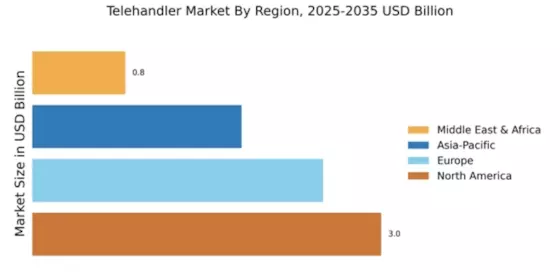
Regional Insights

North America : Market Leader in Telehandlers

North America is poised to maintain its leadership in the telehandler market, holding a significant share of 3.5 in 2024. The growth is driven by robust construction activities, increased demand for material handling solutions, and favorable regulations promoting safety and efficiency. The region's focus on infrastructure development and technological advancements further fuels market expansion. Key players like Caterpillar, JCB, and Bobcat dominate the competitive landscape, supported by a strong distribution network. The U.S. and Canada are the leading countries, with substantial investments in construction and agriculture sectors. The presence of established manufacturers ensures a steady supply of innovative telehandler solutions, catering to diverse industry needs.

Europe : Emerging Market with Growth Potential

Europe's telehandler market, valued at 2.5, is experiencing significant growth, driven by increasing construction activities and a shift towards automation in material handling. Regulatory frameworks promoting sustainability and safety are also key catalysts for market expansion. Countries like Germany, France, and the UK are leading the charge, with investments in infrastructure and green technologies. The competitive landscape features major players such as Manitou, Liebherr, and Merlo, who are innovating to meet evolving customer demands. The European market is characterized by a strong emphasis on quality and efficiency, with manufacturers focusing on advanced features and eco-friendly solutions. As the region adapts to new regulations, the telehandler market is expected to flourish, enhancing operational capabilities across various sectors.

Asia-Pacific : Rapid Growth in Emerging Markets

The Asia-Pacific telehandler market, currently valued at 1.7, is witnessing rapid growth, fueled by urbanization and increasing investments in infrastructure. Countries like China and India are at the forefront, with rising demand for efficient material handling solutions in construction and agriculture. Government initiatives aimed at enhancing infrastructure are also pivotal in driving market growth. The competitive landscape is evolving, with key players like Doosan and Genie expanding their presence in the region. The market is characterized by a mix of established brands and local manufacturers, catering to diverse customer needs. As the region embraces modernization, the telehandler market is expected to see substantial advancements in technology and efficiency, positioning it for future growth.

Middle East and Africa : Emerging Market with Untapped Potential

The Middle East and Africa telehandler market, valued at 0.4, presents significant growth opportunities driven by ongoing infrastructure projects and a growing construction sector. Countries like the UAE and South Africa are leading the way, with substantial investments in urban development and logistics. Regulatory support for construction safety and efficiency is also enhancing market prospects. The competitive landscape is gradually evolving, with both international and local players vying for market share. Companies like Skyjack are establishing a foothold, while local manufacturers are emerging to meet regional demands. As the market matures, the focus on innovative solutions and sustainability will be crucial for capturing growth in this dynamic region.

Key Players and Competitive Insights

The Telehandler Market is currently characterized by a dynamic competitive landscape, driven by increasing demand for versatile lifting equipment across various sectors, including construction, agriculture, and logistics. Key players such as JCB (GB), Caterpillar (US), and Manitou (FR) are strategically positioned to leverage innovation and technological advancements. JCB (GB) has focused on enhancing its product line with advanced telehandlers that incorporate telematics for improved operational efficiency. Meanwhile, Caterpillar (US) emphasizes sustainability in its operations, integrating eco-friendly technologies into its telehandler offerings. Manitou (FR) has adopted a strategy of regional expansion, particularly in emerging markets, to capitalize on the growing demand for material handling solutions. Collectively, these strategies contribute to a competitive environment that is increasingly centered around innovation and sustainability.

In terms of business tactics, companies are localizing manufacturing to reduce costs and enhance supply chain efficiency. This approach is particularly evident in the moderately fragmented market structure, where several players vie for market share. The collective influence of key players shapes the market dynamics, as they engage in strategic partnerships and collaborations to enhance their product offerings and market reach.

In November 2025, JCB (GB) announced the launch of its latest telehandler model, which features an innovative hybrid engine designed to reduce emissions by 30%. This strategic move not only aligns with global sustainability goals but also positions JCB (GB) as a leader in eco-friendly construction equipment. The introduction of this model is expected to attract environmentally conscious customers and enhance the company's competitive edge.

In October 2025, Caterpillar (US) unveiled a new telehandler equipped with advanced AI capabilities for predictive maintenance. This development is significant as it allows operators to anticipate equipment failures, thereby minimizing downtime and enhancing productivity. By integrating AI into its telehandlers, Caterpillar (US) demonstrates its commitment to technological advancement and operational efficiency, which could potentially reshape customer expectations in the market.

In September 2025, Manitou (FR) entered into a strategic partnership with a leading logistics firm to develop telehandlers specifically designed for warehouse applications. This collaboration is indicative of Manitou's focus on diversifying its product offerings and tapping into the growing logistics sector. By aligning with industry leaders, Manitou (FR) is likely to enhance its market presence and drive innovation in telehandler design.

As of December 2025, the Telehandler Market is witnessing trends such as digitalization, sustainability, and AI integration, which are redefining competitive dynamics. Strategic alliances are increasingly shaping the landscape, enabling companies to pool resources and expertise for enhanced innovation. Moving forward, competitive differentiation is expected to evolve from traditional price-based competition to a focus on technological innovation, supply chain reliability, and sustainable practices. This shift underscores the importance of adaptability and forward-thinking strategies in maintaining a competitive edge.

Key Companies in the Telehandler Market market include

Future Outlook

Telehandler Market Future Outlook

The Telehandler Market is projected to grow at a 3.93% CAGR from 2024 to 2035, driven by increased construction activities, technological advancements, and demand for versatile lifting solutions.

New opportunities lie in:

  • Development of electric telehandlers for eco-friendly operations.
  • Integration of telematics for enhanced fleet management.
  • Expansion into emerging markets with tailored financing solutions.

By 2035, the Telehandler Market is expected to achieve robust growth, reflecting evolving industry demands.

Market Segmentation

Telehandler Market Mast Type Outlook

  • Telescopic Mast
  • Fixed Mast
  • Rotating Mast

Telehandler Market Drive Type Outlook

  • Four-Wheel Drive
  • Two-Wheel Drive
  • All-Wheel Drive

Telehandler Market Application Outlook

  • Construction
  • Agriculture
  • Mining
  • Industrial
  • Waste Management

Telehandler Market Engine Type Outlook

  • Internal Combustion Engine
  • Electric
  • Hybrid
  • Hydraulic

Telehandler Market Lifting Capacity Outlook

  • Below 3000 kg
  • 3000 kg to 5000 kg
  • 5000 kg to 8000 kg
  • Above 8000 kg

Report Scope

MARKET SIZE 20247.1(USD Billion)
MARKET SIZE 20257.38(USD Billion)
MARKET SIZE 203510.85(USD Billion)
COMPOUND ANNUAL GROWTH RATE (CAGR)3.93% (2024 - 2035)
REPORT COVERAGERevenue Forecast, Competitive Landscape, Growth Factors, and Trends
BASE YEAR2024
Market Forecast Period2025 - 2035
Historical Data2019 - 2024
Market Forecast UnitsUSD Billion
Key Companies ProfiledJCB (GB), Caterpillar (US), Manitou (FR), Bobcat (US), Liebherr (DE), Merlo (IT), Doosan (KR), Genie (US), Skyjack (CA)
Segments CoveredApplication, Engine Type, Lifting Capacity, Mast Type, Drive Type
Key Market OpportunitiesIntegration of advanced automation and telematics in the Telehandler Market enhances operational efficiency and safety.
Key Market DynamicsRising demand for versatile lifting solutions drives innovation and competition in the telehandler market.
Countries CoveredNorth America, Europe, APAC, South America, MEA

Market Highlights

Author
Tejas Chaudhary
Research Analyst Level II

I have a degree in Engineering (Civil), with masters in Business Administration (Marketing). With more than 4 years of experience in market research and consulting, I am involved in end-to-end process of market research, proposals, project kickoffs and delivery. I have research knowledge and expertise in consumer goods/packaging domain. Also I have worked for various other domains like construction & equipment. Effectively managed and delivered more than 60 report studies for regional as well as global clientele.

Leave a Comment

FAQs

How much is the Telehandler market?

The Telehandler market size was valued at USD 7.10 billion in 2024.

What is the growth rate of the Telehandler market?

Telehandler Market is projected to register a CAGR of 3.93% from 2025-2035

Which Region witnessed the largest market share in the Telehandler market?

Asia-Pacific has the largest share of the Telehandler Market

Who are the key players in the Telehandler market?

The key players in the market are Manitou (U.K.), J C Bamford Excavators Ltd. (U.K), and Merlo S.p.A (Italy), Bobcat Corporate (U.S.)

Which Capacity led the Telehandler market?

The Less than 3-ton Telehandler category dominated the market in 2022.

Which Application had the largest market share in the Telehandler market?

Construction has the largest share of the Telehandler Market

Download Free Sample

Kindly complete the form below to receive a free sample of this Report

Compare Licence

×
Features License Type
Single User Multiuser License Enterprise User
Price $4,950 $5,950 $7,250
Maximum User Access Limit 1 User Upto 10 Users Unrestricted Access Throughout the Organization
Free Customization
Direct Access to Analyst
Deliverable Format
Platform Access
Discount on Next Purchase 10% 15% 15%
Printable Versions