Telescopic Hydraulic Cylinders Market
Telescopic Hydraulic Cylinders Market Summary
As per Market Research Future analysis, the Telescopic Hydraulic Cylinders Market Size was estimated at 1.41 USD Billion in 2024. The Telescopic Hydraulic Cylinders industry is projected to grow from 1.488 USD Billion in 2025 to 2.546 USD Billion by 2035, exhibiting a compound annual growth rate (CAGR) of 5.52% during the forecast period 2025 - 2035
Key Market Trends & Highlights
The Telescopic Hydraulic Cylinders Market is poised for growth driven by technological advancements and increasing applications across various sectors.
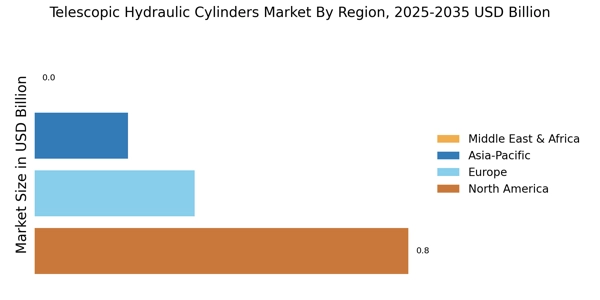
- North America remains the largest market for telescopic hydraulic cylinders, driven by robust construction activities.
- The Asia-Pacific region is emerging as the fastest-growing market, fueled by rapid industrialization and infrastructure development.
- Double-acting cylinders dominate the market, while single-acting cylinders are witnessing the fastest growth due to their efficiency in various applications.
- Rising demand in the construction sector and advancements in hydraulic technology are key drivers propelling market expansion.
Market Size & Forecast
| 2024 Market Size | 1.41 (USD Billion) |
| 2035 Market Size | 2.546 (USD Billion) |
| CAGR (2025 - 2035) | 5.52% |
Major Players
Parker Hannifin (US), Bosch Rexroth (DE), Eaton (US), Hydac (DE), Caterpillar (US), Sauer-Danfoss (DK), Brevini (IT), Wipro Infrastructure Engineering (IN), Aeroquip (US)
Telescopic Hydraulic Cylinders Market Trends
The Telescopic Hydraulic Cylinders Market is currently experiencing a dynamic evolution, driven by various factors that influence its growth trajectory. The increasing demand for efficient lifting and pushing mechanisms across multiple industries, such as construction, agriculture, and transportation, appears to be a primary catalyst. As companies seek to enhance productivity and reduce operational costs, the adoption of advanced hydraulic systems is likely to gain momentum. Furthermore, the trend towards automation and smart technologies in machinery is expected to further propel the market, as telescopic hydraulic cylinders play a crucial role in enabling these innovations. In addition to technological advancements, environmental considerations are becoming increasingly relevant. The push for sustainable practices may lead manufacturers to develop eco-friendly hydraulic solutions, which could reshape product offerings in the Telescopic Hydraulic Cylinders Market. As industries strive to meet regulatory standards and consumer expectations regarding sustainability, the integration of green technologies into hydraulic systems may emerge as a significant trend. Overall, the market landscape is poised for transformation, with a blend of technological innovation and environmental consciousness shaping its future.
Technological Advancements
The Telescopic Hydraulic Cylinders Market is witnessing a surge in technological innovations, particularly in automation and smart systems. These advancements enhance operational efficiency and precision, making hydraulic cylinders more integral to modern machinery.
Sustainability Initiatives
There is a growing emphasis on sustainability within the Telescopic Hydraulic Cylinders Market. Manufacturers are increasingly focusing on developing eco-friendly products that align with environmental regulations and consumer preferences for greener solutions.
Diverse Applications
The versatility of telescopic hydraulic cylinders is leading to their adoption across various sectors, including construction, agriculture, and transportation. This broad applicability is driving demand and encouraging further market expansion.
Telescopic Hydraulic Cylinders Market Drivers
Expansion of Mining Activities
The mining sector is witnessing an expansion, which is positively affecting the Telescopic Hydraulic Cylinders Market. As mining operations grow, the need for heavy machinery that can handle the demanding conditions of mining sites increases. Telescopic hydraulic cylinders are essential components in mining equipment, providing the necessary power for lifting and moving heavy loads. The market is expected to see a significant uptick in demand as mining companies invest in new technologies and equipment to enhance productivity. This expansion indicates a robust future for the industry, as the mining sector continues to evolve and require more advanced hydraulic solutions.
Growing Agricultural Mechanization
The agricultural sector is increasingly adopting mechanization, which is significantly impacting the Telescopic Hydraulic Cylinders Market. As farmers seek to improve productivity and efficiency, the demand for advanced machinery equipped with hydraulic systems is on the rise. Telescopic hydraulic cylinders are integral to various agricultural equipment, such as tractors and harvesters, facilitating tasks that require significant lifting and pushing power. The market is expected to expand as agricultural practices evolve, with a projected increase in the use of hydraulic systems in farming equipment. This trend indicates a shift towards more efficient agricultural operations, thereby enhancing the overall market landscape.
Advancements in Hydraulic Technology
Technological advancements in hydraulic systems are playing a crucial role in shaping the Telescopic Hydraulic Cylinders Market. Innovations such as improved sealing technologies and enhanced materials are leading to more efficient and durable hydraulic cylinders. These advancements not only increase the performance of machinery but also reduce maintenance costs, making them more appealing to manufacturers and end-users alike. The market is likely to see a compound annual growth rate (CAGR) of around 5% over the next few years, as companies invest in research and development to create more sophisticated hydraulic solutions. This trend suggests a promising outlook for the industry, as enhanced technology continues to drive demand.
Increased Focus on Energy Efficiency
There is a growing emphasis on energy efficiency across various industries, which is influencing the Telescopic Hydraulic Cylinders Market. Companies are increasingly seeking hydraulic solutions that not only perform well but also consume less energy. This shift is prompting manufacturers to innovate and develop more energy-efficient hydraulic cylinders, which can lead to reduced operational costs and lower environmental impact. As industries strive to meet regulatory standards and consumer expectations regarding sustainability, the demand for energy-efficient hydraulic systems is likely to rise. This trend suggests a transformative phase for the industry, as energy efficiency becomes a key driver of market growth.
Rising Demand in Construction Sector
The construction sector is experiencing a notable surge in demand for telescopic hydraulic cylinders, primarily due to the increasing number of infrastructure projects. As urbanization accelerates, the need for heavy machinery that utilizes these cylinders becomes more pronounced. The Telescopic Hydraulic Cylinders Market is projected to benefit from this trend, as these cylinders are essential for equipment such as cranes and excavators. In 2025, the construction industry is expected to account for a significant portion of the market share, driven by government investments in public infrastructure. This growth indicates a robust future for the industry, as companies seek efficient solutions to meet the rising demands of construction activities.
Market Segment Insights
By Function: Double-acting (Largest) vs. Single-acting (Fastest-Growing)
In the Telescopic Hydraulic Cylinders Market, the market share distribution reveals that double-acting cylinders hold a prominent position, capturing a significant portion of the market due to their versatility and application across various industries such as construction, agriculture, and manufacturing. These cylinders are favored for their ability to provide power in both directions, making them a preferred choice for heavy-duty operations requiring continuous movement. On the other hand, single-acting cylinders are gaining traction, particularly in applications where space and cost efficiency are critical, appealing to niche markets with specific requirements.
Functionality: Double-acting (Dominant) vs. Single-acting (Emerging)
Double-acting telescopic hydraulic cylinders are renowned for their robust design and efficiency, serving as the dominant choice for industries needing reliable and powerful lifting capabilities. They can handle heavier loads and provide more controlled movement, which positions them well in applications like mobile equipment and infrastructure development. In contrast, single-acting cylinders represent an emerging segment, characterized by their simplicity and cost-effectiveness. They are increasingly adopted in lighter applications where only one side movement is necessary, such as in compact machinery or automotive uses. As manufacturers strive to innovate and cater to diverse operational needs, the demand for single-acting cylinders is expected to rise, potentially reshaping the market landscape.
By Specification: Welded (Largest) vs. Tie Rod (Fastest-Growing)
The specification segment of the Telescopic Hydraulic Cylinders Market is dominated by welded cylinders, which hold the largest market share due to their strong design and durability. These cylinders are widely used in applications where high pressure and safety are critical, such as in construction and heavy machinery. In contrast, tie rod cylinders have been experiencing significant growth, driven by their versatility and cost-effectiveness, appealing to various industrial sectors.
Welded (Dominant) vs. Tie Rod (Emerging)
Welded cylinders are characterized by their robust construction, providing excellent strength and a higher resistance to pressure. This makes them the preferred choice for demanding applications, particularly in construction and mobile equipment. In contrast, tie rod cylinders offer greater flexibility, lower manufacturing costs, and ease of repair, making them increasingly popular among manufacturers seeking efficient and reliable hydraulic solutions. As industries move towards modernization and require more adaptable systems, tie rod cylinders are poised to capture a larger share of the market.
By Application: Industrial (Largest) vs. Mobile (Fastest-Growing)
In the Telescopic Hydraulic Cylinders Market, the application segment is bifurcated into Industrial and Mobile, with Industrial leading in market share. The Industrial application accounts for a significant portion of the overall market, driven by the demand for machinery and equipment integration across various industries such as manufacturing, construction, and marine. This segment benefits from established infrastructure and ongoing industrial activities that require robust hydraulic solutions. Conversely, Mobile applications, though currently smaller in market share, are rapidly gaining traction. These include uses in the automotive sector, agriculture, and construction equipment, where mobility and versatility are pivotal.
Application: Industrial (Dominant) vs. Mobile (Emerging)
The Industrial application segment of the Telescopic Hydraulic Cylinders Market is characterized by its well-established presence, catering to a broad range of heavy machinery used in manufacturing, construction, and off-road vehicles. This segment is pivotal as it integrates hydraulic systems for enhanced lifting and maneuvering capabilities, leading to increased efficiency and productivity. On the other hand, the Mobile application segment is emerging as a critical player, fueled by innovation in mobile equipment design and rising demand for compact and portable hydraulic systems. This segment is attractive to manufacturers looking to modernize equipment, offering a variety of applications from agricultural machinery to telehandlers. The shift towards sustainable and fuel-efficient mobile solutions is driving growth in this segment.
By Bore Size: <50 mm (Largest) vs. 50–150 mm (Fastest-Growing)
In the Telescopic Hydraulic Cylinders Market, the bore size segment is divided into three categories: <50 mm, 50–150 mm, and >150 mm. The <50 mm segment holds the largest market share, attributed to its widespread use in various applications, including compact machinery and construction tools. Meanwhile, the 50–150 mm segment is quickly capturing market attention and is projected to grow rapidly, driven by the increasing demand for hydraulic solutions in medium- to large-sized equipment that require high power and efficiency. Growth trends for the bore size segment are influenced by advancements in hydraulic technology and the increasing need for efficient, powerful hydraulic systems across multiple industries. The shift towards automation and higher operational efficiency also propels the preference for larger bore sizes, especially in industrial and agricultural applications. Additionally, manufacturers are focusing on producing lightweight and compact hydraulic cylinders to improve overall performance, further boosting market demand in the larger bore size brackets.
<50 mm (Dominant) vs. >150 mm (Emerging)
The <50 mm bore size segment dominates the Telescopic Hydraulic Cylinders Market due to its extensive application in smaller machinery, hand tools, and automotive systems. This segment benefits from the growing trend toward compact and lightweight designs, which allows manufacturers to create streamlined hydraulic solutions. In contrast, the >150 mm segment is emerging, primarily driven by demand in heavy-duty applications such as construction equipment, mining machinery, and industrial applications. While the <50 mm segment is characterized by high volume and lower costs, the >150 mm segment provides superior power, catering to large scale applications that require high force outputs. Each segment offers unique advantages that cater to different sectors of the market.
By Industry: Construction (Largest) vs. Agriculture (Fastest-Growing)
The Telescopic Hydraulic Cylinders Market showcases a diverse array of applications across various industries. Among these, the construction sector holds a predominant share, thanks to the enduring demand for heavy machinery and equipment that rely on hydraulic systems for lifting and operating capabilities. Conversely, agriculture is rapidly expanding, with increasing adoption of advanced farming technologies encouraging the usage of telescopic hydraulic cylinders for improved efficiency in equipment like harvesters and tractors. Growth trends within these sectors are largely driven by technological innovation and the need for more efficient machinery. The construction industry is fueled by ongoing infrastructure projects, while the agricultural sector benefits from the rising emphasis on automation and sustainability. As both sectors evolve, there is a noticeable shift towards integrating modern hydraulic solutions that enhance operational performance and reduce downtime, which will significantly influence market dynamics.
Construction: Dominant vs. Agriculture: Emerging
The construction industry stands as the dominant force in the Telescopic Hydraulic Cylinders Market, characterized by its reliance on heavy-duty equipment for various tasks like excavation and loading. Demand for robust and reliable hydraulic cylinders ensures they are integral to construction machinery operations. On the other hand, the agriculture sector is emerging rapidly, driven by trends towards increased mechanization and innovative farming practices. With a push for efficiency and better yield, farmers are increasingly using telescopic hydraulic cylinders in equipment such as planters and agricultural lifts. While construction focuses on durability and strength, agriculture trends towards versatility and efficiency, making both segments vital yet distinct in their operational requirements.
Regional Insights
North America : Innovation and Demand Surge
The North American market for telescopic hydraulic cylinders is driven by robust demand from construction and agriculture sectors, with the U.S. holding the largest market share at approximately 60%. Regulatory support for infrastructure development and advancements in hydraulic technology further catalyze growth. Canada follows as the second-largest market, contributing around 20% to the overall regional share. Key players like Parker Hannifin and Eaton dominate the landscape, leveraging advanced technologies to enhance product efficiency. The competitive environment is characterized by continuous innovation and strategic partnerships. The presence of established manufacturers ensures a steady supply chain, meeting the increasing demand for high-performance hydraulic solutions.
Europe : Regulatory Support and Innovation
Europe is witnessing significant growth in the telescopic hydraulic cylinders market, driven by stringent regulations promoting energy efficiency and sustainability. Germany leads the market with a share of approximately 30%, followed closely by France at 25%. The European Union's commitment to reducing carbon emissions is a key regulatory catalyst, encouraging manufacturers to innovate and adopt eco-friendly technologies. Countries like Germany, France, and Italy are at the forefront, with major players such as Bosch Rexroth and Hydac leading the competitive landscape. The market is characterized by a mix of established companies and emerging players, fostering a dynamic environment for technological advancements. The presence of strong regulatory frameworks ensures compliance and drives market growth.
Asia-Pacific : Emerging Markets and Growth Potential
The Asia-Pacific region is rapidly emerging as a significant player in the telescopic hydraulic cylinders market, driven by industrialization and infrastructure development. China holds the largest market share at around 40%, with India following at approximately 15%. The increasing demand for construction and agricultural machinery is a primary growth driver, supported by government initiatives to boost manufacturing capabilities. Leading countries in this region include China, India, and Japan, with key players like Wipro Infrastructure Engineering and Caterpillar establishing a strong presence. The competitive landscape is evolving, with local manufacturers gaining traction alongside global giants. This dynamic environment is fostering innovation and enhancing product offerings to meet diverse customer needs.
Middle East and Africa : Resource-Rich and Growing Demand
The Middle East and Africa region is experiencing a gradual increase in demand for telescopic hydraulic cylinders, primarily driven by the oil and gas sector and construction activities. The UAE is the largest market, holding approximately 30% of the regional share, while South Africa follows with around 20%. The region's focus on infrastructure development and resource extraction is propelling market growth, supported by government investments in various sectors. Countries like the UAE, South Africa, and Saudi Arabia are key players in this market, with a mix of local and international manufacturers competing for market share. The presence of established companies and the influx of foreign investments are enhancing the competitive landscape, driving innovation and improving product availability.
Key Players and Competitive Insights
Key Companies in the Telescopic Hydraulic Cylinders Market include
Future Outlook
Telescopic Hydraulic Cylinders Market Future Outlook
The Telescopic Hydraulic Cylinders Market is projected to grow at a 5.52% CAGR from 2025 to 2035, driven by increasing demand in construction and agriculture sectors.
New opportunities lie in:
- Development of smart hydraulic systems for enhanced efficiency.
- Expansion into emerging markets with tailored product offerings.
- Partnerships with OEMs for integrated hydraulic solutions.
By 2035, the market is expected to achieve robust growth, solidifying its position in the global landscape.
Market Segmentation
Telescopic Hydraulic Cylinders Market Function Outlook
- Single-acting
- Double-acting
Telescopic Hydraulic Cylinders Market Industry Outlook
- Construction
- Aerospace
- Material Handling
- Agriculture
- Mining
- Automotive
- Marine
- Oil & Gas
- Others
Telescopic Hydraulic Cylinders Market Bore Size Outlook
- <50 mm
- 50–150 mm
- >150 mm
Telescopic Hydraulic Cylinders Market Application Outlook
- Industrial
- Mobile
Telescopic Hydraulic Cylinders Market Specification Outlook
- Welded
- Tie Rod
- Telescopic
- Mill Type
Report Scope
| MARKET SIZE 2024 | 1.41(USD Billion) |
| MARKET SIZE 2025 | 1.488(USD Billion) |
| MARKET SIZE 2035 | 2.546(USD Billion) |
| COMPOUND ANNUAL GROWTH RATE (CAGR) | 5.52% (2025 - 2035) |
| REPORT COVERAGE | Revenue Forecast, Competitive Landscape, Growth Factors, and Trends |
| BASE YEAR | 2024 |
| Market Forecast Period | 2025 - 2035 |
| Historical Data | 2019 - 2024 |
| Market Forecast Units | USD Billion |
| Key Companies Profiled | Parker Hannifin (US), Bosch Rexroth (DE), Eaton (US), Hydac (DE), Caterpillar (US), Sauer-Danfoss (DK), Brevini (IT), Wipro Infrastructure Engineering (IN), Aeroquip (US) |
| Segments Covered | Function, Specification, Application, Bore Size, Industry, Region |
| Key Market Opportunities | Integration of smart technologies enhances efficiency in the Telescopic Hydraulic Cylinders Market. |
| Key Market Dynamics | Rising demand for lightweight materials drives innovation in telescopic hydraulic cylinder design and manufacturing processes. |
| Countries Covered | North America, Europe, APAC, South America, MEA |
FAQs
What is the projected market valuation for the Telescopic Hydraulic Cylinders Market in 2035?
The projected market valuation for the Telescopic Hydraulic Cylinders Market in 2035 is 2.546 USD Billion.
What was the overall market valuation for the Telescopic Hydraulic Cylinders Market in 2024?
The overall market valuation for the Telescopic Hydraulic Cylinders Market in 2024 was 1.41 USD Billion.
What is the expected CAGR for the Telescopic Hydraulic Cylinders Market during the forecast period 2025 - 2035?
The expected CAGR for the Telescopic Hydraulic Cylinders Market during the forecast period 2025 - 2035 is 5.52%.
Which companies are considered key players in the Telescopic Hydraulic Cylinders Market?
Key players in the Telescopic Hydraulic Cylinders Market include Parker Hannifin, Bosch Rexroth, Eaton, and Caterpillar.
What are the projected valuations for single-acting and double-acting cylinders in 2035?
In 2035, the projected valuation for single-acting cylinders is 1.024 USD Billion, while double-acting cylinders is 1.522 USD Billion.
How do the specifications of welded and tie rod cylinders compare in terms of market valuation?
In 2035, welded cylinders are projected to reach 0.81 USD Billion, whereas tie rod cylinders are expected to reach 0.63 USD Billion.
What is the anticipated market size for the industrial application of telescopic hydraulic cylinders in 2035?
What is the projected market valuation for telescopic hydraulic cylinders with a bore size greater than 150 mm in 2035?
Which industry is expected to have the highest market valuation for telescopic hydraulic cylinders in 2035?
What are the projected market valuations for the agriculture and mining industries in 2035?
Kindly complete the form below to receive a free sample of this Report
Customer Stories
“This is really good guys. Excellent work on a tight deadline. I will continue to use you going forward and recommend you to others. Nice job”
“Thanks. It’s been a pleasure working with you, please use me as reference with any other Intel employees.”
“Thanks for sending the report it gives us a good global view of the Betaïne market.”
“Thank you, this will be very helpful for OQS.”
“We found the report very insightful! we found your research firm very helpful. I'm sending this email to secure our future business.”
“I am very pleased with how market segments have been defined in a relevant way for my purposes (such as "Portable Freezers & refrigerators" and "last-mile"). In general the report is well structured. Thanks very much for your efforts.”
“I have been reading the first document or the study, ,the Global HVAC and FP market report 2021 till 2026. Must say, good info! I have not gone in depth at all parts, but got a good indication of the data inside!”
“We got the report in time, we really thank you for your support in this process. I also thank to all of your team as they did a great job.”