Download Free Sample
Kindly complete the form below to receive a free sample of this Report
Global Freight and Shipping Services Market Size, Share and Trends Analysis Research Report Information By End User (Retail, Manufacturing, E-commerce, Pharmaceutical), By Cargo Type (Containerized Cargo, Bulk Cargo, Liquid Cargo, Breakbulk Cargo), By Service Type (Freight Forwarding, Shipping Agency, Customs Brokerage, Logistics Management), And By Region (North America, Europe, Asia-Pacific, And Rest Of The World) – Market Forecast Till 2035.
As per MRFR analysis, the Global Freight and Shipping Services was estimated at 4500.0 USD Million in 2024. The freight and shipping industry is projected to grow from 4630.0 in 2025 to 6200.0 by 2035, exhibiting a compound annual growth rate (CAGR) of 2.96% during the forecast period 2025 - 2035.
The Global Freight and Shipping Services is experiencing a transformative shift driven by digitalization and sustainability efforts.
| 2024 Market Size | 4500.0 (USD Million) |
| 2035 Market Size | 6200.0 (USD Million) |
| CAGR (2025 - 2035) | 2.96% |
The Global Freight and Shipping Services is currently experiencing a transformative phase, driven by evolving consumer demands and advancements in technology. The integration of digital platforms has revolutionized traditional logistics, enabling more efficient tracking and management of shipments. This shift towards digitalization appears to enhance transparency and reduce operational costs, which may attract a broader range of businesses seeking reliable shipping solutions. Furthermore, sustainability initiatives are gaining traction, as companies increasingly prioritize eco-friendly practices in their operations. This trend suggests a potential shift in consumer preferences towards greener logistics options, which could reshape the competitive landscape. In addition, geopolitical factors and trade agreements are influencing the dynamics of The Global Freight and Shipping Services. As nations navigate complex trade relationships, the demand for adaptable and resilient supply chains becomes paramount. This environment may lead to increased collaboration among logistics providers and a focus on innovative solutions to address emerging challenges. Overall, the market seems poised for growth, with a focus on technology, sustainability, and adaptability shaping its future trajectory.
The ongoing digital transformation within The Global Freight and Shipping Services is reshaping how logistics operations are conducted. Companies are increasingly adopting advanced technologies such as artificial intelligence and blockchain to streamline processes, enhance visibility, and improve customer service. This trend indicates a shift towards more automated and data-driven decision-making, which could lead to greater efficiency and reduced costs.
Sustainability initiatives are becoming a focal point for businesses within The Global Freight and Shipping Services. As environmental concerns rise, companies are exploring eco-friendly shipping options and implementing practices that minimize their carbon footprint. This trend suggests a growing awareness of corporate responsibility and may influence consumer choices, as customers increasingly favor companies that prioritize sustainability.
Geopolitical influences are playing a crucial role in shaping The Global Freight and Shipping Services. Trade agreements, tariffs, and international relations are affecting shipping routes and logistics strategies. This trend indicates that companies must remain agile and responsive to changing political landscapes, which could impact their operational strategies and market positioning.
The rapid expansion of e-commerce is reshaping The Global Freight and Shipping Services Industry. With online retail sales projected to reach over 6 trillion USD by 2024, the demand for efficient shipping solutions is surging. This growth is driving logistics companies to enhance their delivery capabilities, including same-day and next-day shipping options. Additionally, the rise of cross-border e-commerce is creating new opportunities for freight services, as businesses seek to reach international markets. Consequently, logistics providers are investing in technology and infrastructure to meet the evolving needs of e-commerce, which is likely to sustain market growth in the coming years.
The dynamics of The Global Freight and Shipping Services Industry. Trade agreements and geopolitical developments significantly influence shipping routes and logistics strategies. For example, the implementation of trade agreements can facilitate smoother customs processes, thereby reducing transit times and costs. Conversely, trade tensions may lead to increased tariffs and regulatory challenges, impacting shipping volumes. As countries navigate these complexities, logistics providers must adapt their strategies to remain competitive. The ability to respond to changing trade dynamics is likely to be a key determinant of success in the freight and shipping sector.
Infrastructure development plays a vital role in shaping The Global Freight and Shipping Services Industry. Investments in ports, railways, and road networks are essential for enhancing the efficiency of logistics operations. For instance, the expansion of major ports can significantly reduce congestion and improve turnaround times for vessels. According to recent reports, global investments in transport infrastructure are expected to exceed 2 trillion USD by 2030. This influx of capital is likely to facilitate the modernization of shipping facilities and enhance intermodal connectivity, ultimately driving growth in the freight and shipping sector. Improved infrastructure is essential for meeting the increasing demands of global trade.
Sustainability has emerged as a pivotal driver in The Global Freight and Shipping Services Industry. Companies are increasingly adopting eco-friendly practices to reduce their carbon footprint and comply with stringent regulations. The International Maritime Organization has set ambitious targets to reduce greenhouse gas emissions from shipping by at least 50% by 2050. This has prompted shipping companies to invest in cleaner technologies, such as LNG-powered vessels and energy-efficient logistics solutions. As consumers become more environmentally conscious, the demand for sustainable shipping options is likely to rise, compelling companies to innovate and adapt their services accordingly.
The integration of advanced technologies in The Global Freight and Shipping Services Industry is transforming operational efficiencies. Automation, artificial intelligence, and blockchain are streamlining logistics, enhancing tracking capabilities, and reducing costs. For instance, the adoption of AI-driven analytics is expected to optimize route planning, potentially decreasing fuel consumption by up to 15%. Furthermore, the implementation of blockchain technology is enhancing transparency and security in transactions, which is crucial for building trust among stakeholders. As these technologies continue to evolve, they are likely to drive significant growth in the market, enabling companies to respond swiftly to changing consumer demands and market conditions.
In The Global Freight and Shipping Services, the segment of Freight Forwarding stands out as the largest contributor, holding a significant share of the overall market pie. This service type enables seamless movement of goods across various transportation modes, providing value-added services such as packaging, documentation, and insurance. Meanwhile, Logistics Management is emerging rapidly, adapting to technological advancements and increasing supply chain complexities, leading to a growing foothold in the market. As digital transformation redefines logistics operations, the Logistics Management segment is witnessing the fastest growth. Factors such as the increasing demand for integrated solutions, a focus on cost efficiency, and enhanced visibility in supply chain processes are propelling this upward trend. Additionally, the rising e-commerce sector has necessitated efficient logistics management, further driving the growth of this segment and reshaping the landscape of the freight and shipping services market.
Freight Forwarding (Dominant) vs. Shipping Agency (Emerging)
Freight Forwarding remains the dominant service type in The Global Freight and Shipping Services, as it encompasses a broad spectrum of tasks that streamline the transportation process. This includes arranging cargo movements, negotiating freight costs, and managing documentation and customs clearance. Its established network and expertise make it essential for businesses looking to navigate international shipping. In contrast, the Shipping Agency segment is emerging, characterized by its role in representing shipowners and operators. As global trade grows, shipping agencies are pivotal in facilitating vessel operations and ensuring compliance with local regulations. While Freight Forwarding leverages extensive logistics networks, Shipping Agencies provide critical services to vessels, navigating through port regulations and assisting in the efficient completion of shipping transactions.
In The Global Freight and Shipping Services, the distribution of market share among the modes of transport reveals a dominant presence of maritime transport, which continues to hold the largest share due to its cost-effectiveness and capacity for bulk shipping. Road and rail transport account for a significant portion of the market as well, benefiting from their versatility and reliability in domestic freight segments. Air transport, while historically smaller, is increasingly gaining traction as it meets the rising demand for quick delivery services. Growth trends indicate that the air transport segment is emerging as the fastest-growing mode due to the global shift towards e-commerce and the need for expedited shipping solutions. Key drivers include technological advancements in logistics, increasing consumer expectations for faster delivery times, and the expansion of global trade networks. This shift underscores a competitive landscape where efficiency and speed are paramount in meeting customer demands.
Maritime: Dominant vs. Rail: Emerging
Maritime transport is the backbone of The Global Freight and Shipping Services, characterized by its ability to move vast quantities of goods over long distances at relatively low costs. This mode is particularly advantageous for international trade, allowing shipping companies to leverage large vessels for consistent delivery schedules. In contrast, rail transport is emerging as a viable option for inland shipping, capitalizing on sustainability and lower carbon emissions. Rail offers efficient long-distance haulage capabilities, especially for bulk commodities. Despite its smaller market share, rail is witnessing innovations such as intermodal solutions and increased investment in infrastructure, positioning it as a competitive alternative for companies seeking to optimize their logistics operations.
In The Global Freight and Shipping Services, the retail segment holds the largest market share, driven by the demand for swift delivery solutions in e-commerce and brick-and-mortar stores. This segment's contribution is significantly bolstered by increased consumer spending patterns and the rising trend of online shopping. Meanwhile, the pharmaceutical sector, while smaller in comparison, is emerging as a crucial driver in the logistics space due to the demand for temperature-controlled supply chains and timely delivery of essential medications.
Retail (Dominant) vs. Pharmaceutical (Emerging)
The retail segment in The Global Freight and Shipping Services is characterized by its vast network of distribution channels and the need for rapid logistics to meet consumer demands. Retailers are investing heavily in optimizing their shipping processes and supply chains, creating a strong demand for freight services. In contrast, the pharmaceutical sector, marked as an emerging segment, focuses on specialized logistics to handle sensitive drugs that require specific storage and transportation conditions. This growing sub-sector prioritizes efficiency and reliability, reflecting the increasing importance of swift delivery in maintaining the quality and efficacy of healthcare products. As regulations tighten and global demand for pharmaceuticals rises, this segment is expected to expand rapidly.
The Global Freight and Shipping Services has distinctive segments, with containerized cargo leading in market share. This segment benefits from the efficiency and versatility of containers, making it the preferred choice for international trade. Bulk cargo follows closely, with significant contributions from sectors like agriculture and mining, while liquid cargo, including chemicals and oils, holds a crucial position in the market. Breakbulk cargo, though valuable, represents a smaller share due to its handling complexities.
Containerized Cargo (Dominant) vs. Liquid Cargo (Emerging)
Containerized cargo stands out as the dominant segment in The Global Freight and Shipping Services due to its adaptability and cost-effectiveness, facilitating the transport of a diverse range of goods. The rise of online retail and globalization further solidifies its position. In contrast, liquid cargo is an emerging segment that is gaining traction, largely driven by the increasing demand for oil and chemical products. As industries evolve, the infrastructure for transporting liquid cargo is improving, thereby enhancing its market presence and creating growth opportunities.
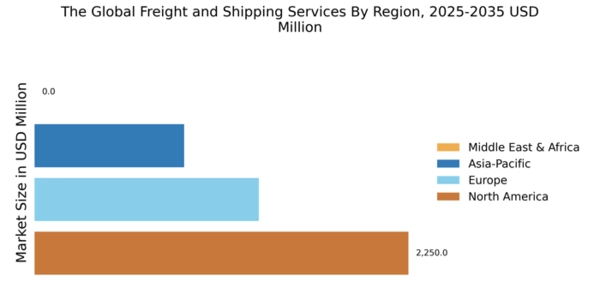
North America continues to lead The Global Freight and Shipping Services, holding a significant market share of $2250.0 million in 2024. The region's growth is driven by robust demand for e-commerce, increased trade activities, and advancements in logistics technology. Regulatory support, including streamlined customs processes and infrastructure investments, further catalyzes market expansion. The region's strategic location and extensive transportation networks enhance its competitive edge. The United States and Canada are the primary players in this market, with major shipping companies like A.P. Moller - Maersk and Mediterranean Shipping Company establishing strong operations. The competitive landscape is characterized by a mix of established players and emerging companies, all vying for market share. The presence of key players ensures a dynamic environment, fostering innovation and efficiency in freight services.
Europe's freight and shipping services market is projected to reach $1350.0 million by 2025, driven by increasing intra-European trade and a shift towards sustainable shipping practices. Regulatory frameworks, such as the European Green Deal, are pushing for greener logistics solutions, which are expected to reshape the market landscape. The demand for efficient supply chains and digitalization in logistics is also contributing to growth in this region. Leading countries like Germany, France, and the Netherlands are at the forefront of this market, with major players such as CMA CGM and Hapag-Lloyd dominating the competitive landscape. The presence of advanced port facilities and a strong logistics infrastructure supports the growth of freight services. The competitive environment is marked by collaborations and partnerships aimed at enhancing service offerings and operational efficiency.
The Asia-Pacific region is witnessing rapid growth in the freight and shipping services market, projected to reach $900.0 million by 2025. This growth is fueled by increasing trade activities, urbanization, and the rise of e-commerce. Countries in this region are investing heavily in infrastructure development and regulatory reforms to enhance logistics efficiency. The demand for reliable shipping services is on the rise, driven by both domestic and international trade. China, Japan, and India are the leading countries in this market, with key players like COSCO Shipping and Evergreen Marine Corporation making significant contributions. The competitive landscape is evolving, with both established companies and new entrants striving to capture market share. The region's diverse shipping routes and strategic ports play a crucial role in facilitating trade and enhancing service delivery.
The Middle East and Africa region currently shows minimal activity in the freight and shipping services market, with a market size of $0.0 million. However, this region presents untapped opportunities for growth, driven by increasing trade and investment in logistics infrastructure. Regulatory improvements and economic diversification efforts are expected to stimulate market development in the coming years. The demand for efficient shipping solutions is anticipated to rise as regional economies continue to grow. Countries like the UAE and South Africa are poised to lead the market as they enhance their logistics capabilities. The competitive landscape is still developing, with potential for both local and international players to establish a presence. As infrastructure projects progress, the region may become a significant player in The Global Freight and Shipping Services.
The Global Freight and Shipping Services is characterized by a dynamic competitive landscape, driven by factors such as increasing global trade, technological advancements, and a growing emphasis on sustainability. Major players like A.P. Moller - Maersk (DK), Mediterranean Shipping Company (CH), and CMA CGM (FR) are at the forefront, each adopting distinct strategies to enhance their market positioning. A.P. Moller - Maersk (DK) has focused on digital transformation, investing heavily in technology to optimize operations and improve customer experience. Mediterranean Shipping Company (CH) has pursued aggressive fleet expansion, enhancing its capacity to meet rising demand. Meanwhile, CMA CGM (FR) has emphasized sustainability, integrating eco-friendly practices into its operations, which collectively shapes a competitive environment increasingly oriented towards innovation and environmental responsibility.Key business tactics within this market include supply chain optimization and localized service offerings, which are essential for meeting diverse customer needs. The market structure appears moderately fragmented, with a mix of large multinational corporations and regional players. The collective influence of these key players fosters a competitive atmosphere where agility and responsiveness to market changes are paramount.
In November A.P. Moller - Maersk (DK) announced a strategic partnership with a leading technology firm to develop AI-driven logistics solutions. This initiative aims to enhance operational efficiency and reduce costs, reflecting the company's commitment to leveraging technology for competitive advantage. The strategic importance of this move lies in its potential to streamline processes and improve service delivery, positioning Maersk as a leader in digital logistics.
In October Mediterranean Shipping Company (CH) unveiled plans to expand its fleet with the acquisition of several new vessels, aimed at increasing its market share in Asia-Pacific. This expansion is significant as it not only enhances MSC's capacity but also strengthens its competitive position in a region experiencing robust trade growth. The strategic implications suggest a proactive approach to capturing emerging market opportunities.
In September CMA CGM (FR) launched a new initiative focused on carbon neutrality, committing to reduce emissions across its fleet by 30% by 2030. This move underscores the growing trend towards sustainability in the shipping industry, as companies increasingly recognize the importance of environmental stewardship. The strategic relevance of this initiative is profound, as it aligns with global regulatory trends and customer preferences for greener shipping solutions.
As of December current competitive trends in The Global Freight and Shipping Services are heavily influenced by digitalization, sustainability, and the integration of AI technologies. Strategic alliances are becoming increasingly vital, enabling companies to pool resources and expertise to navigate complex market challenges. Looking ahead, competitive differentiation is likely to evolve from traditional price-based competition to a focus on innovation, technological advancements, and supply chain reliability, reflecting a broader shift in industry priorities.





The Global Freight and Shipping Services is projected to grow at a 2.96% CAGR from 2025 to 2035, driven by technological advancements, increasing e-commerce demand, and sustainability initiatives.
New opportunities lie in:
By 2035, the market is expected to exhibit robust growth, adapting to evolving global trade dynamics.
| MARKET SIZE 2024 | 4500.0(USD Million) |
| MARKET SIZE 2025 | 4630.0(USD Million) |
| MARKET SIZE 2035 | 6200.0(USD Million) |
| COMPOUND ANNUAL GROWTH RATE (CAGR) | 2.96% (2025 - 2035) |
| REPORT COVERAGE | Revenue Forecast, Competitive Landscape, Growth Factors, and Trends |
| BASE YEAR | 2024 |
| Market Forecast Period | 2025 - 2035 |
| Historical Data | 2019 - 2024 |
| Market Forecast Units | USD Million |
| Key Companies Profiled | A.P. Moller - Maersk (DK), Mediterranean Shipping Company (CH), CMA CGM (FR), Hapag-Lloyd (DE), Evergreen Marine Corporation (TW), COSCO Shipping (CN), Yang Ming Marine Transport Corporation (TW), ZIM Integrated Shipping Services (IL), Hanjin Shipping (KR), PIL (Pacific International Lines) (SG) |
| Segments Covered | Service Type, Mode of Transport, End User, Cargo Type |
| Key Market Opportunities | Integration of advanced technologies enhances efficiency in The Global Freight and Shipping Services. |
| Key Market Dynamics | Technological advancements and regulatory changes are reshaping competitive dynamics in freight and shipping services. |
| Countries Covered | North America, Europe, APAC, South America, MEA |
The projected market valuation for The Global Freight and Shipping Services is expected to reach 6.2 USD Billion by 2035.
The overall market valuation was 4.5 USD Billion in 2024.
The expected CAGR for The Global Freight and Shipping Services during the forecast period 2025 - 2035 is 2.96%.
Key players in the market include A.P. Moller - Maersk, Mediterranean Shipping Company, CMA CGM, Hapag-Lloyd, Evergreen Marine Corporation, COSCO Shipping, Yang Ming Marine Transport Corporation, and Hanjin Shipping.
The Freight Forwarding segment increased from 1.8 USD Billion in 2024 to 2.4 USD Billion in 2025.
The Shipping Agency segment is projected to reach 1.3 USD Billion by 2025.
The Logistics Management segment is expected to grow from 0.8 USD Billion in 2024 to 1.3 USD Billion by 2025.
The Maritime mode of transport is anticipated to have the highest valuation, projected at 2.7 USD Billion by 2025.
The Retail end-use segment is expected to grow from 1.5 USD Billion in 2024 to 2.0 USD Billion by 2025.
Containerized Cargo is projected to reach 2.4 USD Billion by 2025, while Bulk Cargo is expected to reach 1.6 USD Billion.


Kindly complete the form below to receive a free sample of this Report

“This is really good guys. Excellent work on a tight deadline. I will continue to use you going forward and recommend you to others. Nice job”


“Thanks. It’s been a pleasure working with you, please use me as reference with any other Intel employees.”


“Thanks for sending the report it gives us a good global view of the Betaïne market.”


“Thank you, this will be very helpful for OQS.”


“We found the report very insightful! we found your research firm very helpful. I'm sending this email to secure our future business.”


“I am very pleased with how market segments have been defined in a relevant way for my purposes (such as "Portable Freezers & refrigerators" and "last-mile"). In general the report is well structured. Thanks very much for your efforts.”


“I have been reading the first document or the study, ,the Global HVAC and FP market report 2021 till 2026. Must say, good info! I have not gone in depth at all parts, but got a good indication of the data inside!”


“We got the report in time, we really thank you for your support in this process. I also thank to all of your team as they did a great job.”


“The Automotive 48V ECU Components Procurement Intelligence Study” was a complex project, but the Market Research Future (MRFR) team handled it with quality, agility, and customer-centricity. They delivered all requested data on time and within the agreed scope. The team, including Shubhendra Anand and Rahul Gotadki, was always readily available to clarify questions and swiftly implement necessary adjustments, driving the project to a successful conclusion within a very demanding timeframe.
I would also like to specifically commend Akshay Agarwal for his responsiveness and support at every stage—from our initial inquiry on May 6th through to final delivery on June 18th. His dedication made the entire process seamless.”



