Download Free Sample
Kindly complete the form below to receive a free sample of this Report
Global Workforce and Talent Acquisition Services Market Research Report By Industry (Information Technology, Healthcare, Finance, Manufacturing, Retail), By Talent Type (Permanent Placement, Temporary Staffing, Contract Staffing, Executive Search), By Company Size (Small Enterprises, Medium Enterprises, Large Enterprises, Startups), By Service Type (Recruitment Process Outsourcing, Managed Services Provider, Talent Mapping, Employer Branding, Candidate Sourcing), By Technology Utilization (Artificial Intelligence, Applicant Tracking Systems, Data Analytics, Social Media Recruiting) And By Region (North America, Europe, Asia-Pacific, And Rest Of The World) – Market Forecast Till 2035.
As per MRFR analysis, the Global Workforce and Talent Acquisition Services was estimated at 65.5 USD Billion in 2024. The market is projected to grow from 67.99 USD Billion in 2025 to 98.7 USD Billion by 2035, exhibiting a compound annual growth rate (CAGR) of 3.8% during the forecast period 2025 - 2035.
The Global Workforce and Talent Acquisition Services is currently experiencing a transformative shift driven by technological advancements and evolving workforce dynamics.
| 2024 Market Size | 65.5 (USD Billion) |
| 2035 Market Size | 98.7 (USD Billion) |
| CAGR (2025 - 2035) | 3.8% |
Adecco (CH), Randstad (NL), ManpowerGroup (US), Allegis Group (US), Robert Half (US), Hays (GB), Korn Ferry (US), Kelly Services (US), PageGroup (GB), Michael Page (GB)
Our Impact
Enabled $4.3B Revenue Impact for Fortune 500 and Leading Multinationals
Partnering with 2000+ Global Organizations Each Year
30K+ Citations by Top-Tier Firms in the Industry
The Global Workforce and Talent Acquisition Services is currently experiencing a transformative phase, driven by evolving workforce dynamics and technological advancements. Organizations are increasingly recognizing the necessity of adapting their talent acquisition strategies to meet the demands of a diverse and globalized labor market. This shift is characterized by a growing emphasis on digital solutions, which facilitate more efficient recruitment processes and enhance candidate experiences. As companies strive to attract top talent, they are likely to invest in innovative tools and platforms that streamline hiring and improve overall workforce management. Moreover, the market appears to be influenced by changing employee expectations, with a notable focus on flexibility and work-life balance. Employers are adapting their offerings to create more appealing work environments, which may include remote work options and enhanced benefits. This trend suggests that organizations must not only attract talent but also retain it by fostering a supportive culture. As The Global Workforce and Talent Acquisition Services continues to evolve, it is essential for stakeholders to remain agile and responsive to these emerging trends, ensuring they remain competitive in an ever-changing landscape.
The integration of advanced technologies into recruitment processes is reshaping The Global Workforce and Talent Acquisition Services. Organizations are increasingly utilizing artificial intelligence and machine learning to enhance candidate sourcing, screening, and engagement. This trend indicates a shift towards data-driven decision-making, allowing companies to identify the best talent more efficiently.
There is a growing emphasis on improving the overall employee experience within The Global Workforce and Talent Acquisition Services. Companies are recognizing that attracting talent is only part of the equation; retaining it requires a commitment to creating a positive workplace culture. This trend suggests that organizations are investing in initiatives that promote employee well-being and satisfaction.
The importance of diversity and inclusion is becoming increasingly prominent in The Global Workforce and Talent Acquisition Services. Organizations are actively seeking to build diverse teams, recognizing the value of varied perspectives in driving innovation and performance. This trend indicates a broader commitment to social responsibility and equitable hiring practices.
The increasing acceptance of remote work arrangements appears to be a pivotal driver in the Workforce and Talent Acquisition Services Market. Organizations are now more inclined to hire talent from diverse geographical locations, thereby expanding their talent pools. This shift has led to a notable increase in demand for talent acquisition services that specialize in remote hiring. According to recent data, approximately 30 percent of the workforce is expected to work remotely by 2026, which could significantly influence recruitment strategies. Consequently, firms are investing in technology and services that facilitate remote onboarding and virtual interviews, indicating a transformation in traditional hiring practices.
In an era where talent is scarce, organizations are placing greater emphasis on employer branding, which significantly influences the Workforce and Talent Acquisition Services Market. Companies are recognizing that a strong employer brand can attract top talent and reduce hiring costs. Research indicates that organizations with a positive employer brand can see a 50 percent reduction in the cost per hire. This trend has led to a surge in demand for talent acquisition services that assist in developing and promoting employer branding strategies, ensuring that companies stand out in a crowded marketplace.
The rapid evolution of industries necessitates a workforce equipped with specialized skills, which serves as a crucial driver in the Workforce and Talent Acquisition Services Market. As sectors such as technology, healthcare, and renewable energy expand, the need for professionals with niche expertise becomes increasingly pronounced. Data suggests that by 2025, nearly 70 percent of employers will prioritize candidates with specific skill sets over general qualifications. This trend compels organizations to seek talent acquisition services that can effectively identify and attract candidates with the requisite skills, thereby enhancing their competitive edge in the market.
As organizations face challenges in retaining top talent, there is a heightened focus on employee retention strategies, which serves as a significant driver in the Workforce and Talent Acquisition Services Market. Companies are increasingly aware that attracting talent is only part of the equation; retaining that talent is equally crucial. Data indicates that organizations with robust retention strategies can reduce turnover rates by up to 25 percent. This realization has led to a demand for talent acquisition services that not only focus on hiring but also on developing long-term employee engagement and satisfaction strategies.
The integration of advanced technologies in recruitment processes is transforming the Workforce and Talent Acquisition Services Market. Tools such as artificial intelligence, machine learning, and data analytics are being increasingly utilized to streamline hiring processes and enhance candidate experience. For instance, AI-driven platforms can analyze vast amounts of data to identify the best candidates, thereby improving the efficiency of recruitment. It is projected that by 2027, the market for AI in recruitment will reach approximately 1.5 billion dollars, underscoring the growing reliance on technology in talent acquisition.
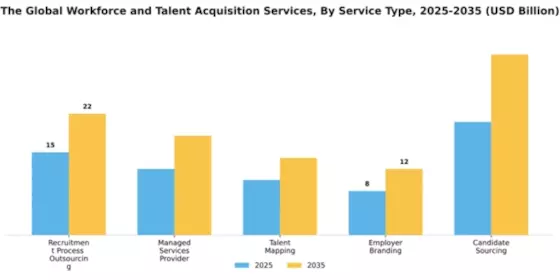
The Global Workforce and Talent Acquisition Services exhibits a diverse distribution of service types, with Recruitment Process Outsourcing (RPO) holding the largest share. This segment has gained traction due to its efficiency in managing recruitment processes for companies seeking to optimize operations. Conversely, Talent Acquisition Consulting has emerged as a significant contributor, rapidly increasing its market presence by addressing the strategic needs of organizations amidst changing employment landscapes, showcasing the dynamic nature of this segment.
Recruitment Process Outsourcing (Dominant) vs. Talent Acquisition Consulting (Emerging)
Recruitment Process Outsourcing (RPO) is recognized as the dominant service in The Global Workforce and Talent Acquisition Services, as it enables organizations to transfer all or part of their recruitment processes to external service providers. This model allows companies to leverage specialized expertise and technology, effectively reducing hiring timelines and improving candidate quality. Meanwhile, Talent Acquisition Consulting has emerged as an essential service, focusing on strategic insights that enhance recruitment effectiveness. This segment is characterized by tailored solutions that address specific organizational needs, driven by evolving labor markets and technological advancements, and is increasingly sought after by businesses aiming to improve their talent acquisition strategies.
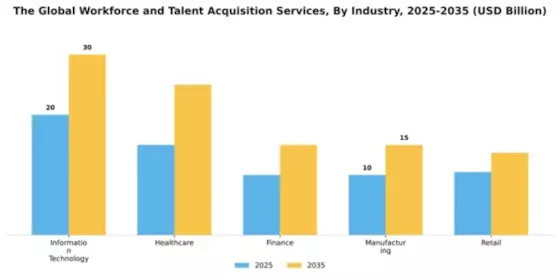
The Global Workforce and Talent Acquisition Services showcases diverse industry segments, with Information Technology commanding the largest market share. IT remains integral in driving digital transformation across businesses and continues to leverage advanced technologies for recruitment. On the flip side, the Healthcare sector is emerging vigorously, reflecting increasing investments in healthcare staffing and workforce management, influenced by an aging population and the demand for healthcare services worldwide.
IT Services: Information Technology (Dominant) vs. Healthcare Staffing (Emerging)
The Information Technology segment stands out for its robust demand for tech talent, driven by the ever-evolving landscape of technology and digital services. Organizations are increasingly prioritizing specialized skills in sectors like AI and cybersecurity, solidifying IT's dominant position in talent acquisition. Conversely, the Healthcare segment is witnessing a rapid rise, fueled by the need for skilled professionals amid global health challenges. With a focus on compliance, compassionate care, and innovative solutions, healthcare staffing is set to become a critical player, responding efficiently to emerging health needs.
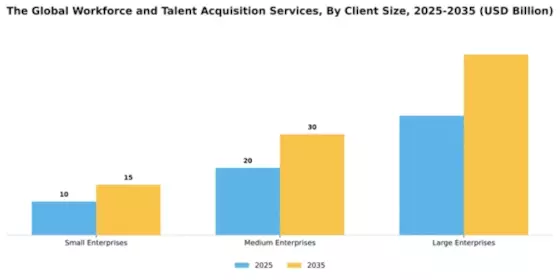
In The Global Workforce and Talent Acquisition Services, the distribution of market share among client size segments reveals that small enterprises hold the largest portion. These businesses often rely heavily on outsourced talent acquisition services due to their limited resources and need for efficiency. On the other hand, medium enterprises are emerging as a significant player, quickly capturing attention with their adaptive strategies that bridge the gap between small and large enterprises. Growth trends within this segment are driven by the increasing trends toward remote work and the need for diversified talent pools. Small enterprises continue to benefit from cost-effective solutions that fit tight budgets, while medium enterprises are embracing technology and innovative recruitment strategies that cater to faster scalability and responsiveness to workforce demands. This adaptability positions medium enterprises as a robust growth segment within the market.
Small Enterprises: Dominant vs. Medium Enterprises: Emerging
Small enterprises are characterized by their need for personalized and streamlined workforce solutions, making them the dominant force in the talent acquisition services market. These companies typically leverage flexible and tailored recruitment strategies to attract talent that aligns closely with their operational goals. In contrast, medium enterprises are emerging rapidly, focusing on integrating technology and data analytics into their recruitment processes. This shift allows them to respond swiftly to changing market dynamics and the growing demand for specialized skill sets. As they scale, medium enterprises are adopting more sophisticated talent acquisition solutions that enhance their competitiveness, positioning them as a vital segment driving market evolution.
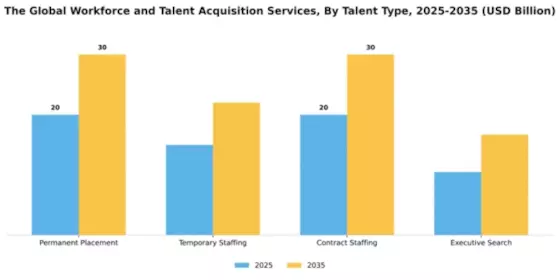
The Global Workforce and Talent Acquisition Services remains heavily influenced by various talent types, with permanent staffing being the largest segment. Permanent staffing captures a significant portion of the market share due to organizations' preference for stable talent solutions. In contrast, temporary staffing has emerged as a vital and growing segment, adapting to the evolving job landscape and fluctuating workforce demands. This shift reflects a broader trend toward flexible work arrangements and organizational agility. As businesses increasingly seek to optimize their workforce, temporary staffing shows superior growth potential. This trend is primarily driven by the rise of the gig economy, alongside changing employee preferences for flexibility and work-life balance. Organizations are leveraging temporary staffing solutions to meet immediate demands without long-term commitments, establishing a dynamic talent acquisition model that is rapidly gaining ground in the marketplace.
Permanent Staffing (Dominant) vs. Temporary Staffing (Emerging)
Permanent staffing remains the dominant force in The Global Workforce and Talent Acquisition Services, characterized by its focus on long-term employment solutions and employee retention. Companies favor this model for its ability to provide skilled and enduring talent, essential for driving organizational success. Conversely, temporary staffing has carved out an emerging niche, appealing to businesses that require adaptability and rapid scaling of workforce capabilities. This segment allows employers to manage seasonal fluctuations and project-based demands efficiently. While permanent staffing underlines stability and continuity, the temporary staffing model caters to the modern workforce's desire for flexibility, creating a balanced ecosystem within the broader talent acquisition landscape.
The Global Workforce and Talent Acquisition Services is increasingly being influenced by technological advancements. Among the key segments in Technology Utilization, Artificial Intelligence leads significantly due to its capabilities in enhancing recruitment processes through automation and predictive analytics. Data Analytics, while currently smaller in market share, is rapidly gaining traction as organizations recognize the value of data-driven decision-making in talent acquisition.
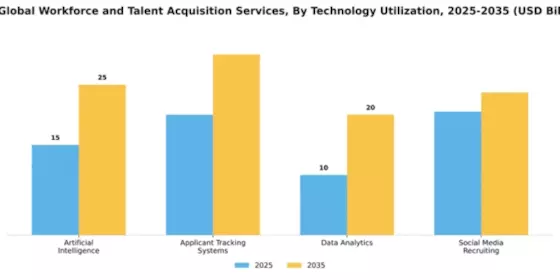
Artificial Intelligence: Dominant vs. Data Analytics: Emerging
Artificial Intelligence (AI) stands out as the dominant force in The Global Workforce and Talent Acquisition Services, revolutionizing how organizations approach hiring by improving efficiency and accuracy. Its ability to automate repetitive tasks and predict candidate suitability sets it apart. Conversely, Data Analytics, while emerging, is quickly becoming essential for organizations seeking to leverage insights for better talent acquisition strategies. This segment focuses on analyzing recruitment data for trends and performance metrics, enabling companies to refine their hiring processes. As firms continue to invest in data tools, the competition between AI and Data Analytics is likely to increase, shaping the future landscape of workforce services.
Get more detailed insights about The Global Workforce and Talent Acquisition Services Market Request Free Sample
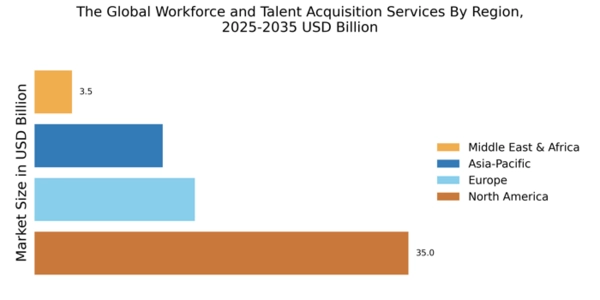
North America continues to lead The Global Workforce and Talent Acquisition Services, holding a significant market share of 35.0% as of 2024. The region's growth is driven by a robust economy, increasing demand for skilled labor, and advancements in technology that streamline recruitment processes. Regulatory support for workforce development and diversity initiatives further catalyzes market expansion, making it a prime location for talent acquisition services. The competitive landscape in North America is characterized by the presence of major players such as ManpowerGroup, Allegis Group, and Randstad. The U.S. remains the largest market, with Canada also showing strong growth in talent acquisition services. Companies are increasingly adopting innovative solutions, including AI-driven recruitment tools, to enhance efficiency and meet the evolving needs of employers and job seekers alike.
Europe's workforce and talent acquisition market is evolving, with a market size of 15.0% as of 2024. The region is experiencing growth driven by digital transformation, increased labor mobility, and a focus on upskilling and reskilling initiatives. Regulatory frameworks across EU member states are increasingly supportive of flexible work arrangements, which enhances the demand for talent acquisition services and fosters a more dynamic labor market. Leading countries in this region include Germany, the UK, and France, where key players like Hays and PageGroup are making significant inroads. The competitive landscape is marked by a mix of local and international firms, all vying for market share. The emphasis on compliance with EU labor laws and regulations is crucial for success, as companies navigate the complexities of cross-border recruitment and workforce management.
The Asia-Pacific region is witnessing a rapid expansion in The Global Workforce and Talent Acquisition Services, with a market share of 12.0% as of 2024. Key growth drivers include a burgeoning middle class, increasing urbanization, and a strong demand for skilled labor in emerging economies. Governments are implementing policies to enhance workforce participation and skill development, which are crucial for sustaining economic growth and attracting foreign investment. Countries like China, India, and Australia are at the forefront of this growth, with significant investments in technology and infrastructure to support talent acquisition services. Major players such as Kelly Services and Korn Ferry are actively expanding their operations in this region, leveraging local partnerships to enhance their service offerings and meet the diverse needs of employers and job seekers.
The Middle East and Africa region is gradually emerging as a significant player in The Global Workforce and Talent Acquisition Services, with a market size of 3.5% as of 2024. The growth is driven by economic diversification efforts, particularly in Gulf Cooperation Council (GCC) countries, and an increasing focus on local talent development. Regulatory initiatives aimed at enhancing workforce participation and skills training are also contributing to market expansion in this region. Leading countries include the UAE and South Africa, where the demand for skilled labor is rising. The competitive landscape features both local and international firms, with key players beginning to establish a foothold in the market. As the region continues to develop, the emphasis on compliance with local labor laws and regulations will be critical for success in talent acquisition services.
The Global Workforce and Talent Acquisition Services is characterized by a dynamic competitive landscape, driven by the increasing demand for skilled labor and the ongoing evolution of recruitment technologies. Major players such as Adecco (CH), Randstad (NL), and ManpowerGroup (US) are strategically positioned to leverage their extensive networks and technological advancements. Adecco (CH) focuses on digital transformation, enhancing its recruitment processes through AI-driven solutions, while Randstad (NL) emphasizes regional expansion, particularly in emerging markets. ManpowerGroup (US) adopts a multifaceted approach, integrating workforce management solutions with talent acquisition services, thereby shaping a competitive environment that prioritizes innovation and adaptability.The market structure appears moderately fragmented, with numerous players vying for market share. Key business tactics include localizing services to meet regional demands and optimizing supply chains to enhance efficiency. The collective influence of these major companies fosters a competitive atmosphere where agility and responsiveness to market changes are paramount. This fragmentation allows for niche players to emerge, further diversifying the competitive landscape.In November Adecco (CH) announced a strategic partnership with a leading AI technology firm to enhance its recruitment platform. This collaboration aims to streamline candidate sourcing and improve matching algorithms, thereby increasing placement efficiency. The strategic importance of this move lies in Adecco's commitment to staying at the forefront of technological advancements, which could significantly enhance its competitive edge in the market.In October Randstad (NL) expanded its operations into Southeast Asia, establishing new offices in key markets such as Vietnam and Indonesia. This expansion reflects Randstad's strategy to tap into the growing labor markets in these regions, where demand for skilled workers is surging. The significance of this move is underscored by the potential for increased market share and the ability to offer localized services tailored to the unique needs of these emerging economies.In September ManpowerGroup (US) launched a new initiative aimed at promoting workforce diversity and inclusion across its client base. This initiative includes training programs and resources designed to help organizations implement more inclusive hiring practices. The strategic importance of this initiative is twofold: it not only enhances ManpowerGroup's reputation as a socially responsible employer but also aligns with the increasing demand for diversity in the workplace, potentially attracting a broader client base.As of December current competitive trends in The Global Workforce and Talent Acquisition Services are heavily influenced by digitalization, sustainability, and AI integration. Strategic alliances are becoming increasingly vital, as companies seek to enhance their service offerings and operational efficiencies. The competitive differentiation is likely to evolve from traditional price-based competition to a focus on innovation, technology, and supply chain reliability. This shift suggests that companies that prioritize these elements will be better positioned to thrive in an increasingly complex market.






The Global Workforce and Talent Acquisition Services is projected to grow at a 3.8% CAGR from 2025 to 2035, driven by technological advancements, evolving workforce needs, and increased globalization.
New opportunities lie in:
By 2035, the market is expected to be robust, reflecting evolving workforce dynamics and technological integration.
| MARKET SIZE 2024 | 65.5(USD Billion) |
| MARKET SIZE 2025 | 67.99(USD Billion) |
| MARKET SIZE 2035 | 98.7(USD Billion) |
| COMPOUND ANNUAL GROWTH RATE (CAGR) | 3.8% (2025 - 2035) |
| REPORT COVERAGE | Revenue Forecast, Competitive Landscape, Growth Factors, and Trends |
| BASE YEAR | 2024 |
| Market Forecast Period | 2025 - 2035 |
| Historical Data | 2019 - 2024 |
| Market Forecast Units | USD Billion |
| Key Companies Profiled | Adecco (CH), Randstad (NL), ManpowerGroup (US), Allegis Group (US), Robert Half (US), Hays (GB), Korn Ferry (US), Kelly Services (US), PageGroup (GB), Michael Page (GB) |
| Segments Covered | Service Type, Industry, Company Size, Talent Type, Technology Utilization |
| Key Market Opportunities | Integration of artificial intelligence in recruitment processes enhances efficiency and candidate matching in The Global Workforce and Talent Acquisition Services. |
| Key Market Dynamics | Rising demand for digital recruitment solutions drives innovation and competition in workforce and talent acquisition services. |
| Countries Covered | North America, Europe, APAC, South America, MEA |
The projected market valuation for The Global Workforce and Talent Acquisition Services in 2035 is 98.7 USD Billion.
The overall market valuation for The Global Workforce and Talent Acquisition Services was 65.5 USD Billion in 2024.
The expected CAGR for The Global Workforce and Talent Acquisition Services during the forecast period 2025 - 2035 is 3.8%.
Key players in the market include Adecco Group, Randstad, ManpowerGroup, Allegis Group, Robert Half, Hays, Korn Ferry, Kelly Services, and PageGroup.
The projected values for Recruitment Process Outsourcing are expected to range from 30.0 USD Billion to 40.0 USD Billion by 2035.
By 2035, the projected values for the industry segment include Information Technology at 30.0 USD Billion, Healthcare at 25.0 USD Billion, Manufacturing at 18.0 USD Billion, and Retail at 25.7 USD Billion.
The anticipated growth for large enterprises is projected to reach between 53.7 USD Billion and 70.0 USD Billion by 2035.
The expected values for temporary staffing services are projected to range from 27.0 USD Billion to 35.0 USD Billion by 2035.
By 2035, the market segment by talent type is expected to show permanent staffing values between 39.0 USD Billion and 50.0 USD Billion.
The projected values for candidate sourcing services are expected to range from 28.7 USD Billion to 35.0 USD Billion by 2035.


Kindly complete the form below to receive a free sample of this Report

“This is really good guys. Excellent work on a tight deadline. I will continue to use you going forward and recommend you to others. Nice job”


“Thanks. It’s been a pleasure working with you, please use me as reference with any other Intel employees.”


“Thanks for sending the report it gives us a good global view of the Betaïne market.”


“Thank you, this will be very helpful for OQS.”


“We found the report very insightful! we found your research firm very helpful. I'm sending this email to secure our future business.”


“I am very pleased with how market segments have been defined in a relevant way for my purposes (such as "Portable Freezers & refrigerators" and "last-mile"). In general the report is well structured. Thanks very much for your efforts.”


“I have been reading the first document or the study, ,the Global HVAC and FP market report 2021 till 2026. Must say, good info! I have not gone in depth at all parts, but got a good indication of the data inside!”


“We got the report in time, we really thank you for your support in this process. I also thank to all of your team as they did a great job.”


“The Automotive 48V ECU Components Procurement Intelligence Study” was a complex project, but the Market Research Future (MRFR) team handled it with quality, agility, and customer-centricity. They delivered all requested data on time and within the agreed scope. The team, including Shubhendra Anand and Rahul Gotadki, was always readily available to clarify questions and swiftly implement necessary adjustments, driving the project to a successful conclusion within a very demanding timeframe.
I would also like to specifically commend Akshay Agarwal for his responsiveness and support at every stage—from our initial inquiry on May 6th through to final delivery on June 18th. His dedication made the entire process seamless.”



