Download Free Sample
Kindly complete the form below to receive a free sample of this Report
Thermocouple Temperature Sensors Market Size, Share and Research Report By Application (Industrial Processes, Automotive, Aerospace, Consumer Electronics, Food Processing), By Type (K-type Thermocouples, J-type Thermocouples, T-type Thermocouples, E-type Thermocouples, N-type Thermocouples), By Installation Type (Surface Mounted, Immersion, Insertion), By End Use Industry (Oil and Gas, Pharmaceuticals, Manufacturing, Automotive, Power Generation) and By Regional (North America, Europe, South America, Asia Pacific, Middle East and Africa)- Industry Forecast Till 2035
As per Market Research Future analysis, the Thermocouple Temperature Sensors Market was estimated at 3.274 USD Billion in 2024. The Thermocouple Temperature Sensors industry is projected to grow from 3.402 USD Billion in 2025 to 5.003 USD Billion by 2035, exhibiting a compound annual growth rate (CAGR) of 3.93% during the forecast period 2025 - 2035
The Thermocouple Temperature Sensors Market is poised for substantial growth driven by technological advancements and increasing demand across various sectors.
| 2024 Market Size | 3.274 (USD Billion) |
| 2035 Market Size | 5.003 (USD Billion) |
| CAGR (2025 - 2035) | 3.93% |
The Thermocouple Temperature Sensors Market is currently experiencing a dynamic evolution, driven by advancements in technology and increasing demand across various industries. These sensors, known for their reliability and wide temperature range, are becoming integral in sectors such as manufacturing, automotive, and aerospace. The growing emphasis on automation and process control is likely to further propel the adoption of thermocouples, as they provide accurate temperature measurements essential for operational efficiency. Additionally, the trend towards smart manufacturing and Industry Four Point Zero is fostering innovation in sensor technology, leading to enhanced performance and integration capabilities. Moreover, the rising focus on energy efficiency and sustainability is influencing the Thermocouple Temperature Sensors Market. Industries are increasingly seeking solutions that not only optimize performance but also minimize environmental impact. This shift is prompting manufacturers to develop more advanced thermocouples that offer improved accuracy and durability. As the market continues to evolve, it appears that the integration of digital technologies and the Internet of Things will play a crucial role in shaping future developments, potentially leading to more sophisticated temperature monitoring systems that enhance overall productivity and safety.
Recent innovations in sensor technology are enhancing the capabilities of thermocouples, making them more efficient and reliable. These advancements may include improved materials and designs that allow for better performance in extreme conditions.
The increasing trend towards automation in various industries is driving the need for precise temperature measurement solutions. Thermocouples are becoming essential components in automated systems, ensuring optimal performance and safety.
As industries prioritize sustainability, there is a notable shift towards energy-efficient solutions. Thermocouples that offer enhanced accuracy and reduced energy consumption are likely to gain traction in the market.
The automotive sector's evolution towards electric and hybrid vehicles is significantly impacting the Thermocouple Temperature Sensors Market. As manufacturers focus on enhancing vehicle performance and safety, the need for precise temperature monitoring in various automotive applications has become increasingly important. Thermocouples are utilized in critical areas such as engine management systems and battery temperature monitoring, ensuring optimal performance and safety. The automotive industry is projected to experience substantial growth, with electric vehiclesales expected to rise dramatically in the coming years. This trend presents a lucrative opportunity for thermocouple manufacturers, as their products are essential for meeting the demands of modern automotive technologies.
The increasing trend towards industrial automation is a pivotal driver for the Thermocouple Temperature Sensors Market. As industries strive for enhanced efficiency and productivity, the demand for precise temperature measurement solutions has surged. Thermocouples, known for their reliability and accuracy, are integral in automated processes across various sectors, including manufacturing and energy. According to recent data, the automation sector is projected to grow at a compound annual growth rate of over 9% in the coming years, further propelling the need for advanced temperature sensing technologies. This growth indicates a robust market potential for thermocouples, as they play a crucial role in ensuring optimal operational conditions and safety in automated environments.
The rise in regulatory standards concerning safety and environmental compliance is a crucial driver for the Thermocouple Temperature Sensors Market. Industries are increasingly required to adhere to stringent regulations that mandate accurate temperature monitoring to ensure safety and efficiency. This trend is particularly evident in sectors such as food and beverage, pharmaceuticals, and chemical processing, where temperature control is vital. As regulations become more rigorous, the demand for reliable thermocouple sensors is expected to grow, as they provide the necessary precision and reliability to meet compliance requirements. This regulatory landscape creates a favorable market environment for thermocouple manufacturers, as companies seek to invest in high-quality temperature sensing solutions.
Technological advancements in sensor technology are driving innovation within the Thermocouple Temperature Sensors Market. The development of new materials and designs has led to enhanced performance characteristics, such as improved accuracy, faster response times, and greater durability. These advancements are particularly relevant in high-temperature applications, where traditional sensors may falter. The market for temperature sensors is anticipated to grow significantly, with estimates suggesting a valuation of several billion dollars by the end of the decade. As industries seek to adopt cutting-edge technologies, the demand for advanced thermocouples that can withstand extreme conditions is likely to increase, positioning them as a preferred choice in various applications.
The shift towards renewable energy sources is significantly influencing the Thermocouple Temperature Sensors Market. As countries invest in solar, wind, and other renewable technologies, the need for effective temperature monitoring becomes paramount. Thermocouples are essential in these applications, providing accurate temperature readings that are critical for the efficiency and safety of energy systems. The renewable energy sector is expected to witness substantial growth, with investments projected to reach trillions of dollars in the next decade. This expansion creates a favorable environment for thermocouple manufacturers, as their products are increasingly utilized in the monitoring and control of renewable energy systems, thereby enhancing overall energy efficiency.
The Thermocouple Temperature Sensors Market is primarily driven by its application in various sectors. Among these, Industrial Processes holds the largest market share, attributed to the extensive use of temperature sensors in manufacturing and quality control processes across numerous industries. The Automotive and Aerospace sectors also contribute significantly, owing to their need for precision in temperature measurement to ensure safety and efficiency. In contrast, the Food Processing sector, although smaller relative to Industrial Processes, is on a rapid upward trajectory, reflecting changing consumer preferences towards food safety and quality.
Industrial Processes: Dominant vs. Food Processing: Emerging
The Industrial Processes segment remains dominant in the Thermocouple Temperature Sensors Market, driven by the need for accurate temperature readings in manufacturing settings. Industries such as oil and gas, chemicals, and pharmaceuticals leverage thermocouples for their reliability in extreme conditions. On the other hand, the Food Processing segment is emerging rapidly, spurred by stringent regulations on food safety and quality control. As consumer awareness grows, manufacturers are increasingly investing in advanced temperature monitoring technologies to ensure compliance with health standards. While Industrial Processes will continue to hold the majority, Food Processing is set to witness significant growth, propelled by innovations and heightened industry focus on food safety.
The Thermocouple Temperature Sensors Market exhibits a diverse range of segment values with K-type Thermocouples leading the market due to their wide applicability across industries such as automotive, aerospace, and manufacturing. Meanwhile, J-type Thermocouples are showcasing impressive growth in specific applications, primarily in refrigeration and food processing, due to their cost-effectiveness and reliability in lower temperature ranges. Other thermocouple types, like T-type, E-type, and N-type, have their niches but do not dominate market share as significantly as K and J types. Growth trends within this segment are driven primarily by advancements in technology and an increasing demand for precision temperature measurement in several sectors. The rise in industrial automation and the growing focus on energy efficiency are creating new opportunities for K-type sensors, which offer a wide temperature range and durability. In contrast, J-type sensors are favored for their affordability and performance in niche applications, contributing to their status as the fastest-growing segment. As industries continue to innovate and seek cost-effective solutions, these trends are expected to further evolve the market landscape.
K-type (Dominant) vs. J-type (Emerging)
K-type Thermocouples are recognized as the dominant player in the Thermocouple Temperature Sensors Market, thanks to their versatility in measuring a broad temperature range and durability against oxidation. They are extensively utilized in aerospace, automotive, and industrial applications where performance is critical. Their widespread acceptance is attributed to reliable performance and cost-effectiveness. In contrast, J-type Thermocouples are emerging rapidly, particularly in sectors like food processing and HVAC systems, where they are preferred for their accuracy in lower temperature applications and lower costs. While K-type remains invaluable in high-demand areas, J-type's growth trajectory suggests an increasing reliance on these sensors for economical solutions in specialized industries, positioning them uniquely against the backdrop of market demands.
In the Thermocouple Temperature Sensors Market, the Surface Mounted installation type holds the largest share due to its simplicity and ease of installation in various applications. This segment is preferred in many industries, such as HVAC and food processing, where temperature monitoring is critical. Conversely, the Immersion type is gaining traction, attributed to its ability to provide accurate readings in liquids and harsh environments, making it increasingly popular in sectors like oil and gas. The growth trends for these installation types reflect evolving market demands. The Immersion segment is characterized by its rapid expansion, driven by the increasing need for precise temperature readings in challenging conditions. As industries focus on enhancing process control and efficiency, the shift towards advanced technologies incorporating immersion sensors is evident, indicating a promising future for this segment in the thermocouple market.
Surface Mounted (Dominant) vs. Insertion (Emerging)
Surface Mounted thermocouples are recognized as the dominant choice in the market, primarily due to their versatility and compatibility with a wide range of surfaces. This installation type is particularly favored in applications where quick temperature measurement is necessary, offering reliable performance and ease of integration into existing systems. In contrast, Insertion thermocouples are emerging as a significant alternative, particularly in high-temperature processes. They are designed for deep installation in systems where the measurement of bulk temperature is required. While still developing, the Insertion segment is gaining interest, highlighting the industry’s trend towards more specialized temperature sensing solutions that adapt to various operational challenges.
In the Thermocouple Temperature Sensors Market, the Oil and Gas sector represents the largest share of the overall market, driven by the strategic need for precision in temperature monitoring in harsh environments. It plays a critical role in enhancing operational efficiency and safety in exploration and extraction processes. The Pharmaceuticals industry follows closely, exhibiting robust growth as well, supported by stringent temperature monitoring requirements in drug development, manufacturing, and storage, emerging as a pivotal sector for thermocouple applications.
Pharmaceuticals (Dominant) vs. Automotive (Emerging)
The Pharmaceuticals sector has established itself as a dominant player in the thermocouple temperature sensors market, driven by the necessity for precise temperature regulation throughout various processes, especially in drug storage and production environments. This industry is characterized by strict regulatory compliance, ensuring product safety and efficacy, which fuels demand for high-quality sensors. Conversely, the Automotive sector, while emerging, is gaining traction with advancements in electric vehicle technology and the need for enhanced temperature monitoring systems. As vehicle designs become more complex, the demand for accurate temperature feedback will increase, signaling promising growth opportunities in this segment.
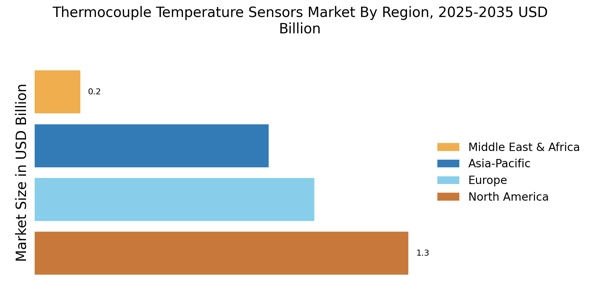
The Global Thermocouple Temperature Sensors Market, as outlined by its regional segmentation, is poised for growth across various areas. In 2024, North America leads the market with a valuation of 1.1 USD Billion, highlighting its significance in the industrial and technological advancements driving demand. Europe follows closely, valued at 0.9 USD Billion, and remains a key player due to its stringent regulatory standards encouraging precision temperature measurements.
The APAC region, with a market value of 1.07 USD Billion in 2024, is significant as it integrates innovative applications across manufacturing sectors and energy production.South America and the MEA regions, albeit smaller, valued at 0.1 USD Billion each in 2024, hold potential for growth due to expanding industrial activities. The majority of the market revenue is concentrated in North America and APAC, reflecting their robust infrastructure and technological investments. The progressive adoption of automation in industries significantly drives market growth, while the challenges include fluctuations in raw material costs and the need for continuous innovation in sensor technology.
Overall, the Global Thermocouple Temperature Sensors Market reflects diverse opportunities for penetration and expansion, with regional dynamics shaping the industry landscape.
The Global Thermocouple Temperature Sensors Market is characterized by a dynamic competitive landscape driven by technological advancements, increasing demand for precision measurements, and the proliferation of automation across various industries. Key players in this market are constantly innovating to enhance product offerings while catering to a wide range of applications, including aerospace, automotive, and industrial processes. Competitive insights reveal that companies are focusing on developing high-performance thermocouples that can withstand extreme conditions, and collaboration with end-users is becoming critical to understand specific needs and tailor solutions accordingly.
Moreover, strategic partnerships and expansions into emerging markets are crucial for gaining a competitive edge.Maxim Integrated stands out in the Global Thermocouple Temperature Sensors Market due to its comprehensive product range and commitment to quality. With a strong emphasis on innovation, Maxim Integrated has leveraged its expertise in analog and mixed-signal design to offer reliable and accurate temperature measurement solutions. The company's thermocouple sensor technology is known for its high performance and reliability at varying temperature ranges, catering to applications in industries such as consumer electronics, automotive, and industrial automation.
Maxim Integrated’s strong research and development capabilities allow it to stay ahead of market trends, ensuring that its products meet the evolving demands of customers while maintaining competitive pricing. The company also benefits from a robust distribution network, extending its market reach and solidifying its presence in both established and emerging markets.Panasonic plays a significant role in the Global Thermocouple Temperature Sensors Market, bringing forward innovative solutions that cater to a diverse set of applications. The company's thermocouple sensors are designed to be both high-quality and cost-effective, and they are widely utilized in sectors including healthcare, industrial machinery, and transportation.
With a strong focus on sustainability and energy efficiency, Panasonic integrates advanced technologies into its sensor offerings, promoting environmentally friendly practices while delivering accurate temperature measurements. The company's commitment to quality assurance and stringent manufacturing processes enhances the reliability and performance of its products, positioning Panasonic as a trusted choice among customers globally. Furthermore, Panasonic's ongoing investment in research and development helps it to continuously upgrade its technology and adapt to the fast-changing market landscape, ensuring its competitive standing remains solid.






Recent developments in the Global Thermocouple Temperature Sensors Market have been notably influenced by advancements in automation and industrial control systems. Major players like Siemens and ABB are pushing for innovations to enhance accuracy and response times in temperature measurement applications across various sectors, including healthcare and manufacturing. Emerson Electric continues to expand its footprint through strategic partnerships that leverage digital technologies to optimize temperature sensor functionality. Additionally, companies such as Honeywell and Fluke Corporation are unveiling new product lines that focus on miniaturization and improved thermal response, catering to the growing demand in the consumer electronics sector.
In terms of market consolidation, there have been significant mergers and acquisitions involving firms like Texas Instruments and Analog Devices, enhancing their technological capabilities and broadening their market reach. The growth in the market valuation of these companies is benefiting the overall industry landscape, as increasing demand for precision and reliability in temperature sensing applications drives investment and innovation, creating competitive advantages within the sector. Each company is adapting to emerging trends, which is reshaping market dynamics and positioning them for future opportunities.
The Thermocouple Temperature Sensors Market is projected to grow at a 3.93% CAGR from 2025 to 2035, driven by advancements in industrial automation and increasing demand for precision measurement.
New opportunities lie in:
By 2035, the market is expected to solidify its position as a leader in temperature sensing technology.
| MARKET SIZE 2024 | 3.274(USD Billion) |
| MARKET SIZE 2025 | 3.402(USD Billion) |
| MARKET SIZE 2035 | 5.003(USD Billion) |
| COMPOUND ANNUAL GROWTH RATE (CAGR) | 3.93% (2025 - 2035) |
| REPORT COVERAGE | Revenue Forecast, Competitive Landscape, Growth Factors, and Trends |
| BASE YEAR | 2024 |
| Market Forecast Period | 2025 - 2035 |
| Historical Data | 2019 - 2024 |
| Market Forecast Units | USD Billion |
| Key Companies Profiled | Omega Engineering (US), Fluke Corporation (US), Honeywell International Inc. (US), Texas Instruments (US), Yokogawa Electric Corporation (JP), Siemens AG (DE), National Instruments Corporation (US), Amphenol Corporation (US), Thermo Fisher Scientific Inc. (US) |
| Segments Covered | Application, Type, Installation Type, End Use Industry, Regional |
| Key Market Opportunities | Integration of advanced materials enhances accuracy and durability in the Thermocouple Temperature Sensors Market. |
| Key Market Dynamics | Rising demand for precision measurement drives innovation and competition in the thermocouple temperature sensors market. |
| Countries Covered | North America, Europe, APAC, South America, MEA |
The projected market valuation for the Thermocouple Temperature Sensors Market in 2035 is 5.003 USD Billion.
The overall market valuation for the Thermocouple Temperature Sensors Market in 2024 was 3.274 USD Billion.
The expected CAGR for the Thermocouple Temperature Sensors Market during the forecast period 2025 - 2035 is 3.93%.
The Industrial Processes application segment is projected to reach 2.2 USD Billion by 2035.
K-type thermocouples are projected to reach 2.2 USD Billion, while J-type thermocouples are expected to reach 1.2 USD Billion in 2035.
The Surface Mounted installation type is anticipated to grow to 2.2 USD Billion by 2035.
The Food Processing segment is expected to reach 0.503 USD Billion by 2035.
The Manufacturing end-use industry is projected to reach 1.8 USD Billion by 2035.
Key players in the Thermocouple Temperature Sensors Market include Omega Engineering, Fluke Corporation, and Honeywell International Inc.
The Oil and Gas segment is projected to reach 1.2 USD Billion by 2035.


Kindly complete the form below to receive a free sample of this Report

“This is really good guys. Excellent work on a tight deadline. I will continue to use you going forward and recommend you to others. Nice job”


“Thanks. It’s been a pleasure working with you, please use me as reference with any other Intel employees.”


“Thanks for sending the report it gives us a good global view of the Betaïne market.”


“Thank you, this will be very helpful for OQS.”


“We found the report very insightful! we found your research firm very helpful. I'm sending this email to secure our future business.”


“I am very pleased with how market segments have been defined in a relevant way for my purposes (such as "Portable Freezers & refrigerators" and "last-mile"). In general the report is well structured. Thanks very much for your efforts.”


“I have been reading the first document or the study, ,the Global HVAC and FP market report 2021 till 2026. Must say, good info! I have not gone in depth at all parts, but got a good indication of the data inside!”


“We got the report in time, we really thank you for your support in this process. I also thank to all of your team as they did a great job.”


“The Automotive 48V ECU Components Procurement Intelligence Study” was a complex project, but the Market Research Future (MRFR) team handled it with quality, agility, and customer-centricity. They delivered all requested data on time and within the agreed scope. The team, including Shubhendra Anand and Rahul Gotadki, was always readily available to clarify questions and swiftly implement necessary adjustments, driving the project to a successful conclusion within a very demanding timeframe.
I would also like to specifically commend Akshay Agarwal for his responsiveness and support at every stage—from our initial inquiry on May 6th through to final delivery on June 18th. His dedication made the entire process seamless.”



