Thin Client Market

Key Players: Dell Technologies, HP Inc., IGEL Technology, Lenovo, Cisco Systems, NComputing, Fujitsu, 10ZiG Technology

Thin Client Market

Thin Client Market Size, Share and Research Report: By Deployment Type (On-Premises, Cloud-Based, Hybrid), By End Use Industry (Education, Healthcare, Manufacturing, Retail), By Operating System (Windows, Linux, Chrome), By Component (Hardware, Software, Services) and By Regional (North America, Europe, South America, Asia Pacific, Middle East and Africa) - Industry Forecast Till 2035
ID: MRFR/SEM/10819-HCR
200 Pages
Ankit Gupta, Shubham Munde
Last Updated: June 22, 2026

Thin Client Market Summary

The Thin Client Market was valued at USD 5.35 Billion in 2025 and is projected to expand from USD 5.80 Billion in 2026 to USD 12.08 Billion by 2035, registering a CAGR of 8.5% during the forecast period (2026–2035). Federal Executive Order 14028 and the Cybersecurity and Infrastructure Security Agency's zero-trust maturity model have accelerated secure endpoint procurement across U.S. government agencies and their private-sector supply chains [3][4]. Enterprises reallocating IT budgets under rising cyber-insurance premiums find centrally managed endpoints a pragmatic path to compliance and cost control.

Traditional fat-client desktops are being replaced by lightweight terminals that stream virtual desktop thin clients from public cloud platforms and centralized data centers. The rate at which businesses are shifting workloads away from local hardware is reflected in forecasts that global investment in virtual desktop infrastructure will surpass USD 9 billion in 2024 [6]. In order to reduce firmware attack surfaces and lower per-seat license costs, suppliers now incorporate hardware-agnostic operating systems, such as Linux-based and Chrome OS.

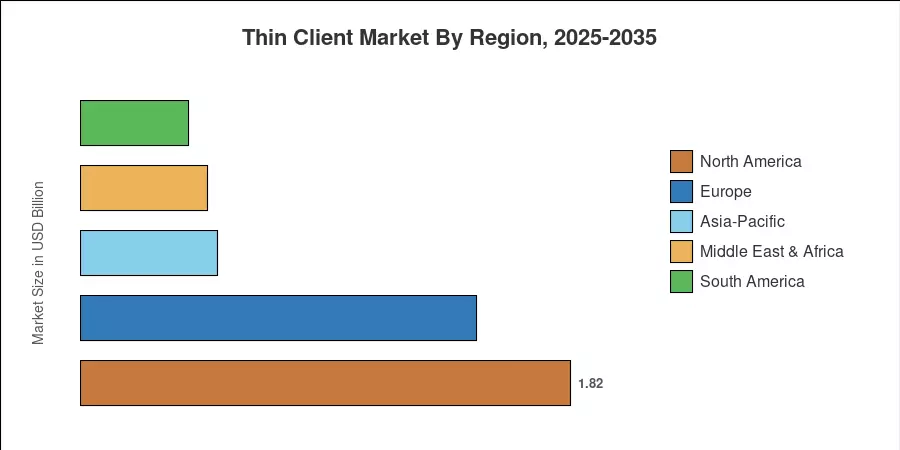
Due to corporate hybrid work budgets and federal zero-trust procurement, North America held the highest share of the thin client market in 2025. With a CAGR of 9.5% through 2035, Asia-Pacific is the fastest-growing market thanks to government digitalization initiatives in China, India, and ASEAN countries [12]. Due to the EU Cyber Resilience Act and scope-2 carbon reporting requirements that prioritize low-power endpoint devices, Europe is the second-largest area. The Thin Client Market's trajectory through 2035 is still steadily rising as global compliance demands and electricity prices rise.

Key Report Takeaways

• By Type

  • Hardware commanded 57.6% of the Thin Client Market revenue in 2025, reflecting persistent demand for purpose-built endpoint terminals across enterprise and government estates.
  • Software and services are forecast to grow at a 9.0% CAGR through 2035, fueled by subscription-based endpoint management platforms and managed desktop-as-a-service offerings.

• By End-User Industry

  • IT and telecom held 26.5% of the Thin Client Market share in 2025, led by service-provider network operations centers and call-center deployments.
  • Healthcare is advancing at a 9.8% CAGR through 2035, driven by HIPAA-compliant workstation mandates and electronic health-record modernization.

• By Geography

  • North America generated 34.0% of global revenue in 2025, supported by federal zero-trust procurement timelines and corporate IT refresh cycles.
  • Asia-Pacific exhibits the fastest trajectory at a 9.5% CAGR to 2035, with India's Digital India program and China's enterprise cloud push as primary catalysts.

Thin Client Market Size and Forecast (2021–2035)

Market sizing integrates primary research across 45+ enterprise IT procurement leaders, validated against vendor shipment data. Historical figures draw on public financial disclosures of leading hardware OEMs and channel distribution data. At the same time, forecast projections apply regression modeling anchored to enterprise endpoint refresh cycles, cloud adoption curves, and regulatory compliance timelines.
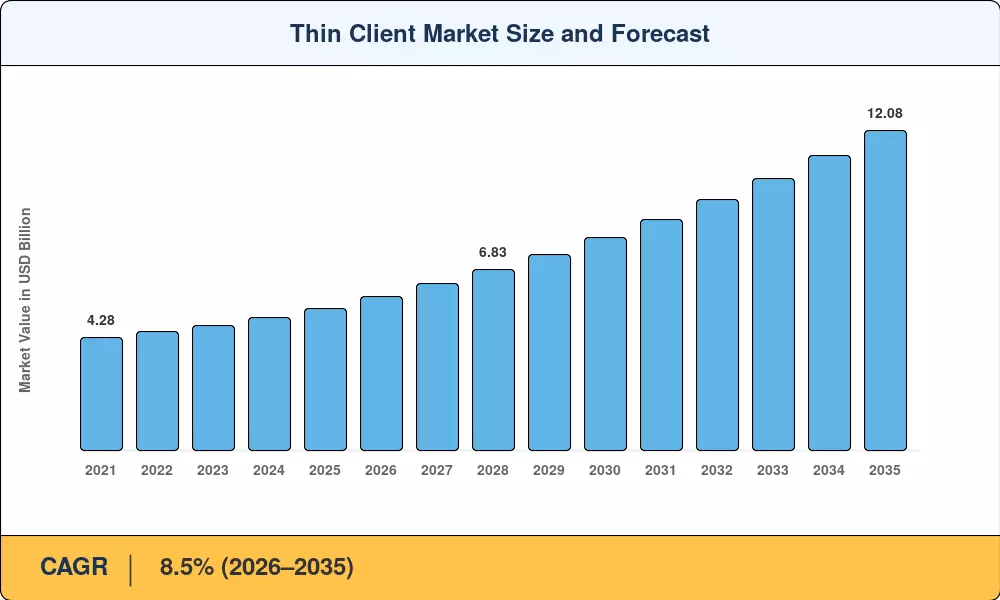
Thin Client Market Size and Forecast
Our Impact
Enabled $4.3B Revenue Impact for Fortune 500 and Leading Multinationals
Partnering with 2000+ Global Organizations Each Year
30K+ Citations by Top-Tier Firms in the Industry

Driver Impact Analysis

Driver ~% Impact on CAGR Geographic Relevance Impact Timeline
Zero-Trust Security Mandates ~18–22% Global Short-term (≤2 yr)
Hybrid and Remote Work Expansion ~15–18% North America, Europe Medium-term (2–4 yr)
Energy-Efficiency Regulations ~12–15% Europe, North America Medium-term (2–4 yr)
Cloud Desktop Infrastructure Adoption ~10–14% Global Long-term (≥4 yr)
Total-Cost-of-Ownership Optimization ~8–12% Global Short-term (≤2 yr)
Government Digital Transformation Programs ~7–10% Asia-Pacific, MEA Long-term (≥4 yr)
Cyber-Insurance Premium Incentives ~5–8% North America Medium-term (2–4 yr)

Zero-Trust Security Mandates

The Cybersecurity and Infrastructure Security Agency Zero Trust Maturity Model requires federal civilian agencies to enforce device-identity verification across all networks fully. This directive forces organizations to transition away from unmanaged legacy PCs toward centrally provisioned thin terminals whose firmware, operating systems, and session policies can be audited continuously in real time.

Hybrid and Remote Work Expansion

The Cybersecurity and Infrastructure Security Agency Zero Trust Maturity Model requires federal civilian agencies to enforce device-identity verification across all networks fully. This directive forces organizations to transition away from unmanaged legacy PCs toward centrally provisioned thin terminals whose firmware, operating systems, and session policies can be audited continuously in real time.

Energy-Efficiency Regulations

The United States Department of Energy Federal Energy Management Program benchmarks endpoint fleets against the ENERGY STAR Thin Client Specification. This standard explicitly caps idle power consumption at minimal baseline wattages, which draw a fraction of the power of conventional desktop PCs, substantially reducing greenhouse gas emissions across large institutional deployments.

Cloud Desktop Infrastructure Adoption

International Telecommunication Union standards for cloud computing frameworks acknowledge a rapid migration toward server-side desktop architectures. This trajectory expands the addressable hardware market for thin terminals, which serve as the optimized access devices for virtual desktops. The expanded public sector adoption inherently creates continuous hardware deployment pipelines globally.

Restraints Impact Analysis

Restraint estimates follow the same directional-impact methodology described in Section 4. Values represent downward pressure on the addressable growth rate, not absolute CAGR reductions.

Restraint ~% Impact on CAGR Geographic Relevance Impact Timeline
Limited Offline Functionality ~–8 to –12% Global Long-term (≥4 yr)
High-Bandwidth Dependency ~–6 to –10% Emerging Markets Medium-term (2–4 yr)
Legacy Application Compatibility ~–5 to –8% North America, Europe Short-term (≤2 yr)
Upfront Migration Costs ~–4 to –7% SME-heavy regions Short-term (≤2 yr)
User Resistance to Desktop Virtualization ~–3 to –5% Global Medium-term (2–4 yr)

Limited Offline Functionality

The Cybersecurity and Infrastructure Security Agency Zero Trust mandates dictate continuous endpoint logging, yet field deployments often lack persistent networks. The Federal Financial Institutions Examination Council architecture guidelines note that disconnected nodes lose localized session auditing capabilities. Because thin terminals require active server links to run applications, engineering fully disconnected terminal hardware remains a highly complex technical challenge.

High-Bandwidth Dependency

Thin terminals rely on low-latency connections to stream remote desktop sessions. However, World Bank regional network data shows that average broadband speeds across multiple developing territories remain beneath the operational baseline requirements outlined by the United Nations Broadband Commission. This specific infrastructure deficit severely restricts the deployment and performance density of session-based hardware.

Legacy Application Compatibility

Enterprises running specialized infrastructure face deep compatibility friction during centralized computing migrations. The Department of Defense Zero Trust Strategy highlights that transferring traditional software architectures to streamed environments demands explicit technical remediation across forty-five distinct core capabilities. This extensive repackaging process creates severe integration delays that stall institutional hardware refresh cycles globally

Thin Client Market Opportunities

Edge Computing Integration

Pairing thin terminals with on-premises edge servers creates a micro-cloud architecture that preserves the security and manageability benefits of centralized computing while dramatically reducing round-trip latency. Manufacturing facilities and healthcare campuses can process latency-sensitive workloads locally, enabling the Thin Client Market to penetrate use cases previously deemed unsuitable for session-based endpoints.

Healthcare Digital Workspace Expansion

HIPAA's 2025 cybersecurity rule update pushes hospitals toward zero-persistence endpoints that retain no patient data locally. With over 6,200 U.S. hospitals and 85,000 outpatient facilities in play, the healthcare vertical alone represents a multi-billion-dollar greenfield opportunity for the Thin Client Market through 2035.

Device-as-a-Service Business Models

Subscription-based hardware procurement — bundling low-power thin computing terminals with management software, warranty, and refresh — lowers the upfront barrier for SMEs. Dell, HP, and Lenovo each expanded DaaS offerings for thin endpoints in 2024, shifting revenue models from one-time sales to recurring annuities.

AI-Powered Endpoint Management

Machine-learning algorithms embedded in cloud management platforms can predict hardware failures, auto-remediate session drops, and optimize resource allocation across thousands of endpoints simultaneously. This layer of intelligence transforms thin terminals from passive access devices into self-healing nodes, making the Thin Client Market attractive to organizations that previously lacked the IT staff to manage large virtualized fleets.

Thin Client Market Future Outlook

Sovereign Cloud and Data Residency

Regulatory frameworks in the EU, India, and the Gulf states increasingly require that citizen and employee data remain within national borders. Thin terminals paired with in-country sovereign cloud infrastructure satisfy residency rules without sacrificing the centralized-management model, positioning the Thin Client Market to capture public-sector budgets that would otherwise flow toward locally hosted PCs [19].

Sustainability-Linked Procurement

Indirect energy reporting mandates under the European Union Corporate Sustainability Reporting Directive compel large organizations to document end-user hardware efficiency metrics. Enterprise technology procurement relies heavily on official regional standards, such as Environmental Protection Agency ENERGY STAR specifications, which establish minimal terminal idle power draw baselines to restrict institutional utility carbon emissions.

Platform Convergence and Unified Endpoint Management

The boundary between thin terminals, Chromebooks, and IoT edge devices is dissolving as vendors converge on unified endpoint-management platforms. By 2033, the Thin Client Market will increasingly overlap with broader managed-device ecosystems, enabling organizations to govern diverse hardware fleets through a single policy engine and expanding the addressable market beyond the traditional thin-terminal form factor [13].

Thin Client Market Segmentation

By Type

Segment Key Metric Primary Demand Driver
Hardware 57.6% share (2025) Enterprise refresh and zero-trust mandates
Software 9.2% CAGR (2026–2035) Subscription management platforms
Services USD 1.04 Billion (2025) Managed DaaS and deployment consulting

Hardware remains the revenue anchor of the Thin Client Market because every new endpoint deployment begins with a physical device purchase. Dell's OptiPlex and HP's t-series together account for the majority of enterprise-grade shipments, supported by refresh cycles averaging 5–6 years. Software and services, however, are closing the gap as organizations adopt subscription-based endpoint operating systems and managed desktop services, locking in recurring revenue streams that grow faster than one-time hardware sales.

By End-User Industry

Segment Key Metric Primary Demand Driver
BFSI USD 0.86 Billion (2025) Regulatory compliance, fraud prevention
IT and Telecom 26.5% share (2025) NOC and call-center densification
Healthcare 9.8% CAGR (2026–2035) HIPAA/zero-persistence requirements
Government 14.2% share (2025) Zero-trust procurement mandates
Manufacturing 8.3% CAGR (2026–2035) Factory-floor digitization
Others USD 0.38 Billion (2025) Education, retail, hospitality

IT and telecom organizations deploy thin terminals at scale in network operations centers and customer-contact facilities where thousands of identical desktops run the same applications. Healthcare is the fastest-growing vertical in the Thin Client Market, driven by regulatory demands for zero-persistence endpoints that prevent protected health information from residing on local storage.

By Form Factor

Segment Key Metric Primary Demand Driver
Desktop 44.4% share (2025) Office and call-center fixed installations
All-In-One USD 0.98 Billion (2025) Space-constrained clinical and retail settings
Mobile 9.1% CAGR (2026–2035) Field service and hybrid-work portability

Desktop thin terminals dominate fixed-installation environments, particularly in government and financial services offices. Mobile form factors are gaining momentum as hybrid-work policies require employees to carry a managed device between home and headquarters, making the Thin Client Market increasingly competitive with lightweight laptop offerings.

By Operating System

Segment Key Metric Primary Demand Driver
Windows 51.7% share (2025) Legacy enterprise-application compatibility
Linux 8.6% CAGR (2026–2035) Open-source cost reduction and security
Chrome OS 9.2% CAGR (2026–2035) Education and kiosk deployments
Other OS USD 0.19 Billion (2025) Proprietary embedded real-time systems

Windows retains the largest installed base in the Thin Client Market because many enterprise applications remain Win32-dependent. Chrome OS is the fastest-growing operating-system segment, propelled by education-sector purchases and kiosk-style deployments where a browser-centric experience satisfies all user requirements.

By Deployment Model

Segment Key Metric Primary Demand Driver
On-Premise USD 1.58 Billion (2025) Data-sovereignty and latency-sensitive workloads
Cloud 41.8% share (2025) DaaS scalability and CapEx reduction
Hybrid 9.0% CAGR (2026–2035) Balanced security and flexibility

Cloud deployments represent the largest single deployment-model segment in the Thin Client Market by revenue share, as organizations increasingly prefer desktop-as-a-service platforms that eliminate on-premises server management. Hybrid configurations are growing fastest because they allow enterprises to keep sensitive workloads on local infrastructure while routing general-purpose sessions through public cloud providers.

Regional Market Share Analysis

Region Key Metric Primary Investment Themes
North America 34.0% share (2025) Zero-trust mandates, hybrid-work budgets
Europe USD 1.47 Billion (2025) Cyber Resilience Act, energy-efficiency directives
Asia-Pacific 9.5% CAGR (2026–2035) Digital-government programs, manufacturing IT
South America USD 0.40 Billion (2025) Government IT modernization
Middle East & Africa 8.8% CAGR (2026–2035) Smart-city and e-government initiatives
Total USD 5.35 Billion (2025)

The Thin Client Market exhibits pronounced regional variation shaped by regulatory timelines, broadband maturity, and enterprise IT spending patterns. North America leads on zero-trust-driven procurement, while Asia-Pacific is growing fastest thanks to government digitization.

North America

Country Key Metric Key Driver
United States 72% of regional share Federal EO 14028, DoD Thunderdome
Canada 8.6% CAGR Hybrid-work policy mandates
Mexico USD 0.22 Billion Nearshoring-driven IT expansion

U.S. federal agencies account for the single largest procurement bloc in the Thin Client Market, with the General Services Administration's endpoint modernization schedule targeting full zero-trust compliance by FY 2027 [3]. Canada's Treasury Board Secretariat issued parallel guidance in 2024, requiring all departments to evaluate centrally managed endpoints during refresh cycles. Mexico's manufacturing corridor — bolstered by USD 35 billion in announced nearshoring investments — is generating net-new demand as multinational firms establish secure factory-floor terminals.

Europe

Country Key Metric Key Driver
Germany 22% of the regional share Industry 4.0 factory-floor endpoints
United Kingdom 8.9% CAGR NHS digital workspace rollout
France USD 0.22 Billion Public-sector modernization
Italy 11% of regional share SME digitization incentives
Spain 8.7% CAGR Banking-sector virtualization
Nordic Countries USD 0.15 Billion Sustainability-linked IT procurement
Russia 5.8% CAGR Import-substitution endpoint programs
Rest of Europe 7% of regional share EU Cohesion Fund IT grants

The EU Cyber Resilience Act compels all hardware vendors selling into the bloc to certify firmware integrity and patch-management capabilities, effectively raising the barrier for fat-client PCs and tilting procurement toward thin-client architectures with centralized update pipelines [8]. Germany's Industry 4.0 initiative drives factory-floor thin-terminal adoption, while the UK's National Health Service digital-workspace program represents one of Europe's largest single-buyer Thin Client Market opportunities.

Asia-Pacific

Country Key Metric Key Driver
China 32% of regional share Enterprise cloud-desktop migration
Japan USD 0.28 Billion Aging-workforce automation
India 10.2% CAGR Digital India infrastructure spending
South Korea 12% of regional share Smart-government endpoint mandates
ASEAN 9.8% CAGR Banking and telecom modernization
Rest of Asia-Pacific USD 0.08 Billion Broadband expansion programs

India's Common Service Center network — spanning over 500,000 digitally connected kiosks — is migrating to thin-client endpoints under the Digital India umbrella, creating one of the world's largest single-program procurement pipelines [12]. China's state-owned enterprises are accelerating desktop virtualization under data-sovereignty regulations that favor on-premises and hybrid-cloud deployments. The Thin Client Market in Asia-Pacific benefits from the convergence of government mandates, rising broadband penetration, and rapidly growing IT services outsourcing.

South America

Country Key Metric Key Driver
Brazil 52% of regional share Banking-sector endpoint security
Argentina 7.9% CAGR Public-sector digital modernization
Rest of South America USD 0.10 Billion Telecom and utility digitization

Brazil's Central Bank Resolution 4893 mandates stringent endpoint-security controls for financial institutions, prompting a wave of thin-terminal deployments across the country's five largest commercial banks. Argentina's Plan Federal de Internet, which aims to connect 2,000 municipal offices by 2028, specifies centrally managed devices as default equipment for new connectivity sites.

Middle East & Africa

Country Key Metric Key Driver
UAE 28% of the regional share Smart Dubai and ADGM endpoints
Saudi Arabia 9.2% CAGR Vision 2030 e-government platforms
South Africa USD 0.07 Billion Financial-services compliance
Egypt 8.4% CAGR New Administrative Capital IT build-out
Rest of MEA 15% of regional share Telecom and education digitization

Saudi Arabia's National Cybersecurity Authority issued mandatory endpoint-hardening standards in 2024, directing all government entities to adopt managed thin terminals for citizen-facing services. The UAE's Smart Dubai initiative integrates thin-client endpoints into municipal service centers and free-zone office parks, positioning the Thin Client Market in the Gulf as one of the fastest-growing sub-regional segments.


Thin Client Market By Region, 2025-2035

Competitive Benchmarking

The Thin Client Market exhibits medium concentration, with the top five vendors accounting for an estimated 48–55% of global revenue. The Herfindahl-Hirschman Index sits in the moderate range (~1,100–1,400), reflecting a duopoly at the top (Dell and HP) balanced by a vibrant tier of specialized challengers. Differentiation strategies revolve around operating-system flexibility, managed-service bundles, and vertical-specific security certifications.

Company Est. Revenue Share Range Key Offerings for Thin Client Market Strategic Positioning
Dell Technologies ~12–15% OptiPlex thin clients, Wyse ThinOS, Wyse Management Suite Full-stack hardware + software integration
HP Inc. ~10–13% HP t-series, HP ThinPro OS, HP Device Manager Broad enterprise portfolio, DaaS bundles
IGEL Technology ~7–9% IGEL OS, Universal Desktop Converter, IGEL Cloud Gateway Software-defined endpoint leader
Lenovo ~5–8% ThinkCentre Nano, ThinkEdge thin clients Enterprise IT ecosystem cross-sell
Cisco Systems ~4–6% Webex DaaS endpoints, secure-access architecture Network-integrated endpoint security
NComputing ~3–5% N-series thin clients, vSpace virtualization Cost-optimized SME and education focus
Fujitsu ~3–5% FUTRO series, Workplace Anywhere platform European public-sector specialization
10ZiG Technology ~2–4% NOS zero clients, 10ZiG Manager Zero-client niche, high-security verticals
Praim ~2–3% ThinOX, Agile4PC, ThinMan management console European healthcare and government
Stratodesk ~1–3% NoTouch OS, NoTouch Center OS-repurposing and legacy-device conversion

Recent News & Developments

  • HP Inc. -- (February 2026) -- Released the HP ThinPro 8.1 SP9 cloud client software update to integrate critical security mitigations across enterprise virtual desktop deployments.
  • LG Electronics -- (February 2026) -- Partnered with IGEL Technology to transition its global enterprise cloud and thin client hardware lines to the modular IGEL OS 12.7 platform.
  • IGEL Technology & Zscaler -- (May 2026) -- Formed a strategic partnership to launch specialized zero-trust healthcare security architectural blueprints for secure cloud-hosted thin endpoint operations.

Thin Client Market Report Scope

Parameter Detail
Market Scope Global Thin Client Market — hardware, software, services
Study Period 2021–2035
CAGR (Forecast Period) 8.5% (2026–2035)
Base Year Value USD 5.35 Billion (2025)
Forecast Endpoint Value USD 12.08 Billion (2035)
Fastest Growing Segments Healthcare (end user); Chrome OS (OS); Mobile (form factor)
Companies Profiled Dell, HP, IGEL, Lenovo, Cisco, NComputing, Fujitsu, 10ZiG, Praim, Stratodesk
Valuation Currency USD Billion


FAQs

How does the thin-client total cost of ownership compare with traditional PCs over a five-year cycle?

estimates a 35–45% lower five-year TCO for thin terminals versus fat-client PCs, driven by reduced desk-side support, longer hardware refresh intervals, and centralized patching [17]. Energy savings alone can exceed USD 50 per seat annually.

What bandwidth is recommended before deploying thin terminals enterprise-wide?

A minimum of 25 Mbps per concurrent session ensures responsive high-definition virtual-desktop performance. Organizations running multimedia or CAD workloads should provision 40–50 Mbps with quality of service prioritization [6].

Can the Thin Client Market support GPU-intensive workloads such as 3D modeling?

Yes — vendors now offer GPU-passthrough and vGPU-enabled sessions through NVIDIA GRID and AMD MxGPU. These configurations stream graphically intensive applications from data-center GPUs to thin endpoints [5].

How does the Thin Client Market address data-sovereignty requirements in regulated industries?

Thin terminals process and store no data locally; all information resides in the data center or sovereign cloud. This architecture simplifies compliance with GDPR, HIPAA, and national data-residency laws [19].

What role do channel partners play in Thin Client Market procurement?

Value-added resellers and managed-service providers influence over 60% of enterprise thin-client purchases, handling deployment, configuration, and ongoing management [13]. Vendor DaaS programs further expand channel reach.

How quickly can an organization migrate from traditional desktops to thin terminals?

Pilot-to-production timelines average 4–6 months for a 5,000-seat deployment. Migration speed depends on application compatibility testing and network readiness assessments [17].

Are refurbished thin-client devices a viable procurement option for budget-constrained buyers?

Certified-refurbished units typically cost 40–55% less than new hardware while retaining manufacturer warranty coverage. Education and public-sector buyers increasingly adopt refurbished programs to stretch IT budgets [6].    
Author
Author
Author Profile
Ankit Gupta LinkedIn
Team Lead - Research
Ankit Gupta is a seasoned market intelligence and strategic research professional with over six plus years of experience in the ICT and Semiconductor industries. With academic roots in Telecom, Marketing, and Electronics, he blends technical insight with business strategy. Ankit has led 200+ projects, including work for Fortune 500 clients like Microsoft and Rio Tinto, covering market sizing, tech forecasting, and go-to-market strategies. Known for bridging engineering and enterprise decision-making, his insights support growth, innovation, and investment planning across diverse technology markets.
Co-Author
Co-Author Profile
Shubham Munde LinkedIn
Team Lead - Research
Shubham brings over 7 years of expertise in Market Intelligence and Strategic Consulting, with a strong focus on the Automotive, Aerospace, and Defense sectors. Backed by a solid foundation in semiconductors, electronics, and software, he has successfully delivered high-impact syndicated and custom research on a global scale. His core strengths include market sizing, forecasting, competitive intelligence, consumer insights, and supply chain mapping. Widely recognized for developing scalable growth strategies, Shubham empowers clients to navigate complex markets and achieve a lasting competitive edge. Trusted by start-ups and Fortune 500 companies alike, he consistently converts challenges into strategic opportunities that drive sustainable growth.
Download Free Sample

Kindly complete the form below to receive a free sample of this Report

Download PDF ×

We do not share your information with anyone. However, we may send you emails based on your report interest from time to time. You may contact us at any time to opt-out.
















