Download Free Sample
Kindly complete the form below to receive a free sample of this Report
Thoracic Drainage Device Market Research Report: Size, Share, Trend Analysis By Product Type (Chest Drains, Drainage Catheters, One-Way Valves, Suction Systems), By Applications (Pneumothorax, Pleural Effusion, Empyema), By End Users (Hospitals, Ambulatory Surgical Centers, Home Care), By Material (Silicone, PVC, Latex) and By Regional (North America, Europe, South America, Asia Pacific, Middle East and Africa) - Growth Outlook & Industry Forecast 2025 To 2035
As per Market Research Future analysis, the Thoracic Drainage Device Market was estimated at 1.864 USD Billion in 2024. The thoracic drainage device industry is projected to grow from 1.973 USD Billion in 2025 to 3.498 USD Billion by 2035, exhibiting a compound annual growth rate (CAGR) of 5.89% during the forecast period 2025 - 2035
The Thoracic Drainage Device Market is experiencing notable growth driven by technological advancements and increasing healthcare demands.
| 2024 Market Size | 1.864 (USD Billion) |
| 2035 Market Size | 3.498 (USD Billion) |
| CAGR (2025 - 2035) | 5.89% |
Medtronic (US), Boston Scientific (US), Teleflex (US), Smiths Medical (US), Halyard Health (US), B. Braun Melsungen AG (DE), Cook Medical (US), ConvaTec (GB), Fresenius Kabi (DE)
Our Impact
Enabled $4.3B Revenue Impact for Fortune 500 and Leading Multinationals
Partnering with 2000+ Global Organizations Each Year
30K+ Citations by Top-Tier Firms in the Industry
The Thoracic Drainage Device Market is currently experiencing a notable evolution, driven by advancements in medical technology and an increasing awareness of respiratory health. The demand for these devices is likely influenced by a growing prevalence of conditions requiring thoracic drainage, such as pleural effusion and pneumothorax. Furthermore, the integration of innovative materials and designs appears to enhance patient comfort and safety, which may contribute to a more favorable adoption rate among healthcare providers. As the healthcare landscape continues to evolve, the emphasis on minimally invasive procedures seems to be shaping the development of thoracic drainage solutions, potentially leading to improved patient outcomes. In addition, the regulatory environment surrounding medical devices is becoming increasingly stringent, which could impact the Thoracic Drainage Device Market. Manufacturers are likely focusing on compliance with safety standards and efficacy requirements, which may drive innovation in product development. The market also appears to be influenced by the rising trend of outpatient procedures, as healthcare systems seek to reduce costs and improve efficiency. This shift could lead to a greater emphasis on portable and user-friendly thoracic drainage devices, catering to the needs of both patients and healthcare professionals.
The Thoracic Drainage Device Market is witnessing a surge in technological innovations, which are enhancing the functionality and effectiveness of these devices. New materials and designs are being developed to improve patient comfort and reduce complications, indicating a shift towards more sophisticated solutions.
As the regulatory landscape becomes more stringent, manufacturers in the Thoracic Drainage Device Market are prioritizing compliance with safety and efficacy standards. This focus on regulation may drive innovation, as companies strive to meet the evolving requirements while ensuring high-quality products.
The trend towards outpatient procedures is reshaping the Thoracic Drainage Device Market. Healthcare providers are increasingly seeking portable and user-friendly devices that facilitate efficient patient care, suggesting a potential shift in product design and functionality to accommodate this demand.
The increasing geriatric population is a significant factor influencing the Thoracic Drainage Device Market. Older adults are more susceptible to respiratory diseases and conditions requiring thoracic drainage, such as heart failure and lung cancer. As the global population ages, the demand for thoracic drainage devices is anticipated to grow. According to demographic studies, the proportion of individuals aged 65 and older is projected to rise substantially in the coming years, leading to a higher incidence of health complications that necessitate thoracic interventions. This demographic shift is likely to drive healthcare providers to invest in thoracic drainage solutions, thereby expanding the market.
Increased awareness and education regarding thoracic drainage procedures among healthcare professionals and patients are contributing to the growth of the Thoracic Drainage Device Market. As medical education programs emphasize the importance of timely intervention in respiratory conditions, healthcare providers are more likely to utilize thoracic drainage devices effectively. Additionally, patient education initiatives are empowering individuals to seek medical attention sooner, which can lead to better health outcomes. This heightened awareness is expected to drive demand for thoracic drainage devices, as both providers and patients recognize the critical role these devices play in managing respiratory complications.
The expansion of healthcare infrastructure, particularly in emerging economies, is a crucial driver for the Thoracic Drainage Device Market. As healthcare facilities grow and modernize, there is an increasing need for advanced medical devices, including thoracic drainage solutions. Investments in hospitals and clinics are likely to enhance access to quality healthcare services, thereby increasing the utilization of thoracic drainage devices. Furthermore, government initiatives aimed at improving healthcare access and quality are expected to support the growth of this market. As more facilities become equipped with the necessary technology and training, the demand for thoracic drainage devices is projected to rise.
Technological advancements in the design and functionality of thoracic drainage devices are propelling the Thoracic Drainage Device Market forward. Innovations such as digital monitoring systems, improved suction mechanisms, and user-friendly interfaces are enhancing the efficacy and safety of these devices. For instance, the introduction of smart drainage systems that provide real-time data on fluid levels and patient status is likely to improve clinical decision-making. Furthermore, the integration of biocompatible materials is reducing the risk of complications, thereby increasing patient satisfaction. As healthcare facilities seek to adopt the latest technologies to improve patient care, the demand for advanced thoracic drainage devices is expected to rise.
The rising incidence of respiratory diseases, such as chronic obstructive pulmonary disease and pneumonia, is a primary driver for the Thoracic Drainage Device Market. As these conditions become more prevalent, the demand for effective thoracic drainage solutions is likely to increase. According to recent estimates, respiratory diseases account for a significant portion of global morbidity and mortality, necessitating advanced medical interventions. This trend suggests that healthcare providers are increasingly adopting thoracic drainage devices to manage pleural effusions and other complications associated with respiratory ailments. Consequently, the market for these devices is expected to expand, driven by the need for improved patient outcomes and enhanced quality of care.
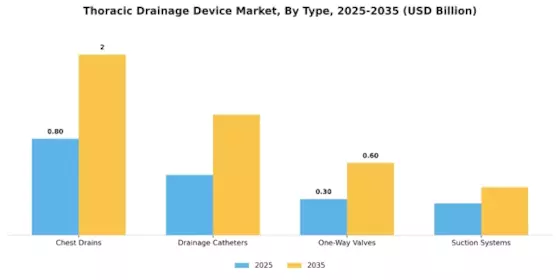
The 'By Type' segment of the Thoracic Drainage Device Market illustrates a diverse distribution among its components. Chest drains hold a significant portion of the market share, establishing their dominance due to their established usage in clinical settings. Drainage catheters, on the other hand, are capturing increased attention and utilization, driven primarily by advancements in technology and a growing emphasis on patient comfort and minimally invasive procedures. Growth trends in the Thoracic Drainage Device Market showcase a robust increase in demand for drainage catheters, which are rapidly becoming a favored choice among healthcare providers. This surge is attributed to their versatility in various scenarios, including emergency and elective surgeries, which amplifies their potential in diverse applications. Increasing healthcare expenditure, coupled with rising awareness about innovative drainage solutions, contributes to the overall growth of this segment.
Chest Drains (Dominant) vs. Drainage Catheters (Emerging)
In the Thoracic Drainage Device Market, Chest Drains are established as the dominant type due to their critical role in managing pleural effusions and pneumothorax effectively. Characterized by their reliability and efficiency, chest drains are widely used in hospitals and emergency situations. On the contrary, Drainage Catheters are emerging as an innovative solution, especially valued for their capability to offer a less invasive approach. As techniques advance, drainage catheters are being improved for ease of use, portability, and effectiveness in fluid management. This emerging category is becoming increasingly popular among healthcare professionals, leading to greater adoption rates, particularly in outpatient care settings.
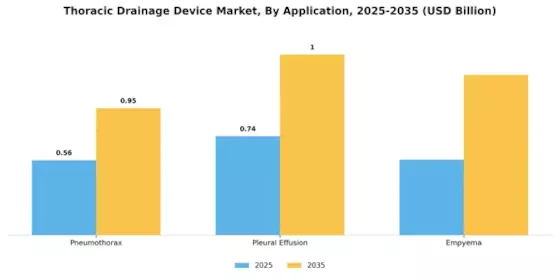
In the Thoracic Drainage Device Market, Pneumothorax stands out as the largest segment, capturing a substantial share of the overall market. This condition, characterized by air within the pleural space, requires effective management, leading to high demand for thoracic drainage devices specifically tailored for this application. On the other hand, Pleural Effusion is rapidly emerging, exhibiting notable growth due to increasing incidences and awareness regarding fluid accumulation in the pleural cavity. The demand for effective drainage solutions in these cases is propelling this segment forward.
Pneumothorax (Dominant) vs. Pleural Effusion (Emerging)
Pneumothorax devices dominate the Thoracic Drainage Device Market due to their established utility in emergency care and intervention strategies for air removal from the pleural space. These devices are typically favored for their reliability and ease of use under critical conditions. Conversely, the Pleural Effusion segment is emerging as a noteworthy contender, driven by both technological advancements and growing awareness about treatment options for fluid build-up. The increasing incidence of conditions leading to pleural effusions, as well as enhanced training for medical professionals, supports the rising demand for specialized drainage devices in this area.
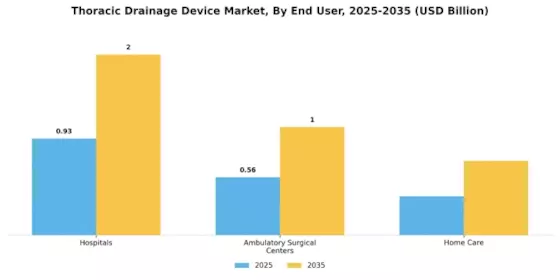
The Thoracic Drainage Device Market is significantly influenced by its end-user distribution, where hospitals hold the largest market share. These institutions leverage thoracic drainage devices for a wide range of medical conditions, leading to high demand and utilization rates. In contrast, ambulatory surgical centers are gaining momentum in the market, showing a notable increase in adoption rates as minimally invasive surgeries become more prevalent, enhancing their market share. Growth trends in the thoracic drainage device segment are driven by advancements in technology and increasing awareness regarding patient safety. Hospitals continue to invest in sophisticated thoracic drainage solutions, while ambulatory surgical centers are rapidly expanding their services, catering to patients who prefer outpatient procedures. This shift towards less invasive treatment options is expected to further boost the adoption of these devices in both settings.
End Users: Hospitals (Dominant) vs. Home Care (Emerging)
Hospitals serve as the dominant end-user segment in the Thoracic Drainage Device Market due to their crucial role in treating a variety of thoracic conditions, which necessitate advanced drainage devices for patient care. The infrastructure and specialized medical staff present in hospitals facilitate high utilization rates of thoracic drainage devices. On the other hand, home care is emerging as a significant segment, driven by patients' preferences for receiving treatment in the comfort of their homes. With technological improvements enabling safer and more effective devices for home use, the demand for thoracic drainage solutions in home care settings is witnessing accelerated growth, reflecting a shift in patient care paradigms.
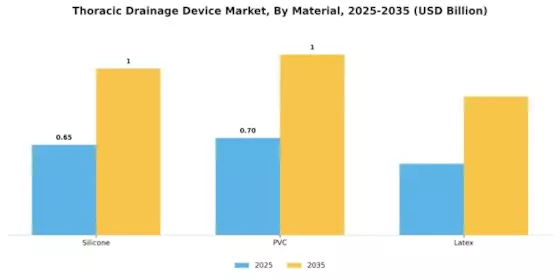
In the Thoracic Drainage Device Market, the material segment is primarily dominated by silicone, which holds a significant market share due to its biocompatibility and flexibility. Silicone's properties make it the material of choice for various thoracic drainage devices, leading to widespread adoption among healthcare providers. PVC follows as a competitive material, especially in the lower-cost segment, attracting budget-conscious healthcare facilities.
Silicone (Dominant) vs. PVC (Emerging)
Silicone has established itself as a dominant material in thoracic drainage devices, favored for its excellent biocompatibility, resistance to kinking, and extended durability. This makes it suitable for prolonged patient use, thereby enhancing patient comfort and clinical outcomes. On the other hand, PVC is emerging as a cost-effective alternative, particularly suitable for short-term applications. Despite being less flexible, it offers adequate performance for specific use cases. The growing preference for PVC among budget-sensitive institutions and the increasing volume of thoracic procedures contribute to its fast-growing presence in this segment.
Get more detailed insights about Thoracic Drainage Device Market Request Free Sample
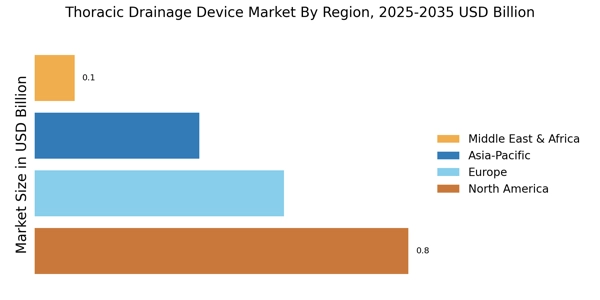
The Global Thoracic Drainage Device Market has been delineated into various regions, showcasing significant variations in market valuation and growth potential. In 2024, North America leads with a valuation of 0.86 USD Billion, expected to rise to 1.6 USD Billion by 2035, thus dominating the market due to advanced healthcare infrastructure and high adoption rates. Europe follows, with a 2024 valuation of 0.58 USD Billion projected to increase to 1.1 USD Billion by 2035, underscoring its importance in the healthcare sector.
The APAC region, valued at 0.28 USD Billion in 2024 and anticipated to grow to 0.55 USD Billion by 2035, displays significant potential, driven by increasing healthcare investments and rising patient populations.South America, though smaller, with a valuation of 0.08 USD Billion in 2024 expected to rise to 0.15 USD Billion by 2035, is emerging steadily, indicating developing healthcare systems. Meanwhile, the MEA region, valued at 0.06 USD Billion in 2024 and projected to reach 0.1 USD Billion by 2035, reflects a growing interest in enhancing medical facilities, albeit at a slower pace.
Overall, the Global Thoracic Drainage Device Market revenue across these regions indicates varying degrees of growth opportunities influenced by local healthcare dynamics, economic conditions and advancements in medical technology. Source: Primary Research, Secondary Research, Market Research Future Database and Analyst Review
The Global Thoracic Drainage Device Market is characterized by a rapidly evolving competitive landscape, where various companies strive to enhance their product offerings and market reach. As medical technology advances, the demand for effective thoracic drainage solutions has increased, leading to the entry of numerous players into the market. Competitive insights reveal that companies are focusing on innovation, quality improvements, and strategic collaborations to gain a competitive edge. The market is also witnessing a shift towards minimally invasive techniques, prompting manufacturers to invest in research and development to meet the changing needs of healthcare providers and patients.As a result, there is a dynamic interplay between established firms and new entrants, creating substantial opportunities for growth and expansion. Teleflex holds a prominent position in the Global Thoracic Drainage Device Market, distinguished by its commitment to product innovation and quality. The company has developed a strong reputation for delivering state-of-the-art thoracic drainage products that meet the highest safety and efficacy standards. Teleflex's extensive portfolio includes a variety of drainage catheters and accessories that are designed for optimal patient comfort and clinical effectiveness.The company benefits from a well-established distribution network and a global presence, allowing it to effectively serve a diverse customer base. Teleflex's emphasis on research and development enables it to introduce advanced technologies, positioning the brand as a leader in the thoracic drainage segment. Furthermore, strong relationships with healthcare providers bolster its market position, fostering trust and reliability among clinicians who rely on its devices. ConvaTec is another significant player in the Global Thoracic Drainage Device Market, recognized for its comprehensive range of thoracic drainage solutions tailored to the specific needs of healthcare professionals.The company has built a solid foundation through rigorous research and product development, establishing a track record for reliability and ease of use within its product offerings. ConvaTec's focus on user-friendly designs and innovative features sets it apart from competitors, making its products more appealing to clinicians and healthcare facilities. Additionally, the company actively engages in partnerships and collaborations, expanding its market presence and enhancing its product line. By prioritizing customer feedback and clinical outcomes, ConvaTec effectively aligns its products with the demands of modern healthcare, further strengthening its competitive position within the thoracic drainage device sector.




Recent developments in the Global Thoracic Drainage Device Market indicate a growing focus on technological advancements and product innovation among leading companies. Teleflex and Medtronic have been notably active, enhancing their product portfolios to address the rise in thoracic surgeries and trauma cases. The market is witnessing a shift towards minimally invasive procedures, with companies like Atrium Medical and Smiths Medical introducing advanced drainage systems that offer improved patient outcomes.
Additionally, the demand for effective management of pleural effusions and pneumothorax is driving growth among manufacturers, leading to strategic partnerships and collaborative research efforts. The valuation of major players in this sector, such as Boston Scientific and ConvaTec, has shown notable increases, reflecting investor confidence and a positive outlook for future growth. Furthermore, recent mergers and acquisitions have played a pivotal role in shaping the competitive landscape, with firms like C.R. Bard and Halyard Health engaging in activities to expand their reach and capabilities in thoracic drainage solutions.
This evolving market is increasingly influenced by regulatory changes and the push for innovative technologies that enhance the efficiency and safety of thoracic drainage procedures.
The Thoracic Drainage Device Market is projected to grow at a 5.89% CAGR from 2025 to 2035, driven by technological advancements, increasing prevalence of respiratory diseases, and rising healthcare expenditure.
New opportunities lie in:
By 2035, the Thoracic Drainage Device Market is expected to achieve substantial growth and innovation.
| MARKET SIZE 2024 | 1.864(USD Billion) |
| MARKET SIZE 2025 | 1.973(USD Billion) |
| MARKET SIZE 2035 | 3.498(USD Billion) |
| COMPOUND ANNUAL GROWTH RATE (CAGR) | 5.89% (2025 - 2035) |
| REPORT COVERAGE | Revenue Forecast, Competitive Landscape, Growth Factors, and Trends |
| BASE YEAR | 2024 |
| Market Forecast Period | 2025 - 2035 |
| Historical Data | 2019 - 2024 |
| Market Forecast Units | USD Billion |
| Key Companies Profiled | Medtronic (US), Boston Scientific (US), Teleflex (US), Smiths Medical (US), Halyard Health (US), B. Braun Melsungen AG (DE), Cook Medical (US), ConvaTec (GB), Fresenius Kabi (DE) |
| Segments Covered | Product Type, Applications, End Users, Material, Regional |
| Key Market Opportunities | Integration of advanced materials and smart technology enhances efficiency in the Thoracic Drainage Device Market. |
| Key Market Dynamics | Technological advancements and regulatory changes drive innovation and competition in the thoracic drainage device market. |
| Countries Covered | North America, Europe, APAC, South America, MEA |
The Thoracic Drainage Device Market is projected to reach a valuation of 3.498 USD Billion by 2035.
In 2024, the market valuation of the Thoracic Drainage Device Market was 1.864 USD Billion.
The expected CAGR for the Thoracic Drainage Device Market during the forecast period 2025 - 2035 is 5.89%.
The Pleural Effusion segment is projected to reach a valuation of 1.35 USD Billion by 2035.
Key types of thoracic drainage devices include Chest Drains, Drainage Catheters, One-Way Valves, and Suction Systems.
The Hospitals segment is expected to grow significantly, reaching a valuation of 1.7408 USD Billion by 2035.
Common materials used in thoracic drainage devices include Silicone, PVC, and Latex.
Leading companies in the Thoracic Drainage Device Market include Medtronic, Boston Scientific, and Teleflex.
The Drainage Catheters segment is projected to reach a valuation of 1.0 USD Billion by 2035.
The Pneumothorax application is projected to reach 0.95 USD Billion, while Pleural Effusion is expected to reach 1.35 USD Billion by 2035.


Kindly complete the form below to receive a free sample of this Report

“This is really good guys. Excellent work on a tight deadline. I will continue to use you going forward and recommend you to others. Nice job”


“Thanks. It’s been a pleasure working with you, please use me as reference with any other Intel employees.”


“Thanks for sending the report it gives us a good global view of the Betaïne market.”


“Thank you, this will be very helpful for OQS.”


“We found the report very insightful! we found your research firm very helpful. I'm sending this email to secure our future business.”


“I am very pleased with how market segments have been defined in a relevant way for my purposes (such as "Portable Freezers & refrigerators" and "last-mile"). In general the report is well structured. Thanks very much for your efforts.”


“I have been reading the first document or the study, ,the Global HVAC and FP market report 2021 till 2026. Must say, good info! I have not gone in depth at all parts, but got a good indication of the data inside!”


“We got the report in time, we really thank you for your support in this process. I also thank to all of your team as they did a great job.”


“The Automotive 48V ECU Components Procurement Intelligence Study” was a complex project, but the Market Research Future (MRFR) team handled it with quality, agility, and customer-centricity. They delivered all requested data on time and within the agreed scope. The team, including Shubhendra Anand and Rahul Gotadki, was always readily available to clarify questions and swiftly implement necessary adjustments, driving the project to a successful conclusion within a very demanding timeframe.
I would also like to specifically commend Akshay Agarwal for his responsiveness and support at every stage—from our initial inquiry on May 6th through to final delivery on June 18th. His dedication made the entire process seamless.”



