×
Request Free Sample ×

Kindly complete the form below to receive a free sample of this Report

* Please use a valid business email

Leading companies partner with us for data-driven Insights

clients tt-cursor
Hero Background

Time-Sensitive Networking Market

ID: MRFR/ICT/9043-HCR
200 Pages
Aarti Dhapte
February 2026

Time Sensitive Networking Market Size, Share and Research Report: By Application (Industrial Automation, Automotive, Aerospace, Smart Grids), By Network Protocol (IEEE 802.1Qbv, IEEE 802.1Qci, IEEE 1588), By End Use (Manufacturing, Transportation, Telecommunications), By Component (Switches, Routers, Software) and By Regional (North America, Europe, South America, Asia Pacific, Middle East and Africa) - Industry Forecast to 2035.

Share:
Download PDF ×

We do not share your information with anyone. However, we may send you emails based on your report interest from time to time. You may contact us at any time to opt-out.

Time-Sensitive Networking Market Infographic
Purchase Options

Time-Sensitive Networking Market Summary

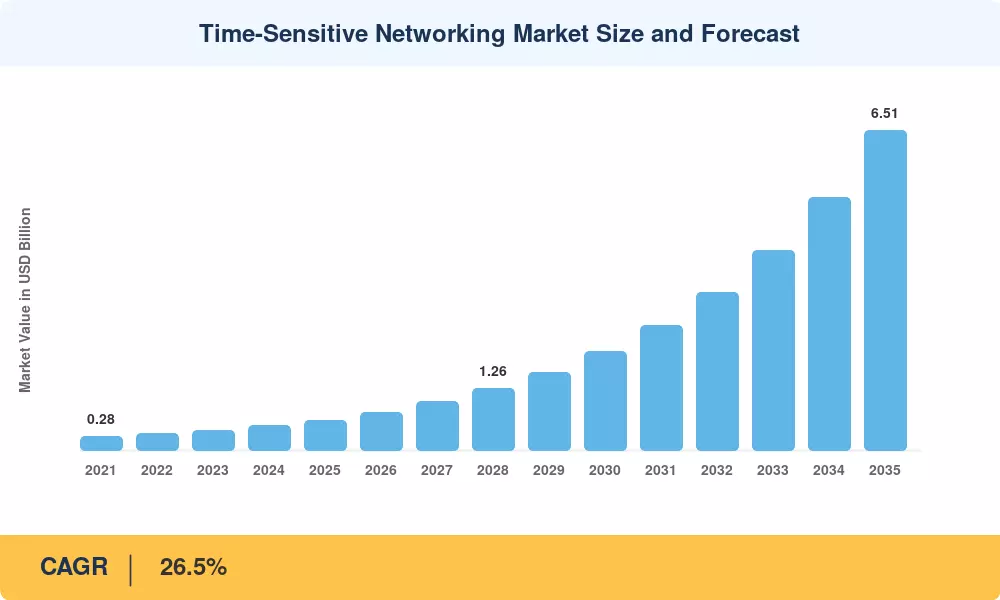
As per Market Research Future analysis, the Time Sensitive Networking Market Size was estimated at 2.28 USD Billion in 2024. The Time Sensitive Networking industry is projected to grow from 2.558 USD Billion in 2025 to 8.088 USD Billion by 2035, exhibiting a compound annual growth rate (CAGR) of 12.2% during the forecast period 2025 - 2035

Key Market Trends & Highlights

The Time Sensitive Networking Market is poised for substantial growth driven by technological advancements and increasing demand across various sectors.

  • The market experiences increased adoption in industrial automation, particularly in North America, which remains the largest market.
  • Automotive applications are expanding rapidly, especially in the Asia-Pacific region, recognized as the fastest-growing market.
  • There is a heightened focus on cybersecurity measures as organizations seek to protect their networks from emerging threats.
  • Rising demand for real-time data processing and the integration of IoT and smart devices are key drivers propelling market growth.

Market Size & Forecast

2024 Market Size 2.28 (USD Billion)
2035 Market Size 8.088 (USD Billion)
CAGR (2025 - 2035) 12.2%

Major Players

Cisco Systems (US), Hewlett Packard Enterprise (US), Siemens (DE), Rockwell Automation (US), Schneider Electric (FR), Moxa (TW), Belden (US), NXP Semiconductors (NL), Intel Corporation (US)

Our Impact
Enabled $4.3B Revenue Impact for Fortune 500 and Leading Multinationals
Partnering with 2000+ Global Organizations Each Year
30K+ Citations by Top-Tier Firms in the Industry

Time-Sensitive Networking Market Trends

The Time Sensitive Networking Market is currently experiencing a notable evolution, driven by the increasing demand for real-time data transmission across various sectors. Industries such as automotive, manufacturing, and telecommunications are adopting Time Sensitive Networking solutions to enhance operational efficiency and ensure reliable communication. This trend appears to be fueled by the growing need for automation and the integration of Internet of Things (IoT) devices, which require low-latency communication to function effectively. As organizations strive to optimize their processes, the adoption of Time Sensitive Networking technologies is likely to expand, fostering innovation and improving overall productivity. Moreover, the Time Sensitive Networking Market seems to be influenced by advancements in network infrastructure and the rising importance of cybersecurity.


As businesses invest in upgrading their networks to support Time Sensitive Networking protocols, they are also prioritizing security measures to protect sensitive data. This dual focus on performance and security may lead to the development of more robust solutions that cater to the evolving needs of various industries. Consequently, the Time Sensitive Networking Market is poised for growth, with stakeholders exploring new opportunities to leverage these technologies for enhanced communication and operational excellence. A time sensitive networking switch plays a crucial role in enabling deterministic Ethernet communication by managing time-aware scheduling and minimizing latency across industrial and automotive networks.


Increased Adoption in Industrial Automation


The Time Sensitive Networking Market is witnessing a surge in adoption within the industrial automation sector. As manufacturers seek to streamline operations and improve efficiency, the integration of Time Sensitive Networking solutions facilitates real-time communication between machines and systems. This trend indicates a shift towards more interconnected and responsive manufacturing environments.


Expansion in Automotive Applications


The automotive industry is increasingly recognizing the potential of Time Sensitive Networking technologies. With the rise of connected vehicles and advanced driver-assistance systems, the need for reliable and timely data exchange is paramount. This trend suggests that automotive manufacturers are likely to invest in Time Sensitive Networking to enhance vehicle safety and performance.


Focus on Cybersecurity Measures


As the Time Sensitive Networking Market evolves, there is a growing emphasis on cybersecurity. Organizations are becoming more aware of the vulnerabilities associated with real-time data transmission. This trend indicates that stakeholders are likely to prioritize the development of secure Time Sensitive Networking solutions to protect sensitive information and maintain trust in their systems.

Time-Sensitive Networking Market Drivers

Advancements in 5G Technology

The advent of 5G technology serves as a catalyst for the Time Sensitive Networking Market. With its promise of ultra-reliable low-latency communication, 5G networks are poised to transform various sectors, including healthcare, automotive, and entertainment. The global rollout of 5G is anticipated to create new opportunities for time-sensitive applications, such as remote surgeries and real-time gaming. Analysts predict that the 5G market will exceed 700 billion USD by 2026, further emphasizing the need for time-sensitive networking solutions that can support these advanced applications. Consequently, the synergy between 5G and time-sensitive networking is likely to drive substantial growth in the Time Sensitive Networking Market.

Integration of IoT and Smart Devices

The proliferation of Internet of Things (IoT) devices significantly influences the Time Sensitive Networking Market. As smart devices become ubiquitous across various sectors, the demand for seamless connectivity and low-latency communication intensifies. The market for IoT devices is expected to reach over 75 billion units by 2025, necessitating robust networking solutions that can handle the increased data traffic. Time-sensitive networking plays a crucial role in ensuring that these devices communicate effectively, particularly in applications such as smart cities and autonomous vehicles. This integration not only enhances user experience but also propels the growth of the Time Sensitive Networking Market.

Increased Focus on Automation and Robotics

The Time Sensitive Networking Market is significantly impacted by the growing emphasis on automation and robotics across various sectors. Industries such as logistics, manufacturing, and agriculture are increasingly adopting automated systems to enhance productivity and reduce operational costs. The Time Sensitive Networking is projected to reach approximately 300 billion USD by 2025, highlighting the need for efficient communication protocols that can support automated processes. Time-sensitive networking solutions are essential for ensuring that robotic systems operate in harmony, minimizing delays and maximizing efficiency. This trend underscores the critical role of time-sensitive networking in the evolving landscape of automation, thereby propelling the growth of the Time Sensitive Networking Market.

Rising Demand for Real-Time Data Processing

The Time Sensitive Networking Market experiences a notable surge in demand for real-time data processing capabilities. Industries such as manufacturing, telecommunications, and healthcare increasingly rely on instantaneous data transmission to enhance operational efficiency. For instance, the manufacturing sector is projected to witness a compound annual growth rate of approximately 15% in the adoption of time-sensitive networking solutions by 2026. This trend indicates a shift towards more interconnected systems that require low-latency communication. As organizations strive to optimize their processes, the need for reliable and timely data exchange becomes paramount, thereby driving the growth of the Time Sensitive Networking Market.

Emerging Applications in Smart Transportation

The emergence of smart transportation systems significantly influences the Time Sensitive Networking Market. As urban areas grapple with congestion and inefficiencies, the integration of time-sensitive networking solutions becomes vital for the development of intelligent transportation systems. These systems rely on real-time data exchange to optimize traffic flow, enhance safety, and improve overall user experience. The smart transportation market is expected to grow substantially, with projections indicating a value of over 200 billion USD by 2026. This growth necessitates robust networking solutions that can support the complex communication requirements of smart vehicles and infrastructure. Thus, the Time Sensitive Networking Market stands to benefit from the increasing focus on smart transportation initiatives.

Market Segment Insights

By Application: Industrial Automation (Largest) vs. Automotive (Fastest-Growing)

In the Time Sensitive Networking Market, the 'Application' segment showcases a diverse landscape with distinct areas such as Industrial Automation, Automotive, Aerospace, and Smart Grids. Among these, Industrial Automation claims the largest share due to its widespread adoption of real-time communication protocols in manufacturing processes, enhancing operational efficiencies. In contrast, the Automotive sector, while smaller, is emerging rapidly as a vital player due to increasing demands for advanced vehicle systems and the integration of smart technologies.

Industrial Automation (Dominant) vs. Automotive (Emerging)

Industrial Automation stands out as the dominant force within the Time Sensitive Networking Market, primarily driven by the surge in automation technologies across factories and production lines. This segment leverages TSN to facilitate seamless communication between devices, ensuring synchronization and minimizing latency, which is paramount in high-speed manufacturing. Conversely, the Automotive segment, classified as emerging, is witnessing unprecedented growth fueled by trends like electric vehicles and autonomous driving. Companies in this sector are increasingly investing in TSN to support critical applications such as real-time data exchange and vehicle-to-everything (V2X) communications, striving to enhance operational safety and efficiency.

By Network Protocol: IEEE 1588 (Largest) vs. IEEE 802.1Qbv (Fastest-Growing)

In the Time Sensitive Networking Market, IEEE 1588 holds the largest market share, demonstrating its established position as a vital protocol for time synchronization across multiple networked devices. Meanwhile, IEEE 802.1Qbv is emerging as the fastest-growing segment. This protocol provides time-aware scheduling features, essential for delivering time-sensitive data packets, contributing to its rising demand and adoption in various applications.

Protocol: IEEE 1588 (Dominant) vs. IEEE 802.1Qbv (Emerging)

IEEE 1588 is widely recognized for its precision in time synchronization, making it a critical component in applications like industrial automation and telecommunications where accurate timing is paramount. Its robustness and reliability have established it as the dominant protocol in the Time Sensitive Networking Market. Conversely, IEEE 802.1Qbv, with its innovative time-aware bridging capabilities, is gaining traction as an emerging solution. Its ability to manage time-sensitive traffic efficiently positions it favorably for future adoption, especially in the realms of smart manufacturing and automotive networking, where low latency and high performance are increasingly prioritized.

By End Use: Manufacturing (Largest) vs. Transportation (Fastest-Growing)

In the Time Sensitive Networking Market, the 'End Use' segment reveals significant differentiation, with Manufacturing capturing the largest market share. This segment is bolstered by the increasing demand for real-time data processing and automation across industrial applications. Conversely, the Transportation sector, while currently smaller in share, is rapidly expanding due to advancements in technologies such as autonomous vehicles and smart logistics, driving the need for ultra-reliable networks. As businesses shift towards digital transformation, the growth in the Telecommunications segment also plays a crucial role in enhancing connectivity and offering robust solutions. The rise of IoT devices and the push towards 5G networks drive the demand in this segment. Overall, the Time Sensitive Networking Market is experiencing dynamic changes within its end-use applications, influenced by technological advancements and increasing connectivity needs.

Manufacturing (Dominant) vs. Telecommunications (Emerging)

The Manufacturing segment stands as the dominant force in the Time Sensitive Networking Market, characterized by its focus on automation and precision in data exchange essential for production processes. This sector benefits from enhanced operational efficiency and reduced latency, forming a backbone for modern manufacturing environments. Conversely, the Telecommunications segment is emerging as a vital player, adapting to the growing demands for enhanced communication infrastructures that support high-speed data transfer and real-time networking solutions. As 5G technology continues to proliferate, the Telecommunications segment is integrating Time Sensitive Networking solutions to provide faster, more reliable services, positioning itself as an essential driver of innovation in the market.

By Component: Switches (Largest) vs. Software (Fastest-Growing)

In the Time Sensitive Networking Market, the component segment is characterized by its diverse offerings including switches, routers, and software. Among these, switches dominate the market, accounting for the largest share due to their critical role in providing low-latency communication for time-sensitive applications. Routers also play a significant role but lag behind switches in terms of market presence. Software solutions are emerging rapidly, indicating a shift in market dynamics driven by increasing demand for flexible and efficient network management.

Component: Switches (Dominant) vs. Software (Emerging)

Switches stand out as the dominant component in the Time Sensitive Networking Market, primarily due to their foundational role in ensuring seamless connectivity and minimal latency across networks. They are essential for applications in various sectors, including automotive and industrial automation, where timing is crucial. On the other hand, software solutions represent the emerging facet of this market, enabling advanced features such as network orchestration, analytics, and enhanced security. The software segment is rapidly evolving, driven by the need for real-time data processing and increased automation in network management. As users demand more integrated and software-driven solutions, the software component is poised for substantial growth, complementing the established dominance of switches.

Get more detailed insights about Time-Sensitive Networking Market

Regional Insights

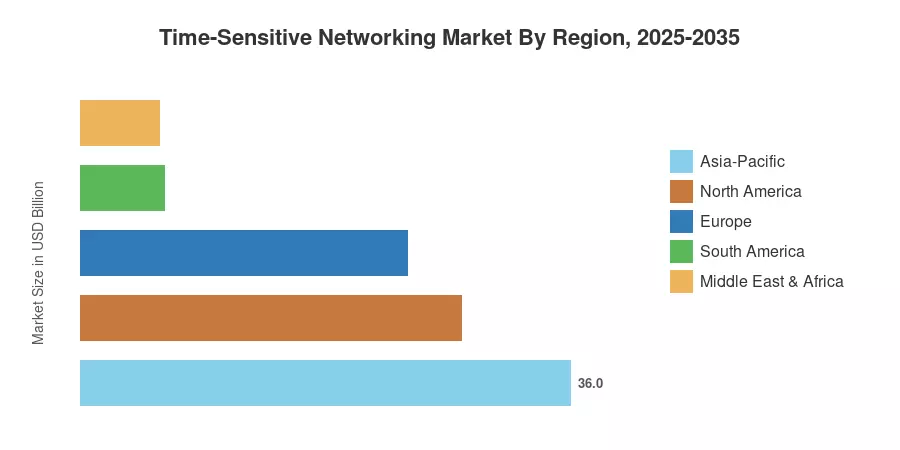
The Time Sensitive Networking Market is poised for robust growth, with regional insights highlighting varying degrees of market activity. North America dominated the market with a valuation of 0.84 USD Billion in 2024, projected to escalate to 2.98 USD Billion by 2035, showcasing significant advancement in sectors like industrial automation and smart manufacturing. Europe follows, valued at 0.64 USD Billion in 2024 and expected to reach 2.32 USD Billion in 2035, reflecting strong demand in the telecommunications and automotive industries.

Asia Pacific, holding an initial value of 0.54 USD Billion in 2024, is anticipated to grow to 1.94 USD Billion, driven by rapid industrialization and increasing investment in smart city initiatives.

The South American segment, though smaller at 0.18 USD Billion in 2024, is emerging with a growth expectation to 0.64 USD Billion by 2035, suggesting potential adoption of advanced network solutions. Meanwhile, the Middle East and Africa, valued at 0.08 USD Billion in 2024, is slowly developing, with a corresponding increase to 0.32 USD Billion by 2035, signifying growing interest in digital transformation initiatives. Overall, the diverse regional dynamics underscore key drivers and opportunities for the Time Sensitive Networking Market, as each area capitalizes on unique technological advancements and industry requirements.

Time-Sensitive Networking Market Regional Image

Key Players and Competitive Insights

The Time Sensitive Networking Market is experiencing significant growth, driven by the increasing demand for real-time data communication across various industries, including automotive, automation, telecommunications, and smart manufacturing. Competitive insights in this market reveal a dynamic landscape where companies are continuously innovating their technologies and solutions to provide low-latency communication. The emphasis on enhancing the quality of service and improving network efficiency has escalated the competition, prompting players to adopt strategic partnerships, product launches, and technological advancements. The market's competitive dynamics are characterized by companies focusing on providing scalable and robust networking architectures capable of handling critical applications that require timely data transmission. The rising need for IoT applications and the shift towards Industry 4.0 are further contributing to the competitive strategies employed in this segment as firms aim to capture shares in both emerging and established markets. Juniper Networks holds a substantial position in the Time Sensitive Networking Market by leveraging its strengths in providing advanced networking solutions and expertise in automated network management. The company has established its presence through innovative technologies that facilitate seamless connectivity and data integrity across various platforms. Juniper Networks emphasizes its commitment to enhancing network performance while reducing latency, making it a preferred choice for industries that rely on real-time communications. The company’s strong focus on research and development allows it to continually refine its offerings and introduce solutions tailored to meet the evolving needs of enterprises and service providers globally. Additionally, Juniper's strategic collaborations with other technology leaders and participation in industry standards organizations bolster its competitive advantage, positioning it as a leader in the Time Sensitive Networking landscape. Broadcom is also a key player in the Time Sensitive Networking Market, recognized for its robust portfolio of networking solutions and semiconductors. The company delivers an extensive range of products that enhance network efficiency and facilitate real-time data processing, catering to the demands of various sectors such as industrial automation and telecommunications. Broadcom's strengths lie in its high-performance TCUs and NICs specifically designed for Time Sensitive Networking, which support applications requiring precise timing and synchronization. The company's global reach is complemented by strategic mergers and acquisitions that enhance its technology offerings and market presence. Broadcom continues to invest in innovation and expand its product lines, ensuring that its solutions align with the industry's advancing needs and standards. Through its commitment to delivering reliable and advanced networking capabilities, Broadcom solidifies its position in this competitive market landscape, addressing the complexities of modern communication infrastructure globally.

Key Companies in the Time-Sensitive Networking Market include

Industry Developments

The Time Sensitive Networking Market has witnessed significant developments recently. Companies like Juniper Networks, Broadcom, and Cisco Systems are making strides in enhancing their TSN capabilities to meet the growing demand for low-latency communication in sectors such as industrial automation and automotive. Moxa earned the world’s first TSN component certification from Avnu Alliance in September 2024. Likewise, Rockwell Automation has been an active OPC UA TSN initiative member since 2018. Texas Instruments, Analog Devices, and Moxa support Avnu’s TSN component certification program. Rockwell, Belden/Hirschmann, and Moxa showcased TSN interoperability at industry events as early as 2022.

The market is expected to continue its upward trajectory, supported by advancements in technology and an increasing number of applications demanding reliable network communication.

Future Outlook

Time-Sensitive Networking Market Future Outlook

The Time Sensitive Networking Market is projected to grow at a 12.2% CAGR from 2025 to 2035, driven by advancements in automation, IoT integration, and demand for real-time data processing.

New opportunities lie in:

  • Development of specialized TSN-enabled industrial automation solutions. Integration of TSN in smart grid technologies for enhanced energy management. Creation of training programs for TSN implementation in various sectors.

By 2035, the Time Sensitive Networking Market is expected to be robust, reflecting substantial growth and innovation.

Market Segmentation

Time-Sensitive Networking Market End Use Outlook

  • Manufacturing

  • Transportation

  • Telecommunications

Time-Sensitive Networking Market Component Outlook

  • Switches

  • Routers

  • Software

Time-Sensitive Networking Market Application Outlook

  • Industrial Automation

  • Automotive

  • Aerospace

  • Smart Grids

Time-Sensitive Networking Market Network Protocol Outlook

  • IEEE 802.1Qbv

  • IEEE 802.1Qci

  • IEEE 1588

Report Scope

MARKET SIZE 2024 2.28(USD Billion)
MARKET SIZE 2025 2.558(USD Billion)
MARKET SIZE 2035 8.088(USD Billion)
COMPOUND ANNUAL GROWTH RATE (CAGR) 12.2% (2025 - 2035)
REPORT COVERAGE Revenue Forecast, Competitive Landscape, Growth Factors, and Trends
BASE YEAR 2024
Market Forecast Period 2025 - 2035
Historical Data 2019 - 2024
Market Forecast Units USD Billion
Key Companies Profiled Cisco Systems (US), Hewlett Packard Enterprise (US), Siemens (DE), Rockwell Automation (US), Schneider Electric (FR), Moxa (TW), Belden (US), NXP Semiconductors (NL), Intel Corporation (US)
Segments Covered Application, Network Protocol, End Use, Component, Regional
Key Market Opportunities Integration of Time Sensitive Networking in industrial automation enhances real-time data processing and communication efficiency.
Key Market Dynamics Rising demand for low-latency communication drives innovation and competition in the Time Sensitive Networking Market.
Countries Covered North America, Europe, APAC, South America, MEA

Market Highlights

Author
Aarti Dhapte
Team Lead - Research

She holds an experience of about 6+ years in Market Research and Business Consulting, working under the spectrum of Information Communication Technology, Telecommunications and Semiconductor domains. Aarti conceptualizes and implements a scalable business strategy and provides strategic leadership to the clients. Her expertise lies in market estimation, competitive intelligence, pipeline analysis, customer assessment, etc.

Leave a Comment

FAQs

What is the projected market valuation of the Time Sensitive Networking Market by 2035?

The Time Sensitive Networking Market is projected to reach a valuation of 8.088 USD Billion by 2035.

What was the market valuation of the Time Sensitive Networking Market in 2024?

In 2024, the market valuation of the Time Sensitive Networking Market was 2.28 USD Billion.

What is the expected CAGR for the Time Sensitive Networking Market during the forecast period 2025 - 2035?

The expected CAGR for the Time Sensitive Networking Market during the forecast period 2025 - 2035 is 12.2%.

Which companies are considered key players in the Time Sensitive Networking Market?

Key players in the Time Sensitive Networking Market include Cisco Systems, Hewlett Packard Enterprise, Siemens, and Rockwell Automation.

What are the main application segments of the Time Sensitive Networking Market?

The main application segments include Industrial Automation, Automotive, Aerospace, and Smart Grids.

How much is the Industrial Automation segment projected to grow by 2035?

The Industrial Automation segment is projected to grow from 0.9 USD Billion in 2024 to 3.24 USD Billion by 2035.

What network protocols are significant in the Time Sensitive Networking Market?

Significant network protocols include IEEE 802.1Qbv, IEEE 802.1Qci, and IEEE 1588.

What is the projected growth for the IEEE 1588 protocol by 2035?

The IEEE 1588 protocol is projected to grow from 0.912 USD Billion in 2024 to 3.192 USD Billion by 2035.

Which end-use sectors are driving the Time Sensitive Networking Market?

The end-use sectors driving the market include Manufacturing, Transportation, and Telecommunications.

What components are essential in the Time Sensitive Networking Market?

Essential components in the market include Switches, Routers, and Software.

Research Approach

Secondary Research

The secondary research process involved comprehensive analysis of technical standards repositories, peer-reviewed engineering journals, industrial automation publications, and authoritative ICT manufacturing organizations. Key sources included the Institute of Electrical and Electronics Engineers (IEEE 802.1 TSN Task Group), International Electrotechnical Commission (IEC 61850/IEEE 802.1 convergence standards), International Society of Automation (ISA), National Institute of Standards and Technology (NIST Smart Grid and Cybersecurity frameworks), Avnu Alliance technical specifications, Industrial Internet Consortium (IIC) testbed reports, OPC Foundation UA over TSN documentation, EU 5G PPP (Public-Private Partnership) Industrial Working Group reports, PROFIBUS & PROFINET International (PI) industry standards, ODVA (CIP over TSN specifications), CC-Link Partner Association (CLPA) technical guidelines, U.S. Federal Communications Commission (FCC) spectrum allocations for industrial wireless, National Manufacturing Institutes (CESMII, ARMI), IEEE Xplore Digital Library, ScienceDirect Automation journals, NASA Technical Reports Server (for aerospace deterministic networking applications), and semiconductor industry associations (SIA, ESA). These sources were used to collect protocol adoption metrics, standards ratification timelines, interoperability certification data, industrial IoT deployment statistics, and competitive landscape analysis across switches, routers, controllers, and TSN-enabled software stacks.

Primary Research

To gather both qualitative and quantitative information, the primary research process involved interviewing players from both the supply and demand sides. From the supply side, we heard from chief technology officers (CTOs), vice presidents of engineering (VPs), product line managers, and ecosystem partnership directors from companies like Intel, NXP, and Texas Instruments, as well as Cisco, HPE, Moxa, and Belden/Hirschmann, as well as Siemens, Rockwell Automation, and Schneider Electric, as well as TTTech and RT-Labs, two providers of TSN software stacks. Automotive original equipment manufacturers (OEMs) (deterministic Ethernet for ADAS/infotainment), discrete manufacturing facilities (Industry 4.0 adopters), utility/smart grid operators, aerospace system manufacturers, and telecommunications infrastructure providers (deploying 5G fronthaul/backhaul networks) made up the demand-side sources. Through primary research, we were able to verify product roadmap timescales for IEEE 802.1ASrev/802.1Qbv implementations, validate standard acceptance curves, evaluate channel pricing strategies for TSN-enabled switches and endpoints, and gain insights into the preferences for brownfield retrofit vs. greenfield deployment.

Primary Respondent Breakdown:

By Designation: C-level Primaries (28%), Director Level (32%), Others (40%)

By Region: North America (32%), Europe (30%), Asia-Pacific (28%), Rest of World (10%)

Market Size Estimation

Global market valuation was derived through revenue mapping, shipment volume analysis of TSN-enabled ports, and software licensing metrics. The methodology included:

Identification of 60+ key manufacturers and standards contributors across North America, Europe, Asia-Pacific, and Latin America, encompassing Ethernet switch silicon vendors (Broadcom, Marvell), industrial networking hardware manufacturers (Phoenix Contact, Siemens Scalance, Cisco Industrial), automotive Ethernet suppliers (Vector, dSPACE), and TSN protocol stack software vendors

Product mapping across IEEE 802.1AS (timing/synchronization), IEEE 802.1Qbv (enhanced traffic scheduling), IEEE 802.1Qbu (frame preemption), IEEE 802.1CB (frame replication/elimination), and IEEE 802.1Qci (per-stream filtering/policing) standards implementations

Component-level segmentation covering managed TSN switches (集成 cut-through switching), TSN-capable routers, endpoint controllers/ASICs, precision time protocol (PTP) grandmaster clocks, and TSN configuration/management software platforms (CNC/CUC software)

Analysis of reported and modeled annual revenues specific to TSN product lines, with particular focus on industrial automation (PROFINET over TSN, CC-Link IE TSN) and automotive (Ethernet/IP for vehicle networks) verticals

Coverage of manufacturers representing 75-80% of global market share in 2024, with specific emphasis on Avnu Alliance certified products and IEC 62439-3 (Parallel Redundancy Protocol) compliant devices

Extrapolation using bottom-up (port shipments × ASP by vertical industry × TSN premium over standard Ethernet) and top-down (manufacturer revenue validation against semiconductor TSN IP licensing fees) approaches to derive segment-specific valuations for hardware (switches accounting for 60%+ share) and software components

Download Free Sample

Kindly complete the form below to receive a free sample of this Report

Compare Licence

×
Features License Type
Single User Multiuser License Enterprise User
Price $4,950 $5,950 $7,250
Maximum User Access Limit 1 User Upto 10 Users Unrestricted Access Throughout the Organization
Free Customization
Direct Access to Analyst
Deliverable Format
Platform Access
Discount on Next Purchase 10% 15% 15%
Printable Versions