×
Request Free Sample ×

Kindly complete the form below to receive a free sample of this Report

* Please use a valid business email

Leading companies partner with us for data-driven Insights

clients tt-cursor
Hero Background

Tin Containers Market

ID: MRFR/PCM/22327-HCR
111 Pages
Snehal Singh
October 2025

Tin Containers Market Research Report: By Material (Tinplate, Steel, Aluminum, Plastic), By Capacity (Less than 1 liter, 1-5 liters, 5-10 liters, More than 10 liters), By Application (Food and beverage, Aerosols, Chemicals, Pharmaceuticals, Industrial products) and By Regional (North America, Europe, South America, Asia Pacific, Middle East and Africa) - Forecast to 2035

Share:
Download PDF ×

We do not share your information with anyone. However, we may send you emails based on your report interest from time to time. You may contact us at any time to opt-out.

Tin Containers Market Infographic
Purchase Options

Tin Containers Market Summary

As per MRFR analysis, the Tin Containers Market Size was estimated at 13.55 USD Billion in 2024. The Tin Containers industry is projected to grow from 14.17 USD Billion in 2025 to 22.27 USD Billion by 2035, exhibiting a compound annual growth rate (CAGR) of 4.62 during the forecast period 2025 - 2035.

Key Market Trends & Highlights

The Tin Containers Market is currently experiencing a robust growth trajectory driven by sustainability and e-commerce trends.

  • North America remains the largest market for tin containers, driven by increasing consumer demand for sustainable packaging solutions.
  • The Asia-Pacific region is emerging as the fastest-growing market, fueled by rapid urbanization and rising disposable incomes.
  • Tinplate containers dominate the market, while aluminum containers are gaining traction due to their lightweight and recyclable properties.
  • Key market drivers include sustainability initiatives and the expansion of e-commerce, which are reshaping consumer preferences for premium packaging.

Market Size & Forecast

2024 Market Size 13.55 (USD Billion)
2035 Market Size 22.27 (USD Billion)
CAGR (2025 - 2035) 4.62%

Major Players

Crown Holdings Inc (US), Ball Corporation (US), Silgan Holdings Inc (US), Ardagh Group (IE), Tinplate Company of India Limited (IN), Mitsubishi Materials Corporation (JP), Toyo Seikan Group Holdings Ltd (JP), Can-Pack S.A. (PL), Hindalco Industries Limited (IN)

Tin Containers Market Trends

The Tin Containers Market is currently experiencing a dynamic evolution, driven by various factors that influence consumer preferences and industry practices. The growing emphasis on sustainability appears to be a pivotal element, as manufacturers increasingly adopt eco-friendly materials and production methods. This shift not only aligns with global environmental goals but also caters to a consumer base that is becoming more conscious of their purchasing decisions. Additionally, the versatility of tin containers in packaging diverse products, ranging from food items to cosmetics, suggests a broadening scope of applications that could enhance market growth. Moreover, the rise of e-commerce platforms has transformed distribution channels, enabling tin containers to reach a wider audience. This trend indicates a potential for increased demand, as online shopping continues to gain traction. Furthermore, innovations in design and functionality may attract new customers, thereby expanding the market's reach. As the Tin Containers Market navigates these changes, it seems poised for continued growth, reflecting both consumer trends and industry advancements.

Sustainability Focus

The emphasis on sustainable practices is reshaping the Tin Containers Market. Manufacturers are increasingly utilizing recyclable materials and eco-friendly production techniques, responding to consumer demand for environmentally responsible products.

E-commerce Expansion

The growth of online shopping platforms is significantly impacting the distribution of tin containers. This trend allows for broader market access, potentially increasing sales and reaching diverse consumer segments.

Innovative Designs

The introduction of innovative designs and functionalities in tin containers is attracting new customers. This trend suggests that creativity in packaging can enhance product appeal and drive market growth.

Tin Containers Market Drivers

E-commerce Growth

The rapid expansion of e-commerce is reshaping the Tin Containers Market. As online shopping continues to gain traction, the need for durable and attractive packaging solutions becomes increasingly critical. Tin containers, known for their sturdiness and aesthetic appeal, are well-suited for e-commerce applications. Recent data indicates that e-commerce sales have surged, with projections estimating a growth rate of approximately 15% annually. This shift necessitates innovative packaging solutions that can withstand shipping and handling while also appealing to consumers. Consequently, the demand for tin containers is likely to rise as businesses seek reliable packaging options that enhance product presentation and protect contents during transit.

Innovative Product Designs

Innovation in product design is a key driver for the Tin Containers Market. Manufacturers are increasingly focusing on creating unique and visually appealing tin containers to differentiate their products in a competitive marketplace. This trend is particularly evident in sectors such as gourmet foods and specialty beverages, where packaging plays a crucial role in attracting consumers. The market for custom-designed tin containers is expected to expand, with estimates suggesting a growth rate of around 6% over the next few years. By investing in innovative designs, companies can enhance brand recognition and consumer engagement, thereby driving demand for tin containers.

Sustainability Initiatives

The increasing emphasis on sustainability appears to be a pivotal driver for the Tin Containers Market. As consumers become more environmentally conscious, the demand for recyclable and eco-friendly packaging solutions rises. Tin containers, being fully recyclable, align well with these sustainability initiatives. In fact, the market for sustainable packaging is projected to grow significantly, with estimates suggesting a compound annual growth rate of over 5% in the coming years. This trend not only encourages manufacturers to adopt greener practices but also influences consumer purchasing decisions, thereby enhancing the overall appeal of tin containers in various sectors, including food and beverage, cosmetics, and pharmaceuticals.

Health and Safety Regulations

The Tin Containers Market is also influenced by stringent health and safety regulations. As industries such as food and pharmaceuticals face increasing scrutiny regarding packaging materials, the demand for safe and compliant packaging solutions rises. Tin containers, which are non-toxic and resistant to corrosion, are often preferred for packaging food products and medicines. Regulatory bodies are continuously updating guidelines to ensure consumer safety, which may lead to a shift towards materials that meet these standards. Consequently, the tin containers market is likely to benefit from this trend, as manufacturers seek compliant packaging options that ensure product integrity and consumer trust.

Consumer Preferences for Premium Packaging

Consumer preferences are shifting towards premium packaging, which serves as a significant driver for the Tin Containers Market. As disposable income rises, consumers are increasingly willing to pay a premium for products that offer superior packaging. Tin containers, with their luxurious appearance and durability, are often perceived as high-quality packaging solutions. This trend is particularly pronounced in sectors such as gourmet foods, cosmetics, and specialty beverages, where packaging plays a vital role in consumer perception. Market analysis suggests that the demand for premium packaging is expected to grow, potentially increasing the market share of tin containers as brands seek to enhance their product offerings and attract discerning consumers.
Market Segment Insights

By Material: Tinplate (Largest) vs. Aluminum (Fastest-Growing)

The Tin Containers Market is predominantly composed of diverse materials including tinplate, steel, aluminum, and plastic. Among these, tinplate holds the largest market share due to its excellent corrosion resistance and ability to preserve food and beverages effectively. Aluminum, while currently smaller in terms of market size, shows impressive growth potential and has been gaining traction among manufacturers and consumers alike for its lightweight and recyclable nature. Growth trends indicate a significant shift towards aluminum as an alternative to traditional materials like steel and tinplate. This shift is driven by increasing consumer awareness of sustainability and environmental impacts. The demand for recyclable and eco-friendly packaging solutions is rising, with aluminum positioned as a preferred option due to its flexibility in design and superior barrier properties, making it a favorite among new market entrants.

Tinplate (Dominant) vs. Steel (Emerging)

Tinplate has established itself as a dominant force in the tin containers market, known for its superior protective qualities and long shelf life. It is particularly favored in food packaging, where its barrier properties ensure product freshness. In contrast, steel is an emerging alternative that is gaining ground due to its strength and durability. While traditionally seen as a heavier option, advancements in technology have allowed for thinner, lighter steel containers that offer similar performance to tinplate. Both materials play crucial roles in the packaging landscape, with tinplate leading the way in established applications while steel is making strides in innovative uses, appealing to industries seeking robustness and reliability in packaging.

By Capacity: 1-5 Liters (Largest) vs. More than 10 Liters (Fastest-Growing)

In the Tin Containers Market, the capacity segment is primarily dominated by the 1-5 liters category, which has garnered significant market share due to its versatility and widespread usage across various applications such as food processing, chemicals, and consumer goods. Smaller capacities, specifically those less than 1 liter, also hold a noteworthy share but do not match the expansive utility of the mid-range segment. The larger capacities, particularly those exceeding 10 liters, while initially less popular, are gaining traction due to shifting consumer preferences towards bulk packaging and sustainability in product storage. The growth trends in the Tin Containers Market indicate a shift towards larger capacities, driven by increasing demand in industrial applications and the need for efficient storage solutions. Additionally, environmental considerations have led to manufacturers focusing on creating larger, reusable containers that cater to both consumer and industrial needs. This segment's growth is further propelled by advancements in manufacturing techniques that boost the durability and appeal of larger tin containers, making them more attractive to a broader audience.

1-5 Liters (Dominant) vs. Less than 1 Liter (Emerging)

The 1-5 liters capacity segment remains dominant in the Tin Containers Market, recognized for its exceptional versatility which accommodates a myriad of applications from household goods to industrial products. This category usually features a range of shapes and styles, appealing to both consumers and businesses alike. Businesses in this segment prioritize innovation and customization, ensuring that their products stand out on the shelves. Conversely, the less than 1 liter segment is emerging primarily due to consumer trends favoring smaller, portable packaging options for convenience and on-the-go consumption. It caters to niche markets such as personal care and specialty foods that emphasize single-serve or travel-compatible products. Despite its smaller market share, growth in this segment is stimulated by rising consumer demand for convenience and portability, indicating a promising development trajectory.

By Application: Food and Beverage (Largest) vs. Pharmaceuticals (Fastest-Growing)

In the Tin Containers Market, the application segment showcases a diverse distribution with food and beverage containers holding the largest share. This dominant segment benefits from the growing demand for packaged food and beverages, reinforcing its position in the market. Other applications, such as aerosols, chemicals, and industrial products, also play a significant role, but their shares are comparatively smaller, underscoring the importance of food-related applications in the overall landscape.

Food and Beverage: Dominant vs. Pharmaceuticals: Emerging

The food and beverage sector remains the dominant application in the Tin Containers Market, characterized by a wide variety of products including canned foods and beverage containers. Its strong consumer base is driven by the global shift towards convenience and longer shelf life products. On the other hand, the pharmaceuticals sector is emerging rapidly, fueled by an increasing demand for secure and tamper-proof packaging solutions. This sector's growth is also propelled by stringent regulations regarding pharmaceutical packaging, creating a lucrative opportunity for manufacturers. As safety and branding continue to be pivotal in these markets, both segments are expected to evolve with innovative packaging solutions.

Get more detailed insights about Tin Containers Market

Regional Insights

North America : Market Leader in Innovation

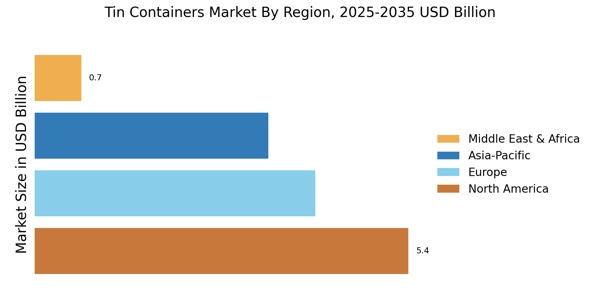
North America is the largest market for tin containers, holding approximately 40% of the global market share. The region's growth is driven by increasing demand for sustainable packaging solutions and stringent regulations promoting recyclable materials. The food and beverage sector is a significant contributor, with rising consumer preference for eco-friendly packaging. Regulatory catalysts, such as the U.S. Environmental Protection Agency's initiatives, further bolster market growth. The United States dominates the North American market, with key players like Crown Holdings Inc and Ball Corporation leading the competitive landscape. The presence of advanced manufacturing technologies and a robust supply chain enhances the region's market position. Canada also plays a vital role, contributing to the overall growth with its focus on sustainable practices. The competitive environment is characterized by innovation and strategic partnerships among leading companies.

Europe : Sustainability Focus Drives Growth

Europe is the second-largest market for tin containers, accounting for approximately 30% of the global market share. The region's growth is fueled by increasing consumer awareness regarding sustainability and the circular economy. Regulatory frameworks, such as the European Union's Packaging and Packaging Waste Directive, encourage the use of recyclable materials, driving demand for tin containers in various sectors, including food and beverages. Leading countries in this region include Germany, France, and the United Kingdom, where companies like Ardagh Group and Can-Pack S.A. are prominent players. The competitive landscape is marked by innovation in design and functionality, catering to evolving consumer preferences. The presence of established manufacturers and a strong distribution network further enhances market dynamics, positioning Europe as a key player in The Tin Containers Market.

Asia-Pacific : Rapid Growth in Emerging Markets

Asia-Pacific is witnessing rapid growth in the tin containers market, driven by increasing urbanization and rising disposable incomes. The region holds approximately 25% of the global market share, with countries like China and India leading the demand. The growing food and beverage industry, coupled with a shift towards sustainable packaging, is propelling market expansion. Regulatory support for eco-friendly materials further enhances growth prospects in this region. China is the largest market in Asia-Pacific, with significant contributions from local manufacturers like Tinplate Company of India Limited and Mitsubishi Materials Corporation. The competitive landscape is characterized by a mix of established players and emerging companies, focusing on innovation and cost-effective solutions. The region's diverse consumer base and evolving preferences create opportunities for growth, making it a vital area for tin container manufacturers.

Middle East and Africa : Untapped Potential in Packaging

The Middle East and Africa (MEA) region presents untapped potential in the tin containers market, holding approximately 5% of the global market share. The growth is driven by increasing demand for packaged food and beverages, alongside a rising trend towards sustainable packaging solutions. Regulatory initiatives aimed at reducing plastic waste are also contributing to the market's expansion, creating opportunities for tin container manufacturers in the region. Leading countries include South Africa and the United Arab Emirates, where local players are beginning to establish a foothold in the market. The competitive landscape is evolving, with both local and international companies vying for market share. The presence of key players like Hindalco Industries Limited is enhancing the region's competitive dynamics, as they focus on innovation and sustainability to meet growing consumer demands.

Tin Containers Market Regional Image

Key Players and Competitive Insights

Major players in the Tin Containers Market industry often engage in strategic collaborations, acquisitions, and partnerships to expand their market presence and strengthen their competitive edge. Leading Tin Containers Market players invest in research and development to innovate new products and technologies that cater to evolving customer demands. They also focus on expanding their production capacities and optimizing their supply chains to meet growing market demands. The competitive landscape of the Tin Containers Market is characterized by intense competition among established players, as well as the emergence of new entrants.

To stay ahead in the market, companies continuously strive to differentiate their offerings, enhance their customer service, and adopt sustainable business practices.One of the leading players in the Tin Containers Market is Silgan Holdings Inc., a  supplier of rigid packaging solutions. The company offers a wide range of tin containers for various industries, including food, beverage, and personal care. Silgan Holdings focuses on innovation and sustainability and has invested in research and development to create eco-friendly packaging solutions. Another major player in the market is Crown Holdings, Inc., a leading provider of metal packaging products.

The company has a  presence and caters to a diverse customer base across multiple industries. Crown Holdings emphasizes quality and customer service and has implemented lean manufacturing practices to improve efficiency and reduce costs.Ball Corporation is another prominent player in the Tin Containers Market. The company manufactures a variety of tin containers, including food cans, beverage cans, and aerosol cans. Ball Corporation has a strong focus on environmental sustainability and has set ambitious goals for reducing its carbon footprint and promoting circularity in its packaging solutions.

Through strategic acquisitions and investments, the company has expanded its  reach and strengthened its position in the market.

Key Companies in the Tin Containers Market market include

Industry Developments

The  tin containers market is projected to reach USD 18.58 billion by 2032, exhibiting a CAGR of 4.62% during the forecast period. The rising demand for canned food and beverages, particularly in emerging economies, is a key driver of market growth. Moreover, the growing popularity of sustainable packaging solutions is expected to provide impetus to the adoption of tin containers, as they are 100% recyclable.Recent news developments include the launch of innovative tin container designs by major players such as Ardagh Group and Crown Holdings. These new designs focus on enhancing product shelf life, improving convenience, and reducing environmental impact.

Additionally, the increasing adoption of e-commerce is creating opportunities for tin containers in the packaging of online orders.

Future Outlook

Tin Containers Market Future Outlook

The Tin Containers Market is projected to grow at a 4.62% CAGR from 2024 to 2035, driven by sustainability trends, increased demand in food packaging, and innovations in design.

New opportunities lie in:

  • Expansion into eco-friendly tin container production
  • Development of smart packaging solutions with QR codes
  • Partnerships with e-commerce platforms for direct-to-consumer sales

By 2035, the market is expected to achieve robust growth, driven by innovation and sustainability.

Market Segmentation

Tin Containers Market Capacity Outlook

  • Less than 1 liter
  • 1-5 liters
  • 5-10 liters
  • More than 10 liters

Tin Containers Market Material Outlook

  • Tinplate
  • Steel
  • Aluminum
  • Plastic

Tin Containers Market Application Outlook

  • Food and beverage
  • Aerosols
  • Chemicals
  • Pharmaceuticals
  • Industrial products

Report Scope

MARKET SIZE 202413.55(USD Billion)
MARKET SIZE 202514.17(USD Billion)
MARKET SIZE 203522.27(USD Billion)
COMPOUND ANNUAL GROWTH RATE (CAGR)4.62% (2024 - 2035)
REPORT COVERAGERevenue Forecast, Competitive Landscape, Growth Factors, and Trends
BASE YEAR2024
Market Forecast Period2025 - 2035
Historical Data2019 - 2024
Market Forecast UnitsUSD Billion
Key Companies ProfiledMarket analysis in progress
Segments CoveredMarket segmentation analysis in progress
Key Market OpportunitiesGrowing demand for sustainable packaging solutions drives innovation in the Tin Containers Market.
Key Market DynamicsRising demand for sustainable packaging drives innovation and competition in the tin containers market.
Countries CoveredNorth America, Europe, APAC, South America, MEA

Leave a Comment

FAQs

What is the current valuation of the Tin Containers Market?

The Tin Containers Market was valued at 13.55 USD Billion in 2024.

What is the projected market size for the Tin Containers Market by 2035?

The market is projected to reach 22.27 USD Billion by 2035.

What is the expected CAGR for the Tin Containers Market during the forecast period?

The expected CAGR for the Tin Containers Market from 2025 to 2035 is 4.62%.

Which materials dominate the Tin Containers Market?

Tinplate, steel, aluminum, and plastic are the primary materials, with tinplate projected to grow from 4.5 to 7.5 USD Billion.

What are the key applications of tin containers?

Key applications include food and beverage, aerosols, chemicals, pharmaceuticals, and industrial products, with food and beverage leading at 5.5 to 9.1 USD Billion.

How does the capacity segment of the Tin Containers Market perform?

The capacity segment shows growth, particularly in the 1-5 liters category, which is expected to rise from 4.05 to 6.8 USD Billion.

Who are the leading players in the Tin Containers Market?

Key players include Crown Holdings Inc, Ball Corporation, Silgan Holdings Inc, and Ardagh Group, among others.

What trends are influencing the growth of the Tin Containers Market?

Trends such as sustainability and the demand for recyclable packaging materials appear to drive growth in the Tin Containers Market.

What is the growth outlook for the aluminum segment within the Tin Containers Market?

The aluminum segment is projected to grow from 2.5 to 4.0 USD Billion during the forecast period.

How does the performance of the chemicals application segment compare to others?

The chemicals application segment is expected to grow from 2.0 to 3.2 USD Billion, indicating a steady demand in the market.

Download Free Sample

Kindly complete the form below to receive a free sample of this Report

Compare Licence

×
Features License Type
Single User Multiuser License Enterprise User
Price $4,950 $ $7,250
Maximum User Access Limit 1 User Upto 10 Users Unrestricted Access Throughout the Organization
Free Customization
Direct Access to Analyst
Deliverable Format
Platform Access
Discount on Next Purchase 10% 15% 15%
Printable Versions