×
Request Free Sample ×

Kindly complete the form below to receive a free sample of this Report

* Please use a valid business email

Leading companies partner with us for data-driven Insights

clients tt-cursor
Hero Background

Titanium Alloys Market

ID: MRFR/CnM/5264-CR
128 Pages
Chitranshi Jaiswal
October 2023

Titanium Alloys Market Research Report Information By Grade (Alpha, Beta, Alpha-Beta and Others) and By Region -Global Forecast to 2035

Share:
Download PDF ×

We do not share your information with anyone. However, we may send you emails based on your report interest from time to time. You may contact us at any time to opt-out.

Titanium Alloys Market Infographic
Purchase Options

Titanium Alloys Market Summary

As per MRFR analysis, the Titanium Alloys Market Size was estimated at 10853.82 USD Million in 2024. The Titanium Alloys industry is projected to grow from 11371.77 USD Million in 2025 to 18125.14 USD Million by 2035, exhibiting a compound annual growth rate (CAGR) of 4.77 during the forecast period 2025 - 2035.

Key Market Trends & Highlights

The Titanium Alloys Market is poised for robust growth driven by diverse applications and technological advancements.

  • The aerospace sector continues to drive the largest demand for titanium alloys, particularly in North America.
  • Sustainability initiatives are increasingly influencing the adoption of titanium alloys across various industries.
  • Advancements in additive manufacturing are enhancing the production capabilities and applications of titanium alloys.
  • Rising demand in automotive applications and growth in medical device manufacturing are key drivers propelling market expansion.

Market Size & Forecast

2024 Market Size 10853.82 (USD Million)
2035 Market Size 18125.14 (USD Million)
CAGR (2025 - 2035) 4.77%

Major Players

Timet (US), Alcoa (US), VSMPO-AVISMA (RU), ATI (US), Haynes International (US), Carpenter Technology Corporation (US), Special Metals Corporation (US), Kobe Steel (JP), RTI International Metals (US)

Titanium Alloys Market Trends

The Titanium Alloys Market is currently experiencing a dynamic phase characterized by evolving applications and technological advancements. Industries such as aerospace, automotive, and medical are increasingly adopting titanium alloys due to their superior strength-to-weight ratio and corrosion resistance. This shift appears to be driven by a growing demand for lightweight materials that enhance performance and fuel efficiency. Furthermore, the market seems to be influenced by the rising emphasis on sustainability, prompting manufacturers to explore eco-friendly production methods and recycling processes. As a result, the Titanium Alloys Market is likely to witness a transformation in its supply chain dynamics, with a focus on reducing environmental impact while maintaining product quality. In addition, the competitive landscape of the Titanium Alloys Market is becoming more intricate, with numerous players striving to innovate and differentiate their offerings. Collaborations and partnerships among companies are emerging as a strategy to leverage complementary strengths and expand market reach. Moreover, advancements in additive manufacturing technologies are opening new avenues for the production of complex titanium alloy components, which could potentially revolutionize traditional manufacturing processes. Overall, the Titanium Alloys Market appears poised for growth, driven by technological innovations and a shift towards sustainable practices.

Increased Demand in Aerospace Sector

The aerospace industry is witnessing a notable surge in the utilization of titanium alloys, primarily due to their lightweight properties and exceptional strength. This trend indicates a shift towards materials that enhance fuel efficiency and overall aircraft performance, suggesting a long-term commitment to innovation in aviation.

Sustainability Initiatives

There is a growing focus on sustainability within the Titanium Alloys Market, as manufacturers seek to implement eco-friendly practices. This trend may lead to the development of recycling programs and sustainable sourcing strategies, reflecting a broader industry commitment to reducing environmental footprints.

Advancements in Additive Manufacturing

The emergence of additive manufacturing technologies is reshaping the production landscape for titanium alloys. This trend suggests that companies are increasingly adopting 3D printing techniques to create complex geometries, potentially enhancing design flexibility and reducing material waste.

Titanium Alloys Market Drivers

Market Growth Projections

The Global Titanium Alloys Market Industry is projected to experience substantial growth over the next decade. With a market value of approximately 10.8 USD Billion in 2024, it is anticipated to reach 18.1 USD Billion by 2035. This growth trajectory suggests a compound annual growth rate of 4.77% from 2025 to 2035. Factors such as increasing demand from aerospace and medical sectors, advancements in manufacturing technologies, and the push for lightweight materials in automotive applications are likely to drive this expansion. The market's resilience and adaptability to changing industry needs indicate a promising future for titanium alloys.

Growing Demand from Aerospace Sector

The Global Titanium Alloys Market Industry is experiencing heightened demand from the aerospace sector, which is increasingly utilizing titanium alloys for their superior strength-to-weight ratio and corrosion resistance. As of 2024, the market is valued at approximately 10.8 USD Billion, driven by the need for lightweight materials that enhance fuel efficiency and performance in aircraft. Major aerospace manufacturers are integrating titanium alloys into their designs, which could lead to a projected market growth to 18.1 USD Billion by 2035. This trend indicates a robust compound annual growth rate of 4.77% from 2025 to 2035, reflecting the aerospace industry's commitment to advanced materials.

Rising Applications in Medical Devices

The Global Titanium Alloys Market Industry is witnessing a surge in applications within the medical devices sector, particularly in orthopedic implants and dental applications. Titanium alloys are favored for their biocompatibility and strength, which are essential for long-lasting medical solutions. The increasing prevalence of orthopedic surgeries and dental procedures is likely to propel market growth. As healthcare providers seek durable and reliable materials, the demand for titanium alloys is expected to rise significantly. This trend aligns with the overall market trajectory, contributing to the anticipated growth from 10.8 USD Billion in 2024 to 18.1 USD Billion by 2035.

Advancements in Manufacturing Technologies

Innovations in manufacturing technologies are playing a pivotal role in the Global Titanium Alloys Market Industry. Techniques such as additive manufacturing and advanced casting methods are enhancing the production efficiency and reducing costs associated with titanium alloys. These advancements enable manufacturers to create complex geometries and customized components, which are increasingly sought after in various industries, including aerospace and automotive. The ability to produce high-quality titanium parts at a lower cost could stimulate market growth, potentially leading to a compound annual growth rate of 4.77% from 2025 to 2035, as the industry adapts to evolving technological landscapes.

Increasing Demand in Automotive Applications

The Global Titanium Alloys Market Industry is also benefiting from rising demand in automotive applications, where manufacturers are exploring lightweight materials to improve fuel efficiency and reduce emissions. Titanium alloys are being integrated into high-performance vehicles, particularly in components such as exhaust systems and suspension parts. This shift towards lightweight materials aligns with global sustainability goals and regulatory pressures on emissions. As the automotive sector continues to innovate, the market for titanium alloys is expected to expand, contributing to the overall growth from 10.8 USD Billion in 2024 to an estimated 18.1 USD Billion by 2035.

Market Segment Insights

By Application: Aerospace (Largest) vs. Medical (Fastest-Growing)

In the Titanium Alloys Market, the application segment showcases a diverse array of industries, with aerospace leading the market share due to its critical demand for high-performance materials that offer strength and lightness. Aerospace accounts for a significant portion of the total share, benefitting from ongoing innovations in aircraft design and manufacturing processes. Medical applications are also prominent, capturing a notable market share as advancements in medical devices and implants drive utilization of titanium alloys, recognized for biocompatibility and corrosion resistance.

Aerospace (Dominant) vs. Medical (Emerging)

The aerospace sector remains the dominant force within the Titanium Alloys Market, driven by its stringent requirements for lightweight yet robust materials in aircraft and spacecraft applications. The demand for titanium alloys in this industry is propelled by their ability to withstand high temperatures and pressures, ensuring safety and efficiency in flight. Conversely, the medical segment is characterized as an emerging market, rapidly adopting titanium alloys due to their favorable properties for surgical implants and prosthetics. The increasing prevalence of orthopedic surgeries and advancements in medical technology position medical titanium alloys for significant growth, as healthcare providers seek durable and bio-compatible materials to enhance patient outcomes.

By End Use: Commercial Aircraft (Largest) vs. Medical Implants (Fastest-Growing)

The Titanium Alloys Market is primarily dominated by the commercial aircraft sector, which represents the largest segment in terms of usage. This dominance is attributed to the rising demand for lightweight and fuel-efficient aircraft designs. Military aircraft also hold a significant share, though it is overshadowed by the rapid growth seen in sectors like medical implants and automotive components. Medical implants are the fastest-growing segment as the healthcare industry increasingly adopts advanced materials for prosthetics and implants. Automotive components are benefiting from the industry's shift towards lightweight materials for better fuel efficiency and vehicle performance. The marine equipment sector contributes but is relatively smaller in market share compared to the aforementioned segments, reflecting an overall diversified utilization of titanium alloys across industries.

Commercial Aircraft (Dominant) vs. Medical Implants (Emerging)

Commercial aircraft remain the dominant end use for titanium alloys due to their exceptional strength-to-weight ratio and corrosion resistance, which are crucial for aerospace applications. This sector drives significant innovation in alloy formulations, contributing to enhanced aircraft designs and fuel efficiency. In contrast, the medical implants sector is emerging as a key player in the titanium alloys market, characterized by its rapid innovation and increasing demand for biocompatible materials. The growth in this segment is propelled by advancements in medical technology and an aging population that requires surgical implants, leading to a synergistic relationship between healthcare needs and the development of specialized titanium alloys suitable for medical applications.

By Form: Sheet (Largest) vs. Bar (Fastest-Growing)

In the Titanium Alloys Market, the form segment is diverse, including sheet, bar, forging, powder, and welding wire. Among these, the sheet form is the largest segment due to its extensive applications across various industries such as aerospace and automotive. Bar forms follow closely, being utilized in medical implants and military applications. Forging and powder forms, while smaller, contribute significantly, particularly in specialized sectors needing high-performance materials. Welding wire, though a niche, plays a crucial role in construction and repair processes.

Sheet (Dominant) vs. Bar (Emerging)

The sheet form of titanium alloys is currently the dominant form in the market, primarily due to its excellent strength-to-weight ratio and corrosion resistance, making it ideal for demanding applications in the aerospace and automotive industries. Its widespread use in structural components has solidified its position. Conversely, bar forms have gained traction as an emerging segment, driven by their versatility and increasing use in industries such as medical and defense. Their ability to be machined into specific components aligns with growing demands for customized solutions across various sectors.

By Alloy Type: Alpha Titanium Alloys (Largest) vs. Beta Titanium Alloys (Fastest-Growing)

In the Titanium Alloys Market, Alpha Titanium Alloys hold a significant share due to their superior weldability, corrosion resistance, and high-temperature strength. This segment is extensively utilized in aerospace and medical applications, which drives its status as the largest alloy type within this market. In contrast, Beta Titanium Alloys are quickly gaining traction, presenting themselves as the fastest-growing segment. Their unique properties, including excellent ductility and high strength-to-weight ratio, make them appealing for automotive and sports equipment applications. The growth trends for Titanium Alloys are shaped by continuous innovations and increased demand across various industries. The aerospace sector, in particular, is expanding, leading to a higher reliance on lightweight yet strong alloys like Alpha and Beta Titanium Alloys. Emerging technologies allowing cost-effective production and enhanced performance features further fuel this market's growth. Additionally, the rising focus on sustainability and recycling in material manufacturing is opening new avenues for various titanium alloys, contributing to their overall market expansion.

Alpha Titanium Alloys (Dominant) vs. Titanium Metal Matrix Composites (Emerging)

Alpha Titanium Alloys are primarily characterized by their superior mechanical properties and high corrosion resistance, making them the dominant force in the Titanium Alloys Market. They are extensively utilized in critical applications across aerospace, military, and medical segments. In contrast, Titanium Metal Matrix Composites are emerging as a vital segment due to their enhanced strength and durability compared to conventional alloys. This innovative material combines the lightness of titanium with the toughness of metallic matrices, thus presenting new opportunities in aerospace, automotive, and electronics. The ability to tailor their properties for specific applications positions Titanium Metal Matrix Composites as a compelling alternative for demanding engineering challenges, which is why they are seen as a segment poised for significant growth.

By Production Method: Forging (Largest) vs. Additive Manufacturing (Fastest-Growing)

In the Titanium Alloys Market, the distribution among the various production methods shows forging as the largest segment, owing to its extensive application in industries requiring high-strength materials. Casting and machining follow, granting flexibility and precision, respectively, while additive manufacturing, though currently smaller in share, is rapidly gaining traction. As industries shift towards integrating newer technologies, the segment dynamics reflect a blend of traditional and innovative methods, providing a comprehensive approach to titanium alloy production. The growth trends in the production methods segment are primarily driven by advancements in additive manufacturing technology and increasing demand for forged components in the aerospace and automotive industries. Forging continues to secure its leading position due to its proven capabilities in producing durable parts, while additive manufacturing is emerging as a game-changer, catering to niche applications with complex geometries and customization needs. This juxtaposition of established versus innovative practices fuels continuous evolution in the titanium alloys market.

Forging (Dominant) vs. Additive Manufacturing (Emerging)

Forging remains the dominant production method in the titanium alloys market, primarily due to its ability to produce components with superior mechanical properties through deformation processes. This method is widely utilized in sectors such as aerospace and military, where material strength is paramount. The established forging practices foster robust relationships with supply chains and technology, ensuring quality and reliability. In contrast, additive manufacturing represents an emerging trend, offering novel advantages like customization and cost-effective production for small batches. This method caters to specialized industries needing intricate designs and rapid prototyping solutions. With advancements in 3D printing technology, additive manufacturing positions itself as a disruptive force, challenging traditional methods and pushing the boundaries of titanium alloy applications.

Get more detailed insights about Titanium Alloys Market

Regional Insights

North America : Market Leader in Titanium Alloys

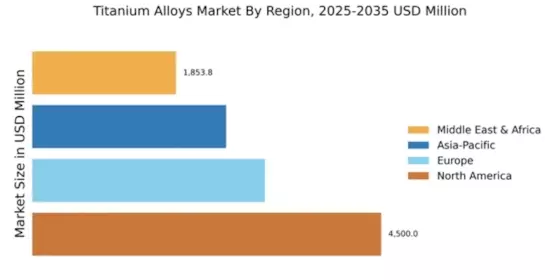
North America is poised to maintain its leadership in the Titanium Alloys market, with a projected market size of $4500.0 million by December 2025. The region's growth is driven by increasing demand from aerospace and defense sectors, alongside stringent regulations promoting lightweight materials. The presence of major manufacturers and technological advancements further bolster market expansion. The United States stands as the primary contributor, housing key players like Timet, Alcoa, and ATI. These companies are investing in R&D to enhance product performance and sustainability. The competitive landscape is characterized by innovation and strategic partnerships, ensuring that North America remains at the forefront of the Titanium Alloys market.

Europe : Emerging Market with Growth Potential

Europe's Titanium Alloys market is projected to reach $3000.0 million by December 2025, driven by increasing applications in automotive and medical sectors. Regulatory frameworks promoting lightweight materials and sustainability are key growth catalysts. The region is witnessing a shift towards advanced manufacturing techniques, enhancing the demand for high-performance alloys. Leading countries such as Germany, France, and the UK are at the forefront of this market, supported by established companies like VSMPO-AVISMA and Kobe Steel. The competitive landscape is marked by innovation and collaboration among manufacturers, ensuring a robust supply chain. As the market evolves, Europe is set to become a significant player in the global Titanium Alloys arena.

Asia-Pacific : Rapid Growth in Emerging Economies

The Asia-Pacific region is experiencing rapid growth in the Titanium Alloys market, with a projected size of $2500.0 million by December 2025. This growth is fueled by increasing industrialization and demand from sectors such as aerospace and automotive. Countries are implementing policies to enhance manufacturing capabilities, driving the adoption of advanced materials. China and Japan are leading the charge, with significant contributions from companies like Kobe Steel and RTI International Metals. The competitive landscape is evolving, with local manufacturers emerging to meet the growing demand. As the region continues to develop, Asia-Pacific is expected to play a crucial role in The Titanium Alloys.

Middle East and Africa : Emerging Market with Unique Challenges

The Middle East and Africa region is projected to reach a Titanium Alloys market size of $1853.82 million by December 2025. The growth is driven by increasing investments in infrastructure and aerospace sectors, alongside a growing awareness of the benefits of titanium alloys. However, challenges such as limited local production capabilities and reliance on imports persist. Countries like South Africa and the UAE are leading the market, with efforts to enhance local manufacturing and attract foreign investment. The competitive landscape is gradually evolving, with both local and international players vying for market share. As the region develops its capabilities, it holds significant potential for growth in the Titanium Alloys market.

Key Players and Competitive Insights

The Titanium Alloys Market is characterized by a competitive landscape that is increasingly shaped by innovation, strategic partnerships, and a focus on sustainability. Key players such as Timet (US), Alcoa (US), and VSMPO-AVISMA (RU) are actively pursuing strategies that enhance their market positioning. Timet (US) has been focusing on expanding its production capabilities to meet the rising demand in aerospace and medical applications, while Alcoa (US) emphasizes sustainability through its low-carbon aluminum production, which complements its titanium alloy offerings. VSMPO-AVISMA (RU) appears to be leveraging its extensive experience in the aerospace sector to strengthen its global supply chain, thereby enhancing its competitive edge.

The business tactics employed by these companies include localizing manufacturing and optimizing supply chains to reduce costs and improve delivery times. The market structure is moderately fragmented, with several players vying for market share. However, the collective influence of major companies like Timet, Alcoa, and VSMPO-AVISMA is significant, as they set industry standards and drive technological advancements.

In October 2025, Timet (US) announced a strategic partnership with a leading aerospace manufacturer to develop next-generation titanium alloys tailored for high-performance applications. This collaboration is expected to enhance Timet's product portfolio and solidify its position in the aerospace sector, where demand for lightweight and durable materials is surging. The partnership underscores the importance of innovation in maintaining competitive advantage.

In November 2025, Alcoa (US) unveiled a new initiative aimed at reducing the carbon footprint of its titanium alloy production processes. This initiative includes investments in renewable energy sources and advanced recycling technologies. By prioritizing sustainability, Alcoa not only addresses regulatory pressures but also aligns with the growing demand for environmentally friendly materials, potentially attracting a broader customer base.

In December 2025, VSMPO-AVISMA (RU) expanded its production facility in Russia to increase output capacity for titanium alloys. This expansion is strategically significant as it positions the company to better serve the burgeoning aerospace market in Asia and North America. The move reflects a proactive approach to meet anticipated demand and reinforces VSMPO-AVISMA's commitment to maintaining its leadership in the titanium alloys sector.

As of December 2025, the competitive trends in the Titanium Alloys Market are increasingly influenced by digitalization, sustainability, and the integration of AI technologies. Strategic alliances are becoming more prevalent, as companies recognize the need to collaborate to enhance innovation and efficiency. Looking ahead, competitive differentiation is likely to evolve from traditional price-based competition to a focus on technological advancements, supply chain reliability, and sustainable practices. This shift may redefine market dynamics, compelling companies to innovate continuously to maintain their competitive edge.

Key Companies in the Titanium Alloys Market market include

Industry Developments

July 2023: ATI Inc. (NYSE: ATI) announced its Richland, Washington operations as titanium melting expansion through investment in new, state-of-the-art assets. The expansion will increase ATI's production of aerospace and defense-grade titanium by approximately 35% over the 2022 baseline levels, helping to meet strong titanium demand. The expansion is projected to be online by the end of 2024, with product qualifications occurring in 2025.

January 2023: Nippon Steel Corporation ("Nippon Steel") announced that the titanium alloy Super-TIX 20AFG of its designing titanium TranTixxii collection has been adopted by CASIO COMPUTER CO., LTD. ("Casio") for the bezel and band of its new G-SHOCK model GMW-B5000TCC-1, which launched in January 20. The electronics manufacturer is using Super-TIX 20AFG for the G-SHOCK collection for the second time after it adopted this new alloy for the GMW-B5000TR-9 model launched in April 2021.

Future Outlook

Titanium Alloys Market Future Outlook

The Titanium Alloys Market is projected to grow at a 4.77% CAGR from 2024 to 2035, driven by aerospace demand, automotive innovations, and medical applications.

New opportunities lie in:

  • Development of lightweight titanium components for electric vehicles
  • Expansion into emerging markets with tailored alloy solutions
  • Investment in recycling technologies for titanium scrap recovery

By 2035, the Titanium Alloys Market is expected to achieve robust growth and diversification.

Market Segmentation

Titanium Alloys Market Form Outlook

  • Sheet
  • Bar
  • Forging
  • Powder
  • Welding Wire

Titanium Alloys Market End Use Outlook

  • Commercial Aircraft
  • Military Aircraft
  • Medical Implants
  • Automotive Components
  • Marine Equipment

Titanium Alloys Market Alloy Type Outlook

  • Alpha Titanium Alloys
  • Beta Titanium Alloys
  • Alpha-Beta Titanium Alloys
  • Titanium Metal Matrix Composites

Titanium Alloys Market Application Outlook

  • Aerospace
  • Medical
  • Automotive
  • Marine
  • Industrial

Titanium Alloys Market Production Method Outlook

  • Casting
  • Forging
  • Machining
  • Additive Manufacturing

Report Scope

MARKET SIZE 202410853.82(USD Million)
MARKET SIZE 202511371.77(USD Million)
MARKET SIZE 203518125.14(USD Million)
COMPOUND ANNUAL GROWTH RATE (CAGR)4.77% (2024 - 2035)
REPORT COVERAGERevenue Forecast, Competitive Landscape, Growth Factors, and Trends
BASE YEAR2024
Market Forecast Period2025 - 2035
Historical Data2019 - 2024
Market Forecast UnitsUSD Million
Key Companies ProfiledTimet (US), Alcoa (US), VSMPO-AVISMA (RU), ATI (US), Haynes International (US), Carpenter Technology Corporation (US), Special Metals Corporation (US), Kobe Steel (JP), RTI International Metals (US)
Segments CoveredApplication, End Use, Form, Alloy Type, Production Method
Key Market OpportunitiesGrowing demand for lightweight materials in aerospace and automotive sectors drives Titanium Alloys Market expansion.
Key Market DynamicsRising demand for lightweight materials drives innovation and competition in the titanium alloys market.
Countries CoveredNorth America, Europe, APAC, South America, MEA

Market Highlights

Author
Chitranshi Jaiswal
Research Analyst Level I

In her 3 years of experience in the market research field, she has handled critical cross-domain projects. She has an in-depth knowledge of market estimation & analysis, problem-solving, primary as well as secondary research, and team management.She holds an engineering degree and is an MBA professional from a well-known university, capable of evaluating the market and competitive conditions. An exceptional strategist with excellent communication skills and a passion for delivering cutting-edge & practical insights for the market. Proficient in multi-tasking, and can successfully deal with competing demands, while maintaining complete confidentiality. Generated business through active client and project development, networking, and high-quality responses. Her knowledge and skills have helped in making solid business decisions, securing funding from investors, and avoiding business failures.

Leave a Comment

FAQs

How much is Titanium Alloys Market?

Titanium Alloys Market crossed a valuation of USD 10853.82 Billion in 2024

What is the growth rate of the Titanium Alloys Market?

Titanium Alloys Market is projected to register a CAGR of 4.77% from 2025-2035

Which region held the largest market share in the Titanium Alloys Market?

North America had the largest share in the Titanium Alloys Market

Who are the key players in the Titanium Alloys Market?

ATI Inc. (US), Arconic Corporation (US), Nippon Steel Corp (Japan), Kobe Steel, Ltd (Japan), Hermith GmbH (Germany), Daido Metal Co., Ltd (Japan), AMG Critical Materials NV (Netherlands), Toho Titanium Co Ltd (Japan), Haynes International, Inc. (US), Korporatsiya VSMPO-AVISMA PAO (Russia), Shanghai LTM industry Co., LTD (China), ABLTi Corporation (China), Altemp Alloys (US), High Performance Alloys Inc (US), NeoNickel (UK), UNITED TITANIUM (US), Aerospace Alloys, Inc (US), PTC Industries Ltd (India), Titanium Metals Corporation (US), BaoJi Titanium Industry Co Ltd (China), Acnis International (France), General Electric Company (US), Dynamic Metals UK (UK), Carpenter Additive (UK), Weber Metals, Inc (US), Mishra Dhatu Nigam Limited (India), BRISTOL METALS, LLC (US), DES RAJ BANSAL GROUP (India), PERRYMAN COMPANY LLC (US), SLM Solutions (Germany), RTI International Metal (US), Praxair Surface Technologies (US)

Which Grade had the largest market share in the Titanium Alloys Market?

Alpha-Beta had the largest share of the Titanium Alloys Market

Download Free Sample

Kindly complete the form below to receive a free sample of this Report

Compare Licence

×
Features License Type
Single User Multiuser License Enterprise User
Price $4,950 $5,950 $7,250
Maximum User Access Limit 1 User Upto 10 Users Unrestricted Access Throughout the Organization
Free Customization
Direct Access to Analyst
Deliverable Format
Platform Access
Discount on Next Purchase 10% 15% 15%
Printable Versions