×
Request Free Sample ×

Kindly complete the form below to receive a free sample of this Report

* Please use a valid business email

Leading companies partner with us for data-driven Insights

clients tt-cursor
Hero Background

Transcritical Co2 Market

ID: MRFR/CnM/28936-HCR
100 Pages
Sejal Akre
October 2025

Transcritical Co2 Market Research Report By Application (Commercial Refrigeration, Industrial Refrigeration, Transport Refrigeration, Other Applications), By Component (Compressors, Exchangers, Valves, Piping and Fittings, Monitoring and Control Systems), By System Capacity (Below 50 kW, 50-200 kW, 200-1000 kW, Above 1000 kW), By Refrigerant (R744 (Carbon Dioxide), Other Refrigerants), By End-use Industry (Food and Beverage, Pharmaceutical, Chemical, Oil and Gas, Other Industries) and By Regional (North America, Europe, South America, Asia ... read more

Share:
Download PDF ×

We do not share your information with anyone. However, we may send you emails based on your report interest from time to time. You may contact us at any time to opt-out.

Transcritical Co2 Market Infographic
Purchase Options

Transcritical Co2 Market Summary

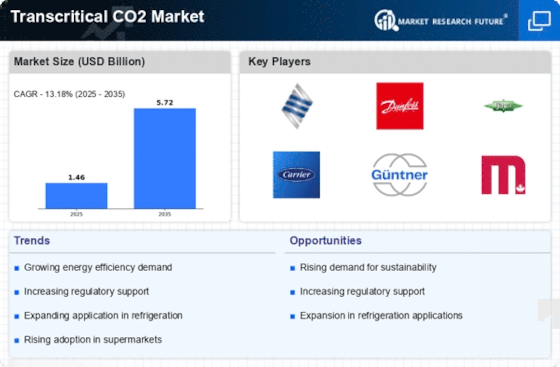
As per MRFR analysis, the Transcritical CO2 Market Size was estimated at 1.464 USD Billion in 2024. The Transcritical CO2 industry is projected to grow from 1.657 in 2025 to 5.717 by 2035, exhibiting a compound annual growth rate (CAGR) of 13.18 during the forecast period 2025 - 2035.

Key Market Trends & Highlights

The Transcritical CO2 Market is experiencing robust growth driven by sustainability and technological advancements.

  • The market is witnessing a pronounced shift towards sustainability, with increasing adoption of eco-friendly refrigerants.
  • Technological advancements in refrigeration systems are enhancing the efficiency and performance of transcritical CO2 solutions.
  • North America remains the largest market, while the Asia-Pacific region is emerging as the fastest-growing area for transcritical CO2 applications.
  • Rising demand for energy efficiency and stringent environmental regulations are key drivers propelling market growth.

Market Size & Forecast

2024 Market Size 1.464 (USD Billion)
2035 Market Size 5.717 (USD Billion)
CAGR (2025 - 2035) 13.18%

Major Players

Emerson (US), Danfoss (DK), Bitzer (DE), Carrier (US), Güntner (DE), Mayekawa (JP), Sanden (JP), AHT Cooling Systems (AT), Secop (DE)

Transcritical Co2 Market Trends

The Transcritical CO2 Market is currently experiencing a notable shift towards sustainability and energy efficiency. This market, characterized by its use of carbon dioxide as a refrigerant, is gaining traction due to its low environmental impact compared to traditional refrigerants. As industries increasingly prioritize eco-friendly solutions, the adoption of transcritical CO2 systems appears to be on the rise. This trend is further supported by regulatory frameworks that encourage the reduction of greenhouse gas emissions, thereby fostering innovation in refrigeration technologies. Moreover, the Transcritical CO2 Market is likely to benefit from advancements in technology that enhance system performance and reliability. Manufacturers are investing in research and development to optimize the efficiency of transcritical systems, which may lead to broader applications across various sectors, including food and beverage, commercial refrigeration, and industrial processes. The growing awareness of climate change and the need for sustainable practices could drive further growth in this market, as stakeholders seek to align with global sustainability goals.

Sustainability Focus

The emphasis on environmentally friendly solutions is reshaping the Transcritical CO2 Market. Stakeholders are increasingly prioritizing systems that minimize ecological footprints, leading to a surge in demand for CO2-based refrigeration.

Technological Advancements

Innovations in refrigeration technology are enhancing the efficiency and reliability of transcritical CO2 systems. Ongoing research and development efforts are likely to expand the applications of these systems across diverse industries.

Regulatory Support

Government policies aimed at reducing greenhouse gas emissions are fostering growth in the Transcritical CO2 Market. Regulatory frameworks are encouraging the adoption of low-impact refrigerants, thereby promoting the use of transcritical CO2 systems.

Transcritical Co2 Market Drivers

Expansion of Cold Chain Logistics

The Transcritical CO2 Market is poised for growth due to the expansion of cold chain logistics, which is essential for preserving the quality of perishable goods. As the demand for fresh food and pharmaceuticals increases, efficient refrigeration systems become critical. Transcritical CO2 systems offer reliable and energy-efficient solutions for cold chain applications, making them an attractive option for logistics providers. The increasing investment in cold chain infrastructure is likely to drive the adoption of transcritical CO2 systems, as companies seek to enhance their operational efficiency while meeting consumer demands for quality and sustainability.

Growing Awareness of Climate Change

The Transcritical CO2 Market is increasingly shaped by the growing awareness of climate change and its impacts. As consumers and businesses become more conscious of their carbon footprints, there is a rising preference for sustainable refrigeration solutions. Transcritical CO2 systems, which utilize a natural refrigerant with a low environmental impact, are gaining traction as a preferred choice. This shift in consumer behavior is likely to encourage manufacturers to invest in transcritical CO2 technologies, thereby expanding the market. The alignment of consumer preferences with environmental sustainability is expected to create new opportunities for growth in the transcritical CO2 market.

Rising Demand for Energy Efficiency

The Transcritical CO2 Market is experiencing a notable increase in demand for energy-efficient refrigeration and heating solutions. As energy costs continue to rise, businesses and consumers are seeking alternatives that reduce energy consumption. Transcritical CO2 systems, known for their high efficiency, are becoming increasingly popular in commercial refrigeration applications. According to recent data, these systems can achieve energy savings of up to 30% compared to traditional refrigerants. This trend is likely to drive the adoption of transcritical CO2 systems across various sectors, including food retail and industrial applications, thereby enhancing the overall market growth.

Environmental Regulations and Standards

The Transcritical CO2 Market is significantly influenced by stringent environmental regulations aimed at reducing greenhouse gas emissions. Governments worldwide are implementing policies that encourage the use of low-impact refrigerants, such as CO2, which has a negligible global warming potential. The European Union's F-Gas Regulation, for instance, has led to a marked shift towards natural refrigerants, including CO2. This regulatory support is expected to bolster the market, as companies strive to comply with these standards while also enhancing their sustainability profiles. The increasing focus on environmental responsibility is likely to propel the adoption of transcritical CO2 systems in various applications.

Technological Innovations in Refrigeration

The Transcritical CO2 Market is benefiting from ongoing technological innovations that enhance the performance and efficiency of CO2 refrigeration systems. Advances in compressor technology, heat exchangers, and system controls are making transcritical CO2 systems more viable for a broader range of applications. For instance, the development of efficient gas cooler designs has improved the overall efficiency of these systems, making them more attractive to end-users. As technology continues to evolve, it is anticipated that the market will see increased penetration in sectors such as food processing and commercial refrigeration, further driving growth.


Market Segment Insights

By Application: Commercial Refrigeration (Largest) vs. Industrial Refrigeration (Fastest-Growing)

The Transcritical CO2 Market exhibits a diverse range of applications, with commercial refrigeration holding the largest market share. This segment benefits from the growing demand for energy-efficient refrigeration systems across supermarkets and retail outlets. In contrast, industrial refrigeration also plays a significant role, capturing substantial attention from industries, although it currently lags behind commercial applications in terms of total market share. Nevertheless, as businesses aim for sustainability, industrial refrigeration is set to increase its relevance.

Commercial Refrigeration (Dominant) vs. Industrial Refrigeration (Emerging)

Commercial refrigeration is the dominant application in the Transcritical CO2 Market, primarily driven by the increasing need for sustainable and efficient cooling solutions in retail environments, such as grocery chains and supermarkets. This segment leverages state-of-the-art technology to reduce environmental impact while maintaining optimal product temperatures. On the other hand, industrial refrigeration represents an emerging sector, expanding rapidly due to rising industrial activity and stringent regulations on refrigerants. As companies increasingly adopt green practices, industrial refrigeration is positioned for significant growth, adopting transcritical CO2 systems to meet compliance and efficiency targets.

By Component: Compressors (Largest) vs. Valves (Fastest-Growing)

In the Transcritical CO2 Market, the component segment showcases a diverse range of essential elements, with compressors holding the largest market share. They are instrumental in enhancing system efficiencies and performance, thus attracting significant investments. Following them, valves are increasingly becoming pivotal due to their role in energy-efficient CO2 systems, marking themselves as the fastest-growing component in the sector. As sustainability becomes a pivotal focus, the reliance on these components continues to rise in various applications, notably in refrigeration and heating solutions. The growth trends within this segment are primarily driven by the escalating demand for environmentally friendly refrigeration systems. Furthermore, advancements in technology have led to the development of innovative components such as smart valves and high-efficiency compressors that are tailored for transcritical applications. Factors such as regulations aimed at reducing carbon footprints and the increasing adoption of natural refrigerants also fuel the expansion of this segment, as businesses seek to comply with environmental standards while optimizing their operational efficiency.

Compressors (Dominant) vs. Piping and Fittings (Emerging)

Compressors are the dominant force in the Transcritical CO2 Market, owing to their critical role in the efficiency of refrigeration and HVAC systems. Their advanced technological evolution has led to designs that offer improved energy efficiency and reliability, making them a key investment area for companies looking to enhance operational performance. In contrast, piping and fittings are emerging as essential components, driven by the need for efficient and flexible system designs. They ensure seamless fluid transport, and their growing importance aligns with trends towards modular systems and retrofitting older installations. As the market evolves, both compressors and piping systems will increasingly work in tandem to optimize the performance of transcritical CO2 systems, illustrating the synergy between dominant and emerging components.

By System Capacity: 50-200 kW (Largest) vs. 200-1000 kW (Fastest-Growing)

In the Transcritical CO2 Market, the system capacity segment showcases a distinctive distribution where the 50-200 kW range emerges as the largest contributor, holding a significant share due to its widespread adoption in commercial refrigeration applications. This capacity range is favored for its balance between efficiency and size, catering to a diverse range of customers that require reliable cooling solutions. On the other hand, the 200-1000 kW segment is recognized as the fastest-growing segment, driven by the increasing demand for larger CO2 refrigeration systems in industrial sectors, which are focusing on sustainable practices and energy efficiency.

Capacity: 50-200 kW (Dominant) vs. 200-1000 kW (Emerging)

The 50-200 kW segment is characterized by its dominant market presence, primarily serving medium-sized enterprises and retail stores that demand effective cooling solutions without the necessity for extensive infrastructure. This capacity range benefits from established technologies, lower operational costs, and a strong customer base that prioritizes green refrigeration. Conversely, the 200-1000 kW category is emerging rapidly as businesses expand operations and seek higher-capacity systems. This segment is increasingly influenced by innovations in transcritical CO2 technology, which offer greater efficiency and reduced environmental impact, reflecting a shift toward larger installations in both commercial and industrial applications.

By Refrigerant: R744 (Carbon Dioxide) (Largest) vs. Other Refrigerants (Fastest-Growing)

In the Transcritical CO2 Market, R744 (Carbon Dioxide) retains a substantial market share due to its eco-friendliness, efficiency, and favorable thermodynamic properties. This segment has garnered attention as industries strive to reduce greenhouse gas emissions. Conversely, Other Refrigerants, while currently smaller in market share, are gaining traction, primarily due to innovations in refrigerant technology and increased regulatory support for alternatives to traditional HFCs. These dynamics showcase a notable shift towards a diversified approach in refrigerant utilization.

R744 (Carbon Dioxide) (Dominant) vs. Other Refrigerants (Emerging)

R744 (Carbon Dioxide) is recognized as the dominant player in the Transcritical CO2 Market, offering exceptional energy efficiency and a low global warming potential. Its widespread adoption across commercial refrigeration applications underscores its viability as a sustainable refrigerant option. In contrast, Other Refrigerants, labeled as emerging, are making significant inroads into the market driven by technological advancements and regulatory initiatives favoring greener solutions. These alternatives are characterized by their lower environmental impact and improved performance in specific applications, reflecting a growing tendency towards innovation and compliance with environmental mandates.

By End-use Industry: Food and Beverage (Largest) vs. Pharmaceutical (Fastest-Growing)

The end-use industry segment of the Transcritical CO2 Market showcases a diverse distribution, with the food and beverage sector commanding the largest share. This is primarily due to the sector's reliance on CO2 for processes such as refrigeration and carbonating beverages. In contrast, the pharmaceutical industry, although smaller in overall share, is rapidly gaining traction due to the increasing use of CO2 in extraction processes and as a solvent in drug formulation, positioning it as the fastest-growing segment in this market.

Food and Beverage (Dominant) vs. Pharmaceutical (Emerging)

The food and beverage industry stands as the dominant player in the Transcritical CO2 Market, leveraging its significant volume requirements for refrigeration and preserving freshness. Its established infrastructure and extensive use cases ensure a steady demand for CO2 solutions. Conversely, the pharmaceutical industry, characterized as an emerging segment, is witnessing accelerated growth driven by technological advancements and a heightened focus on sustainable practices. The adoption of CO2 in critical extraction and formulation processes is expected to enhance product quality while minimizing environmental impact, creating substantial opportunities for innovation and market expansion.

Get more detailed insights about Transcritical Co2 Market

Regional Insights

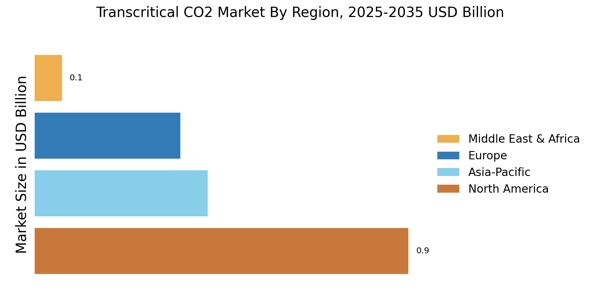
The Transcritical Co2 Market is expected to reach a valuation of USD 1.15 billion in 2023 and is projected to expand at a CAGR of 13.18%, reaching USD 3.5 billion by 2032. Regionally, the market is segmented into North America, Europe, APAC, South America, and MEA. North America is anticipated to dominate the market over the forecast period due to the presence of well-established industries and the early adoption of transcritical CO2 technology.

Europe is projected to follow North America, driven by stringent environmental regulations and government initiatives promoting energy efficiency.APAC is expected to witness significant growth, particularly in China and India, as these countries are experiencing rapid industrialization and urbanization, leading to an increased demand for energy-efficient cooling solutions. South America and MEA are expected to contribute moderately to the global market, with growth driven by factors such as rising energy costs and a growing focus on sustainability.

Transcritical Co2 Market Regional Image

Key Players and Competitive Insights

Major players in the Transcritical Co2 Market industry are continuously investing in research and development to enhance their product offerings and gain a competitive advantage. Leading Transcritical Co2 Market players are focusing on developing innovative solutions that meet the evolving needs of customers. The Transcritical Co2 Market industry is characterized by intense competition, with key players constantly striving to outmaneuver each other through strategic initiatives such as product launches, acquisitions, and partnerships.

The Transcritical Co2 Market Competitive Landscape is expected to remain highly competitive in the coming years, with the entry of new players and the expansion of existing players.A leading company in the Transcritical Co2 Market, Emerson Electric Co. has a strong global presence and offers a diverse range of transcritical CO2 solutions. The company's focus on innovation has resulted in the development of advanced products that meet the specific requirements of various industries. Emerson Electric Co. is committed to providing reliable and efficient transcritical CO2 systems that help customers reduce their environmental impact and improve their overall operations.

The company's extensive distribution network and strong customer support make it a preferred choice for customers worldwide.A notable competitor in the Transcritical Co2 Market, Danfoss A/S is known for its energy-efficient and sustainable solutions. The company offers a comprehensive range of transcritical CO2 components and systems that are designed to meet the unique needs of different applications. Danfoss A/S emphasizes research and development to continually improve the performance and reliability of its products. With a global presence and a strong commitment to innovation, Danfoss A/S is well-positioned to meet the growing demand for transcritical CO2 solutions in various industries.

Key Companies in the Transcritical Co2 Market market include

Industry Developments

The market growth is attributed to the rising demand for energy-efficient cooling systems, increasing environmental concerns, and supportive government regulations. The Asia Pacific region is expected to dominate the market due to rapid industrialization and urbanization. Key industry participants include Danfoss, Emerson Electric, and Johnson Controls. Recent developments include the launch of new products and the expansion of production capacities.

Future Outlook

Transcritical Co2 Market Future Outlook

The Transcritical CO2 Market is projected to grow at a 13.18% CAGR from 2024 to 2035, driven by sustainability initiatives, regulatory support, and technological advancements.

New opportunities lie in:

  • Expansion of CO2 refrigeration systems in commercial sectors
  • Development of integrated CO2 heat pump solutions
  • Investment in training programs for CO2 system technicians

By 2035, the Transcritical CO2 Market is poised for robust growth and increased adoption across various industries.

Market Segmentation

Transcritical Co2 Market Component Outlook

  • Compressors
  • Exchangers
  • Valves
  • Piping and Fittings
  • Monitoring and Control Systems

Transcritical Co2 Market Application Outlook

  • Commercial Refrigeration
  • Industrial Refrigeration
  • Transport Refrigeration
  • Other Applications

Transcritical Co2 Market Refrigerant Outlook

  • R744 (Carbon Dioxide)
  • Other Refrigerants

Transcritical Co2 Market System Capacity Outlook

  • Below 50 kW
  • 50-200 kW
  • 200-1000 kW
  • Above 1000 kW

Transcritical Co2 Market End-use Industry Outlook

  • Food and Beverage
  • Pharmaceutical
  • Chemical
  • Oil and Gas
  • Other Industries

Report Scope

MARKET SIZE 20241.464(USD Billion)
MARKET SIZE 20251.657(USD Billion)
MARKET SIZE 20355.717(USD Billion)
COMPOUND ANNUAL GROWTH RATE (CAGR)13.18% (2024 - 2035)
REPORT COVERAGERevenue Forecast, Competitive Landscape, Growth Factors, and Trends
BASE YEAR2024
Market Forecast Period2025 - 2035
Historical Data2019 - 2024
Market Forecast UnitsUSD Billion
Key Companies ProfiledMarket analysis in progress
Segments CoveredMarket segmentation analysis in progress
Key Market OpportunitiesGrowing demand for sustainable refrigeration solutions drives innovation in the Transcritical CO2 Market.
Key Market DynamicsRising demand for sustainable refrigeration solutions drives innovation and competition in the Transcritical CO2 Market.
Countries CoveredNorth America, Europe, APAC, South America, MEA

Leave a Comment

FAQs

What is the projected market valuation of the Transcritical CO2 Market by 2035?

The Transcritical CO2 Market is projected to reach a valuation of 5.717 USD Billion by 2035.

What was the market valuation of the Transcritical CO2 Market in 2024?

In 2024, the market valuation of the Transcritical CO2 Market was 1.464 USD Billion.

What is the expected CAGR for the Transcritical CO2 Market during the forecast period 2025 - 2035?

The expected CAGR for the Transcritical CO2 Market during the forecast period 2025 - 2035 is 13.18%.

Which application segment is projected to have the highest valuation by 2035?

The Commercial Refrigeration segment is projected to reach a valuation of 2.267 USD Billion by 2035.

What are the key components driving the Transcritical CO2 Market?

Key components driving the market include Compressors, Exchangers, and Valves, with Compressors projected to reach 2.267 USD Billion by 2035.

Which refrigerant is expected to dominate the market by 2035?

R744 (Carbon Dioxide) is expected to dominate the market, projected to reach 4.2 USD Billion by 2035.

What end-use industry is anticipated to contribute significantly to the market growth?

The Food and Beverage industry is anticipated to contribute significantly, with a projected valuation of 2.267 USD Billion by 2035.

Who are the key players in the Transcritical CO2 Market?

Key players in the Transcritical CO2 Market include Emerson, Danfoss, Bitzer, Carrier, and others.

What is the projected valuation for the Industrial Refrigeration segment by 2035?

The Industrial Refrigeration segment is projected to reach a valuation of 1.688 USD Billion by 2035.

How does the market for Other Refrigerants compare to R744 by 2035?

The market for Other Refrigerants is projected to reach 1.517 USD Billion by 2035, significantly lower than R744's 4.2 USD Billion.

Download Free Sample

Kindly complete the form below to receive a free sample of this Report

Compare Licence

×
Features License Type
Single User Multiuser License Enterprise User
Price $4,950 $5,950 $7,250
Maximum User Access Limit 1 User Upto 10 Users Unrestricted Access Throughout the Organization
Free Customization
Direct Access to Analyst
Deliverable Format
Platform Access
Discount on Next Purchase 10% 15% 15%
Printable Versions