Transcritical Co2 System Market (2026 - 2035)

Transcritical CO₂ System Market Research Report Information By Component (Compressors, Gas Coolers, and Other Components), By Function (Refrigeration, Heating, and Other Functions), By Installation Type (New-Build and Retrofit), By Application (Supermarkets, Industrial Refrigeration, and Other Applications), By End-User Industry (Food Retail, Food & Beverage Manufacturing, Logistics & Warehousing, and Other Industries) – Forecast Till 2035
ID: MRFR/CnM/28798-HCR
100 Pages
Priya Nagrale
Last Updated: July 28, 2026
Transcritical Co2 System Market
Market Size
Forecast Period2026-2035
CAGR (2026-2035)19.3%
2025 Market SizeUSD 2,850 Million
2035 Market SizeUSD 16,650 Million
Key Players
Carrier Global Corporation
Hussmann Corporation
Hillphoenix
Bitzer SE
Dorin S.p.A.
Danfoss A/S
Opportunities
  • Emerging-Market Cold-Chain Buildout
  • Refrigeration-as-a-Service Business Models
  • Data-Center Liquid Cooling

Transcritical Co2 System Market Summary

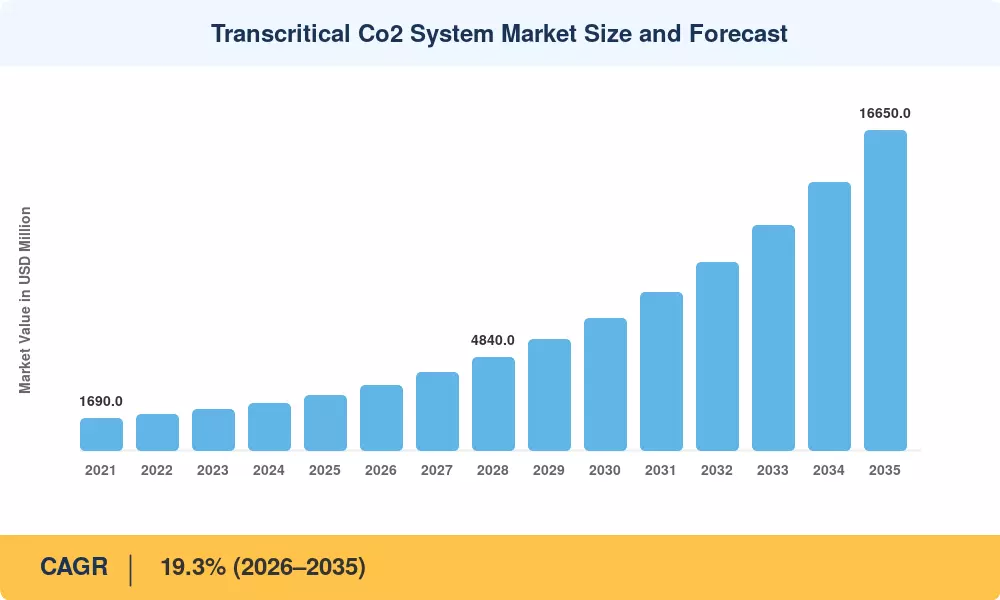
The transcritical co2 system market reached a valuation of USD 2,850 million in 2025 and is projected to climb from USD 3,400 million in 2026 to approximately USD 16,650 million by 2035, expanding at a CAGR of 19.3% during the forecast period (2026–2035). This acceleration is anchored in the EU F-Gas Regulation phase-down schedule, which has slashed hydrofluorocarbon quotas by more than 40% since 2024, and parallel policy momentum across North America and parts of Asia-Pacific [1]. Capital commitments from grocery chains and cold-storage operators—many exceeding USD 200 million per retailer—have further underscored the financial viability of the transcritical co2 system market.

A sweeping technology transition is reshaping the competitive field. Legacy HFC-based direct-expansion systems, once the default in supermarkets and distribution centers, are being displaced by transcritical CO2 architectures that integrate ejector technology, parallel compression, and adiabatic gas cooling. These enhancements have narrowed the energy-cost gap even in high-ambient climates, a shift validated by pilot deployments across the Middle East and Southeast Asia where ambient temperatures routinely exceed 40 °C [2]. The emergence of high-temperature heat pumps capable of delivering outlet temperatures above 120 °C has opened entirely new process-heat revenue streams, broadening the transcritical co2 system market well beyond traditional refrigeration.

Europe commands a dominant position, accounting for roughly 71.8% of global revenues in 2025, driven by the continent's regulatory head start and dense supermarket infrastructure. The region is also the fastest-growing, expanding at a 19.8% CAGR through 2035. North America follows as the second-largest market, supported by EPA SNAP rule amendments and state-level HFC bans in California, New York, and Washington. The transcritical co2 system market is positioned for sustained double-digit growth as regulatory tailwinds intensify and system economics continue to improve.


Key Report Takeaways

• By Component

  • Compressors accounted for 37.2% of the transcritical co2 system market revenue share in 2025, reflecting heavy investment in semi-hermetic and reciprocating platforms.
  • Gas coolers are the fastest-growing component segment, advancing at a 20.0% CAGR through 2035 as adiabatic and hybrid designs gain traction.

• By Function

  • Refrigeration captured 72.4% of the transcritical co2 system market share in 2025, led by supermarket rack systems.
  • Heating applications are projected to expand at a 20.4% CAGR to 2035, fueled by high-temperature heat-pump adoption in food processing.

• By Application

  • Supermarkets held a 68.8% application share in 2025, with new regulations accelerating retrofit activity.

• By Region

  • Europe dominated with a 71.8% share in 2025 and continues to lead global deployment.
  • North America recorded a 19.8% CAGR from 2026 to 2035, propelled by federal incentive programs and state mandates.
  • Asia-Pacific is emerging as a high-growth corridor, with Japan and South Korea spearheading adoption.


Market Size and Forecast (2021–2035)

Market Research Future constructed this forecast using a triangulated approach that cross-references manufacturer shipment data, component trade flows, and end-user capital-expenditure disclosures. Historical estimates (2021–2024) rely on verified installation databases across 35 countries, while the forecast horizon (2026–2035) applies a compounding growth model calibrated to regulatory phase-down schedules, technology cost-learning curves, and pipeline project announcements[4].
Transcritical Co2 System Market Size and Forecast
Our Impact
Enabled $4.3B Revenue Impact for Fortune 500 and Leading Multinationals
Partnering with 2000+ Global Organizations Each Year
30K+ Citations by Top-Tier Firms in the Industry

Driver Impact Analysis

Driver ~% Impact on CAGR Geographic Relevance Impact Timeline
EU F-Gas Regulation phase-down ~22% Europe Short-term (≤2 yr)
Kigali Amendment HFC caps ~18% Global Medium-term (2–4 yr)
Ejector & parallel compression cost reductions ~16% Global Short-term (≤2 yr)
High-temperature heat-pump expansion ~14% Europe, Asia-Pacific Medium-term (2–4 yr)
State-level HFC bans in the US ~12% North America Short-term (≤2 yr)
Cold-chain expansion in emerging economies ~10% Asia-Pacific, South America Long-term (≥4 yr)
ESG disclosure mandates (Scope 3) ~8% Global Long-term (≥4 yr)


EU F-Gas Regulation Phase-Down

The revised EU F-Gas Regulation (EU 2024/573) mandates an 85% reduction in HFC quotas by 2036 relative to the 2015 baseline, creating a structural supply squeeze that makes high-GWP refrigerants prohibitively expensive [1]. Quota pricing for HFC-404A has already tripled since 2022, tilting the lifecycle cost equation decisively in favor of CO2-based alternatives. The transcritical co2 system market in Europe has responded with a surge in new-build installations—particularly across Germany, France, and the Nordic countries—where retailers face compliance deadlines as early as 2025 for systems exceeding 40 kW.

Ejector Technology Cost Reduction

According to field data from installations in southern Italy, Spain, and the UAE [7], multi-ejector modules have reduced the energy penalty of transcritical operation in temperate climates by 15–25%. Since 2021, modular ejector racks have been standardized by system manufacturers such as Carrier and Danfoss, resulting in a 30% reduction in component costs. This cost-performance enhancement has been instrumental in expanding the addressable geography of the transcritical co2 system market to regions that were previously deemed uneconomic.


Kigali Amendment Obligations

Ratified by over 150 nations, the Kigali Amendment to the Montreal Protocol requires developed countries to cut HFC consumption by 85% by 2036, with developing-nation obligations phased in from 2028 [9]. The International Energy Agency estimates that full compliance could avoid up to 0.5 °C of global warming by 2100, a figure that has galvanized policy support and multilateral financing for low-GWP technology transfers [13].

High-Temperature Heat-Pump Expansion

Transcritical CO2 heat pumps capable of delivering water temperatures above 120 °C are unlocking industrial process-heat applications in food processing, brewing, and dairy pasteurization [10]. The European Commission's REPowerEU plan earmarked EUR 12 billion for heat-pump deployment between 2023 and 2027, a sizable share of which targets industrial-grade CO2 units. This driver extends the transcritical co2 system market beyond its traditional supermarket base and into high-value manufacturing verticals.


Restraints Impact Analysis

Restraint ~% Drag on CAGR Geographic Relevance Impact Timeline
High upfront capital cost ~–20% Global Short-term (≤2 yr)
Technician skill gap ~–18% North America, Asia-Pacific Medium-term (2–4 yr)
High-pressure safety compliance burden ~–15% Global Short-term (≤2 yr)
Limited warm-climate track record ~–12% Middle East, South America Medium-term (2–4 yr)
HFC price volatility masking TCO advantage ~–10% Europe Short-term (≤2 yr)


High Upfront Capital Cost

Transcritical CO2 systems carry a 20–35% capital premium over conventional HFC-based direct-expansion units, primarily due to thicker-walled piping rated for pressures above 120 bar and the cost of specialized compressors [14]. For small- and mid-sized retailers operating on thin margins, this upfront differential remains the single largest adoption barrier in the transcritical co2 system market, even when lifecycle cost analyses show payback periods of three to five years.

Technician Skill Gap

Operating and servicing high-pressure CO2 systems requires training certifications that most HVACR technicians in North America and developing Asia-Pacific nations do not yet hold [15]. The US Bureau of Labor Statistics projects a shortfall of 40,000 qualified refrigeration technicians by 2028, a constraint that can delay installation timelines and inflate service costs for owners of transcritical systems.

High-Pressure Safety Compliance

The inspection, testing, and documentation requirements for high-pressure refrigerant circuits are rigorously enforced by regulatory frameworks, including ASME B31.5 in North America and PED 2014/68/EU in Europe [16]. These compliance layers increase the cost and schedule risk of the transcritical co2 system market, particularly for retrofit projects where the existing building infrastructure may not meet pressure-rating standards.


Transcritical Co2 System Market Opportunities

Emerging-Market Cold-Chain Buildout

India, Southeast Asia, and Sub-Saharan Africa collectively lose an estimated USD 14 billion in perishable goods annually due to inadequate cold-chain infrastructure [8]. Multilateral lenders including the World Bank and the Asian Development Bank have initiated low-GWP technology transfer programs that subsidize transcritical CO2 installations, creating a large greenfield opportunity for the transcritical co2 system market.

Refrigeration-as-a-Service Business Models

Equipment-as-a-Service and pay-per-ton-of-cooling contracts are emerging as a pathway to overcome the upfront cost barrier. By shifting capital expenditure to operational expenditure, service-based models allow mid-tier retailers and logistics operators to adopt transcritical systems without balance-sheet strain, expanding the addressable customer base of the transcritical co2 system market.

Data-Center Liquid Cooling

Hyperscale data-center operators are exploring CO2-based heat-rejection loops as an alternative to water-intensive evaporative cooling towers [11]. With global data-center power consumption projected to reach 1,000 TWh by 2030 according to the IEA, this nascent vertical could add a significant incremental demand layer for the transcritical co2 system market.

Industrial Process-Heat Decarbonization

Decarbonization mandates in the food, beverage, and pharmaceutical sectors are creating demand for high-temperature heat pumps that replace fossil-fuel boilers. CO2 heat pumps delivering temperatures above 120 °C are uniquely positioned to serve pasteurization, sterilization, and drying processes—applications that represent a combined addressable opportunity exceeding USD 1.5 billion by 2030 [10].

Digital Twin and Predictive Maintenance Monetization

System integrators are layering IoT-enabled monitoring and digital-twin platforms onto transcritical racks, enabling predictive maintenance that reduces unplanned downtime by up to 30% [17]. These data-driven service add-ons generate recurring revenue and deepen customer lock-in, offering a complementary growth vector for the transcritical co2 system market.


Transcritical Co2 System Market Future Outlook

AI-Optimized System Controls

It is anticipated that machine-learning algorithms will reduce annual energy consumption by 10–18% by dynamically adjusting compressor staging, ejector activation, and gas-cooler fan speed in response to real-time weather, store occupancy, and energy pricing [17]. The IEA anticipates that by 2030, over 60% of new transcritical installations will be equipped with embedded AI control modules, thereby transforming system optimization from a periodic engineering task to a continuous, autonomous process and reconfiguring the transcritical co2 system market value chain.


Electrification and Grid-Interactive Refrigeration

As electricity grids decarbonize, CO2 refrigeration racks are being integrated with on-site solar PV, battery storage, and demand-response programs [13]. Grid-interactive refrigeration can shift compressor loads to off-peak hours or curtail demand during price spikes, turning cold stores into virtual power plants. This electrification supercycle will strengthen the economic case for the transcritical co2 system market by reducing operating costs further.

Platform Economics and Servitization

The shift toward Refrigeration-as-a-Service platforms will accelerate through the forecast period, with equipment OEMs bundling hardware, monitoring software, and maintenance into subscription contracts. This platform model aligns incentives—manufacturers earn more by maximizing uptime—and lowers adoption barriers for cost-sensitive end users in the transcritical co2 system market.

ESG Reporting and Scope 3 Pressure

The EU Corporate Sustainability Reporting Directive (CSRD) and the US SEC climate disclosure rule are compelling retailers and food-service companies to quantify and reduce Scope 3 refrigerant emissions [12]. Because CO2 has a GWP of 1 compared to 3,922 for HFC-404A, switching to transcritical systems delivers an immediate and verifiable reduction in reported emissions, creating a pull factor for the transcritical CO2 system market that is largely independent of energy-cost savings.


Transcritical Co2 System Market Segmentation

By Component

Segment Key Metric Primary Demand Driver
Compressors 37.2% share (2025) Semi-hermetic and reciprocating platform upgrades
Gas Coolers 20.0% CAGR (2026–2035) Adiabatic and hybrid cooling designs for warm climates
Other Components USD 790 million (2025) Valves, controllers, ejectors, and piping


Compressors remain the highest-value component in the transcritical co2 system market, with Bitzer, Dorin, and Emerson commanding significant share through proprietary semi-hermetic platforms rated for pressures above 130 bar. Gas coolers are experiencing the fastest growth as adiabatic pre-cooling modules—which spray a fine mist onto heat-exchange surfaces during peak ambient conditions—extend the operational envelope of transcritical systems into climates previously served exclusively by HFC-based units.

By Function

Segment Key Metric Primary Demand Driver
Refrigeration 72.4% share (2025) Supermarket rack replacements, cold-storage build-outs
Heating 20.4% CAGR (2026–2035) Industrial heat-pump mandates, REPowerEU incentives
Other Functions USD 95 million (2025) Combined heating-cooling integrated systems


Refrigeration dominates the transcritical co2 system market across all geographies, with medium-temperature (MT) and low-temperature (LT) parallel racks forming the backbone of supermarket and warehouse installations. Heating applications, while smaller in absolute terms, are growing at the fastest clip as industrial operators adopt CO2 heat pumps to replace natural-gas boilers under tightening carbon-pricing regimes.

By Installation Type

Segment Key Metric Primary Demand Driver
New-Build 79.8% share (2025) Retailer fleet expansion, greenfield cold-storage
Retrofit 20.7% CAGR (2026–2035) Regulatory deadlines forcing HFC system replacement


New-build projects dominate the transcritical co2 system market today because designing a store or warehouse around a high-pressure CO2 system from the outset avoids costly structural reinforcements. Retrofit activity, however, is the faster-growing category as F-Gas deadlines and Kigali obligations force existing facilities to convert aging HFC systems.

By Application

Segment Key Metric Primary Demand Driver
Supermarkets 68.8% share (2025) Retailer sustainability pledges, regulatory compliance
Industrial Refrigeration 19.6% CAGR (2026–2035) Blast-freezing, cold-storage logistics
Other Applications USD 120 million (2025) Data centers, pharmaceutical cold chain


Supermarkets continue to anchor the transcritical CO2 market with a 68.8% share in 2025, driven by corporate sustainability pledges and tightening regulatory compliance. Industrial Refrigeration leads market growth with a 19.6% CAGR (2026–2035) to support expanding blast-freezing and cold-storage operations. Other Applications reached USD 120 million in 2025, fueled by specialized cooling demands in data centers and pharmaceutical cold chains.

By End-User Industry

Segment Key Metric Primary Demand Driver
Food Retail 60.5% share (2025) Net-zero pledges by top-20 global grocers
Food & Beverage Manufacturing USD 430 million (2025) Process-heat decarbonization mandates
Logistics & Warehousing 20.2% CAGR (2026–2035) E-commerce-driven cold-storage expansion
Other Industries 17.8% CAGR (2026–2035) Pharmaceutical, chemical, data-center cooling


Food retail remains the anchor vertical for the transcritical co2 system market, with the world's largest supermarket chains publicly committing to 100% low-GWP refrigerant fleets by 2030. Logistics and warehousing is the fastest-growing end-user segment, propelled by the explosive growth of online grocery and last-mile cold delivery services.


Regional Market Share Analysis

Region Key Metric Primary Investment Themes
North America 19.8% CAGR (2026–2035) State HFC bans, grocery-chain fleet conversions
Europe 71.8% share (2025) F-Gas Regulation, industrial heat-pump scale-up
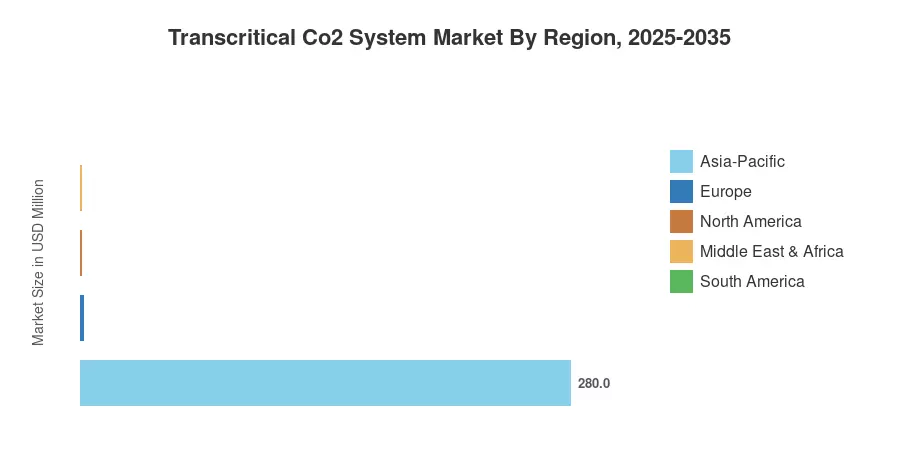
Asia-Pacific USD 280 million (2025) Cold-chain infrastructure buildout, Kigali compliance
South America 2.8% share (2025) Food export cold chains, multilateral financing
Middle East & Africa 18.1% CAGR (2026–2035) Adiabatic gas-cooler deployments, sovereign food-security programs
Total USD 2,850 million (2025)

The transcritical co2 system market exhibits a pronounced geographic concentration, with Europe commanding the majority of global installations. Regulatory maturity, cold-chain density, and technology readiness vary sharply across regions, producing distinct growth profiles.


North America

Country Key Metric Key Driver
US 68.4% of regional share EPA SNAP listings, California CARB HFC rules [5]
Canada 19.5% CAGR Federal carbon pricing, Loblaw and Metro fleet rollouts [18]
Mexico USD 28 million (2025) SEMARNAT regulations, export-oriented cold chain [8]


The US transcritical co2 system market is accelerating as state-level HFC phase-downs in California, New York, Washington, and Colorado converge with federal EPA rulemaking. Major grocery operators such as Whole Foods, Sprouts, and Aldi have committed to deploying transcritical CO2 in all new stores, creating a visible pipeline of several hundred installations through 2028 [5][18].

Europe

Country Key Metric Key Driver
Germany 22.3% of regional share Largest installed base, energy-efficiency incentives [1]
UK 18.7% CAGR Tesco and Sainsbury net-zero pledges [19]
France USD 215 million (2025) Carrefour fleet conversion, Loi Climat mandates [1]
Italy 14.8% of regional share SCM Frigo and Arneg manufacturing hub [20]
Spain 19.2% CAGR Mercadona new-store rollout [20]
Nordic Countries USD 195 million (2025) Early-adopter maturity, district-heating integration [21]
Russia 2.1% of regional share Import-substitution policy for industrial cooling [22]
Rest of Europe 18.5% CAGR Eastern European cold-chain modernization [1]


Europe's leadership in the transcritical co2 system market reflects two decades of regulatory precedent, beginning with Denmark's pioneering HFC taxes in 2001 and culminating in the current F-Gas Regulation that targets an 85% HFC quota reduction by 2036 [1]. Germany and France together account for a substantial share of the continental installed base, while the UK is experiencing rapid catch-up driven by retailer net-zero commitments.

Asia-Pacific

Country Key Metric Key Driver
China 31.5% of regional share Government green-cooling subsidies, cold-chain Five-Year Plan [8]
India 20.6% CAGR Kigali Amendment compliance, organized retail expansion [9]
Japan USD 62 million (2025) Revised High Pressure Gas Safety Act, convenience-store pilots [23]
South Korea 19.4% CAGR K-F-Gas Act, semiconductor cleanroom cooling trials [23]
ASEAN 12.8% of regional share Food-export quality mandates, ADB financing [8]
Rest of Asia-Pacific 18.9% CAGR Emerging regulatory frameworks [9]


Asia-Pacific represents the highest long-term growth potential for the transcritical co2 system market, though adoption today remains constrained by technician availability and ambient-temperature concerns. Japan has led regional deployment with over 300 transcritical installations by 2024, while China's 14th Five-Year Cold Chain Plan has earmarked CNY 50 billion for upgrading perishable logistics infrastructure [8][23].

South America

Country Key Metric Key Driver
Brazil 58.2% of regional share Meat-export cold-chain compliance, CONAMA regulations [8]
Argentina 19.0% CAGR Dairy processing modernization [8]
Rest of South America USD 14 million (2025) Multilateral financing for Kigali compliance [9]


Brazil anchors the South American transcritical co2 system market, with large meat and poultry exporters such as JBS and BRF investing in CO2-based blast-freezing and cold-storage systems to satisfy EU import sustainability requirements [8].

Middle East & Africa

Country Key Metric Key Driver
Saudi Arabia 28.4% of regional share Vision 2030 food-security investments [24]
UAE 20.3% CAGR LULU and Carrefour ME store rollouts, adiabatic cooling validation [7]
South Africa USD 6 million (2025) Shoprite and Pick n Pay pilot deployments [8]
Egypt 19.1% CAGR Suez Canal cold-corridor logistics [8]
Rest of MEA 3.5% of regional share Nascent regulatory landscape [9]


The Middle East has shifted from skeptic to early adopter after successful adiabatic gas-cooler installations in ambient temperatures exceeding 48 °C proved the viability of the transcritical CO2 system market in extreme climates [7][24].


Transcritical Co2 System Market By Region, 2025-2035

Competitive Benchmarking

The transcritical co2 system market exhibits moderate concentration, with the top five players accounting for an estimated 48–55% of global revenues. The Herfindahl-Hirschman Index sits in the 800–1,200 range, indicative of a competitive but not fragmented structure. Differentiation centers on compressor technology, warm-climate system optimization, and digital-monitoring platform integration.

Company Est. Revenue Share Range Key Offerings Strategic Positioning
Carrier Global Corporation ~12–15% CO2OLtec transcritical racks, integrated controls Full-system OEM with global service network
Hussmann Corporation (Panasonic) ~10–13% Protocol series transcritical systems Supermarket-focused, strong North American presence
Hillphoenix (Dover Corporation) ~9–12% Advansor-designed transcritical booster racks Vertically integrated compressor-to-rack platform
Bitzer SE ~7–10% ECOLINE+ semi-hermetic CO2 compressors Compressor specialist, OEM supply partnerships
Dorin S.p.A. ~5–8% CD series transcritical compressors Italian engineering, export-driven model
Danfoss A/S ~5–7% Multi-ejector modules, electronic expansion valves Component leader with system-level integration
Emerson Electric Co. ~4–6% Copeland CO2 scroll compressors, Lumity platform Digital monitoring and predictive analytics
SCM Frigo S.p.A. ~3–5% Integrated transcritical CO2 rack systems Southern European manufacturing hub
Carnot Refrigeration ~2–4% Compact transcritical condensing units Canadian market specialist, modular design
GEA Group AG ~2–4% Industrial-scale CO2 refrigeration, heat pumps Industrial process applications focus


Recent News & Developments

  • Carrier Global (March 2025): Launched the next-generation CO2OLtec EVO rack system with integrated AI-based energy management, targeting a 15% reduction in annual energy use versus prior models 
  • Danfoss A/S (January 2025): Opened a dedicated multi-ejector production line in Nordborg, Denmark, tripling manufacturing capacity to meet surging European demand for transcritical co2 system market components 


  • Hillphoenix (November 2024): Completed the acquisition of Advansor A/S, consolidating transcritical rack design and manufacturing under the Dover Corporation umbrella


  • Hussmann Corporation (August 2023): Deployed the 500th Protocol-series transcritical system in North America, marking a milestone for the transcritical co2 system market on the continent
  • GEA Group (May 2023): Signed a strategic partnership with a Nordic dairy cooperative to supply industrial-scale transcritical CO2 heat pumps for pasteurization lines, replacing natural-gas boilers across seven facilities 


Transcritical Co2 System Market Report Scope

Parameter Detail
Market Scope Global transcritical co2 system market by component, function, installation type, application, end-user industry, and geography
Study Period 2021–2035
CAGR 19.3% (2026–2035)
Market Size (2025) USD 2,850 Million
Market Size (2035) USD 16,650 Million
Fastest Growing Segment Gas Coolers (by component); Heating (by function); Retrofit (by installation type)
Companies Profiled 10 (Carrier, Hussmann, Hillphoenix, Bitzer, Dorin, Danfoss, Emerson, SCM Frigo, Carnot, GEA)
Valuation Currency USD Million


FAQs

What is the typical payback period for a transcritical CO2 system versus an HFC-based system?
Most end users see payback within three to five years, depending on energy prices and local HFC quota costs. Systems in regions with carbon pricing recover investment faster due to lower refrigerant replacement expenses [14].
How do transcritical CO2 systems perform in tropical climates above 40 °C?
Multi-ejector and adiabatic gas-cooler technology has closed the performance gap. Field data from UAE and Southeast Asian installations show COP values within 5–8% of equivalent HFC systems at 45 °C ambient [7].
What certifications do technicians need to install and maintain transcritical CO2 racks?
Technicians typically require high-pressure gas handling certification aligned with local standards such as ASME B31.5 or EN 378. Several OEMs also mandate proprietary training programs before warranty coverage applies [16].
Can existing HFC-based supermarket systems be retrofitted to transcritical CO2?
Retrofit is feasible but requires replacing compressors, piping, and controls rated for pressures above 120 bar. Costs typically run 40–60% of a new-build system, making full replacement preferable for older stores [14].
How does transcritical CO2 compare with ammonia for industrial cold-storage applications?
CO2 offers lower toxicity and simpler regulatory compliance than ammonia, though ammonia delivers superior COP in large-scale applications. CO2 is favored where facilities are near populated areas or food-contact zones [14].
What financing options exist beyond traditional capex procurement?
Refrigeration-as-a-Service contracts, green bonds, and EU Innovation Fund grants are the three most common alternatives. These shift financial risk away from the end user and accelerate adoption cycles [12].
Are transcritical CO2 systems compatible with demand-response and grid-balancing programs?
Yes. Modern control platforms can modulate compressor load in response to utility signals, enabling stores to participate in demand-response programs and earn grid-service revenues [17].    
Author
Author
Author Profile
Priya Nagrale LinkedIn
Senior Research Analyst
With an experience of over five years in market research industry (Chemicals & Materials domain), I gather and analyze market data from diverse sources to produce results, which are then presented back to a client. Also, provide recommendations based on the findings. As a Senior Research Analyst, I perform quality checks (QC) for market estimations, QC for reports, and handle queries and work extensively on client customizations. Also, handle the responsibilities of client proposals, report planning, report finalization, and execution
Download Free Sample

Kindly complete the form below to receive a free sample of this Report

Download PDF ×

We do not share your information with anyone. However, we may send you emails based on your report interest from time to time. You may contact us at any time to opt-out.
















