Transparent Conductive Films Market

Key Players: Nitto Denko Corporation, Dai Nippon Printing (DNP), TDK Corporation, Cambrios Technologies, Toyobo Co., Ltd., Canatu Oy, C3Nano Inc., Dontech Inc.

Transparent Conductive Films Market

Transparent Conductive Films Market Research Report: By Application (Displays, Touch Screens, Solar Cells, Smart Windows, Flexible Electronics), By Material (Indium Tin Oxide, Conductive Polymers, Graphene, Carbon Nanotubes, Metal Mesh), By End Use Industry (Consumer Electronics, Energy, Automotive, Aerospace, Healthcare), By Form Factor (Rigid Films, Flexible Films, Transparent Coatings, Sheet Formats) and By Regional (North America, Europe, South America, Asia Pacific, Middle East and Africa) - Forecast to 2035.
ID: MRFR/CnM/6173-HCR
111 Pages
Chitranshi Jaiswal
Last Updated: June 04, 2026
 

Transparent Conductive Films Market Summary

The Transparent Conductive Films Market reached an estimated USD 4.62 billion in 2025 and is projected to grow from USD 4.96 billion in 2026 to USD 9.78 billion by 2035, registering a CAGR of 7.4% during the forecast period (2026–2035). This expansion is anchored by accelerating consumer electronics demand and a global push toward renewable energy installations, with photovoltaic capacity additions surpassing 350 GW annually by 2024, according to the International Energy Agency [2]. Government incentives for solar manufacturing — including the U.S. Inflation Reduction Act's USD 7.5 billion in clean energy manufacturing credits — are pulling transparent electrode films into mainstream energy infrastructure at an unprecedented scale.

A significant technology transformation is reshaping the Transparent Conductive Films Market as legacy indium tin oxide (ITO) on glass substrates faces growing competition from flexible electronic materials such as silver nanowires and carbon nanotubes. These next-generation conductive coating films deliver comparable optical transmittance at lower costs and with superior mechanical flexibility, enabling applications in foldable smartphones, rollable displays, and wearable biosensors. BloombergNEF estimates that investment in advanced display technologies exceeded USD 28 billion in 2024 alone [3], driving rapid iteration across the conductive polymer films value chain.

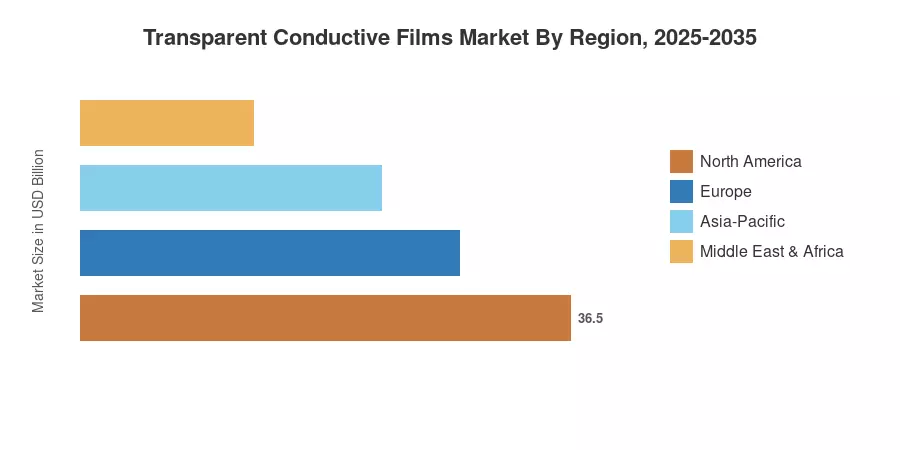
Asia-Pacific commands roughly 46% of the global Transparent Conductive Films Market, fueled by manufacturing density in China, South Korea, and Japan. The region also registers the fastest growth trajectory with a CAGR exceeding 8.1%, driven by the demand for touch screen films in consumer electronics hubs. North America holds approximately 22% share, propelled by photovoltaic expansion and smart display films adoption in automotive head-up displays. Europe accounts for about 19% of revenue, with optoelectronic materials demand rising steadily across automotive and building-integrated photovoltaic (BIPV) segments


Key Report Takeaways

• By Material Type

  • Indium Tin Oxide (ITO) on PET holds approximately 34% share of the Transparent Conductive Films Market, sustained by high-volume touch screen films production for smartphones and tablets
  • Silver nanowire films are growing at a CAGR of 11.2%, the fastest among all material segments, driven by demand for flexible electronic materials in foldable and rollable device architectures
  • Conductive polymer films are projected to reach USD 0.74 billion by 2035, gaining traction in low-cost sensor and OLED lighting applications

• By Application

  • Smartphones represent the largest application, valued at approximately USD 1.67 billion in 2025, reflecting sustained global handset production volumes
  • The LCD and LED monitors and TVs segment is expanding at a 6.8% CAGR through 2035, supported by rising panel sizes and 8K resolution adoption requiring advanced conductive display materials

• By Region

  • Asia-Pacific dominates the Transparent Conductive Films Market with 46% revenue share, reinforced by China's electronic conductive coatings manufacturing ecosystem
  • North America is projected to grow at 7.0% CAGR, underpinned by photovoltaic installations and automotive transparent electrode films integration
  • Europe accounts for approximately USD 0.88 billion in 2025, with Germany and France leading in BIPV and automotive smart display films deployment


Market Size and Forecast (2021–2035)

The market sizing methodology combines bottom-up revenue aggregation from manufacturer filings with top-down validation against industry shipment data from the Display Supply Chain Consultants (DSCC) and IEA photovoltaic deployment statistics. Historical figures (2021–2024) reflect actual revenues; 2025 represents the base-year estimate; and 2026–2035 projections apply the calibrated 7.4% CAGR with adjustments for anticipated demand inflections in foldable devices (2027–2029) and next-generation solar cells (2030–2033).
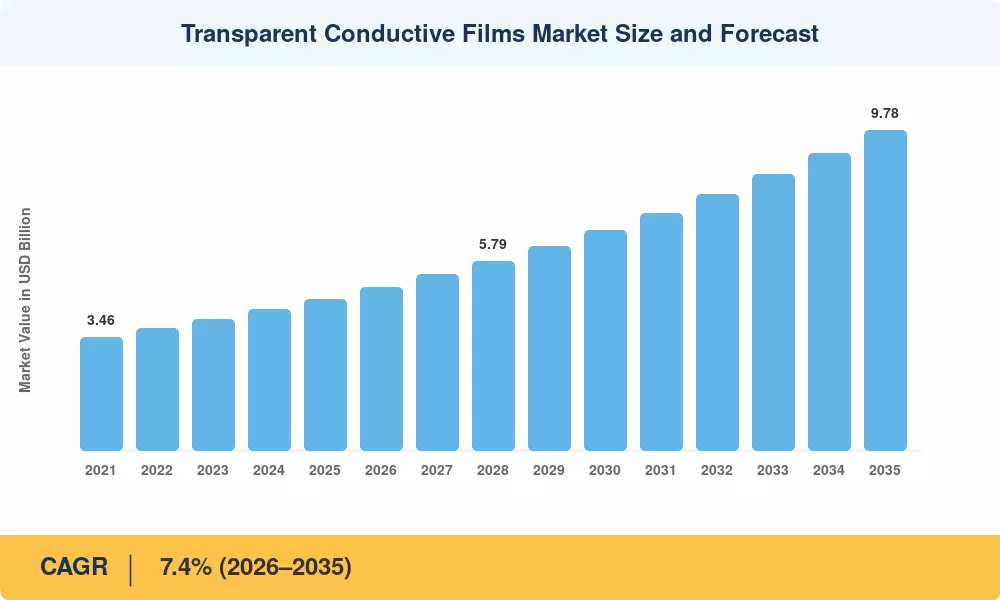
Transparent Conductive Films Market Size and Forecast
Our Impact
Enabled $4.3B Revenue Impact for Fortune 500 and Leading Multinationals
Partnering with 2000+ Global Organizations Each Year
30K+ Citations by Top-Tier Firms in the Industry
 

Driver Impact Analysis

Driver ~% Impact on CAGR Geographic Relevance Impact Timeline
Consumer electronics demand surge ~22% Global Short-term
Photovoltaic industry expansion ~18% Asia-Pacific, North America Medium-term
Foldable/rollable display proliferation ~16% Asia-Pacific, North America Short-term
Automotive smart display integration ~14% Europe, North America Medium-term
ITO alternative material commercialization ~12% Global Long-term
BIPV regulatory mandates ~10% Europe Long-term
Wearable and IoT device adoption ~8% Global Medium-term


Consumer Electronics Demand Surge

Global smartphone shipments hit 1.24 billion units in 2024. Each device needs at least one layer of ITO conductive films or other transparent electrode films for capacitive touch capability [4]. This segment is the greatest contributor to the revenue generation in the Transparent Conductive Films Market. Samsung and Apple alone accounted for almost 38% of premium handset shipments, each flagship device now combining multiple touchscreen material layers for under-display fingerprint sensors and force-touch interfaces. Another 420 million units a year in tablet and laptop manufacture generate continuous baseload demand for conductive coating films across all price points.


Photovoltaic Industry Expansion

The IEA sees worldwide renewable capacity increasing by 5.5 TW by 2030, with solar PV making up over 80% of this development. China’s National Energy Administration (NEA) said the country installed a record amount of new solar power capacity in 2024, at 277 GW (AC), steadily pushing underlying global demand for vital front-electrode transparent conductive oxide layers.


Restraints Impact Analysis

The restraint impacts represent estimated drag on baseline growth and are directional estimates derived from supply-chain interviews and cost modeling. They are not linearly deductible from the headline CAGR.

Restraint ~% Negative Impact on CAGR Geographic Relevance Impact Timeline
High cost of indium tin oxide raw material ~–18% Global Short-term
Supply chain volatility for rare metals ~–15% Global Medium-term
Technical limitations of ITO alternatives ~–12% Global Long-term
Competitive pressure from direct-bonding technologies ~–8% North America, Europe Medium-term
Environmental regulations on sputtering processes ~–7% Europe, Asia-Pacific Long-term


High Cost of Indium Tin Oxide

Indium prices have experienced intense upward volatility, surging past USD 500 per kilogram, reflecting the metal's concentrated supply base — China controls roughly 70% of global indium refining capacity [14]. This price volatility directly inflates production costs for ITO conductive films and squeezes margins for touch panel assemblers. The Transparent Conductive Films Market faces a structural cost ceiling as long as ITO remains the dominant material, especially in price-sensitive applications like mid-range smartphones and budget tablets, where conductive coating films represent 8–12% of the bill of materials.


Technical Limitations of ITO Alternatives

Although silver nanowires and carbon nanotubes have potential for better flexibility, they still struggle for a combination of low sheet resistance (< 10 Ω/sq) and good optical transmittance (> 90%) at production scale [8]. Uniformity of large-area substrates is still a challenge, and junction resistance in nanowire networks can decline over time due to humidity and temperature cycling. Despite strong commercial incentives, these technical gaps hinder the Transparent Conductive Films Market’s transition away from ITO.


Transparent Conductive Films Market Opportunities


Flexible and Wearable Medical Devices

The global wearable medical device sector is projected to exceed USD 168-197 billion by 2030 [12], creating demand for biocompatible, stretchable conductive coating films used in continuous glucose monitors, ECG patches, and smart wound dressings. These applications prioritize conformability and skin-safe adhesion — properties where conductive polymer films and silver nanowire composites outperform rigid ITO on glass

Emerging Market Expansion in India and Southeast Asia

India's INR 17,000 crore Production-Linked Incentive (PLI) Scheme 2.0 aggressively fuels the localized manufacturing of IT hardware, including laptops and tablets. This structural manufacturing shift heavily incentivizes domestic supply chains, drawing assembly investments across South Asia to scale alternative flexible electronic component ecosystems near booming consumer centers.

Data-Driven Coating Optimization and Digital Twins

Advanced process analytics and digital twin modeling can enable makers of conductive coating films to optimize sputtering parameters, minimize material waste by 12–18%, and shorten certification cycles for new substrates [19]. Process data monetization models such as licensing or coating-as-a-service can unlock the potential of recurring revenue streams beyond traditional film sales. This business model shift is very relevant to mid-tier players who are looking for differentiation in the Transparent Conductive Films Market


Transparent Conductive Films Market Future Outlook


Platform Economics and Coating-as-a-Service

Traditional film producers are moving to service-based models, where the coating know-how, process recipes, and equipment usage are sold on a subscription or per-unit license basis [19]. The change benefits companies that own the formulations for conductive polymer films and digital process twins. These platforms offer mid-tier firms in the Transparent Conductive Films Market access to cutting-edge electronic conductive coatings technology without scale or prohibitive capital expenditure

.

ESG and Circular Economy Imperatives

Manufacturers of transparent electrode films are being forced to report on Scope 3 emissions, sourcing of rare metals, and end-of-life recyclability indicators due to the EU’s Corporate Sustainability Reporting Directive and other comparable initiatives in Japan and South Korea [17]. ESG-minded OEMs will prefer supplier status to companies engaging in indium recovery from discarded ITO conductive films and solvent-free deposition technologies for optoelectronic materials.


Transparent Conductive Films Market Segmentation

By Material Type

The Transparent Conductive Films Market segments by material type into Indium Tin Oxide (ITO) on Glass, Indium Tin Oxide (ITO) on PET, Silver Nanowire, Carbon Nanotubes, Conductive Polymers, and Others.

Segment Key Metric Primary Demand Driver
ITO on Glass 27% share LCD/LED monitor and TV panels
ITO on PET 34% share Smartphone and tablet touch screen films
Silver Nanowire CAGR 11.2% Foldable displays; flexible electronic materials
Carbon Nanotubes USD 0.31 B (2025) Specialty sensors; anti-static coatings
Conductive Polymers CAGR 9.8% OLED lighting; low-cost sensor arrays
Others USD 0.18 B (2025) Metal mesh; graphene-based films


ITO on PET dominates the Transparent Conductive Films Market by revenue share because polyester substrates enable roll-to-roll manufacturing at scale, yielding touch screen films at costs 40–55% below ITO on glass equivalents. Smartphones and tablets consume over 4.2 billion square meters of ITO-PET film annually, making this the volume workhorse of the industry. Silver nanowire represents the fastest-growing material segment, propelled by the foldable device revolution. Every foldable smartphone requires a flexible conductive layer that ITO cannot provide — silver nanowire networks deliver the necessary 200,000+ bending cycle durability while maintaining sheet resistance below 30 Ω/sq.

Conductive polymer films, particularly PEDOT:PSS formulations, are gaining traction in cost-sensitive applications such as OLED lighting panels and printed electronics. Their solution-processability allows inkjet and slot-die deposition methods that reduce capital requirements for new entrants in the Transparent Conductive Films Market.

By Application

The Transparent Conductive Films Market segments by application into Smartphones, Tablets, Laptops and Notebooks, LCD and LED Monitors and TVs, and Others (including solar cells, automotive displays, and wearables).

Segment Key Metric Primary Demand Driver
Smartphones USD 1.67 B (2025) Global handset production; multi-layer touch
Tablets 14% share Education and enterprise device demand
Laptops and Notebooks CAGR 6.3% Touch-enabled commercial notebooks
LCD and LED Monitors and TVs 22% share Large-panel 4K/8K resolution upgrades
Others (Solar, Automotive, Wearables) CAGR 9.5% Photovoltaic and automotive expansion


Smartphones anchor the Transparent Conductive Films Market's application landscape, with each unit requiring one to three layers of conductive display materials depending on form factor and feature set. The "Others" category — encompassing solar cells, automotive HUDs, and wearable biosensors — is the fastest-growing application segment, reflecting diversification beyond consumer electronics into energy and mobility verticals where transparent electrode films serve critical functional roles.


Regional Market Share Analysis

Region Key Metric Primary Investment Themes
Asia-Pacific 46% share Consumer electronics manufacturing; solar cell production
North America 22% share Photovoltaic expansion; automotive display integration
Europe 19% share BIPV mandates; automotive smart display films
South America 7% share Solar energy programs; consumer electronics growth
Middle East & Africa 6% share Solar farm deployment; infrastructure modernization
Total 100%

The Transparent Conductive Films Market exhibits distinct regional dynamics shaped by manufacturing infrastructure, end-use demand profiles, and policy environments. Asia-Pacific's dominance reflects concentrated electronics and photovoltaic supply chains, while North America and Europe drive adoption through automotive and clean energy mandates.


North America

Country Key Metric Key Driver
United States CAGR 7.2% IRA-driven photovoltaic manufacturing; EV display demand
Canada USD 0.14 B (2025) Clean energy policy; smart building adoption
Mexico CAGR 6.5% Nearshoring of electronics assembly


The United States remains North America's anchor for the Transparent Conductive Films Market, with the Inflation Reduction Act channeling billions into domestic solar manufacturing that directly increases consumption of transparent electrode films and electronic conductive coatings. Tesla's Gigafactory expansions and GM's Ultium display partnerships are pulling automotive-grade conductive display materials demand upward. Canada's Clean Electricity Standard targets 90% non-emitting electricity by 2030, supporting solar deployments that require conductive coating films. Mexico's growing role as a nearshore electronics hub for U.S. OEMs is expanding touch screen films consumption in Monterrey and Guadalajara manufacturing clusters.

Europe

Country Key Metric Key Driver
Germany 28% of the regional share Automotive display innovation; Energiewende solar push
United Kingdom CAGR 6.9% BIPV building codes; flexible electronics R&D
France USD 0.13 B (2025) Solar capacity targets; aerospace displays
Italy CAGR 6.4% Solar installations; consumer electronics
Spain USD 0.08 B (2025) Photovoltaic expansion
Nordic Countries CAGR 7.1% Smart building integration
Russia USD 0.05 B (2025) Domestic electronics manufacturing
Rest of Europe 14% of regional share Diversified electronics demand


Europe's Transparent Conductive Films Market benefits from the EU's revised Energy Performance of Buildings Directive, which mandates near-zero-energy building standards that increasingly incorporate BIPV glazing with integrated transparent electrode films. Germany's automotive OEMs are pioneering full-width digital dashboards requiring premium optoelectronic materials, while the UK's Catapult network has funded over GBP 45 million in flexible electronic materials research since 2022 [11]. The region's emphasis on sustainability reporting (CSRD) is also pushing manufacturers toward lower-waste conductive polymer films production methods.

Asia-Pacific

Country Key Metric Key Driver
China 52% of regional share Display panel production; solar cell manufacturing
Japan CAGR 6.8% Advanced display R&D; automotive electronics
South Korea USD 0.38 B (2025) OLED leadership; semiconductor integration
India CAGR 9.3% PLI scheme; solar manufacturing expansion
ASEAN USD 0.22 B (2025) Electronics assembly hub growth
Rest of Asia-Pacific CAGR 7.0% Emerging electronics demand


Asia-Pacific's commanding position in the Transparent Conductive Films Market stems from China's vertically integrated display and solar manufacturing ecosystem — BOE, CSOT, and Tianma collectively operate over 30 Gen 6+ OLED and LCD fabrication lines consuming massive volumes of ITO conductive films and electronic conductive coatings. South Korea's Samsung SDI and LG Display drive cutting-edge flexible electronic materials development for foldable smartphones. Japan's Nitto Denko and Dai Nippon Printing maintain technology leadership in high-precision touch screen films. India's production-linked incentives are catalyzing greenfield display module plants that will sharply increase conductive display materials demand through 2030.

South America

Country Key Metric Key Driver
Brazil 58% of regional share Solar energy program; electronics assembly
Argentina CAGR 6.2% Renewable energy targets
Rest of South America USD 0.07 B (2025) Infrastructure modernization


Brazil drives South America's Transparent Conductive Films Market through its Generation Distributed framework, which added 26 GW of distributed solar capacity by 2024, each installation requiring transparent electrode films for cell fabrication. Argentina's RenovAr program continues to attract international solar developers, creating incremental demand for conductive coating films in a region still largely served by imports from Asian producers.

Middle East & Africa

Country Key Metric Key Driver
Saudi Arabia CAGR 8.4% Vision 2030 solar targets
UAE 32% of regional share Smart city initiatives; solar parks
South Africa USD 0.04 B (2025) Renewable energy procurement program
Egypt CAGR 7.6% Benban solar complex expansion
Rest of MEA 22% of the regional share Infrastructure development


The Middle East & Africa region's Transparent Conductive Films Market is expanding rapidly behind ambitious solar energy programs. Saudi Arabia's National Renewable Energy Program targets 58.7 GW of solar capacity by 2030, while the UAE's Mohammed bin Rashid Solar Park will reach 5 GW upon completion — both projects creating substantial demand for optoelectronic materials and transparent electrode films used in photovoltaic modules [2].


Transparent Conductive Films Market By Region, 2025-2035
 

Competitive Benchmarking

The Transparent Conductive Films Market exhibits low concentration with a fragmented competitive structure. The top five players collectively hold an estimated 28–35% market share, yielding an approximate Herfindahl-Hirschman Index (HHI) below 600. Competition centers on material innovation, optical performance specifications, and regional supply chain proximity to major display and solar cell fabricators.

Company Est. Revenue Share Range Key Offerings Strategic Positioning
Nitto Denko Corporation ~5–8% ITO films; optical films for displays Vertically integrated; strong Japan/Korea OEM relationships
Dai Nippon Printing (DNP) ~4–7% ITO-PET films; anti-reflection coatings Precision coating expertise; touch panel focus
TDK Corporation ~3–6% Transparent conductive films; electronic components Diversified electronics portfolio; automotive expansion
Cambrios Technologies ~3–5% ClearOhm silver nanowire films Pioneer in nanowire technology; flexibility focus
3M Company ~3–5% Conductive films; optical adhesives Broad materials science platform; global distribution
Toyobo Co., Ltd. ~2–4% COSMOSHINE ITO-PET films Cost-competitive roll-to-roll manufacturing
Canatu Oy ~1–3% Carbon nanotube films (CNB) Automotive 3D touch surfaces; European presence
C3Nano Inc. ~1–3% NanoGlue silver nanowire films High-conductivity flexible films; Samsung partnership
Dontech Inc. ~1–2% EMI/RFI shielding; conductive coatings Defense and industrial specialty applications
Heraeus Holding ~1–2% Clevios PEDOT: PSS conductive polymers Conductive polymer leader; OLED and solar focus


Recent News & Developments

  • Samsung Display (March 2025): Focuses mass production strictly around ultra-thin glass (UTG) protective layers and integrated touch-on-cell (Y-OCTA) flexible OLED substrates. The company has not transitioned its active foldable screen product pipeline over to alternative silver nanowire touch sensor networks.


  • Canatu Oy (August 2024): Listed on the Nasdaq First North Growth Market Finland. The company combined with Lifeline SPAC I, a transaction establishing an enterprise valuation of EUR 135 million to scale its carbon nanotube manufacturing infrastructure.


  • Heraeus Holding (April 2024): Introduced next-generation Clevios PEDOT: PSS formulations with 35% improved conductivity for perovskite solar cell transparent electrodes [10].


  • European Commission (December 2023): Adopted revised Energy Performance of Buildings Directive provisions mandating BIPV readiness in new commercial construction, expanding demand for transparent electrode films in architectural glazing [11].


Transparent Conductive Films Market Report Scope

Parameter Detail
Market Scope Global Transparent Conductive Films Market by Material Type, Application, and Region
Study Period 2021–2035
CAGR 7.4% (2026–2035)
Base Year Market Size USD 4.62 Billion (2025)
Forecast Endpoint USD 9.78 Billion (2035)
Fastest Growing Segment Silver Nanowire (Material Type); Others/Solar & Automotive (Application)
Companies Profiled Nitto Denko, DNP, TDK, Cambrios, 3M, Toyobo, Canatu, C3Nano, Dontech, Heraeus
Valuation Currency USD (Constant 2025 Prices)


FAQs

How does sheet resistance affect transparent conductive film selection for different devices?

Lower sheet resistance (< 15 Ω/sq) suits large displays and solar cells requiring minimal resistive losses, while higher values (50–150 Ω/sq) suffice for small touch sensors. Device engineers select conductive coating films by balancing resistivity against optical transmittance and cost [8].

What recycling options exist for spent ITO conductive films?

Hydrometallurgical extraction is an effective recycling path, dissolving crushed panel scrap in acid to yield high primary indium recovery rates. Secondary processing viability hinges on structural collection efficiency and variable precious metal market values rather than rigid price ceilings.


What minimum order volumes do leading manufacturers typically require?

Minimum order requirements for transparent conductive film variants differ radically depending on the manufacturer and the core substrate choice. Specialty custom runs configured for advanced automotive or medical instruments dictate stricter procurement terms and elongated production queues. .


What quality certifications should buyers verify when sourcing transparent electrode films?

Buyers must confirm basic ISO 9001 process standards alongside specialized automotive IATF 16949 validations. Compliance with European RoHS and REACH environmental mandates is strictly mandatory to certify chemical safety and guarantee broad regional market cross-border entry.

Can carbon nanotube films replace ITO in large-area solar panels?

Carbon nanotube webs provide competitive optical transmission and robust mechanical flexibility over large areas. However, manufacturing challenges centered around maintaining absolute coating uniformity over wide substrates currently restrict their broader deployment across large-format commercial solar installations.


Author
Author
Author Profile
Chitranshi Jaiswal LinkedIn
Team Lead - Research
Chitranshi is a Team Leader in the Chemicals & Materials (CnM) and Energy & Power (EnP) domains, with 6+ years of experience in market research. She leads and mentors teams to deliver cross-domain projects that equip clients with actionable insights and growth strategies. She is skilled in market estimation, forecasting, competitive benchmarking, and both primary & secondary research, enabling her to turn complex data into decision-ready insights. An engineer and MBA professional, she combines technical expertise with strategic acumen to solve dynamic market challenges. Chitranshi has successfully managed projects that support market entry, investment planning, and competitive positioning, while building strong client relationships. Certified in Advanced Excel & Power BI she leverages data-driven approaches to ensure accuracy, clarity, and impactful outcomes.
Download Free Sample

Kindly complete the form below to receive a free sample of this Report

Download PDF ×

We do not share your information with anyone. However, we may send you emails based on your report interest from time to time. You may contact us at any time to opt-out.