Download Free Sample
Kindly complete the form below to receive a free sample of this Report
UK Cell Surface Markers Market Research Report: Size, Share, Trend Analysis By Product (Antibody, PCR Array), By Applications (Research, Clinical), By Source (Mice, Rat), and By Cell Type (T Cells, B Cells, NK Cells) - Growth Outlook & Industry Forecast 2025 To 2035
As per Market Research Future analysis, the UK cell surface-markers market Size was estimated at 23.0 USD Million in 2024. The UK cell surface-markers market is projected to grow from 24.63 USD Million in 2025 to 48.75 USD Million by 2035, exhibiting a compound annual growth rate (CAGR) of 7.0% during the forecast period 2025 - 2035
The UK cell surface-markers market is experiencing robust growth driven by advancements in personalized medicine and biopharmaceuticals.
| 2024 Market Size | 23.0 (USD Million) |
| 2035 Market Size | 48.75 (USD Million) |
| CAGR (2025 - 2035) | 7.07% |
Thermo Fisher Scientific (US), BD (US), Merck KGaA (DE), Beckman Coulter (US), Bio-Rad Laboratories (US), Miltenyi Biotec (DE), Abcam (GB), R&D Systems (US)
Our Impact
Enabled $4.3B Revenue Impact for Fortune 500 and Leading Multinationals
Partnering with 2000+ Global Organizations Each Year
30K+ Citations by Top-Tier Firms in the Industry
The cell surface-markers market is currently experiencing notable advancements, driven by increasing research activities and technological innovations. The demand for precise diagnostic tools and targeted therapies is rising, as healthcare professionals seek to enhance patient outcomes. This market is characterized by a growing emphasis on personalized medicine, which relies heavily on the identification and analysis of specific cell surface markers. As a result, various stakeholders, including academic institutions and biotechnology firms, are investing in the development of novel assays and reagents to facilitate these advancements. Moreover, regulatory support and funding initiatives from governmental bodies are likely to bolster the growth of the cell surface-markers market. Collaborative efforts between public and private sectors are fostering an environment conducive to innovation. The integration of advanced technologies, such as artificial intelligence and machine learning, into research methodologies is also anticipated to streamline processes and improve accuracy in marker identification. This evolving landscape suggests a promising future for the market, with potential expansions in applications across diagnostics and therapeutics, ultimately benefiting patient care and treatment efficacy.
The cell surface-markers market is witnessing a surge in demand for personalized medicine approaches. This trend is driven by the need for tailored therapies that cater to individual patient profiles. As healthcare providers increasingly recognize the importance of specific biomarkers in treatment decisions, the market is likely to expand, offering innovative solutions that enhance therapeutic outcomes.
Recent technological advancements are significantly impacting the cell surface-markers market. Innovations in assay development, including high-throughput screening and multiplexing techniques, are enabling researchers to analyze multiple markers simultaneously. This efficiency not only accelerates research timelines but also enhances the accuracy of results, thereby attracting more investment into the sector.
The cell surface-markers market is benefiting from increased regulatory support and funding initiatives. Governmental bodies are recognizing the potential of cell surface markers in diagnostics and therapeutics, leading to the establishment of grants and programs aimed at fostering research and development. This support is likely to stimulate growth and innovation within the market.
The cell surface-markers market is experiencing a surge in research activities focused on immunology. This growth is driven by the increasing recognition of the immune system's role in various diseases, including cancer and autoimmune disorders. In the UK, funding for immunological research has seen a notable increase, with government and private sectors investing heavily. This trend is likely to enhance the development of novel therapies and diagnostics that utilize cell surface markers. As a result, the demand for specific markers used in immunological studies is expected to rise, potentially leading to a market growth rate of around 8% annually. The cell surface-markers market is thus positioned to benefit from these advancements, as researchers seek innovative solutions to complex health challenges.
The biopharmaceutical sector in the UK is expanding rapidly, which is positively impacting the cell surface-markers market. With the increasing number of biopharmaceutical products entering the market, there is a growing need for precise characterization of these products, particularly in terms of their cellular interactions. Cell surface markers play a crucial role in this characterization process, facilitating the development of targeted therapies. The UK biopharmaceutical market is projected to reach £30 billion by 2026, indicating a robust demand for cell surface markers. This growth is likely to drive innovation and investment in the cell surface-markers market, as companies strive to meet the evolving needs of biopharmaceutical development.
The prevalence of chronic diseases in the UK is on the rise, which is significantly influencing the cell surface-markers market. Conditions such as diabetes, cardiovascular diseases, and various cancers are becoming increasingly common, necessitating advanced diagnostic and therapeutic approaches. Cell surface markers are essential for the identification and monitoring of these diseases, as they provide critical information about disease progression and treatment response. The market for diagnostic tools related to chronic diseases is expected to grow at a CAGR of 7% over the next five years. Consequently, the cell surface-markers market is likely to see increased demand for innovative solutions that can aid in the early detection and management of chronic conditions.
The cell surface-markers market is witnessing an increased focus on biomarker discovery, particularly in the context of precision medicine. In the UK, there is a growing emphasis on identifying biomarkers that can predict patient responses to specific treatments. This trend is being supported by both public and private funding initiatives aimed at enhancing biomarker research. The cell surface-markers market is likely to benefit from this focus, as the identification of new biomarkers can lead to the development of more effective and personalized therapeutic strategies. The market for biomarkers is projected to grow at a CAGR of 9% in the coming years, indicating a robust opportunity for stakeholders in the cell surface-markers market.
Recent advancements in cell biology techniques are significantly impacting the cell surface-markers market. Techniques such as flow cytometry, mass cytometry, and single-cell sequencing are becoming more sophisticated, allowing for more detailed analysis of cell surface markers. These innovations enable researchers to explore cellular functions and interactions at unprecedented levels of resolution. In the UK, the adoption of these advanced techniques is expected to increase, driven by both academic and commercial research initiatives. This trend may lead to a projected growth of 10% in the cell surface-markers market as researchers and clinicians seek to leverage these technologies for better diagnostic and therapeutic outcomes.
In the UK cell surface-markers market, Drug Discovery leads as the largest segment, commanding a significant share due to its extensive applications in pharmaceutical research and development. Diagnostics, while a smaller player, is rapidly increasing its footprint, leveraging advancements in personalized medicine and point-of-care testing. This distribution reflects the current focus on innovative therapies and the increasing importance of early disease detection. Growth trends indicate that Drug Discovery remains a cornerstone of biotechnological advancements and is expected to continue driving market dynamics, bolstered by ongoing investments in research. Conversely, the Diagnostics segment is emerging as the fastest-growing area, spurred by technological innovations and heightened demand for efficient diagnostic tools, emphasizing the need for rapid and accurate patient assessment and monitoring.
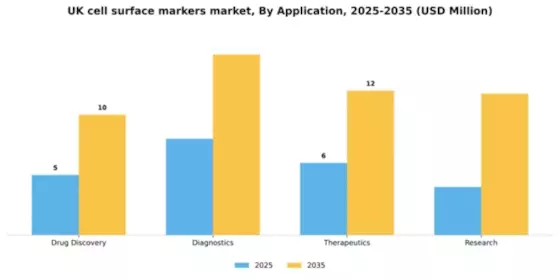
Drug Discovery (Dominant) vs. Diagnostics (Emerging)
Drug Discovery is characterized by its significant role in the development of new therapeutic agents, relying heavily on cell surface markers for target validation and compound screening. This segment has established a stable market presence through collaborations between biotech firms and academic institutions. On the other hand, Diagnostics represents an emerging area driven by trends in health technology, particularly in biomarker discovery and disease monitoring. The advancement in diagnostic assays, coupled with the increasing emphasis on preventive healthcare, positions Diagnostics as a rapidly growing segment, anticipating wider adoption and integration into clinical settings.
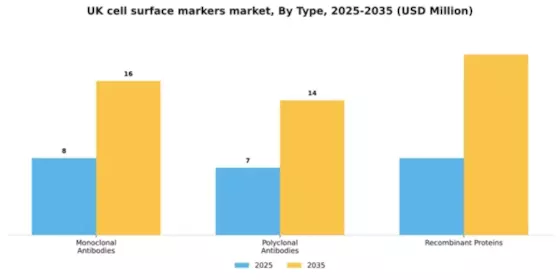
The market share distribution in this segment shows that Monoclonal Antibodies dominate the landscape, reflecting their established presence in various research and diagnostic applications. Meanwhile, Polyclonal Antibodies account for a significant portion of the market, catering to specific needs within laboratories. Recombinant Proteins, while currently smaller in market share, are emerging due to advancements in biotechnology and rising demand for targeted therapies. Growth trends in this segment are driven by innovation in biopharmaceutical manufacturing and the increasing usage of personalized medicine. Monoclonal Antibodies continue to hold a strong position because of their specificity and efficacy. Conversely, Recombinant Proteins are witnessing a surge in popularity, attributed to ongoing research initiatives and the need for high-quality, consistent products, making it a breakthrough sector.
Monoclonal Antibodies (Dominant) vs. Recombinant Proteins (Emerging)
Monoclonal Antibodies are recognized as the dominant force in the segment, largely due to their high specificity and effectiveness in therapeutic and diagnostic applications. They are extensively utilized in cancer treatment, autoimmune disorders, and infectious diseases, leading to a robust demand in the market. In contrast, Recombinant Proteins, categorized as an emerging segment, are gaining traction as new manufacturing techniques enhance their availability and production efficiency. The increasing research interest in recombinant technologies and their application in novel therapies highlight their potential for significant growth. As the landscape evolves, these two segments will continue to play pivotal roles, offering diverse options for researchers and healthcare professionals alike.
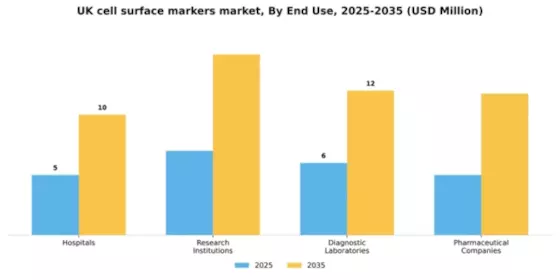
In the UK cell surface-markers market, the distribution of market share is significantly led by hospitals, which account for the largest segment in terms of utilization and application of cell surface markers in diagnostic procedures and patient management. Research institutions follow closely, demonstrating a strong presence as they leverage these markers for innovative research applications in fields such as immunology and oncology. Growth trends indicate a dynamic shift in the market, particularly driven by the increasing investments in research and development activities within research institutions. The expansion of clinical applications in hospitals is spurred by the rising prevalence of chronic diseases and the need for advanced diagnostic tools. Meanwhile, research institutions are rapidly emerging as a vital force as they explore novel therapeutic avenues, thereby intensifying their demand for sophisticated cell surface marker technologies.
Hospitals (Dominant) vs. Research Institutions (Emerging)
Hospitals remain the dominant force in the market, primarily due to their extensive use of cell surface markers for diagnostic and therapeutic applications. The integration of these markers in clinical settings enhances patient outcomes through targeted therapies and personalized medicine. Conversely, research institutions are emerging as crucial players, driven by their role in advancing scientific knowledge and technological innovation. Their focus on exploring new applications for cell surface markers positions them as a key driver of market growth. Both segments complement each other, wherein hospitals utilize findings from research institutions to enhance clinical practices, creating a symbiotic relationship that fuels advancements in the UK cell surface-markers market.
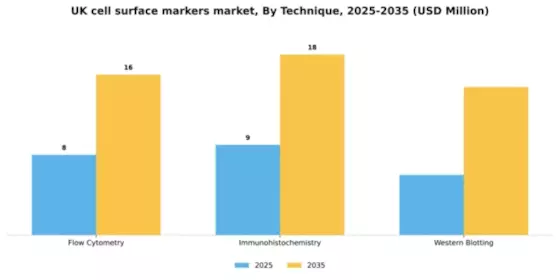
In the UK cell surface-markers market, Flow Cytometry holds a significant share, making it the largest technique segment. Its broad application in diagnostics and research settings bolsters its market presence, reflecting the growing demand for precise cellular analysis. Immunohistochemistry, while smaller in market share compared to Flow Cytometry, is recognized for its rapid growth driven by increasing research activities and advancements in cancer diagnostics, marking it as an emerging player in the segment. The growth of the UK cell surface-markers market can be attributed to several factors influencing the adoption of these techniques. Flow Cytometry is favored for its high throughput and ability to analyze multiple parameters simultaneously, reinforcing its dominant position. Conversely, Immunohistochemistry is becoming essential due to the demand for personalized medicine and the development of new biomarkers, attracting significant investment and research focus, thus driving its growth at an accelerated pace.
Flow Cytometry (Dominant) vs. Immunohistochemistry (Emerging)
Flow Cytometry stands as the dominant technique within the UK cell surface-markers market, recognized for its efficiency and effectiveness in quantitative analysis of cell populations. Its ability to rapidly process samples and provide detailed cellular data makes it invaluable in various fields, including immunology and hematology. In contrast, Immunohistochemistry serves as an emerging technique, gaining momentum due to its critical role in tissue-based diagnostics and biomarker discovery. It allows for the visualization of specific antigens in tissue sections, which is invaluable in cancer research and diagnostics. Both techniques complement each other; as Flow Cytometry offers quantitative data while Immunohistochemistry provides qualitative insights, together driving innovations in cellular research.
Cell Surface Markers Market Cell Type Insights
The UK Cell Surface Markers Market demonstrates a significant focus on the Cell Type segment, which is vital for understanding immune responses and developing targeted therapies. Within this segment, T Cells, B Cells, and NK Cells are among the primary types that play crucial roles in immunology and disease management. T Cells are essential for cellular immunity, involved in recognizing and destroying infected cells, which presents vast opportunities in cancer immunotherapy.
B Cells are central to the production of antibodies, providing clarity in diagnostic development and therapeutic interventions for various diseases.Meanwhile, NK Cells are recognized for their ability to respond rapidly to viral infections and tumor cells, making them increasingly relevant in novel treatment strategies. The growing interest in personalized medicine and targeted therapies further strengthens the importance of these cell types in the UK, driven by an emphasis on Research and Development initiatives within the healthcare system.
The advancements in biotechnological innovations provide additional promising avenues for the exploitation and application of these cellular components in regenerative medicine and therapeutic processes.As the market develops, understanding these cell types is fundamental to enhancing patient outcomes through focused therapeutic strategies.
Get more detailed insights about UK Cell Surface Markers Market Request Free Sample
The cell surface-markers market exhibits a dynamic competitive landscape characterized by rapid innovation and strategic collaborations. Key growth drivers include the increasing demand for personalized medicine and advancements in biotechnology. Major players such as Thermo Fisher Scientific (US), BD (US), and Merck KGaA (DE) are strategically positioned to leverage their extensive product portfolios and R&D capabilities. For instance, Thermo Fisher Scientific (US) focuses on enhancing its product offerings through continuous innovation, while BD (US) emphasizes strategic partnerships to expand its market reach. Collectively, these strategies foster a competitive environment that is both collaborative and competitive, driving advancements in cell surface-marker technologies.In terms of business tactics, companies are increasingly localizing manufacturing to enhance supply chain efficiency and reduce operational costs. The market structure appears moderately fragmented, with several key players holding substantial market shares. This fragmentation allows for a diverse range of products and services, while the collective influence of these major companies shapes market trends and consumer preferences.
In October Merck KGaA (DE) announced a strategic partnership with a leading biotechnology firm to co-develop novel cell surface markers aimed at improving diagnostic accuracy. This collaboration is significant as it not only enhances Merck's product pipeline but also positions the company at the forefront of innovation in the diagnostics sector. Such partnerships are likely to accelerate the development of cutting-edge technologies that meet the evolving needs of healthcare providers.
In September BD (US) launched a new line of cell surface markers designed specifically for immunotherapy applications. This product introduction is crucial as it aligns with the growing trend towards targeted therapies in cancer treatment. By expanding its product range, BD strengthens its competitive position and addresses the increasing demand for specialized diagnostic tools in the oncology market.
In August Bio-Rad Laboratories (US) expanded its manufacturing capabilities in the UK to enhance its supply chain resilience. This move is indicative of a broader trend towards localizing production to mitigate risks associated with global supply chain disruptions. By investing in local facilities, Bio-Rad not only improves its operational efficiency but also demonstrates a commitment to meeting the needs of its UK customer base more effectively.
As of November the competitive trends in the cell surface-markers market are increasingly defined by digitalization, sustainability, and the integration of artificial intelligence (AI) in product development. Strategic alliances are becoming more prevalent, enabling companies to pool resources and expertise to drive innovation. Looking ahead, competitive differentiation is likely to evolve from traditional price-based competition towards a focus on technological advancements, innovative solutions, and reliable supply chains. This shift underscores the importance of agility and responsiveness in a rapidly changing market environment.


Recent developments in the UK Cell Surface Markers Market have been notable, with various companies actively expanding their offerings and collaborations within the sector. In September 2023, F. Hoffmann-La Roche announced advancements in precision medicine utilizing cell surface markers, contributing to their ongoing commitment to targeted therapies. Stemcell Technologies continues to innovate, with their new products focusing on immunology research presented at major conferences in early 2023. BioRad Laboratories has enhanced its product line to provide more efficient cell surface marker assays, reflecting the industry's shift towards more precise and faster diagnostic tools.
In mergers and acquisitions, Thermo Fisher Scientific acquired a smaller diagnostics company in July 2023, aiming to broaden its influence on the UK market. Additionally, Miltenyi Biotec's strategic partnerships have strengthened its position in cell sorting technologies, impacting overall market dynamics. The UK's cell surface markers market is projected to grow, driven by increased funding for biomedical research and a growing focus on personalized medicine. Key players like BD and Merck KGaA have reported growth in market valuation, highlighting the heightened competitive environment that fuels innovation in the sector.
The Cell Surface Markers Market is projected to grow at a 7.07% CAGR from 2025 to 2035, driven by advancements in diagnostics, personalized medicine, and increasing research funding.
New opportunities lie in:
By 2035, the market is expected to achieve substantial growth, reflecting its critical role in healthcare advancements.
| MARKET SIZE 2024 | 23.0(USD Million) |
| MARKET SIZE 2025 | 24.63(USD Million) |
| MARKET SIZE 2035 | 48.75(USD Million) |
| COMPOUND ANNUAL GROWTH RATE (CAGR) | 7.07% (2025 - 2035) |
| REPORT COVERAGE | Revenue Forecast, Competitive Landscape, Growth Factors, and Trends |
| BASE YEAR | 2024 |
| Market Forecast Period | 2025 - 2035 |
| Historical Data | 2019 - 2024 |
| Market Forecast Units | USD Million |
| Key Companies Profiled | Thermo Fisher Scientific (US), BD (US), Merck KGaA (DE), Beckman Coulter (US), Bio-Rad Laboratories (US), Miltenyi Biotec (DE), Abcam (GB), R&D Systems (US) |
| Segments Covered | Application, Type, End Use, Technique |
| Key Market Opportunities | Advancements in personalized medicine drive demand for innovative cell surface-markers in diagnostics and therapeutics. |
| Key Market Dynamics | Rising demand for personalized medicine drives innovation in cell surface-markers for targeted therapies and diagnostics. |
| Countries Covered | UK |
The overall market valuation was $23.0 Million in 2024.
The projected valuation for 2035 is $48.75 Million.
The expected CAGR during the forecast period 2025 - 2035 is 7.07%.
The Diagnostics segment had the highest valuation at $15.0 Million in 2024.
The projected values for the Drug Discovery application segment range from $5.0 Million to $10.0 Million.
Recombinant Proteins, with a projected range of $8.0 Million to $18.75 Million, may show the highest growth potential.
The Monoclonal Antibodies segment was valued at $16.0 Million in 2024.
The Research Institutions end-use segment, with a projected range of $7.0 Million to $15.0 Million, is likely to grow the most.
The primary techniques include Flow Cytometry, Immunohistochemistry, and Western Blotting.
Key players include Thermo Fisher Scientific, BD, Merck KGaA, Beckman Coulter, Bio-Rad Laboratories, Miltenyi Biotec, Abcam, and R&D Systems.


Kindly complete the form below to receive a free sample of this Report

“This is really good guys. Excellent work on a tight deadline. I will continue to use you going forward and recommend you to others. Nice job”


“Thanks. It’s been a pleasure working with you, please use me as reference with any other Intel employees.”


“Thanks for sending the report it gives us a good global view of the Betaïne market.”


“Thank you, this will be very helpful for OQS.”


“We found the report very insightful! we found your research firm very helpful. I'm sending this email to secure our future business.”


“I am very pleased with how market segments have been defined in a relevant way for my purposes (such as "Portable Freezers & refrigerators" and "last-mile"). In general the report is well structured. Thanks very much for your efforts.”


“I have been reading the first document or the study, ,the Global HVAC and FP market report 2021 till 2026. Must say, good info! I have not gone in depth at all parts, but got a good indication of the data inside!”


“We got the report in time, we really thank you for your support in this process. I also thank to all of your team as they did a great job.”


“The Automotive 48V ECU Components Procurement Intelligence Study” was a complex project, but the Market Research Future (MRFR) team handled it with quality, agility, and customer-centricity. They delivered all requested data on time and within the agreed scope. The team, including Shubhendra Anand and Rahul Gotadki, was always readily available to clarify questions and swiftly implement necessary adjustments, driving the project to a successful conclusion within a very demanding timeframe.
I would also like to specifically commend Akshay Agarwal for his responsiveness and support at every stage—from our initial inquiry on May 6th through to final delivery on June 18th. His dedication made the entire process seamless.”



