×
Request Free Sample ×

Kindly complete the form below to receive a free sample of this Report

Leading companies partner with us for data-driven Insights

clients tt-cursor
Hero Background

UK Laboratory Informatics Market

ID: MRFR/MED/49182-HCR
200 Pages
Garvit Vyas
October 2025

UK Laboratory Informatics Market Research Report By Application (Laboratory Information Management Systems, Electronic Lab Notebooks, Chromatography Data Systems, Scientific Data Management Systems), By Deployment Type (On-Premise, Cloud-Based, Hybrid), By End User (Pharmaceuticals, Biotechnology, Clinical Laboratories, Academic Institutes, Environmental Testing) andBy Component (Software, Services, Hardware)- Forecast to 2035

Share:
Download PDF ×

We do not share your information with anyone. However, we may send you emails based on your report interest from time to time. You may contact us at any time to opt-out.

UK Laboratory Informatics Market Infographic
Purchase Options

UK Laboratory Informatics Market Summary

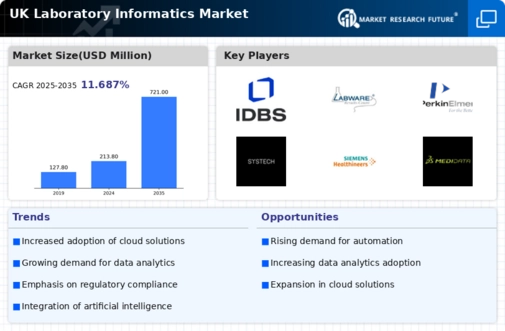
As per MRFR analysis, the UK laboratory informatics market size was estimated at 348.75 $ Million in 2024. The UK laboratory informatics market is projected to grow from $363.33 Million in 2025 to $547.12 Million by 2035, exhibiting a compound annual growth rate (CAGR) of 4.18% during the forecast period 2025 - 2035.

Key Market Trends & Highlights

The UK laboratory informatics market is experiencing robust growth driven by technological advancements and evolving regulatory landscapes.

  • The market is witnessing increased adoption of cloud solutions, enhancing accessibility and collaboration.
  • Integration of AI and machine learning is transforming data analysis and decision-making processes.
  • The focus on regulatory compliance is intensifying, necessitating advanced informatics solutions.
  • Rising demand for data management solutions and emphasis on automation and efficiency are key drivers of market growth.

Market Size & Forecast

2024 Market Size 348.75 (USD Million)
2035 Market Size 547.12 (USD Million)

Major Players

Thermo Fisher Scientific (US), Abbott Laboratories (US), PerkinElmer (US), Agilent Technologies (US), Waters Corporation (US), LabWare (US), Veeva Systems (US), IDBS (GB), Siemens Healthineers (DE)

UK Laboratory Informatics Market Trends

The laboratory informatics market is currently experiencing a transformative phase, driven by advancements in technology and the increasing need for efficient data management solutions. Organizations are increasingly adopting laboratory informatics systems to streamline operations, enhance data accuracy, and improve compliance with regulatory standards. This shift is largely influenced by the growing emphasis on automation and digitalization within laboratories, which facilitates better decision-making and accelerates research processes. Furthermore, the integration of artificial intelligence and machine learning into laboratory informatics tools is becoming more prevalent, allowing for sophisticated data analysis and predictive modeling. As a result, stakeholders are likely to invest in these technologies to remain competitive and responsive to evolving market demands. In addition, the laboratory informatics market is witnessing a rise in cloud-based solutions, which offer flexibility and scalability for laboratories of all sizes. These solutions enable remote access to data and applications, fostering collaboration among researchers and enhancing operational efficiency. The ongoing trend towards data-driven decision-making is also prompting laboratories to seek out advanced informatics solutions that can provide real-time insights and analytics. Overall, the laboratory informatics market appears poised for continued growth, as organizations recognize the value of leveraging technology to optimize their laboratory operations and drive innovation.

Increased Adoption of Cloud Solutions

The laboratory informatics market is seeing a notable shift towards cloud-based solutions. These platforms provide laboratories with enhanced flexibility, allowing for remote access to data and applications. This trend supports collaboration among researchers and streamlines workflows, ultimately leading to improved operational efficiency.

Integration of AI and Machine Learning

There is a growing trend towards the incorporation of artificial intelligence and machine learning within laboratory informatics systems. This integration enables advanced data analysis and predictive modeling, which can significantly enhance decision-making processes and research outcomes.

Focus on Regulatory Compliance

As regulatory requirements become more stringent, laboratories are increasingly prioritizing informatics solutions that ensure compliance. This focus drives the demand for systems that facilitate accurate data management and reporting, helping organizations to meet industry standards and avoid potential penalties.

UK Laboratory Informatics Market Drivers

Focus on Enhanced Data Security

Data security is an increasingly pressing concern within the laboratory informatics market, as laboratories handle sensitive information that must be protected from breaches. The rise in cyber threats has prompted laboratories to prioritize the implementation of robust security measures within their informatics systems. In the UK, regulatory bodies are also emphasizing the importance of data security, leading to heightened scrutiny of laboratory practices. As a result, laboratories are investing in informatics solutions that offer advanced security features, such as encryption and access controls. This focus on enhanced data security is likely to drive growth in the laboratory informatics market, as organizations seek to safeguard their data while ensuring compliance with regulatory standards.

Growing Need for Interoperability

Interoperability is becoming a critical driver in the laboratory informatics market, as laboratories increasingly require systems that can communicate seamlessly with one another. The ability to share data across different platforms and devices is essential for enhancing collaboration and improving research outcomes. In the UK, the laboratory informatics market is responding to this need by developing solutions that facilitate interoperability among various laboratory instruments and software. This trend is particularly relevant in multi-disciplinary research environments, where diverse data sources must be integrated for comprehensive analysis. As laboratories strive to enhance their collaborative capabilities, the demand for interoperable informatics solutions is likely to rise, further propelling the growth of the laboratory informatics market.

Emphasis on Automation and Efficiency

The laboratory informatics market is witnessing a significant emphasis on automation and operational efficiency. Laboratories are increasingly adopting automated systems to reduce manual errors and enhance productivity. Automation not only streamlines processes but also allows for real-time data collection and analysis, which is crucial for timely decision-making. In the UK, the laboratory informatics market is expected to benefit from this trend, as organizations seek to optimize their workflows and reduce operational costs. The integration of automated laboratory systems with informatics solutions is likely to enhance data accuracy and reliability, thereby improving overall laboratory performance. This focus on automation is anticipated to drive growth in the laboratory informatics market, as more laboratories recognize the value of investing in technology that supports efficient operations.

Rising Demand for Data Management Solutions

The laboratory informatics market is experiencing a notable surge in demand for advanced data management solutions. This trend is driven by the increasing volume of data generated in laboratories, necessitating efficient storage, retrieval, and analysis. In the UK, the laboratory informatics market is projected to grow at a CAGR of approximately 8% from 2025 to 2030. Laboratories are seeking integrated systems that can streamline workflows and enhance data integrity. As regulatory requirements become more stringent, the need for robust data management solutions is amplified, prompting laboratories to invest in informatics systems that ensure compliance and facilitate data sharing. This rising demand is likely to propel innovation within the laboratory informatics market, as vendors strive to offer solutions that meet the evolving needs of laboratory professionals.

Increased Investment in Research and Development

Investment in research and development (R&D) is a significant driver of growth in the laboratory informatics market. The UK government and private sector organizations are allocating substantial funds to R&D initiatives, particularly in the life sciences and biotechnology sectors. This investment is fostering innovation in laboratory informatics solutions, as companies seek to develop cutting-edge technologies that can support complex research activities. The laboratory informatics market is expected to benefit from this influx of funding, as new solutions emerge that address the specific needs of researchers. Furthermore, as competition intensifies, organizations are likely to prioritize R&D to maintain a competitive edge, thereby stimulating further growth in the laboratory informatics market.


Market Segment Insights

By Type: LIMS (Largest) vs. ELN (Fastest-Growing)

In the UK laboratory informatics market, the Laboratory Information Management System (LIMS) holds the largest share, commanding a significant portion of the overall market. Electronic Lab Notebooks (ELN) emerge as a notable contender, displaying robust growth trends and becoming increasingly vital for labs looking to enhance data collection and management efficiency. Other segments such as Scientific Data Management Systems (SDMS), Chromatography Data Systems (CDS), and Analytics Software also contribute to the market, albeit at a smaller scale and share. The growth of the UK laboratory informatics market is driven by the increasing demand for data integrity, compliance with regulations, and automation in laboratory processes. Vendors are focusing on enhancing capabilities through advanced technologies such as cloud computing and artificial intelligence, enabling labs to manage vast amounts of data efficiently. Furthermore, the emphasis on remote collaboration and increased research funding in technology-driven initiatives also fuels the adoption of informatics solutions, particularly in the ELN segment, which is expected to witness the fastest growth in the coming years.

LIMS (Dominant) vs. ELN (Emerging)

The Laboratory Information Management System (LIMS) remains the dominant player in the UK laboratory informatics market, characterized by its comprehensive features aimed at streamlining laboratory workflows and ensuring regulatory compliance. LIMS provides robust data management capabilities, allowing laboratories to manage samples, associated data, and laboratory processes efficiently. On the other hand, Electronic Lab Notebooks (ELN) are emerging rapidly as the preferred tool for researchers, particularly in environments that require flexibility in data documentation and collaboration. ELNs cater to the contemporary need for digital solutions, offering functionalities that support real-time data entry, integration with other laboratory instruments, and improved accessibility for research teams, thus positioning themselves as an essential tool in modern laboratories.

By Deployment Type: Cloud-Based (Largest) vs. On-Premise (Fastest-Growing)

The UK laboratory informatics market currently shows that Cloud-Based solutions hold the largest market share among deployment types due to their scalability, ease of access, and cost-effectiveness. Organizations are increasingly investing in cloud technologies, leading to a significant competitive edge for providers in this segment. Meanwhile, On-Premise deployments are also notable, primarily serving organizations with specific compliance, security, and data sovereignty requirements. In terms of growth trends, the On-Premise segment is recognized as the fastest-growing, driven by the rising need for secure data management within laboratories. Factors such as regulatory compliance and a growing focus on data integrity are propelling this segment's expansion. Additionally, the Hybrid model is gaining traction as it combines the benefits of both cloud and on-premise solutions, appealing to organizations looking for flexible deployment options.

Cloud-Based (Dominant) vs. On-Premise (Emerging)

Cloud-Based solutions dominate the UK laboratory informatics market due to their ability to offer efficient, scalable services that require less upfront investment and maintenance. These solutions enable laboratories to access data and analytical tools remotely, fostering collaboration and innovation. Their continuing evolution and integration with advanced technologies like AI and Machine Learning position them favorably against competing deployment types. On the other hand, On-Premise solutions are emerging strongly, driven by sectors that prioritize stringent data control and protection. This segment appeals particularly to organizations that operate in highly regulated environments, ensuring data stays within their infrastructure while also addressing specific institutional needs.

By End User: Pharmaceuticals (Largest) vs. Biotechnology (Fastest-Growing)

The market share distribution in the segment of end users reveals that Pharmaceuticals take the lead as the largest segment in the UK laboratory informatics market. This sector benefits significantly from the increasing demand for drug development and regulatory compliance, contributing to a substantial portion of the market share. Biotechnology, while smaller in overall share, demonstrates rapid growth as innovative therapies and personalized medicine continue to gain traction, indicating an increasing investment in research and development across this sector. Growth trends in the UK laboratory informatics market underscore the importance of both Pharmaceuticals and Biotechnology. Pharmaceuticals are projected to maintain their dominance, driven by technological advancements and an increased focus on precision medicine. Conversely, the Biotechnology sector is poised for substantial growth due to its agility in adopting new technology and the rising need for data management in research settings, marking it as the fastest-growing segment with a promising outlook for the near future.

Pharmaceuticals (Dominant) vs. Biotechnology (Emerging)

Pharmaceuticals remain the dominant force in the UK laboratory informatics market, fuelled by a robust pipeline of drug development and a focus on regulatory compliance. This segment benefits from substantial investments in technological infrastructure and data analysis tools that enhance operational efficiency and research capabilities. On the other hand, Biotechnology is emerging rapidly due to the increasing focus on innovative drug solutions and personalized therapies. As research institutions and startups focus on biotechnological advancements, this segment is attracting significant investment, highlighting a shift in market dynamics where agility and innovation drive competitiveness.

By Application: Drug Discovery (Largest) vs. Clinical Research (Fastest-Growing)

In the UK laboratory informatics market, the application segment is witnessing significant distribution among various categories. Drug Discovery holds the largest share, demonstrating its critical role in pharmaceutical development and innovation. Quality Control and Environmental Testing also contribute to the market, but their shares are comparatively smaller. Food and Beverage Testing is essential for compliance and safety but lags in share relative to other segments. As the market evolves, Clinical Research emerges as the fastest-growing area, driven by increased demand for efficient data management solutions and regulatory compliance. The advancements in technology and the push towards personalized medicine are propelling Drug Discovery forward. Moreover, growing investments in research and development across sectors are set to enhance the robustness of the entire application landscape.

Drug Discovery: Dominant vs. Clinical Research: Emerging

Drug Discovery represents the dominant force within the application segment of the UK laboratory informatics market, characterized by its extensive use in driving pharmaceutical advancements and innovation. It facilitates complex data analysis and integration, crucial for modern drug development processes. Conversely, Clinical Research is an emerging segment, gaining momentum due to the increasing need for rapid data collection and analysis in clinical trials. This segment benefits notably from the integration of advanced informatics solutions that streamline operations and enhance collaboration among research teams. The emphasis on patient-centric approaches is further accelerating its growth, presenting a dynamic shift that complements Drug Discovery's established dominance.

Get more detailed insights about UK Laboratory Informatics Market

Key Players and Competitive Insights

The laboratory informatics market is currently characterized by a dynamic competitive landscape, driven by technological advancements and increasing demand for data management solutions. Key players such as Thermo Fisher Scientific (US), Agilent Technologies (US), and LabWare (US) are strategically positioned to leverage innovation and digital transformation. Thermo Fisher Scientific (US) focuses on enhancing its software solutions to integrate seamlessly with laboratory instruments, thereby improving operational efficiency. Meanwhile, Agilent Technologies (US) emphasizes partnerships with academic institutions to foster research and development, which enhances its product offerings. LabWare (US) is concentrating on expanding its cloud-based solutions, which aligns with the growing trend towards remote data access and management. Collectively, these strategies contribute to a competitive environment that prioritizes technological integration and customer-centric solutions.

In terms of business tactics, companies are increasingly localizing manufacturing and optimizing supply chains to enhance responsiveness to market demands. The market structure appears moderately fragmented, with several key players holding substantial market shares while also facing competition from emerging firms. This fragmentation allows for diverse offerings and innovation, as companies strive to differentiate themselves through unique value propositions.

In October 2025, Thermo Fisher Scientific (US) announced a strategic partnership with a leading biotechnology firm to develop advanced laboratory informatics solutions tailored for genomic research. This collaboration is expected to enhance data analysis capabilities, thereby positioning Thermo Fisher as a leader in the genomic informatics space. The strategic importance of this partnership lies in its potential to accelerate product development cycles and improve customer engagement through tailored solutions.

In September 2025, Agilent Technologies (US) launched a new cloud-based platform designed to streamline laboratory workflows and enhance data sharing among researchers. This initiative reflects Agilent's commitment to digital transformation and positions the company to capitalize on the increasing demand for integrated laboratory solutions. The launch is significant as it not only enhances Agilent's product portfolio but also addresses the growing need for collaborative research environments.

In August 2025, LabWare (US) expanded its operations in the UK by establishing a new regional office aimed at providing localized support and services. This move is indicative of LabWare's strategy to strengthen its market presence and improve customer service. By enhancing its local footprint, LabWare is likely to gain a competitive edge in responding to customer needs and adapting to regional market dynamics.

As of November 2025, current competitive trends in the laboratory informatics market include a pronounced focus on digitalization, sustainability, and the integration of artificial intelligence (AI) into laboratory processes. Strategic alliances are increasingly shaping the landscape, enabling companies to pool resources and expertise to drive innovation. Looking ahead, competitive differentiation is expected to evolve, with a shift from price-based competition towards a focus on innovation, technological advancements, and supply chain reliability. This transition underscores the importance of agility and responsiveness in meeting the evolving needs of the market.

Key Companies in the UK Laboratory Informatics Market market include

Industry Developments

The UK Laboratory Informatics Market has seen significant developments recently, highlighted by the growth of companies specializing in laboratory data management solutions. In August 2023, Oracle Corporation expanded its cloud services tailored for life sciences, aiming to enhance data integration in laboratory environments. IDBS, with a focus on data management, launched a new platform in July 2023 designed to streamline research processes, reflecting a growing emphasis on agility in laboratories.

In the merger and acquisition landscape, Thermo Fisher Scientific entered into an agreement in June 2023 to acquire a significant UK-based laboratory informatics firm, enhancing its software portfolio. The valuation of major players like Agilent Technologies and Waters Corporation has shown upward trends, indicating increased investment in innovative laboratory solutions that integrate advanced analytics. Moreover, Siemens Healthineers introduced new informatics solutions in September 2023, further enabling laboratories to utilize real-time data for improved decision-making.

The increasing demand for automation, integration of artificial intelligence, and streamlined workflows is actively reshaping the laboratory informatics segment in the UK, reflecting a market poised for continued growth and innovation.

Future Outlook

UK Laboratory Informatics Market Future Outlook

The Laboratory Informatics Market is projected to grow at 4.18% CAGR from 2024 to 2035, driven by technological advancements, regulatory compliance, and increasing demand for data management solutions.

New opportunities lie in:

  • Integration of AI-driven analytics platforms for enhanced data insights.
  • Development of cloud-based laboratory management systems for remote access.
  • Expansion of mobile laboratory informatics solutions for on-the-go data collection.

By 2035, the laboratory informatics market is expected to achieve substantial growth and innovation.

Market Segmentation

UK Laboratory Informatics Market Type Outlook

  • Laboratory Information Management System (LIMS)
  • Electronic Lab Notebooks (ELN)
  • Scientific Data Management System (SDMS)
  • Chromatography Data System (CDS)
  • Analytics Software

UK Laboratory Informatics Market End User Outlook

  • Pharmaceuticals
  • Biotechnology
  • Clinical Laboratories
  • Academic Research
  • Environmental Testing

UK Laboratory Informatics Market Application Outlook

  • Drug Discovery
  • Quality Control
  • Clinical Research
  • Environmental Testing
  • Food and Beverage Testing

UK Laboratory Informatics Market Deployment Type Outlook

  • On-Premise
  • Cloud-Based
  • Hybrid

Report Scope

MARKET SIZE 2024 348.75(USD Million)
MARKET SIZE 2025 363.33(USD Million)
MARKET SIZE 2035 547.12(USD Million)
COMPOUND ANNUAL GROWTH RATE (CAGR) 4.18% (2024 - 2035)
REPORT COVERAGE Revenue Forecast, Competitive Landscape, Growth Factors, and Trends
BASE YEAR 2024
Market Forecast Period 2025 - 2035
Historical Data 2019 - 2024
Market Forecast Units USD Million
Key Companies Profiled Thermo Fisher Scientific (US), Abbott Laboratories (US), PerkinElmer (US), Agilent Technologies (US), Waters Corporation (US), LabWare (US), Veeva Systems (US), IDBS (GB), Siemens Healthineers (DE)
Segments Covered Type, Deployment Type, End User, Application
Key Market Opportunities Integration of artificial intelligence in laboratory informatics enhances data analysis and operational efficiency.
Key Market Dynamics Growing demand for integrated laboratory informatics solutions driven by regulatory compliance and technological advancements in the UK.
Countries Covered UK

Leave a Comment

FAQs

What is the expected market size of the UK Laboratory Informatics Market in 2024?

The UK Laboratory Informatics Market is expected to be valued at 213.75 million USD in 2024.

What is the projected market value for the UK Laboratory Informatics Market by 2035?

By 2035, the UK Laboratory Informatics Market is projected to reach a value of 721.0 million USD.

What is the expected compound annual growth rate (CAGR) for the UK Laboratory Informatics Market from 2025 to 2035?

The expected CAGR for the UK Laboratory Informatics Market from 2025 to 2035 is 11.687 %.

Which application is expected to dominate the UK Laboratory Informatics Market by 2035?

Laboratory Information Management Systems are expected to dominate the market, with a value of 300.0 million USD by 2035.

What is the market value for Electronic Lab Notebooks in 2024?

The market value for Electronic Lab Notebooks is projected at 60.0 million USD in 2024.

How much is the Chromatography Data Systems segment expected to grow by 2035?

The Chromatography Data Systems segment is expected to grow to 140.0 million USD by 2035.

Who are the major players in the UK Laboratory Informatics Market?

Major players include Oracle Corporation, Agilent Technologies, and Thermo Fisher Scientific among others.

What are some key growth drivers for the UK Laboratory Informatics Market?

Increased automation and demand for efficient data management are key growth drivers for the market.

What challenges does the UK Laboratory Informatics Market currently face?

Challenges include data privacy concerns and the need for seamless integration of diverse systems.

What is the market value for Scientific Data Management Systems in 2024?

The market value for Scientific Data Management Systems is expected to be 28.75 million USD in 2024.

Download Free Sample

Kindly complete the form below to receive a free sample of this Report

Compare Licence

×
Features License Type
Single User Multiuser License Enterprise User
Price $4,950 $5,950 $7,250
Maximum User Access Limit 1 User Upto 10 Users Unrestricted Access Throughout the Organization
Free Customization
Direct Access to Analyst
Deliverable Format
Platform Access
Discount on Next Purchase 10% 15% 15%
Printable Versions