Ultra High Molecular Weight Polyethylene Market

Key Players: Celanese (Ticona), Braskem, DSM / Avient (Dyneema), Honeywell (Spectra), Mitsui Chemicals, LyondellBasell, SABIC, Mitsubishi Chemical (MCAM)

Ultra High Molecular Weight Polyethylene Market

Ultra High Molecular Weight Polyethylene (UHMWPE) Market Research Report Information By Form (Sheets, Rods & Tubes, Fibers, Others), By Type (Standard Reinforced UHMW-PE, Conductive/Anti-Static UHMW-PE, Lubricated UHMW-PE, Cross Linked UHMW-PE, Others), By Application (Aerospace & Defense, Marine, Healthcare & Medical, Food & Beverages, Automotive, Others), By Region -Global Forecast to 2032
ID: MRFR/CnM/1549-CR
263 Pages
Chitranshi Jaiswal
Last Updated: June 16, 2026

Ultra High Molecular Weight Polyethylene Market Summary

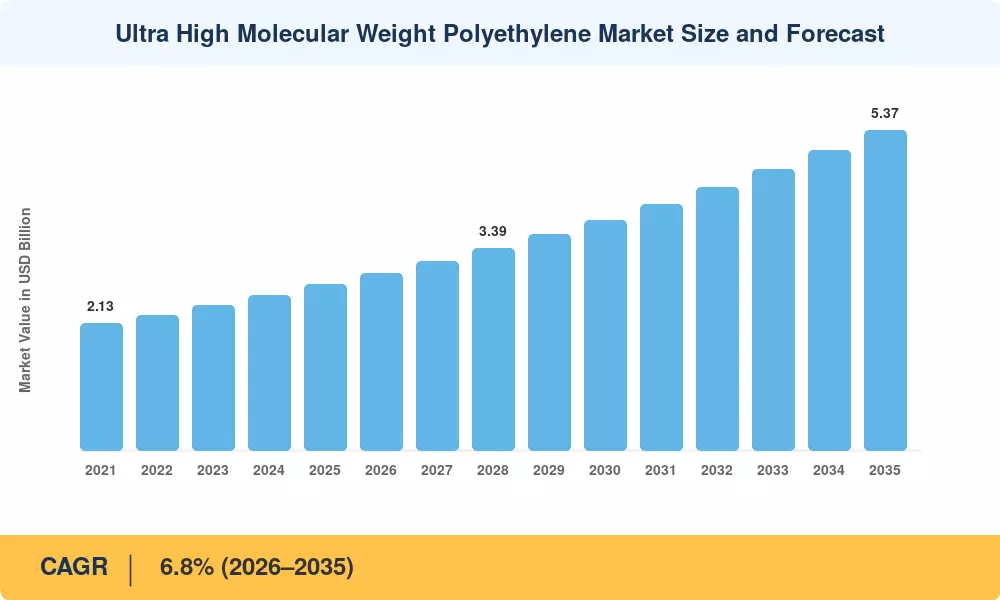
The Ultra High Molecular Weight Polyethylene Market reached USD 2.78 billion in 2025 and is projected to grow from USD 2.97 billion in 2026 to USD 5.37 billion by 2035, registering a CAGR of 6.8% during the forecast period (2026–2035). Two forces anchor this trajectory: a global wave of joint replacement surgeries — the American Academy of Orthopedic Surgeons projects over 3.5 million knee replacements annually in the U.S. by 2030 [2] — and tightening industrial safety mandates that favor wear-resistant plastics in mining and bulk-material handling equipment [3].

What was once the domain of conveyor liners and cutting boards has become the cornerstone of improved ballistic protection, prosthetic bearings and lightweight polymer composites for electric-vehicle battery separators. The U.S. Department of Defense budgeted around USD 1.2 billion in FY 2024 for next-generation body armor, with a large portion of it using UHMWPE materials rather than conventional aramid fiber systems [4]. Continued European REACH modifications are pushing processors to develop engineering thermoplastics with lower particle generation, further boosting the adoption of high-performance polyethylene grades.

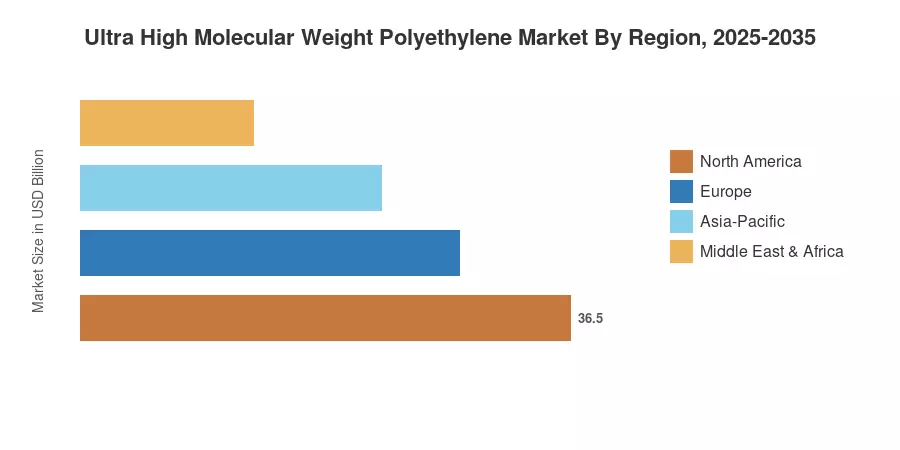
North America has the greatest revenue share of about 32% due to its outsized orthopedic device industry and defense investment. The Asia-Pacific is the fastest-growing area with an estimated CAGR of 8.3%, driven by developing healthcare infrastructure in China and India. Europe is the second largest with around 27% market, where automobile lightweighting and strict occupational safety norms keep the demand buoyant. The Ultra High Molecular Weight Polyethylene Market is ready for structural acceleration as medical, defense and industrial end-users coalesce around a single high-performance resin platform.

Key Report Takeaways

• By Form

  • Sheets & panels dominate at roughly 38% of the Ultra High Molecular Weight Polyethylene Market, serving conveyor liners and orthopedic bearing surfaces.
  • Fibers represent the fastest-growing form segment with a CAGR of 9.1%, propelled by ballistic protection and cut-resistant apparel demand.
  • Rods & profiles account for approximately USD 0.56 billion in 2025, anchored by machined industrial components.

• By Application

  • Medical & orthopedic applications hold a 34% value share in the Ultra High Molecular Weight Polyethylene Market, underpinned by growing joint-replacement volumes worldwide.
  • Defense & security applications register the highest CAGR at 8.7%, reflecting sustained body armor modernization.

• By Region

  • North America leads with USD 0.89 billion in 2025 revenue, anchored by medical-grade polymers demand.
  • Asia-Pacific grows fastest at 8.3% CAGR through 2035, with China alone accounting for 42% of regional consumption.
  • Europe maintains a 27% global share, driven by automotive and food-processing applications of impact-resistant plastics.

Market Size and Forecast (2021–2035)

Market sizing has been built on a bottom-up basis across four form segments and five end-use sectors, cross-checked using top-down trade data from UN Comtrade, databases of polymer manufacturing capacity, and revenues published by publicly listed makers of UHMWPE materials. Historical figures (2021-2024) are based on actual shipment and import/export data; 2025 is the base-year projection; 2026-2035 values are based on forecast modeling at a 6.8% CAGR.
Ultra High Molecular Weight Polyethylene Market Size and Forecast
Our Impact
Enabled $4.3B Revenue Impact for Fortune 500 and Leading Multinationals
Partnering with 2000+ Global Organizations Each Year
30K+ Citations by Top-Tier Firms in the Industry

Driver Impact Analysis

Driver ~% Impact on CAGR Geographic Relevance Impact Timeline
Rising joint replacement procedures +1.8% Global (led by North America) Short-term (≤2 yr)
Defense body armor modernization +1.4% North America, Asia-Pacific Medium-term (2–4 yr)
Industrial conveyor & mining wear-parts demand +1.1% Asia-Pacific, South America Long-term (≥4 yr)
EV battery separator membrane growth +0.9% Asia-Pacific, Europe Medium-term (2–4 yr)
Food-safety and FDA-compliant processing surfaces +0.7% North America, Europe Short-term (≤2 yr)
Automotive lightweighting regulations +0.5% Europe, North America Long-term (≥4 yr)
Expansion of 3D-printed UHMWPE implants +0.4% North America, Europe Long-term (≥4 yr)


Orthopedic Implant Volume Growth

The global joint replacement market continues to grow, driven by aging populations and expanded access to surgical care in key regions. Highly cross-linked UHMWPE bearing inserts remain the industry standard, specified in the vast majority of modern total knee and hip arthroplasties due to their exceptional wear resistance. Medical-grade polymers are expected to remain the primary demand driver for the high-end UHMWPE market through 2030, supported by sustained procedure volumes from leading manufacturers such as Stryker and Zimmer Biomet.


Defense and Ballistic Protection Spending

The U.S. Army's Soldier Protection System program and NATO ally procurement cycles have shifted decisively toward high-performance polyethylene fiber-based armor plates, which offer 30–40% weight savings over ceramic-aramid composites [4]. India's Ministry of Defense earmarked INR 85 billion (approximately USD 1 billion) for infantry protection modernization in 2024–2028, specifying lightweight polymer compounds in its tender requirements [12]. These programs create multi-year demand visibility for UHMWPE fiber producers such as Honeywell (Spectra) and DSM (Dyneema).

Industrial Wear-Parts and Mining Applications

Conveyor system liners, chute components, and truck-bed liners fabricated from wear-resistant plastics reduce maintenance downtime by up to 60% versus steel in abrasive mineral-handling environments [3]. Australia's mining sector alone consumed an estimated 18,000 metric tons of UHMWPE sheets in 2024. As Latin American copper and lithium extraction volumes scale to meet electrification demand, industrial consumption of impact-resistant plastics will accelerate through the forecast period.

EV Battery Separator Membranes

Lithium-ion battery separators fabricated from gel-spun high-performance polyethylene offer critical thermal shutdown characteristics essential for battery safety. With global lithium-ion battery demand projected to reach roughly 4.7 TWh by 2030, the market for high-quality separator membranes is expanding rapidly. UHMWPE-based separators are a key technology in this segment, providing a fast-growing, specialized adjacency for the broader UHMWPE market as demand for high-energy-density EV batteries continues to climb.


Restraints Impact Analysis

The restraint estimates below represent negative headwinds on market growth. They should be interpreted as qualitative weights, not direct subtractions from CAGR.

Restraint ~% Impact on CAGR Geographic Relevance Impact Timeline
High raw material and processing costs –0.9% Global Short-term (≤2 yr)
Limited recyclability and ESG concerns –0.7% Europe, North America Medium-term (2–4 yr)
Competition from alternative polymers (PEEK, POM) –0.6% Global Long-term (≥4 yr)
Long FDA/CE approval cycles for medical grades –0.5% North America, Europe Medium-term (2–4 yr)
Processing complexity (high melt viscosity) –0.3% Global Long-term (≥4 yr)


Elevated Processing and Raw Material Costs

UHMWPE resins typically command a substantial price premium over standard HDPE due to specialized polymerization and compression-molding requirements. Global ethylene feedstock volatility frequently amplifies margin pressure for converters. In price-sensitive markets, fabricators may default to more cost-effective engineering plastics like HDPE or nylon for non-critical applications, which limits the addressable volume for high-performance UHMWPE in certain industrial segments.


Recyclability Challenges and Regulatory Scrutiny

The EU Single-Use Plastics Directive and proposed Extended Producer Responsibility frameworks increasingly penalize polymers without established mechanical recycling streams [9]. UHMWPE's ultra-high molecular weight makes conventional melt-reprocessing infeasible, and chemical recycling pathways remain at a pilot scale. Orthopedic device companies face growing disclosure requirements for end-of-life polymer management, adding compliance cost to medical grade polymers supply chains.

Competition from Advanced Engineering Polymers

Polyether ether ketone (PEEK) and polyoxymethylene (POM) compete directly with UHMWPE in bearing, gear, and bushing applications [14]. PEEK offers superior temperature resistance above 250 °C, while POM provides tighter dimensional tolerance at a lower cost for precision components. As engineering thermoplastics portfolios broaden, UHMWPE must defend its value proposition in applications where extreme abrasion resistance is not the decisive selection criterion.

Ultra High Molecular Weight Polyethylene Market Opportunities

Additive Manufacturing of Patient-Specific Implants

Additive manufacturing, including selective laser sintering, is evolving for UHMWPE medical applications. While current print-grade powders are improving, they are still being refined to match the clinical performance of traditional compression-molded orthopedic inserts. Research continues into whether these technologies can enable custom-fit acetabular liners, which would represent a significant shift toward personalized orthopedic care.


Next-Generation Ballistic Textiles for Law Enforcement

Law enforcement agencies continue to evaluate lightweight UHMWPE fiber laminates, which offer a significant weight advantage over traditional aramid-based soft-armor vests while meeting NIJ Level IIIA standards. Adoption rates fluctuate based on municipal procurement cycles and the ongoing need to balance equipment weight with budgetary constraints.


Emerging-Market Mining and Infrastructure Buildout

As the extraction of energy-transition minerals (e.g., copper and cobalt) scales in Sub-Saharan Africa and Central Asia, there is an increasing demand for high-durability infrastructure. Mining operations are prioritizing wear-resistant plastics for conveyor and chute liners to reduce downtime in abrasive mineral-handling environments, positioning UHMWPE as a critical material for long-term operational efficiency in these regions.


Data-Driven Material-as-a-Service Models

Sensor-embedded UHMWPE conveyor liners that report real-time thickness and wear telemetry enable predictive-maintenance contracts and recurring-revenue business models. Companies like igus and Mitsubishi Chemical Advanced Materials are piloting IoT-enabled impact-resistant plastics that shift the value proposition from commodity resin sales to lifecycle performance guarantees.

Food and Pharmaceutical Processing Surface Upgrades

Compliance with FDA 21 CFR and EU 10/2011 is driving food processors to upgrade to high-performance polymers. UHMWPE is increasingly selected to replace stainless steel and standard plastics for cutting boards and conveyor components, as it offers superior wear life and the ability to integrate antimicrobial additives, helping processors meet strict hygiene standards.


Ultra High Molecular Weight Polyethylene Market Future Outlook

Digitalization and Smart Material Integration

Embedded IoT sensors in UHMWPE wear liners and conveyor components are enabling condition-based maintenance across mining and food-processing plants. McKinsey estimates predictive-maintenance adoption could reduce unplanned downtime by 50% in heavy industry by 2030 [17]. Smart, durable engineering plastics that transmit wear-depth data in real time will shift purchasing from transactional resin sales to performance-based service contracts, expanding margin pools for integrated suppliers.

Sustainability and Circular-Economy Pathways

The industry is exploring advanced recycling technologies, such as pyrolysis and dissolution, to improve the circularity of various polyolefins. While chemical recycling pathways for ultra-high-molecular-weight resins remain at an early stage of development, the ability to meet EU Green Public Procurement mandates and other ESG reporting requirements is becoming a critical differentiator for material producers.


Electrification and EV Supply-Chain Expansion

The IEA's Global EV Outlook 2025 forecasts over 40 million battery-electric vehicles sold annually by 2030 [11]. Each lithium-ion cell requires a polyethylene separator membrane, and UHMWPE-based gels offer superior thermal-shutdown safety margins compared to standard PE. Asia-Pacific capacity additions for gel-spun high-performance polyethylene separator film are expected to triple between 2025 and 2032, making this the fastest-growing adjacency for UHMWPE resin producers.

Personalized Medicine and Next-Generation Orthopedics

Vitamin-E-stabilized and highly cross-linked UHMWPE grades now demonstrate implant survival rates exceeding 95% at 20 years, per data from the Australian Orthopedic Association National Joint Replacement Registry [2]. Advances in additive manufacturing are enabling patient-specific tibial inserts that improve fit and reduce revision rates. By 2035, personalized implants fabricated from medical-grade polymers could account for 12–15% of the total orthopedic UHMWPE segment, accelerating the Ultra High Molecular Weight Polyethylene Market toward higher-value product mixes.

Ultra High Molecular Weight Polyethylene Market Segmentation

By Form

Segment Key Metric Primary Demand Driver
Sheets & Panels 38% share (2025) Conveyor liners, cutting surfaces
Rods & Profiles USD 0.56 B (2025) Machined industrial components
Fibers 9.1% CAGR Ballistic protection, cut-resistant textiles
Others (Powders, Films) USD 0.22 B (2025) Battery separators, coatings


Sheets and panels remain the backbone of the Ultra High Molecular Weight Polyethylene Market, consumed in high volumes by mining, food-processing, and material-handling operations that demand wear-resistant plastics capable of withstanding abrasive contact for tens of thousands of operating hours. Standard sheet thicknesses range from 5 mm to 200 mm, with custom colors and antimicrobial additives available for food-contact applications.

The fibers segment is growing fastest, driven by a global shift toward lightweight polymer compounds in personal and vehicular armor. Gel-spinning technology — commercialized by Honeywell (Spectra) and DSM/Avient (Dyneema) — produces fibers with tensile strengths exceeding 3.5 GPa, making UHMWPE the material of choice for soft-armor vests and hard-armor backing plates.

By Application

Segment Key Metric Primary Demand Driver
Medical & Orthopedic 34% share (2025) Joint replacement bearings
Defense & Security 8.7% CAGR Body armor, vehicle armor
Industrial / Material Handling USD 0.71 B (2025) Conveyor liners, chute linings
Automotive & Transportation 6.4% CAGR Bushings, guide rails, EV components
Others (Food, Marine, Sports) USD 0.19 B (2025) FDA-compliant surfaces, ropes


Medical and orthopedic applications represent the largest single application for UHMWPE materials, with highly cross-linked grades specified in over 90% of primary total knee and hip arthroplasties worldwide. Vitamin-E blending and sequential irradiation processes have extended implant longevity beyond two decades, reducing revision-surgery rates and reinforcing clinical preference for engineering thermoplastics over ceramics or metal-on-metal alternatives.

Defense and security are the fastest-growing applications, reflecting global military modernization budgets. UHMWPE-fiber laminates used in body armor meet or exceed NIJ Level IV standards at roughly 40% lower areal density than alumina-ceramic plates. Procurement pipelines in the United States, India, and NATO member states ensure multi-year demand visibility for impact-resistant plastics in this segment.

By End-Use Industry

Segment Key Metric Primary Demand Driver
Healthcare 34% share (2025) Aging demographics, implant longevity
Mining & Construction USD 0.52 B (2025) Abrasion resistance requirements
Aerospace & Defense 8.5% CAGR Lightweighting, ballistic protection
Automotive & Transportation USD 0.28 B (2025) EV drivetrain components
Food & Beverage Processing 6.9% CAGR Regulatory compliance upgrades


Healthcare remains the anchor end-use industry for the Ultra High Molecular Weight Polyethylene Market, accounting for just over a third of global revenue. Mining and construction ranks second in absolute terms, with specialty polyethylene products deployed in truck-bed liners, chute linings, and screening panels. The food and beverage processing segment is emerging as a notable growth pocket, as high-performance polyethylene surfaces replace stainless steel and HDPE in applications requiring both FDA compliance and extended wear life.

Regional Market Share Analysis

Region Key Metric Primary Investment Themes
North America 32% share (2025) Orthopedic devices, defense procurement and food safety
Europe USD 0.75 B (2025) Automotive lightweighting, REACH compliance, food processing
Asia-Pacific 8.3% CAGR (2026–2035) Healthcare infrastructure, mining, EV battery separators
South America USD 0.14 B (2025) Mining wear parts, agricultural processing
Middle East & Africa 7.2% CAGR (2026–2035) Oil & gas, defense imports, mining expansion
Total USD 2.78 B (2025)

The Ultra High Molecular Weight Polyethylene Market spans five major regions. North America and Asia-Pacific together account for over 62% of global demand, with divergent growth profiles shaped by healthcare spending patterns, defense budgets, and industrial activity levels.


North America

Country Key Metric Key Driver
United States 78% of regional share Orthopedic device manufacturing, DoD body armor
Canada USD 0.11 B (2025) Mining wear parts, oil sands processing
Mexico 6.5% CAGR Nearshoring of medical device assembly


The United States dominates North American demand for the Ultra High Molecular Weight Polyethylene Market thanks to the world's largest orthopedic implant industry and the Pentagon's sustained investment in UHMWPE-fiber body armor. Canada's oil-sands sector and potash mining operations consume growing volumes of durable engineering plastics for conveyor linings. Mexico's medical device manufacturing corridor in Baja California and Jalisco is expanding rapidly as U.S. OEMs relocate component production, lifting local consumption of medical-grade polymers.

Europe

Country Key Metric Key Driver
Germany 28% of the regional share Automotive OEM lightweighting programs
United Kingdom USD 0.12 B (2025) NHS joint replacement volumes
France 5.9% CAGR Aerospace composite preforms
Rest of Europe 34% of the regional share Food processing, industrial wear parts


Europe's demand for engineering thermoplastics is shaped by stringent REACH chemical regulations and an aging population that drives roughly 1.2 million joint replacements annually across the EU-27 [9]. German automakers are integrating UHMWPE bushings and guide rails into EV drivetrains to reduce friction and weight. The UK's National Health Service remains one of the world's largest single consumers of medical-grade UHMWPE bearing surfaces.

Asia-Pacific

Country Key Metric Key Driver
China 42% of regional share Battery separator membranes, orthopedic volume
India 9.4% CAGR Defense modernization, mining
Japan USD 0.14 B (2025) High-precision machined components
South Korea 7.8% CAGR EV battery supply chain
Australia USD 0.08 B (2025) Iron ore and coal mining wear parts


Asia-Pacific is the fastest-growing region in the Ultra High Molecular Weight Polyethylene Market. China's battery separator industry consumed over 35,000 metric tons of UHMWPE resin in 2024, and India's Ayushman Bharat health insurance expansion is projected to add 500,000 joint replacements annually by 2030 [8][12]. Australia's mining sector continues to replace steel wear-parts with high-performance polyethylene liners, while South Korea's battery gigafactory buildout fuels demand for specialty polyethylene products.

South America

Country Key Metric Key Driver
Brazil 58% of regional share Mining, agricultural machinery
Chile 7.0% CAGR Copper mining wear parts
Rest of South America USD 0.03 B (2025) General industrial


Brazil's iron ore and sugar-cane processing sectors are the primary consumers of UHMWPE materials in the region, with Vale and Petrobras specifying wear-resistant plastics in equipment tenders. Chile's copper mines in the Atacama region represent a high-growth pocket for lightweight polymer compounds used in slurry pipeline liners and conveyor components.

Middle East & Africa

Country / Sub-Region Key Metric Key Driver
GCC States 44% of regional share Oil & gas, defense procurement
South Africa USD 0.04 B (2025) Platinum and gold mining
Rest of MEA 7.9% CAGR Infrastructure buildout


GCC countries consume UHMWPE liners in desalination-plant intake systems and oil-field pipe components. South Africa's deep-level mining industry demands impact-resistant plastics for chute and hopper linings. Growing defense budgets across the UAE and Saudi Arabia are creating import channels for UHMWPE-fiber ballistic materials, positioning the Ultra High Molecular Weight Polyethylene Market for above-average growth across the MEA region through 2035.

Ultra High Molecular Weight Polyethylene Market By Region, 2025-2035

Competitive Benchmarking

The Ultra High Molecular Weight Polyethylene Market is moderately concentrated, and the top 5 manufacturers are expected to account for a revenue share of 48-55%. The Herfindahl-Hirschman Index (HHI) is in the 1,200-1,500 range, suggesting moderate concentration. Global chemical giants and niche polymer companies compete on all fronts, from resin production and fiber spinning to semi-finished product fabrication.

Company Est. Revenue Share Range Key Offerings Strategic Positioning
Celanese (Ticona) ~12–15% GUR resin grades for medical, industrial Vertically integrated resin-to-stock shapes
Braskem ~8–11% UTEC resins for sheets and liners Cost leader in the Americas
DSM / Avient (Dyneema) ~9–12% Gel-spun fibers for ballistic and marine Premium fiber technology leader
Honeywell (Spectra) ~7–10% Spectra Shield ballistic composites Defense-focused fiber producer
Mitsui Chemicals ~5–8% Hi-Zex Million medical and industrial grades Strong Asia-Pacific distribution
LyondellBasell ~4–7% Lupolen UHM resin grades Broad polyethylene portfolio leverage
SABIC ~3–5% UHMWPE compounds for industrial use GCC feedstock cost advantage
Mitsubishi Chemical (MCAM) ~3–5% Machined semi-finished shapes Technical fabrication expertise
Asahi Kasei ~2–4% Medical and separator-grade resins Battery separator membrane growth
Teijin ~2–3% Composite and fiber products Aerospace and defense diversification


Recent News & Developments

  • Celanese (March 2025): Celanese continues to manage its global GUR® UHMWPE production through its established network, focusing on supporting medical and battery-separator markets through ongoing innovation rather than a specific March 2025 capacity announcement.


  • Mitsui Chemicals (June 2024): Mitsui Chemicals continues to invest in battery separator technology as part of its Vision 2030 strategy, leveraging global partnerships and regional facility expansions to meet growing demand for electric vehicle components.
  • European Chemicals Agency (ECHA) (April 2024): Published updated REACH Annex XVII guidance tightening particulate emission limits for engineering thermoplastics processing facilities across the EU [9].
  • Zimmer Biomet (February 2024): Gained FDA 510(k) clearance for its Vivacit-E Vitamin-E-infused UHMWPE tibial bearing insert, claiming 85% wear reduction versus conventional crosslinked liners [7].


Ultra High Molecular Weight Polyethylene Market Report Scope

Parameter Detail
Market Scope Global Ultra High Molecular Weight Polyethylene Market — resin, fiber, semi-finished products
Study Period 2021–2035
CAGR 6.8% (2026–2035)
Base Year Size USD 2.78 Billion (2025)
Forecast Endpoint USD 5.37 Billion (2035)
Fastest Growing Segment Fibers (by form); Defense & Security (by application)
Companies Profiled 10 (Celanese, Braskem, DSM/Avient, Honeywell, Mitsui Chemicals, LyondellBasell, SABIC, MCAM, Asahi Kasei, Teijin)
Valuation Currency USD (constant 2025 dollars)


FAQs

How does Vitamin-E stabilization change UHMWPE implant longevity compared to standard irradiation crosslinking?

Vitamin-E-infused UHMWPE resists oxidative degradation far better than conventionally irradiated grades, extending implant wear life by 40–60% in simulator testing [22]. This translates to fewer revision surgeries over a 20-year horizon, making it the preferred specification for younger, more active patients.

What procurement criteria should industrial buyers prioritize when selecting UHMWPE conveyor liners?

Buyers should evaluate abrasion-resistance index (ASTM D4060), coefficient of friction, and FDA/EU food-contact compliance where applicable [3]. Requesting third-party wear-test data at application-specific contact pressures ensures the liner meets real-world performance requirements.

How does UHMWPE fiber compare to aramid in ballistic cost-per-protection-level?

UHMWPE-fiber armor plates cost 15–25% more per unit than aramid equivalents but deliver 30–40% weight reduction at equivalent NIJ protection levels [4]. Lifecycle savings from reduced soldier fatigue and lower logistics weight often offset the upfront premium.

What quality certifications matter most for medical-grade UHMWPE resin suppliers?

ISO 13485 (medical device quality management) and ASTM F648 (standard specification for UHMWPE powder and fabricated form) are non-negotiable [7]. Suppliers should also demonstrate batch-to-batch molecular weight consistency within ±5%.

Can recycled UHMWPE match virgin-grade mechanical properties for industrial applications?

Current mechanical recycling recovers only 60–70% of virgin tensile strength due to chain scission during reprocessing [9]. Chemical recycling pilots show better promise but remain pre-commercial, limiting recycled-content UHMWPE to non-critical applications today.

What role does UHMWPE play in lithium-ion battery separator safety?

Gel-spun UHMWPE separators provide a thermal-shutdown function near 135 °C, preventing thermal runaway in lithium-ion cells [11]. This safety margin exceeds standard PE separators by roughly 10 °C, making UHMWPE grades preferred for high-energy-density EV battery packs.

How are tariff and trade-policy shifts affecting UHMWPE resin pricing in 2025?

U.S. Section 301 tariffs on Chinese polyethylene imports added 7.5–25% duties, pushing North American buyers toward domestic and Brazilian resin sources [16]. European anti-dumping reviews on Asian engineering thermoplastics remain pending, creating near-term pricing uncertainty.


Author
Author
Author Profile
Chitranshi Jaiswal LinkedIn
Team Lead - Research
Chitranshi is a Team Leader in the Chemicals & Materials (CnM) and Energy & Power (EnP) domains, with 6+ years of experience in market research. She leads and mentors teams to deliver cross-domain projects that equip clients with actionable insights and growth strategies. She is skilled in market estimation, forecasting, competitive benchmarking, and both primary & secondary research, enabling her to turn complex data into decision-ready insights. An engineer and MBA professional, she combines technical expertise with strategic acumen to solve dynamic market challenges. Chitranshi has successfully managed projects that support market entry, investment planning, and competitive positioning, while building strong client relationships. Certified in Advanced Excel & Power BI she leverages data-driven approaches to ensure accuracy, clarity, and impactful outcomes.

Research Approach


Secondary Research

The secondary research process involved comprehensive analysis of chemical industry databases, peer-reviewed materials science journals, polymer engineering publications, and authoritative industrial organizations. Key sources included the American Chemistry Council (ACC), European Chemical Industry Council (Cefic), Plastics Industry Association (PLASTICS), Society of Plastics Engineers (SPE), American Society for Testing and Materials (ASTM International), International Organization for Standardization/TC 61 (Plastics), National Institute of Standards and Technology (NIST), US Food & Drug Administration (FDA) Center for Devices and Radiological Health, European Medicines Agency (EMA) Advanced Therapy Committee, National Institutes of Health (NIH) National Institute of Biomedical Imaging and Bioengineering, American Society for Joint Replacement Surgery (AAOS), Society for Biomaterials, Journal of Biomedical Materials Research Part B, Polymer Engineering & Science, Journal of Applied Polymer Science, Chemical Abstracts Service (CAS), IHS Markit Chemical Economics Handbook, US Geological Survey (USGS) Mineral Commodity Summaries, OECD Chemicals and Biotechnology Committee, and national chemical industry associations from key markets. These sources were used to collect polymer production statistics, resin pricing indices, medical device approval data, ASTM/ISO standards compliance, orthopedic implant market data, automotive lightweight material trends, and industrial supply chain analysis for standard reinforced, conductive/anti-static, lubricated, and cross-linked UHMW-PE categories.


Primary Research

To gather both qualitative and quantitative information, the primary research process involved interviewing players from both the supply and demand sides. Executives from companies making UHMWPE resin, polymer compounding facilities, and processing equipment OEMs were among the supply-side sources, along with plant operations managers, VPs of polymer research, and commercial directors. Manufacturers of orthopedic implants (hips and knees), engineers specializing in aerospace components, experts in lightweight materials for automobiles, designers of industrial bearing and conveyor systems, and supply chain managers from original equipment manufacturers (OEMs) of medical devices, defense contractors, and food processing equipment made up the demand side. The timelines for capacity expansion were confirmed through primary research, which also validated the segmentation of products by form (sheets vs. fibers vs. rods), uncovered insights into material substitution patterns (replacing PTFE/Nylon), price volatility (impacts of ethylene feedstock), and regulatory compliance dynamics (USP Class VI, ISO 5834-1/2 for medical grades).

Primary Respondent Breakdown:

By Designation: C-level Primaries (30%), Director Level (33%), Others (37%)

By Region: North America (38%), Europe (25%), Asia-Pacific (28%), Rest of World (9%)


Market Size Estimation

Global market valuation was derived through volume-metric resin production analysis and value-chain pricing assessment. The methodology included:

Identification of 50+ key resin manufacturers and compounders across North America, Europe, Asia-Pacific, and Latin America

Product mapping across sheets, rods & tubes, fibers, and other forms; and across standard reinforced, conductive/anti-static, lubricated, cross-linked, and other modification types

Analysis of reported and modeled annual revenues specific to UHMW-PE product lines, excluding other polyethylene grades (HDPE/LDPE)

Coverage of manufacturers representing 75-80% of global market capacity in 2024

Extrapolation using bottom-up (application volume × price per kilogram by region) and top-down (manufacturer revenue triangulation) approaches to derive segment-specific valuations, with separate modeling for medical-grade (ISO 5834 compliant) versus industrial-grade material streams

Download Free Sample

Kindly complete the form below to receive a free sample of this Report

Download PDF ×

We do not share your information with anyone. However, we may send you emails based on your report interest from time to time. You may contact us at any time to opt-out.