Download Free Sample
Kindly complete the form below to receive a free sample of this Report
Uninterruptible Power Supply (UPS) Repair and Maintenance Market Research Report By End Use (Small and Medium Enterprises, Large Enterprises, Residential, Government, Educational Institutions), By Technology (Offline UPS, Line-Interactive UPS, Online UPS, Flywheel UPS, Hybrid UPS), By Application (Data Center, Telecommunications, Industrial, Healthcare, Commercial), By Power Rating (Less than 1 kVA, 1 kVA to 5 kVA, 5 kVA to 10 kVA, 10 kVA to 20 kVA, Above 20 kVA), By Service Type (Preventive Maintenance, Corrective Maintenance, Emergency Repair, Installation Services, Battery Replacement) And By Region (North America, Europe, Asia-Pacific, And Rest Of The World) – Market Forecast Till 2035.
As per MRFR analysis, the Uninterruptible Power Supply (UPS) Repair and Maintenance Market was estimated at 5.2 USD Billion in 2024. The UPS Repair and Maintenance industry is projected to grow from 5.51 USD Billion in 2025 to 9.8 USD Billion by 2035, exhibiting a compound annual growth rate (CAGR) of 5.93% during the forecast period 2025 - 2035.
The Uninterruptible Power Supply (UPS) Repair and Maintenance Market is experiencing a dynamic shift towards advanced technologies and sustainable practices.
| 2024 Market Size | 5.2 (USD Billion) |
| 2035 Market Size | 9.8 (USD Billion) |
| CAGR (2025 - 2035) | 5.93% |
Schneider Electric (FR), Eaton (US), Vertiv (US), Emerson Electric (US), Riello UPS (IT), CyberPower Systems (TW), Tripp Lite (US), APC by Schneider Electric (FR), Legrand (FR)
Our Impact
Enabled $4.3B Revenue Impact for Fortune 500 and Leading Multinationals
Partnering with 2000+ Global Organizations Each Year
30K+ Citations by Top-Tier Firms in the Industry
The Uninterruptible Power Supply (UPS) Repair and Maintenance Market is currently experiencing a notable evolution, driven by the increasing reliance on uninterrupted power for critical operations across various sectors. As organizations continue to prioritize operational continuity, the demand for reliable UPS systems has surged. This trend is further amplified by the growing complexity of electrical systems and the need for regular maintenance to ensure optimal performance. Consequently, service providers are adapting their offerings to meet the diverse needs of clients, which may include preventive maintenance, emergency repairs, and system upgrades. The market landscape appears to be shifting towards more integrated service solutions, where providers not only repair but also enhance the efficiency of existing systems. In addition, the rise of renewable energy sources and the integration of smart technologies into power management systems are likely to influence the Uninterruptible Power Supply (UPS) Repair and Maintenance Market. As businesses increasingly adopt solar and wind energy solutions, the compatibility of UPS systems with these technologies becomes paramount. This integration may necessitate specialized repair and maintenance services, thereby creating new opportunities for service providers. Overall, the market seems poised for growth, with an emphasis on innovation and adaptability to meet the evolving demands of power reliability and sustainability.
The incorporation of smart technologies into UPS systems is becoming more prevalent. This trend suggests that service providers may need to adapt their repair and maintenance strategies to accommodate advanced monitoring and control features, enhancing system efficiency.
There is a growing emphasis on preventive maintenance within the Uninterruptible Power Supply (UPS) Repair and Maintenance Market. Organizations appear to recognize the value of regular servicing to prevent unexpected failures, which could disrupt operations.
The shift towards sustainability and the adoption of renewable energy sources are influencing the market. UPS systems that can integrate with solar and wind energy solutions may require specialized maintenance, presenting new avenues for service providers.
Regulatory compliance and adherence to industry standards are becoming increasingly important in various sectors, particularly in healthcare and finance. Organizations are mandated to maintain uninterrupted power supply systems to comply with safety and operational regulations. This necessity drives the Uninterruptible Power Supply (UPS) Repair and Maintenance Market, as companies must ensure their systems are not only functional but also compliant with relevant standards. The ongoing evolution of regulations may further stimulate demand for maintenance services, as organizations strive to avoid penalties and ensure operational continuity.
Technological advancements in UPS systems are reshaping the landscape of the Uninterruptible Power Supply (UPS) Repair and Maintenance Market. Innovations such as lithium-ion batteries and smart monitoring systems enhance the efficiency and reliability of UPS solutions. As these technologies become more prevalent, the need for specialized repair and maintenance services increases. Companies are likely to invest in training and resources to keep pace with these advancements, thereby driving growth in the maintenance sector. This trend suggests a dynamic future for the UPS repair and maintenance market, as technology continues to evolve.
The increasing reliance on technology across various sectors has led to a heightened demand for reliable power solutions. As businesses and consumers alike seek to mitigate the risks associated with power outages, the Uninterruptible Power Supply (UPS) Repair and Maintenance Market is experiencing significant growth. According to recent data, the market for UPS systems is projected to expand at a compound annual growth rate of approximately 6.5% over the next few years. This trend underscores the necessity for effective repair and maintenance services to ensure the longevity and efficiency of UPS systems, thereby driving the market forward.
There is a growing awareness among businesses regarding the importance of power quality and its impact on operational efficiency. Fluctuations in power supply can lead to equipment damage and data loss, prompting organizations to invest in UPS systems. The Uninterruptible Power Supply (UPS) Repair and Maintenance Market is thus benefiting from this heightened awareness, as companies seek to ensure their UPS systems are well-maintained and capable of handling power quality issues. This trend is likely to continue, as more industries recognize the financial implications of power-related disruptions.
The proliferation of data centers and the expansion of IT infrastructure are pivotal factors influencing the Uninterruptible Power Supply (UPS) Repair and Maintenance Market. As organizations increasingly rely on data-driven operations, the need for uninterrupted power supply becomes critical. The demand for UPS systems in data centers is expected to rise, with estimates suggesting that the market could reach a valuation of over 10 billion dollars by 2027. This growth necessitates a robust repair and maintenance framework to support the operational integrity of these systems, thereby propelling the market.
In the Uninterruptible Power Supply (UPS) Repair and Maintenance Market, the application segments are predominantly led by Data Centers, which hold the largest share due to their critical need for continuous operation and power reliability. This segment encompasses a wide range of facilities requiring robust UPS systems to handle the increasing data loads and ensure uninterrupted services. Following Data Centers, the Telecommunications sector emerges as a significant player, showcasing growth driven by the rising demand for constant connectivity and redundancy in power supplies to support expanding network infrastructures. The growth trends within these application segments are primarily propelled by the escalating reliance on technology in various sectors. The Data Center segment is experiencing sustained demand, fueled by advancements in cloud computing and storage needs for big data. Meanwhile, the Telecommunications sector is witnessing the fastest growth, driven by the proliferation of 5G technology and the need for reliable UPS systems to support expanding telecom infrastructures. Additionally, the increasing incorporation of IoT devices and smart technologies further contributes to the maintenance needs of UPS systems across these applications.
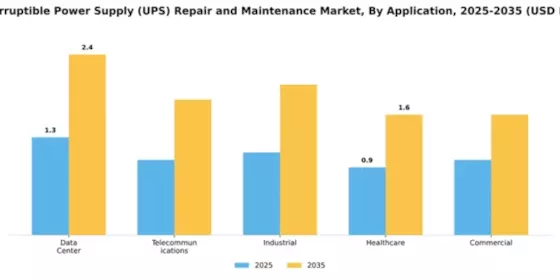
Data Center (Dominant) vs. Telecommunications (Emerging)
Data Centers represent the dominant segment within the UPS Repair and Maintenance Market, characterized by their vast energy consumption and critical operational needs. These facilities require sophisticated UPS systems to ensure uptime against power outages, especially as cloud-based services and digitalization proliferate. The unique demands of Data Centers necessitate regular maintenance and timely repairs, resulting in substantial spending on UPS maintenance services. On the other hand, the Telecommunications sector is regarded as an emerging segment, rapidly expanding due to the escalating demand for reliable power sources, especially with the rollout of 5G networks. This growth is fostering innovative solutions in UPS technologies and maintenance services, as telecommunications providers seek to minimize disruption and enhance service reliability through optimized UPS systems.
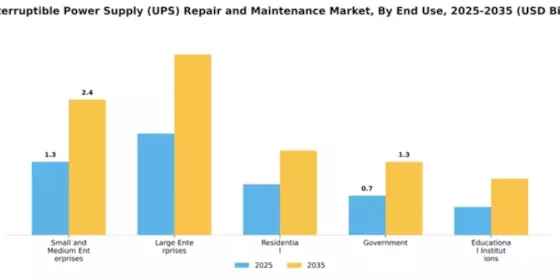
In the Uninterruptible Power Supply (UPS) Repair and Maintenance Market, the distribution of market share among end-use segments reveals that Small and Medium Enterprises (SMEs) account for a substantial portion, characterized by their frequent need for reliable power solutions. This segment benefits from the growing reliance on technology and increased digitization in business operations. In contrast, Large Enterprises also hold a significant market share, yet they are more inclined towards advanced UPS systems necessitating specialized repair and maintenance services.
SMEs (Dominant) vs. Large Enterprises (Emerging)
Small and Medium Enterprises (SMEs) occupy a dominant position in the UPS Repair and Maintenance Market, primarily due to their growing adoption of UPS systems to safeguard their operations against power disruptions. Conversely, Large Enterprises are emerging swiftly as vital players in the market. Their requirements for complex UPS systems result in a demand for specialized repair services that cater to their high-capacity needs. As these large organizations increasingly recognize the value of maintaining operational continuity, their investment in UPS maintenance services is set to escalate, thereby reshaping the competitive landscape.
The Uninterruptible Power Supply (UPS) Repair and Maintenance Market showcases a diverse distribution of power rating segments, each catering to distinct sectors. The 10 kVA to 20 kVA segment holds the largest market share, primarily due to its widespread adoption in industrial and commercial applications that require robust power support. Meanwhile, the less than 1 kVA and 1 kVA to 5 kVA segments are also significant, but exhibit a growing demand as smaller businesses and home offices continue to seek reliable power solutions for computer systems and telecommunications. Growth trends within the power rating segment are being driven by the increasing reliance on digital infrastructure and the need for energy efficiency. Businesses are becoming more aware of the risks associated with power disruptions, propelling the demand for UPS systems across various power ratings. The fastest growth is expected in the 1 kVA to 5 kVA segment, fueled by the surge in remote work and digital transformation, making efficient back-up power solutions essential for smaller setups and individual applications.
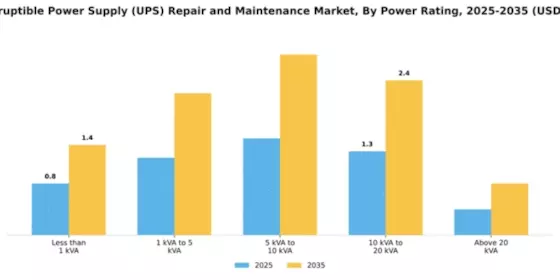
10 kVA to 20 kVA (Dominant) vs. 5 kVA to 10 kVA (Emerging)
The 10 kVA to 20 kVA segment is recognized as the dominant force in the UPS Repair and Maintenance Market due to its ability to support critical infrastructure in data centers, hospitals, and other facilities that require uninterrupted power. This segment is characterized by robust, high-capacity systems that are designed to handle significant power loads while ensuring reliability. On the other hand, the 5 kVA to 10 kVA segment is emerging as a vital player, catering to mid-sized companies seeking efficient and affordable power solutions. These systems offer a balance between capacity and energy savings, making them suitable for a diverse range of applications such as retail and smaller industrial operations. As technology advances, both segments are positioning themselves strategically to meet the evolving demands of various industries.
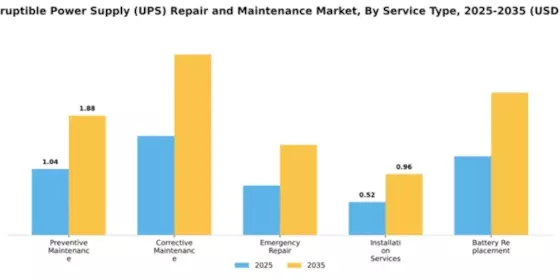
The Uninterruptible Power Supply (UPS) Repair and Maintenance Market showcases a dynamic landscape characterized by diverse service types. Preventive Maintenance holds the largest market share, driven by businesses seeking to prolong the lifespan of their UPS systems and minimize unexpected downtimes. This proactive approach not only enhances efficiency but also reduces overall maintenance costs. Other segments like Emergency Repair have carved out a significant niche, particularly as businesses prioritize quick recovery solutions when unexpected failures occur.
Preventive Maintenance (Dominant) vs. Emergency Repair (Emerging)
Preventive Maintenance is regarded as the dominant service in the UPS Repair and Maintenance Market, focusing on routine inspections, testing, and part replacements to avert potential failures. This segment appeals to enterprises aiming for reliability, thereby preventing costly outages. On the other hand, Emergency Repair is an emerging segment that addresses immediate repair needs, providing quick responses to equipment failures. The growing reliance on uninterrupted power has positioned emergency services as essential for organizations, particularly in sectors where uptime is critical. This segment is witnessing rapid growth, fueled by rising awareness of operational continuity and technological advancements that enable faster response times.
In the Uninterruptible Power Supply (UPS) Repair and Maintenance Market, Online UPS systems dominate with a significant share due to their ability to provide continuous power and protect sensitive equipment. Offline UPS systems, while smaller in market share, are gaining traction for specific applications where cost-effectiveness is a priority. Their simpler design appeals to budget-conscious consumers, enhancing their competitive stance in the market.
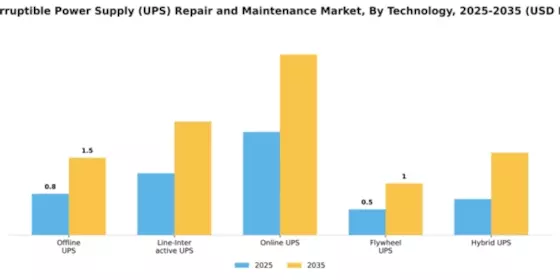
Technology: Online UPS (Dominant) vs. Offline UPS (Emerging)
Online UPS systems are characterized by their ability to provide seamless power support, ensuring that sensitive electronics receive uninterruptible power. Their advanced technology includes double conversion processes that guarantee maximum power quality and efficiency. On the other hand, Offline UPS systems serve as an economical choice for smaller applications, providing basic backup power without extensive features. As organizations seek reliable and cost-effective solutions, the Offline UPS is rapidly emerging, adapting to newer technologies, positioning itself as a successful alternative without compromising quality.
Get more detailed insights about Uninterruptible Power Supply (UPS) Repair and Maintenance Market Request Free Sample
North America is poised to maintain its leadership in the Uninterruptible Power Supply (UPS) Repair and Maintenance Market, holding a significant market size of $2.6 billion. The region's growth is driven by increasing demand for reliable power solutions across various sectors, including healthcare, data centers, and manufacturing. Regulatory support for energy efficiency and sustainability initiatives further catalyzes market expansion, ensuring robust growth in UPS services. The competitive landscape in North America is characterized by the presence of major players such as Schneider Electric, Eaton, and Vertiv. These companies are investing heavily in innovation and service enhancements to meet the growing needs of customers. The U.S. remains the largest market, supported by a strong infrastructure and technological advancements. As businesses increasingly rely on uninterrupted power supply, the demand for UPS repair and maintenance services is expected to rise significantly.
Europe's Uninterruptible Power Supply (UPS) Repair and Maintenance Market is valued at $1.5 billion, reflecting a growing demand for reliable power solutions. The region is witnessing a surge in investments in renewable energy and energy efficiency, driven by stringent regulations aimed at reducing carbon emissions. This regulatory environment is fostering innovation and enhancing the demand for UPS services across various industries, including telecommunications and healthcare. Leading countries in this market include Germany, France, and the UK, where key players like Schneider Electric and Riello UPS are actively expanding their service offerings. The competitive landscape is marked by a focus on sustainability and technological advancements, with companies investing in smart UPS systems. As the region transitions towards greener energy solutions, the UPS repair and maintenance market is expected to experience significant growth.
The Asia-Pacific region is witnessing a burgeoning Uninterruptible Power Supply (UPS) Repair and Maintenance Market, currently valued at $1.3 billion. This growth is fueled by rapid industrialization, urbanization, and increasing reliance on digital infrastructure. Countries like China and India are leading the charge, with significant investments in data centers and telecommunications, driving the demand for reliable power solutions and maintenance services. The competitive landscape is evolving, with key players such as CyberPower Systems and Tripp Lite expanding their presence in the region. The market is characterized by a mix of local and international companies, all vying for a share of the growing demand. As businesses increasingly prioritize uninterrupted power supply, the UPS repair and maintenance market is set for substantial growth in the coming years.
The Middle East and Africa region is gradually developing its Uninterruptible Power Supply (UPS) Repair and Maintenance Market, currently valued at $0.8 billion. The growth is driven by increasing investments in infrastructure and energy projects, particularly in the Gulf Cooperation Council (GCC) countries. Regulatory initiatives aimed at enhancing energy reliability and efficiency are also contributing to market expansion, albeit at a slower pace compared to other regions. Key players in this market include local firms and international companies like Emerson Electric and APC by Schneider Electric. The competitive landscape is marked by challenges such as varying regulatory environments and economic instability in certain areas. However, as the demand for reliable power solutions grows, the UPS repair and maintenance market is expected to gain traction in the region.
The Uninterruptible Power Supply (UPS) Repair and Maintenance Market is characterized by a competitive landscape that is increasingly shaped by technological advancements and evolving customer demands. Key growth drivers include the rising reliance on uninterrupted power supply systems across various sectors, such as healthcare, data centers, and telecommunications. Major players like Schneider Electric (FR), Eaton (US), and Vertiv (US) are strategically positioned to leverage innovation and digital transformation to enhance their service offerings. Schneider Electric (FR) focuses on sustainability and energy efficiency, while Eaton (US) emphasizes its commitment to smart technologies and integrated solutions. Vertiv (US) is enhancing its operational focus on critical infrastructure, which collectively shapes a competitive environment that is both dynamic and multifaceted.In terms of business tactics, companies are increasingly localizing manufacturing and optimizing supply chains to enhance responsiveness to market demands. The competitive structure of the market appears moderately fragmented, with several key players exerting influence over their respective segments. This fragmentation allows for a diverse range of service offerings, yet the collective impact of these major players is significant, as they drive innovation and set industry standards.In November Eaton (US) announced a strategic partnership with a leading cloud service provider to enhance its UPS solutions for data centers. This collaboration aims to integrate advanced monitoring and predictive maintenance capabilities, which could potentially reduce downtime and improve operational efficiency for clients. Such strategic moves indicate Eaton's commitment to staying at the forefront of technological advancements in the UPS sector.In October Schneider Electric (FR) launched a new line of eco-friendly UPS systems designed to minimize energy consumption and carbon footprint. This initiative aligns with global sustainability trends and reflects the company's strategic focus on providing environmentally responsible solutions. The introduction of these products may enhance Schneider's competitive edge by appealing to environmentally conscious consumers and businesses.In September Vertiv (US) expanded its service network in Asia-Pacific by acquiring a regional UPS maintenance provider. This acquisition is likely to bolster Vertiv's market presence and enhance its service capabilities in a rapidly growing region. The strategic importance of this move lies in Vertiv's ability to offer localized support and faster response times, which are critical in the UPS repair and maintenance market.As of December current competitive trends indicate a strong emphasis on digitalization, sustainability, and the integration of AI technologies within the UPS sector. Strategic alliances are increasingly shaping the landscape, allowing companies to pool resources and expertise to drive innovation. The competitive differentiation is likely to evolve from traditional price-based competition to a focus on technological innovation, reliability, and supply chain efficiency, as companies strive to meet the complex demands of modern power management.



The Uninterruptible Power Supply (UPS) Repair and Maintenance Market is projected to grow at a 5.93% CAGR from 2025 to 2035, driven by increasing demand for reliable power solutions and technological advancements.
New opportunities lie in:
By 2035, the UPS Repair and Maintenance Market is expected to be robust, reflecting sustained growth and innovation.
| MARKET SIZE 2024 | 5.2(USD Billion) |
| MARKET SIZE 2025 | 5.51(USD Billion) |
| MARKET SIZE 2035 | 9.8(USD Billion) |
| COMPOUND ANNUAL GROWTH RATE (CAGR) | 5.93% (2025 - 2035) |
| REPORT COVERAGE | Revenue Forecast, Competitive Landscape, Growth Factors, and Trends |
| BASE YEAR | 2024 |
| Market Forecast Period | 2025 - 2035 |
| Historical Data | 2019 - 2024 |
| Market Forecast Units | USD Billion |
| Key Companies Profiled | Schneider Electric (FR), Eaton (US), Vertiv (US), Emerson Electric (US), Riello UPS (IT), CyberPower Systems (TW), Tripp Lite (US), APC by Schneider Electric (FR), Legrand (FR) |
| Segments Covered | Application, End Use, Power Rating, Service Type, Technology |
| Key Market Opportunities | Integration of smart technologies enhances efficiency in the Uninterruptible Power Supply (UPS) Repair and Maintenance Market. |
| Key Market Dynamics | Rising demand for reliable power solutions drives growth in Uninterruptible Power Supply repair and maintenance services. |
| Countries Covered | North America, Europe, APAC, South America, MEA |
The market is projected to reach a valuation of 9.8 USD Billion by 2035.
The overall market valuation was 5.2 USD Billion in 2024.
The expected CAGR for the market during this period is 5.93%.
The Data Center application segment is expected to grow from 1.3 to 2.4 USD Billion by 2035.
By 2035, the market for Large Enterprises is projected to grow from 1.8 to 3.2 USD Billion, indicating substantial demand.
Key service types include Preventive Maintenance, Corrective Maintenance, and Battery Replacement, with the latter expected to grow from 1.24 to 2.24 USD Billion.
The Online UPS technology segment is projected to grow from 2.0 to 3.5 USD Billion by 2035.
The Industrial application segment is expected to increase from 1.1 to 2.0 USD Billion by 2035.
Key players include Schneider Electric, Eaton, Vertiv, and Emerson Electric, among others.
The Residential end-use segment is projected to grow from 0.9 to 1.5 USD Billion by 2035.


Kindly complete the form below to receive a free sample of this Report

“This is really good guys. Excellent work on a tight deadline. I will continue to use you going forward and recommend you to others. Nice job”


“Thanks. It’s been a pleasure working with you, please use me as reference with any other Intel employees.”


“Thanks for sending the report it gives us a good global view of the Betaïne market.”


“Thank you, this will be very helpful for OQS.”


“We found the report very insightful! we found your research firm very helpful. I'm sending this email to secure our future business.”


“I am very pleased with how market segments have been defined in a relevant way for my purposes (such as "Portable Freezers & refrigerators" and "last-mile"). In general the report is well structured. Thanks very much for your efforts.”


“I have been reading the first document or the study, ,the Global HVAC and FP market report 2021 till 2026. Must say, good info! I have not gone in depth at all parts, but got a good indication of the data inside!”


“We got the report in time, we really thank you for your support in this process. I also thank to all of your team as they did a great job.”


“The Automotive 48V ECU Components Procurement Intelligence Study” was a complex project, but the Market Research Future (MRFR) team handled it with quality, agility, and customer-centricity. They delivered all requested data on time and within the agreed scope. The team, including Shubhendra Anand and Rahul Gotadki, was always readily available to clarify questions and swiftly implement necessary adjustments, driving the project to a successful conclusion within a very demanding timeframe.
I would also like to specifically commend Akshay Agarwal for his responsiveness and support at every stage—from our initial inquiry on May 6th through to final delivery on June 18th. His dedication made the entire process seamless.”



