×
Request Free Sample ×

Kindly complete the form below to receive a free sample of this Report

* Please use a valid business email

Leading companies partner with us for data-driven Insights

clients tt-cursor
Hero Background

US Aircraft Jack Market

ID: MRFR/AD/18030-HCR
128 Pages
Sejal Akre
October 2025

US Aircraft Jack Market Research Report: By Type (Hydraulic Jacks, Mechanical Jacks, Pneumatic Jacks, Electric Jacks), By Application (Civil Aviation, Military Aviation, Cargo Aircraft), By Load Capacity (Below 5 Tons, 5-10 Tons, 10-15 Tons, Above 15 Tons) and By End Use (MRO Facilities, Aircraft Manufacturing, Airports) - Forecast to 2035

Share:
Download PDF ×

We do not share your information with anyone. However, we may send you emails based on your report interest from time to time. You may contact us at any time to opt-out.

US Aircraft Jack Market Infographic
Purchase Options

US Aircraft Jack Market Summary

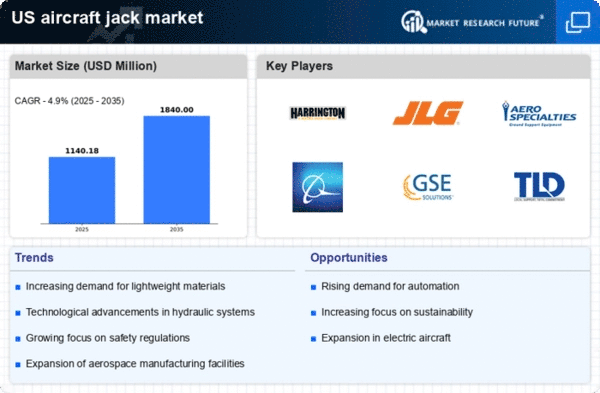
As per MRFR analysis, the US aircraft jack market size was estimated at 1086.92 USD Million in 2024. The US aircraft jack market is projected to grow from 1140.18 USD Million in 2025 to 1840.0 USD Million by 2035, exhibiting a compound annual growth rate (CAGR) of 4.9% during the forecast period 2025 - 2035.

Key Market Trends & Highlights

The US aircraft jack market is poised for growth driven by technological advancements and increasing demand for maintenance.

  • Technological advancements in aircraft jacks enhance efficiency and safety in ground support operations.
  • The largest segment in the market is the hydraulic aircraft jack, while the fastest-growing segment is the electric aircraft jack.
  • Regulatory compliance and sustainability initiatives are shaping the future of the aircraft jack market.
  • Increasing demand for aircraft maintenance and growth in the aviation sector are key drivers of market expansion.

Market Size & Forecast

2024 Market Size 1086.92 (USD Million)
2035 Market Size 1840.0 (USD Million)
CAGR (2025 - 2035) 4.9%

Major Players

Harrington Hoists Inc (US), JLG Industries Inc (US), AeroSpecialties Inc (US), Boeing (US), GSE Solutions (US), TLD Group (FR), AeroLift (US), Miller Electric Mfg Co (US), Hoffman Manufacturing (US)

US Aircraft Jack Market Trends

The aircraft jack market is currently experiencing notable developments driven by advancements in technology and increasing demand for efficient maintenance solutions. As the aviation sector continues to expand, the need for reliable and safe lifting equipment becomes paramount. Innovations in materials and design are enhancing the performance and safety features of aircraft jacks, making them more appealing to operators. Furthermore, regulatory standards are evolving, necessitating that manufacturers comply with stricter safety and operational guidelines. This shift is likely to influence purchasing decisions, as operators seek equipment that meets these new requirements while also providing cost-effectiveness. In addition, the aircraft jack market is witnessing a trend towards sustainability, with manufacturers exploring eco-friendly materials and energy-efficient designs. This focus on environmental responsibility aligns with broader industry goals to reduce carbon footprints and enhance operational efficiency. As stakeholders become increasingly aware of their environmental impact, the demand for sustainable solutions is expected to grow. Overall, the aircraft jack market appears poised for growth, driven by technological advancements, regulatory changes, and a shift towards sustainable practices.

Technological Advancements

Recent innovations in the aircraft jack market focus on enhancing safety and efficiency. Manufacturers are integrating smart technologies, such as sensors and automation, to improve operational performance. These advancements not only streamline maintenance processes but also reduce the risk of accidents, thereby increasing overall safety in aircraft operations.

Regulatory Compliance

The aircraft jack market is influenced by evolving regulatory standards that emphasize safety and operational efficiency. Manufacturers are adapting their products to meet these stringent requirements, which may lead to increased costs but ultimately enhances the reliability of lifting equipment used in aviation.

Sustainability Initiatives

There is a growing emphasis on sustainability within the aircraft jack market, as manufacturers seek to develop eco-friendly products. This trend includes the use of recyclable materials and energy-efficient designs, reflecting a broader commitment to reducing environmental impact and promoting responsible practices in the aviation industry.

US Aircraft Jack Market Drivers

Growth in Aviation Sector

The aircraft jack market is poised for growth, largely due to the expansion of the aviation sector in the US. With the rise in air travel and the increasing number of airlines, there is a corresponding need for enhanced ground support equipment, including aircraft jacks. The US Bureau of Transportation Statistics indicates that air travel has seen a consistent upward trajectory, which in turn drives the demand for maintenance and repair services. As airlines invest in their fleets to accommodate growing passenger numbers, the aircraft jack market is likely to see a significant uptick in sales. This growth is projected to be around 6% annually, reflecting the robust health of the aviation sector.

Rising Focus on Cost Efficiency

The aircraft jack market is also being shaped by a rising focus on cost efficiency within the aviation industry. Airlines and maintenance organizations are increasingly seeking ways to reduce operational costs while maintaining high safety and performance standards. This trend has led to a greater emphasis on investing in durable and efficient aircraft jacks that can withstand frequent use without incurring high maintenance costs. The aircraft jack market is likely to benefit from this shift, as manufacturers respond by offering products that provide long-term value and reliability. Analysts suggest that this focus on cost efficiency could contribute to a market growth rate of around 5% over the coming years.

Increasing Demand for Aircraft Maintenance

The aircraft jack market is experiencing a notable surge in demand driven by the increasing need for aircraft maintenance. As the aviation industry expands, the number of aircraft in operation rises, necessitating regular maintenance and inspections. This trend is particularly evident in the US, where the Federal Aviation Administration (FAA) has reported a steady increase in the number of commercial and private aircraft. Consequently, the demand for reliable and efficient aircraft jacks is expected to grow, as these tools are essential for performing maintenance tasks safely and effectively. The aircraft jack market is likely to benefit from this trend, with projections indicating a potential growth rate of approximately 5% annually over the next few years.

Regulatory Standards and Safety Compliance

The aircraft jack market is heavily influenced by regulatory standards and safety compliance requirements set forth by aviation authorities. In the US, the FAA mandates strict adherence to safety protocols, which necessitates the use of high-quality, compliant equipment for aircraft maintenance. This regulatory environment compels airlines and maintenance providers to invest in reliable aircraft jacks that meet these standards. As a result, the aircraft jack market is expected to see a steady demand for products that not only comply with regulations but also enhance operational safety. This focus on compliance could drive market growth by approximately 3% annually as companies prioritize safety in their operations.

Technological Innovations in Ground Support Equipment

Technological advancements in ground support equipment are significantly influencing the aircraft jack market. Innovations such as lightweight materials, automated systems, and enhanced safety features are becoming increasingly prevalent. These advancements not only improve the efficiency of aircraft jacks but also enhance safety during maintenance operations. The aircraft jack market is adapting to these changes, with manufacturers investing in research and development to create more sophisticated products. As a result, the market is likely to witness a shift towards more advanced jacks that can accommodate a wider range of aircraft types, potentially increasing market share by 4% over the next few years.


Market Segment Insights

By Type: Hydraulic Jacks (Largest) vs. Electric Jacks (Fastest-Growing)

In the US aircraft jack market, Hydraulic Jacks account for the largest share, attributed to their reliability and efficiency in lifting heavy aircraft components. Mechanical Jacks follow, offering cost-effective solutions but lacking the advanced technology and ease-of-use provided by hydraulic alternatives. Pneumatic Jacks are gaining traction due to their speed and effectiveness in various maintenance scenarios, while Electric Jacks are catching up as they become the fastest-growing segment, appealing to modernized facilities seeking automation and ease of operation. The growth trends in the US aircraft jack market are driven by advancements in technology and the increasing demand for efficient aircraft maintenance solutions. The shift towards Electric Jacks is particularly notable as companies aim for automation to enhance productivity. Additionally, the emphasis on safety standards and compliance is prompting the adoption of innovative jack types that meet the evolving industry requirements, thus improving overall operational efficiency.

Hydraulic Jacks (Dominant) vs. Electric Jacks (Emerging)

Hydraulic Jacks have a strong market presence, favored for their immense lifting power and ability to handle heavy aircraft securely. They utilize hydraulic fluid to lift and lower loads, ensuring precision and control. In contrast, Electric Jacks are emerging rapidly, primarily due to their convenience and reduced physical effort required for operation. Electric models provide efficient lifting with the push of a button and are appealing to facilities looking to streamline processes and minimize labor costs. Both segment values play crucial roles in the maintenance landscape, with Hydraulic Jacks being essential for heavy-duty tasks while Electric Jacks represent innovation and the shift towards more automated solutions.

By Application: Civil Aviation (Largest) vs. Military Aviation (Fastest-Growing)

In the US aircraft jack market, the distribution of market share among the application segments reveals that civil aviation commands the majority share, driven by the growing number of commercial flights and an increasing fleet of passenger aircraft. In contrast, military aviation holds a notable share as well, due to sustained defense budgets and modernization efforts among armed forces. Cargo aircraft, while significant, occupy a smaller portion of the market, reflecting a more niche segment that caters to freight and logistics needs. The growth trends in this segment are substantially influenced by the overarching trends in aviation. Civil aviation continues to thrive owing to a rise in air travel demand, while military aviation is bolstered by advancements in technology and strategic initiatives. The cargo aircraft segment is expanding as e-commerce pressures logistics networks, leading to increased investments in dedicated freighters. Overall, the application segments are set to witness shifting dynamics due to varying demands and innovations.

Civil Aviation: Dominant vs. Military Aviation: Emerging

Civil aviation remains the dominant segment in the US aircraft jack market, characterized by its extensive usage across commercial airlines and private jet operators. As air travel surges, the demand for reliable and high-performance jacks increases, with manufacturers focusing on enhancing safety and efficiency. On the other hand, military aviation is emerging as a critical segment, powered by modernization efforts and technological upgrades within defense systems. Military applications require robust and adaptable jacks capable of supporting various aircraft types, making it an important area of growth. The interplay between these segments indicates a market driven by innovation, regulatory demands, and the vital role of aviation in national and global contexts.

By Load Capacity: 5-10 Tons (Largest) vs. 10-15 Tons (Fastest-Growing)

The load capacity segment of the US aircraft jack market exhibits varied distribution among its categories. The 5-10 Tons segment holds the largest share, driven by the demand for jacks that can support a wide range of aircraft. Other segments, such as Below 5 Tons and Above 15 Tons, cater to niche applications, contributing moderately to the overall market. Meanwhile, the 10-15 Tons segment, although smaller in share, is gaining traction rapidly as aviation overhaul activities increase. Growth within the load capacity segment is influenced by several factors including technological advancements, regulatory changes, and increasing air traffic. The demand for bigger aircraft and enhanced maintenance capabilities has spurred interest in the 10-15 Tons category, which is positioned to grow swiftly. In contrast, the Below 5 Tons segment continues to meet local needs while facing competition from emerging technologies that aim to improve functionalities and user safety.

5-10 Tons (Dominant) vs. 10-15 Tons (Emerging)

The 5-10 Tons segment stands as the dominant force in the load capacity market, favored for its versatility and effective handling of a broad range of aircraft. This segment caters specifically to maintenance facilities where a variety of jets and small aircraft require reliable jacking solutions. Meanwhile, the 10-15 Tons category is emerging as a key player, capitalizing on the increasing complexity of aircraft maintenance and the need for higher load capacities. This rising segment is particularly appealing for larger aircraft types, aligning with trends focused on improving operational efficiency and extending the lifecycle of aviation assets.

By End Use: MRO Facilities (Largest) vs. Airports (Fastest-Growing)

The US aircraft jack market exhibits a diverse distribution of market share across its end-use segments. MRO (Maintenance, Repair, and Overhaul) facilities hold the largest share, primarily due to the ongoing demand for maintenance services and inspections in the aviation sector. In contrast, airports are emerging rapidly, driven by an increase in air traffic and the expansion of airport infrastructure. Growth trends in this market are influenced by several key factors. The need for efficient and reliable maintenance practices at MRO facilities is pushing advancements in aircraft jack technologies. Airports are experiencing the fastest growth as more investments are made into upgrading existing facilities to accommodate growing passenger numbers and the introduction of newer aircraft models, which require specialized lifting equipment.

MRO Facilities: Dominant vs. Airports: Emerging

MRO facilities are characterized by their integral role in ensuring aircraft safety and compliance with aviation standards. They dominate the US aircraft jack market, offering a wide range of specialized jacks designed for various aircraft types, which enhances operational efficiency. On the other hand, airports, while currently a smaller segment, are rapidly emerging as key players in the aircraft jack market. The increase in airport capacity necessitates advanced equipment to handle newer aircraft models. This rising trend compels airports to invest in modern aircraft jacks that accommodate heavier loads and improve service times, thereby sustaining their growth trajectory and setting the stage for future market dynamics.

Get more detailed insights about US Aircraft Jack Market

Key Players and Competitive Insights

The aircraft jack market is characterized by a competitive landscape that is increasingly shaped by innovation, strategic partnerships, and a focus on sustainability. Key players such as Boeing (US), JLG Industries Inc (US), and AeroSpecialties Inc (US) are actively pursuing strategies that enhance their market positioning. Boeing (US), for instance, emphasizes technological advancements in its product offerings, while JLG Industries Inc (US) focuses on expanding its operational footprint through strategic acquisitions. Meanwhile, AeroSpecialties Inc (US) is leveraging partnerships to enhance its service capabilities, thereby contributing to a dynamic competitive environment.

In terms of business tactics, companies are increasingly localizing manufacturing to reduce lead times and optimize supply chains. The market structure appears moderately fragmented, with several players vying for market share. This fragmentation allows for a diverse range of products and services, but also intensifies competition among key players. The collective influence of these companies is significant, as they drive innovation and set industry standards that others may follow.

In October 2025, JLG Industries Inc (US) announced a strategic partnership with a leading aerospace manufacturer to develop advanced aircraft jacks that incorporate smart technology. This move is likely to enhance JLG's product offerings and position it as a leader in the integration of digital solutions within the aircraft jack market. The partnership underscores the importance of technological innovation in meeting evolving customer demands.

In September 2025, Boeing (US) unveiled a new line of environmentally friendly aircraft jacks designed to reduce carbon emissions during operation. This initiative aligns with the growing trend towards sustainability in the aerospace sector and positions Boeing as a forward-thinking player committed to environmental responsibility. The introduction of these products may attract environmentally conscious customers and enhance Boeing's competitive edge.

In August 2025, AeroSpecialties Inc (US) expanded its service network by opening new service centers across the US. This expansion is indicative of the company's strategy to enhance customer support and accessibility, which is crucial in a market where service reliability is paramount. By increasing its service footprint, AeroSpecialties is likely to improve customer satisfaction and loyalty, further solidifying its market position.

As of November 2025, the aircraft jack market is witnessing trends that emphasize digitalization, sustainability, and the integration of artificial intelligence. Strategic alliances are becoming increasingly important, as companies seek to leverage each other's strengths to enhance their competitive positioning. The shift from price-based competition to a focus on innovation and technology is evident, suggesting that future differentiation will hinge on the ability to deliver reliable, cutting-edge solutions that meet the demands of a rapidly evolving market.

Key Companies in the US Aircraft Jack Market market include

Industry Developments

The US Aircraft Jack Market has recently seen significant developments, particularly with the advancements made by companies such as Vestergaard, Parker Hannifin, and Caldwell Manufacturing, which have focused on enhancing the safety and efficiency of aircraft maintenance operations. Current affairs in this market include the increasing demand for lightweight and high-strength jacking solutions, driven by both commercial and military aviation sectors. In terms of mergers and acquisitions, there were reports in August 2023 of Parker Hannifin acquiring certain assets from another manufacturing entity to bolster their product offerings in aircraft ground support.

Additionally, LiftAll has expanded its market presence through strategic partnerships in July 2022 aimed at improving its distribution capabilities. The overall growth in market valuation, spurred by rising air travel and the need for efficient maintenance solutions, is influencing how companies are investing in Research and Development to innovate their product lines. The period from 2021 to 2023 has seen noteworthy advancements in technologies that enhance the performance and safety of aircraft jacks, reflecting the US industry's commitment to maintaining high operational standards in aviation.

Future Outlook

US Aircraft Jack Market Future Outlook

The Aircraft Jack Market is projected to grow at a 4.9% CAGR from 2024 to 2035, driven by technological advancements, increasing air travel, and the need for efficient maintenance solutions.

New opportunities lie in:

  • Development of lightweight, high-capacity jacks for commercial aircraft.
  • Integration of IoT technology for real-time monitoring and diagnostics.
  • Expansion into emerging markets with tailored product offerings.

By 2035, the aircraft jack market is expected to achieve robust growth, driven by innovation and strategic market positioning.

Market Segmentation

US Aircraft Jack Market Type Outlook

  • Hydraulic Jacks
  • Mechanical Jacks
  • Pneumatic Jacks
  • Electric Jacks

US Aircraft Jack Market End Use Outlook

  • MRO Facilities
  • Aircraft Manufacturing
  • Airports

US Aircraft Jack Market Application Outlook

  • Civil Aviation
  • Military Aviation
  • Cargo Aircraft

US Aircraft Jack Market Load Capacity Outlook

  • Below 5 Tons
  • 5-10 Tons
  • 10-15 Tons
  • Above 15 Tons

Report Scope

MARKET SIZE 2024 1086.92(USD Million)
MARKET SIZE 2025 1140.18(USD Million)
MARKET SIZE 2035 1840.0(USD Million)
COMPOUND ANNUAL GROWTH RATE (CAGR) 4.9% (2024 - 2035)
REPORT COVERAGE Revenue Forecast, Competitive Landscape, Growth Factors, and Trends
BASE YEAR 2024
Market Forecast Period 2025 - 2035
Historical Data 2019 - 2024
Market Forecast Units USD Million
Key Companies Profiled Harrington Hoists Inc (US), JLG Industries Inc (US), AeroSpecialties Inc (US), Boeing (US), GSE Solutions (US), TLD Group (FR), AeroLift (US), Miller Electric Mfg Co (US), Hoffman Manufacturing (US)
Segments Covered Type, Application, Load Capacity, End Use
Key Market Opportunities Integration of advanced materials and automation technologies enhances efficiency in the aircraft jack market.
Key Market Dynamics Technological advancements drive innovation in aircraft jack designs, enhancing safety and efficiency in maintenance operations.
Countries Covered US

Leave a Comment

FAQs

What is the expected market size of the US Aircraft Jack Market in 2024?

The US Aircraft Jack Market is expected to be valued at approximately 1.1 billion USD in 2024.

What will be the valuation of the US Aircraft Jack Market by 2035?

By 2035, the US Aircraft Jack Market is projected to reach a valuation of around 1.84 billion USD.

What is the Compound Annual Growth Rate (CAGR) of the US Aircraft Jack Market from 2025 to 2035?

The market is expected to grow at a CAGR of approximately 4.788 percent from 2025 to 2035.

Which types of aircraft jacks have significant market values in 2024?

In 2024, hydraulic jacks are valued at 0.44 billion USD, mechanical jacks at 0.27 billion USD, pneumatic jacks at 0.18 billion USD, and electric jacks at 0.21 billion USD.

Which type of aircraft jack is projected to have the highest market value in 2035?

In 2035, hydraulic jacks are projected to have the highest market value at 0.73 billion USD.

Who are the major players in the US Aircraft Jack Market?

Key players in the US Aircraft Jack Market include Vestergaard, Parker Hannifin, LiftAll, GSE Dynamics, and Caldwell Manufacturing.

What are the expected challenges in the US Aircraft Jack Market?

Challenges in the market include maintaining safety standards and adapting to rapidly changing technology.

What are the growth drivers for the US Aircraft Jack Market?

The growth drivers for the US Aircraft Jack Market include advancements in aircraft maintenance technologies and increasing air travel demands.

What is the significance of pneumatic jacks in the market by 2035?

Pneumatic jacks are expected to grow to a market value of 0.3 billion USD by 2035, highlighting their importance in aircraft maintenance.

How does the US Aircraft Jack Market benefit from the current global aviation trends?

The market benefits from the growing focus on aircraft safety and efficiency, driven by the increasing number of flight operations.

Download Free Sample

Kindly complete the form below to receive a free sample of this Report

Compare Licence

×
Features License Type
Single User Multiuser License Enterprise User
Price $4,950 $5,950 $7,250
Maximum User Access Limit 1 User Upto 10 Users Unrestricted Access Throughout the Organization
Free Customization
Direct Access to Analyst
Deliverable Format
Platform Access
Discount on Next Purchase 10% 15% 15%
Printable Versions