×
Request Free Sample ×

Kindly complete the form below to receive a free sample of this Report

* Please use a valid business email

Leading companies partner with us for data-driven Insights

clients tt-cursor
Hero Background

US Arthroscopy Instruments Market

ID: MRFR/MED/14517-HCR
100 Pages
Rahul Gotadki
October 2025

US Arthroscopy Instruments Market Research Report By Product (Arthroscope, Arthroscopy Implants, Fluid Management Systems, Visualization Systems, Radiofrequency Systems, Others), By Sub-product (Knee Implants, Hip Implants, Shoulder Implants, RF Generators, RF Probes and wands, Footswitch), By Application (Knee Arthroscopy, Hip Arthroscopy, Spine Arthroscopy, Foot & Ankle Arthroscopy, Shoulder & Elbow Arthroscopy, Others) and By End User (Hospitals, Ambulatory Surgical Centers & Clinics, Others) - Forecast to 2035

Share:
Download PDF ×

We do not share your information with anyone. However, we may send you emails based on your report interest from time to time. You may contact us at any time to opt-out.

US Arthroscopy Instruments Market Infographic
Purchase Options

US Arthroscopy Instruments Market Summary

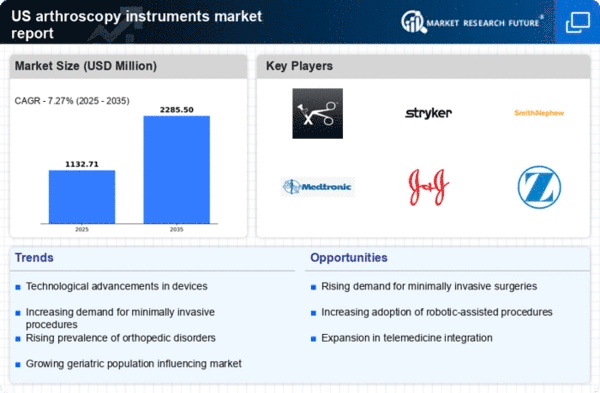
As per MRFR analysis, the US arthroscopy instruments market size was estimated at 1055.95 USD Million in 2024. The US arthroscopy instruments market is projected to grow from 1132.71 USD Million in 2025 to 2285.5 USD Million by 2035, exhibiting a compound annual growth rate (CAGR) of 7.27% during the forecast period 2025 - 2035.

Key Market Trends & Highlights

The US arthroscopy instruments market is experiencing robust growth driven by technological advancements and increasing demand for minimally invasive procedures.

  • Technological advancements are enhancing the efficacy and precision of arthroscopy instruments.
  • The rising demand for minimally invasive procedures is significantly influencing market dynamics.
  • The aging population is contributing to a higher prevalence of orthopedic conditions, thereby expanding the market.
  • Key market drivers include the increasing prevalence of sports injuries and growing awareness of joint health.

Market Size & Forecast

2024 Market Size 1055.95 (USD Million)
2035 Market Size 2285.5 (USD Million)
CAGR (2025 - 2035) 7.27%

Major Players

Arthrex (US), Stryker (US), Smith & Nephew (GB), Medtronic (IE), Johnson & Johnson (US), Zimmer Biomet (US), Olympus (JP), Conmed (US)

US Arthroscopy Instruments Market Trends

the arthroscopy instruments market is experiencing notable growth, driven by advancements in surgical techniques and an increasing prevalence of orthopedic conditions. The demand for minimally invasive procedures is rising, as patients and healthcare providers alike seek options that reduce recovery time and minimize surgical trauma. This trend is further supported by technological innovations, such as the development of high-definition cameras and improved visualization tools, which enhance the precision and effectiveness of arthroscopic surgeries. As a result, hospitals and surgical centers are increasingly investing in state-of-the-art arthroscopy instruments to meet the evolving needs of patients and surgeons. Moreover, the aging population in the United States is contributing to a higher incidence of joint-related disorders, thereby fueling the need for effective treatment options. The arthroscopy instruments market is likely to benefit from this demographic shift, as older individuals are more prone to conditions such as osteoarthritis and sports-related injuries. Additionally, the emphasis on outpatient procedures is expected to drive further growth, as healthcare systems aim to reduce costs while maintaining high standards of care. Overall, the market appears poised for continued expansion, with ongoing innovations and a focus on patient-centered care shaping its future.

Technological Advancements

The arthroscopy instruments market is witnessing rapid technological advancements, particularly in imaging and instrumentation. Innovations such as high-definition cameras and robotic-assisted systems are enhancing surgical precision and outcomes. These developments are likely to attract more healthcare facilities to adopt advanced arthroscopic techniques.

Rising Demand for Minimally Invasive Procedures

There is a growing preference for minimally invasive surgical options among patients and healthcare providers. This trend is driven by the benefits of reduced recovery times and lower complication rates. As awareness of these advantages increases, the arthroscopy instruments market is expected to expand.

Aging Population and Orthopedic Conditions

The increasing aging population in the United States is contributing to a rise in orthopedic conditions, such as osteoarthritis. This demographic shift is likely to drive demand for arthroscopic procedures, thereby positively impacting the arthroscopy instruments market.

US Arthroscopy Instruments Market Drivers

Rising Healthcare Expenditure

The increase in healthcare expenditure in the US is a critical driver for the arthroscopy instruments market. As healthcare budgets expand, hospitals and surgical centers are more inclined to invest in advanced surgical technologies and instruments. This trend is supported by the growing emphasis on improving surgical outcomes and patient satisfaction. According to recent statistics, healthcare spending in the US is projected to reach approximately $4 trillion by 2025, with a significant portion allocated to surgical services. This financial commitment enables healthcare facilities to upgrade their arthroscopy instruments, thereby enhancing their capabilities to perform minimally invasive procedures. Consequently, the arthroscopy instruments market is likely to benefit from this upward trend in healthcare investment, as facilities seek to provide cutting-edge treatment options.

Growing Awareness of Joint Health

There is a growing awareness of joint health among the US population, which is significantly influencing the arthroscopy instruments market. Educational campaigns and increased access to information have led individuals to seek preventive care and treatment for joint-related issues. This heightened awareness is particularly relevant for conditions such as osteoarthritis and tendon injuries, which are prevalent among various age groups. As more patients recognize the benefits of early intervention through arthroscopic procedures, the demand for these instruments is expected to rise. Furthermore, healthcare providers are increasingly promoting arthroscopy as a viable option for joint health maintenance, further contributing to market growth. The emphasis on proactive healthcare solutions is likely to sustain the momentum of the arthroscopy instruments market in the coming years.

Increasing Prevalence of Sports Injuries

The rising incidence of sports-related injuries in the US is a notable driver for the arthroscopy instruments market. As more individuals engage in various sports and physical activities, the demand for effective treatment options increases. According to recent data, sports injuries account for a significant portion of emergency room visits, leading to a heightened need for arthroscopic procedures. This trend is particularly evident among younger populations, where injuries such as ACL tears and meniscus injuries are common. Consequently, healthcare providers are increasingly adopting arthroscopy as a preferred method for diagnosis and treatment, thereby propelling the growth of the arthroscopy instruments market. The market is projected to expand as advancements in surgical techniques and instruments continue to improve patient outcomes and recovery times.

Increased Focus on Rehabilitation and Recovery

An increased focus on rehabilitation and recovery post-surgery is emerging as a significant driver for the arthroscopy instruments market. As healthcare providers recognize the importance of effective rehabilitation in achieving optimal surgical outcomes, there is a growing demand for instruments that facilitate both surgical procedures and subsequent recovery. This trend is particularly relevant in the context of arthroscopic surgeries, where the integration of rehabilitation protocols enhances recovery times and improves patient satisfaction. The collaboration between orthopedic surgeons and rehabilitation specialists is becoming more common, leading to a holistic approach to patient care. As a result, the arthroscopy instruments market is likely to see growth as facilities invest in instruments that support both surgical and rehabilitation processes.

Technological Innovations in Surgical Instruments

Technological advancements in surgical instruments are transforming the landscape of the arthroscopy instruments market. Innovations such as high-definition cameras, robotic-assisted systems, and improved visualization techniques enhance the precision and effectiveness of arthroscopic procedures. These advancements not only improve surgical outcomes but also reduce recovery times for patients. The integration of smart technologies, such as augmented reality and artificial intelligence, is also gaining traction, allowing surgeons to perform complex procedures with greater accuracy. As a result, the demand for state-of-the-art arthroscopy instruments is likely to increase, driving market growth. The US market is particularly responsive to these innovations, as healthcare facilities strive to adopt the latest technologies to remain competitive and provide superior patient care.


Market Segment Insights

By Product: Arthroscope (Largest) vs. Arthroscopy Implants (Fastest-Growing)

In the US arthroscopy instruments market, the product segment showcases a varied distribution of market values. Arthroscopes represent the largest share, primarily due to their essential role in minimally invasive surgeries. Following them, arthroscopy implants and visualization systems hold significant positions, catering to the increasing demand for innovative surgical techniques. Fluid management systems and radiofrequency systems also contribute, albeit to a lesser extent, reflecting the diverse applications within the arthroscopic sphere. Looking ahead, the growth trends in this segment are driven by technological advancements and increasing adoption of minimally invasive procedures. The arthroscopy implants category is emerging as the fastest-growing segment, attributed to the rising necessity for effective treatment solutions in orthopedic surgeries. Additionally, the integration of advanced imaging and fluid management systems is expected to further enhance the overall growth of this market, fostering a landscape rich in innovative solutions.

Arthroscope (Dominant) vs. Arthroscopy Implants (Emerging)

The dominant segment in the US arthroscopy instruments market is arthroscopes, known for their crucial role in enhancing surgical precision through minimally invasive techniques. This segment benefits from continuous innovations aimed at improving functionality and patient outcomes. Conversely, arthroscopy implants represent an emerging segment, driven by the growing need for effective orthopedic solutions. These implants are gaining traction due to advancements in biomaterials and design, catering to patient-specific requirements. Together, these segments highlight the shift toward innovative, patient-centric solutions within the arthroscopic domain, reflecting a dynamic market landscape that adapts to evolving healthcare needs.

By Application: Knee Arthroscopy (Largest) vs. Shoulder Arthroscopy (Fastest-Growing)

Among the various applications of arthroscopy instruments, knee arthroscopy holds the largest market share due to its widespread use in sports and injury-related procedures. This segment remains pivotal as healthcare facilities increasingly adopt minimally invasive techniques, leading to higher volumes of knee surgeries and subsequently driving demand for specialized instruments. In contrast, shoulder arthroscopy is emerging rapidly, fueled by an increase in rotator cuff injuries and a greater awareness of shoulder-related problems among the active population. As patient demographics shift towards a younger, more active demographic, the demand for shoulder surgeries is expected to escalate. The growth trends indicate a robust rise in both segments, although shoulder arthroscopy shows potential for the fastest growth driven by advancements in surgical techniques and technologies. Factors such as increasing participation in sports, rising incidence of orthopedic disorders, and the preference for minimally invasive procedures are key drivers. Furthermore, the adoption of innovative arthroscopic instruments and techniques is enhancing surgical outcomes and safety, appealing to both surgeons and patients alike. This evolution reflects a broader trend towards precision and efficiency in orthopedic surgeries, meeting the rising expectations of healthcare providers and patients.

Knee Arthroscopy (Dominant) vs. Shoulder Arthroscopy (Emerging)

Knee arthroscopy is the dominant segment in the US arthroscopy instruments market, primarily due to its extensive application in treating common knee issues such as meniscus tears, ACL injuries, and patellar problems. Its established position is supported by robust surgical practices and a strong patient base seeking effective treatment options. In contrast, shoulder arthroscopy, while emerging, is gaining traction as an important technique for addressing shoulder instability, rotator cuff tears, and other orthopedic conditions. The rising trends in sports injuries and active lifestyles among the population are catalyzing the growth of this segment. With continuous innovations in instrument design and a growing emphasis on minimally invasive surgeries, shoulder arthroscopy is poised to carve out a significant share of the market, potentially turning it into a key growth area.

By End-User: Hospitals (Largest) vs. Ambulatory Surgical Centers (Fastest-Growing)

In the US arthroscopy instruments market, hospitals occupy the largest share, driven by their extensive surgical facilities and the prevalence of complex procedures that necessitate advanced arthroscopy instruments. Ambulatory surgical centers, however, are gaining traction, attributed to an increase in outpatient surgeries and a growing preference for cost-effective healthcare solutions that these facilities offer. The shift towards minimally invasive surgeries has further reinforced the role of these segments in the market. The growth trends within these segments reflect broader healthcare dynamics, with hospitals focusing on integrating cutting-edge technology to enhance surgical outcomes and improve patient experiences. On the other hand, ambulatory surgical centers leverage their operational efficiencies to attract more patients, emerging as a preferred choice for many procedures. Innovations in arthroscopy instrumentation that cater to the unique needs of these centers are expected to bolster their growth further, highlighting a competitive landscape in the US arthroscopy instruments market.

Hospitals (Dominant) vs. Ambulatory Surgical Centers (Emerging)

Hospitals are the dominant end-user segment in the US arthroscopy instruments market, characterized by their capacity to perform a large volume of complex surgeries requiring sophisticated technologies. Equipped with specialized surgical teams and advanced facilities, hospitals continue to invest in the latest arthroscopy instruments to improve patient outcomes and operational efficiencies. Ambulatory surgical centers, while emerging, represent a growing alternative for outpatient surgeries, focusing on streamlining processes and minimizing patient wait times. The rise of minimally invasive procedures has necessitated a reevaluation of service delivery in these centers, allowing them to offer competitive services that cater to a more health-conscious and cost-sensitive patient base. Together, these segments illustrate the evolving nature of surgical care in the US.

Get more detailed insights about US Arthroscopy Instruments Market

Key Players and Competitive Insights

The arthroscopy instruments market is characterized by a dynamic competitive landscape, driven by technological advancements and increasing demand for minimally invasive surgical procedures. Key players such as Arthrex (US), Stryker (US), and Smith & Nephew (GB) are strategically positioned to leverage innovation and expand their market presence. Arthrex (US) focuses on developing cutting-edge surgical solutions, while Stryker (US) emphasizes a robust portfolio of orthopedic instruments and digital technologies. Smith & Nephew (GB) is enhancing its offerings through strategic partnerships and acquisitions, collectively shaping a competitive environment that prioritizes innovation and operational efficiency.

In terms of business tactics, companies are increasingly localizing manufacturing to reduce lead times and optimize supply chains. The market appears moderately fragmented, with several key players exerting influence over various segments. This structure allows for competitive differentiation, as companies adopt unique strategies to capture market share and respond to evolving customer needs.

In October 2025, Stryker (US) announced the launch of a new line of advanced arthroscopic instruments designed to enhance surgical precision and reduce recovery times. This strategic move underscores Stryker's commitment to innovation and positions the company to meet the growing demand for minimally invasive procedures. By integrating advanced technology into their product offerings, Stryker aims to solidify its market leadership and respond effectively to competitive pressures.

In September 2025, Smith & Nephew (GB) completed the acquisition of a leading digital health company, enhancing its capabilities in remote patient monitoring and surgical planning. This acquisition is strategically significant as it aligns with the increasing trend towards digitalization in healthcare, allowing Smith & Nephew to offer comprehensive solutions that improve patient outcomes and streamline surgical workflows. The integration of digital health solutions is likely to provide a competitive edge in a rapidly evolving market.

In August 2025, Arthrex (US) expanded its manufacturing facility in Florida, a move that reflects its commitment to increasing production capacity and meeting rising demand. This expansion not only enhances operational efficiency but also positions Arthrex to respond swiftly to market changes. By investing in local manufacturing, the company aims to strengthen its supply chain reliability and reduce dependency on international suppliers, which is increasingly critical in today's market.

As of November 2025, current competitive trends in the arthroscopy instruments market include a strong emphasis on digitalization, sustainability, and the integration of artificial intelligence (AI) into surgical practices. Strategic alliances are becoming more prevalent, enabling companies to pool resources and expertise to drive innovation. Looking ahead, competitive differentiation is likely to evolve from traditional price-based competition to a focus on technological advancements, product innovation, and supply chain resilience. This shift indicates a transformative phase in the market, where companies that prioritize these elements may gain a substantial advantage.

Key Companies in the US Arthroscopy Instruments Market market include

Industry Developments

The US Arthroscopy Instruments Market has seen significant developments recently. In September 2023, Medtronic announced the launch of its next-generation arthroscopic instruments aimed at enhancing surgical efficiency. Additionally, in August 2023, Arthrex received FDA approval for its innovative fixation devices, emphasizing their commitment to advancing orthopedic surgery.

The market is also witnessing considerable growth, with valuations projected to rise due to increasing incidences of sports injuries and a higher aging population, necessitating arthroscopic interventions. Recent mergers and acquisitions have shaped the landscape, with Zimmer Biomet acquiring a key subsidiary of DJO Global in July 2023, enhancing their service portfolio and market presence. In another notable event, Stryker completed its acquisition of a niche arthroscopy technology firm in June 2023, further solidifying its position in the market.

The competition remains robust as companies such as DePuy Synthes, Olympus Corporation, and Smith and Nephew continue to innovate, contributing to a dynamic and expanding sector that is responsive to evolving medical needs and technological advancements.

Future Outlook

US Arthroscopy Instruments Market Future Outlook

The Arthroscopy Instruments Market is projected to grow at a 7.27% CAGR from 2024 to 2035, driven by technological advancements, increasing sports injuries, and rising demand for minimally invasive surgeries.

New opportunities lie in:

  • Development of advanced imaging systems for enhanced surgical precision.
  • Expansion of telemedicine platforms for remote consultations and follow-ups.
  • Introduction of biodegradable arthroscopy instruments to meet sustainability demands.

By 2035, the market is expected to achieve substantial growth, driven by innovation and evolving healthcare needs.

Market Segmentation

US Arthroscopy Instruments Market Product Outlook

  • Arthroscope
  • Arthroscopy Implants
  • Fluid Management Systems
  • Visualization Systems
  • Radiofrequency Systems
  • Power Shavers
  • Others

US Arthroscopy Instruments Market End-User Outlook

  • Hospitals
  • Ambulatory Surgical Centers
  • Others

US Arthroscopy Instruments Market Application Outlook

  • Knee Arthroscopy
  • Hip Arthroscopy
  • Spine Arthroscopy
  • Foot & Ankle Arthroscopy
  • Shoulder Arthroscopy
  • Others

Report Scope

MARKET SIZE 20241055.95(USD Million)
MARKET SIZE 20251132.71(USD Million)
MARKET SIZE 20352285.5(USD Million)
COMPOUND ANNUAL GROWTH RATE (CAGR)7.27% (2024 - 2035)
REPORT COVERAGERevenue Forecast, Competitive Landscape, Growth Factors, and Trends
BASE YEAR2024
Market Forecast Period2025 - 2035
Historical Data2019 - 2024
Market Forecast UnitsUSD Million
Key Companies Profiled["Arthrex (US)", "Stryker (US)", "Smith & Nephew (GB)", "Medtronic (IE)", "Johnson & Johnson (US)", "Zimmer Biomet (US)", "Olympus (JP)", "Conmed (US)"]
Segments CoveredProduct, Application, End-User
Key Market OpportunitiesIntegration of advanced imaging technologies enhances precision in the arthroscopy instruments market.
Key Market DynamicsTechnological advancements and regulatory changes drive innovation and competition in the arthroscopy instruments market.
Countries CoveredUS

Leave a Comment

FAQs

What is the expected market size of the US Arthroscopy Instruments Market in 2024?

The US Arthroscopy Instruments Market is expected to be valued at 714.0 million USD in 2024.

What is the projected market value of the US Arthroscopy Instruments Market by 2035?

By 2035, the US Arthroscopy Instruments Market is projected to reach a value of 1614.0 million USD.

What is the expected compound annual growth rate (CAGR) for the US Arthroscopy Instruments Market from 2025 to 2035?

The expected CAGR for the US Arthroscopy Instruments Market from 2025 to 2035 is 7.696%.

Which segment of the US Arthroscopy Instruments Market is anticipated to lead in terms of market share?

The Arthroscopy Implants segment is anticipated to lead with a growth from 200.0 million USD in 2024 to 500.0 million USD by 2035.

Who are the key players in the US Arthroscopy Instruments Market?

Major players in the market include Smith and Nephew, Braun Melsungen AG, DJO Global, Arthrex, and Medtronic.

What is the expected growth of the Arthroscope product segment between 2024 and 2035?

The Arthroscope product segment is expected to grow from 150.0 million USD in 2024 to 350.0 million USD by 2035.

How much is the Fluid Management Systems segment expected to be valued in 2035?

The Fluid Management Systems segment is anticipated to be valued at 280.0 million USD by 2035.

What are some emerging trends driving the US Arthroscopy Instruments Market?

Key trends include advancements in minimally invasive procedures and increasing demand for outpatient surgeries.

What are the main challenges faced by the US Arthroscopy Instruments Market?

Challenges include high costs of advanced instruments and the need for skilled professionals in the field.

How is the visualization systems segment expected to perform by 2035?

The visualization systems segment is expected to grow from 180.0 million USD in 2024 to 400.0 million USD by 2035.

Download Free Sample

Kindly complete the form below to receive a free sample of this Report

Compare Licence

×
Features License Type
Single User Multiuser License Enterprise User
Price $4,950 $5,950 $7,250
Maximum User Access Limit 1 User Upto 10 Users Unrestricted Access Throughout the Organization
Free Customization
Direct Access to Analyst
Deliverable Format
Platform Access
Discount on Next Purchase 10% 15% 15%
Printable Versions