×
Request Free Sample ×

Kindly complete the form below to receive a free sample of this Report

* Please use a valid business email

Leading companies partner with us for data-driven Insights

clients tt-cursor
Hero Background

US Beef Market

ID: MRFR/FnB/19707-HCR
200 Pages
Snehal Singh
October 2025

US Beef Market Research Report: By Product Type (Fresh Beef, Processed Beef, Frozen Beef, Canned Beef), By Distribution Channel (Supermarkets, Online Retail, Convenience Stores, Meat Shops), By Cut Type (Steaks, Ground Beef, Roasts, Ribs) and By Packaging Type (Vacuum Packaging, Modified Atmosphere Packaging, Traditional Packaging) - Forecast to 2035

Share:
Download PDF ×

We do not share your information with anyone. However, we may send you emails based on your report interest from time to time. You may contact us at any time to opt-out.

US Beef Market Infographic
Purchase Options

US Beef Market Summary

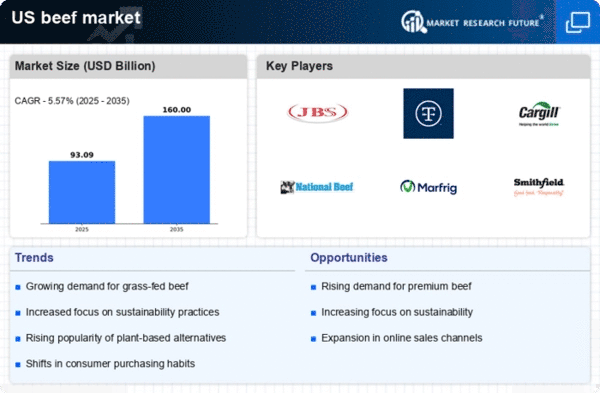
As per MRFR analysis, the US beef market Size was estimated at 88.18 USD Billion in 2024. The US beef market is projected to grow from 93.09 USD Billion in 2025 to 160.0 USD Billion by 2035, exhibiting a compound annual growth rate (CAGR) of 5.57% during the forecast period 2025 - 2035.

Key Market Trends & Highlights

The US beef market is experiencing a shift towards health-conscious and sustainable practices, driven by evolving consumer preferences.

  • Health-conscious choices are increasingly influencing consumer purchasing decisions in the US beef market.
  • Sustainability and transparency in beef production are becoming critical factors for consumers, particularly among millennials.
  • Technological innovations in production methods are enhancing efficiency and quality in the beef supply chain.
  • Rising feed costs and consumer preferences for quality beef are significant drivers shaping the current market landscape.

Market Size & Forecast

2024 Market Size 88.18 (USD Billion)
2035 Market Size 160.0 (USD Billion)
CAGR (2025 - 2035) 5.57%

Major Players

JBS S.A. (BR), Tyson Foods, Inc. (US), Cargill, Inc. (US), National Beef Packing Company, LLC (US), Marfrig Global Foods S.A. (BR), Smithfield Foods, Inc. (US), Danish Crown A/S (DK), BRF S.A. (BR), Hormel Foods Corporation (US)

US Beef Market Trends

The beef market in the United States is currently experiencing a dynamic phase characterized by evolving consumer preferences and shifting production practices. As health consciousness rises among consumers, there is a noticeable trend towards leaner cuts and grass-fed options. This shift appears to be influencing purchasing decisions, with many opting for products perceived as healthier or more sustainable. Additionally, the demand for transparency in sourcing and production methods is becoming increasingly pronounced, as consumers seek assurance regarding the quality and origin of their meat. Moreover, technological advancements in farming and processing are likely to reshape the landscape of the beef market. Innovations such as precision agriculture and enhanced supply chain management may improve efficiency and reduce waste. These developments could potentially lead to more competitive pricing and better quality products for consumers. As the market continues to adapt to these trends, stakeholders must remain vigilant and responsive to the changing landscape, ensuring they meet the evolving needs of consumers while maintaining sustainable practices.

Health-Conscious Choices

Consumers are increasingly favoring leaner cuts and grass-fed beef, reflecting a broader trend towards healthier eating. This shift suggests a growing awareness of nutritional content and the impact of dietary choices on overall health.

Sustainability and Transparency

There is a rising demand for transparency in sourcing and production methods. Consumers are seeking assurance about the quality and origin of their beef, which may drive producers to adopt more sustainable practices.

Technological Innovations

Advancements in farming and processing technologies are likely to enhance efficiency within the beef market. Innovations such as precision agriculture could lead to improved product quality and competitive pricing.

US Beef Market Drivers

Rising Feed Costs

The beef market is significantly affected by fluctuations in feed costs, which have been on the rise due to various factors including drought conditions and increased demand for corn and soybeans. In recent months, feed costs have surged by nearly 20%, putting pressure on beef producers' profit margins. As feed becomes more expensive, producers may be compelled to adjust their pricing strategies, which could lead to higher retail prices for consumers. This situation creates a complex dynamic within the beef market, as producers must balance cost management with maintaining product quality. The ongoing volatility in feed prices is likely to remain a critical driver influencing the overall landscape of the beef market.

Shifts in Dietary Trends

The beef market is experiencing shifts in dietary trends, particularly as more consumers adopt plant-based diets or reduce their meat consumption. This trend has led to a notable decline in beef consumption, with reports indicating a decrease of approximately 5% in the last year. However, there remains a strong segment of the population that continues to favor beef as a primary protein source. This duality creates a complex landscape for the beef market, where producers must navigate changing consumer preferences while also appealing to traditional beef lovers. Marketing strategies that highlight the nutritional benefits of beef, alongside initiatives to promote sustainable practices, may help to mitigate the impact of declining consumption among certain demographics.

Evolving Regulatory Environment

The beef market is subject to a constantly evolving regulatory environment that impacts production practices and market access. Recent changes in food safety regulations and labeling requirements have prompted producers to adapt their operations to comply with new standards. For instance, the implementation of stricter guidelines on antibiotic use in livestock has led to a shift towards more sustainable farming practices. These regulatory changes can create both challenges and opportunities for producers in the beef market. While compliance may increase operational costs, it also opens avenues for marketing beef products as healthier and more responsibly sourced. As regulations continue to evolve, their influence on the beef market will likely intensify.

Consumer Preferences for Quality Beef

The beef market in the US is increasingly influenced by consumer preferences that prioritize quality over quantity. Shoppers are willing to pay a premium for beef that is grass-fed, organic, or sourced from local farms. This trend is reflected in the rising sales of premium beef products, which have seen an increase of approximately 15% in the last year. As consumers become more discerning, the demand for high-quality beef is expected to continue driving growth in the beef market. Retailers are responding by expanding their offerings of specialty beef products, which cater to this evolving consumer base. This shift not only impacts pricing strategies but also encourages producers to adopt better farming practices to meet consumer expectations.

Technological Advancements in Production

Technological advancements are playing a pivotal role in shaping the beef market, particularly in production efficiency and quality control. Innovations such as precision agriculture and genetic improvements in livestock are enabling producers to enhance yield and reduce waste. For example, the adoption of data analytics in farming practices has shown to increase productivity by up to 10%. These advancements not only contribute to cost savings but also align with consumer demands for higher quality beef. As technology continues to evolve, its integration into the beef market is likely to drive further improvements in sustainability and profitability, positioning producers to better meet the challenges of a competitive marketplace.

Market Segment Insights

US Beef Market Segment Insights:

US Beef Market Segment Insights:

Beef Market Product Type Insights

Beef Market Product Type Insights

The Product Type segment of the US Beef Market serves as a crucial classification that reflects the diverse preferences and consumption patterns among American consumers. With the increasing demand for high-quality meat products, Fresh Beef remains a significant category, appealing to health-conscious consumers seeking minimally processed options. Fresh Beef offers an array of cuts, from steaks to roasts, that cater to various culinary traditions and personal tastes.

Processed Beef, on the other hand, has gained traction due to its convenience and versatility.Products such as sausages, deli meats, and jerky not only provide quick meal solutions but also have longer shelf lives, making them a preferred choice for busy households. The Frozen Beef segment caters to the necessity of storing meat for longer durations without compromising quality. This segment has experienced growth as more consumers opt for buying in bulk, effectively reducing food waste and ensuring a steady supply of beef products.

Canned Beef plays a niche yet essential role; it appeals to consumers looking for easy-to-prepare meals or those needing shelf-stable options.The packaging innovations and variety in flavors have made canned beef products popular among families and emergency preppers who seek convenience and long-lasting protein sources. Each of these categories addresses unique consumer needs and preferences, driving the overall growth in the consumption of beef products in the United States.

Get more detailed insights about US Beef Market

Key Players and Competitive Insights

The US beef market exhibits a competitive landscape characterized by a blend of established players and emerging dynamics. Key growth drivers include increasing consumer demand for high-quality beef products, a growing focus on sustainability, and advancements in supply chain technologies. Major companies such as Tyson Foods, Inc. (US), Cargill, Inc. (US), and JBS S.A. (BR) are strategically positioned to leverage these trends. Tyson Foods, for instance, emphasizes innovation in product offerings and sustainability initiatives, while Cargill focuses on optimizing its supply chain to enhance efficiency and reduce environmental impact. Collectively, these strategies shape a competitive environment that is increasingly focused on quality, sustainability, and operational excellence.

In terms of business tactics, companies are localizing manufacturing to better serve regional markets and optimize supply chains to mitigate risks associated with global disruptions. The market structure appears moderately fragmented, with a few dominant players exerting considerable influence. This fragmentation allows for niche players to thrive, yet the collective power of major companies like National Beef Packing Company, LLC (US) and Smithfield Foods, Inc. (US) shapes pricing and distribution strategies across the sector.

In October 2025, Tyson Foods, Inc. (US) announced a partnership with a tech startup to develop AI-driven solutions for beef production. This strategic move aims to enhance operational efficiency and improve animal welfare standards, reflecting a broader trend towards technology integration in the industry. The implications of this partnership could lead to significant advancements in production processes, potentially setting new benchmarks for the sector.

In September 2025, Cargill, Inc. (US) launched a new line of sustainably sourced beef products, targeting environmentally conscious consumers. This initiative not only aligns with growing consumer preferences for sustainable options but also positions Cargill as a leader in the sustainable beef market. The strategic importance of this launch lies in its potential to capture market share in a segment that is increasingly prioritized by consumers.

In August 2025, JBS S.A. (BR) expanded its operations in the US by acquiring a regional beef processing facility. This acquisition is likely to enhance JBS's production capacity and distribution network, allowing for greater market penetration. The strategic significance of this move is underscored by the need for increased efficiency and responsiveness to consumer demands in a competitive landscape.

As of November 2025, current competitive trends in the beef market include a pronounced shift towards digitalization, sustainability, and the integration of AI technologies. Strategic alliances are increasingly shaping the landscape, enabling companies to pool resources and expertise to address evolving consumer preferences. Looking ahead, competitive differentiation is expected to evolve from traditional price-based competition to a focus on innovation, technology adoption, and supply chain reliability, underscoring the importance of adaptability in a rapidly changing market.


Key Companies in the US Beef Market market include

Industry Developments

The US Beef Market has seen notable developments recently, particularly with major players like Tyson Foods and JBS USA driving innovations in sustainability and production efficiency. In September 2023, Tyson Foods announced advancements in their practices to reduce carbon emissions, aiming for carbon neutrality by 2050. Meanwhile, Hormel Foods has introduced plant-based products to expand their offerings in response to growing consumer interest in alternative proteins. In terms of mergers and acquisitions, in August 2023, National Beef Packing Company has inquired about potential acquisitions to bolster its market reach, though specific deals have yet to be finalized.

Market valuations of companies such as Sanderson Farms and Cargill Protein have increased, reflecting improvements in supply chain management and consumer demand for high-quality beef products. Over the past few years, the US Beef Market has faced challenges such as price volatility and supply chain disruptions, notably in 2021 due to COVID-19 impacts and labor shortages. Efforts to enhance traceability and quality assurance are becoming increasingly prioritized. Major companies are investing heavily in technology and infrastructure to support these initiatives, ultimately seeking to improve both market share and consumer trust in US beef products.

Future Outlook

US Beef Market Future Outlook

The Beef Market is projected to grow at a 5.57% CAGR from 2024 to 2035, driven by rising consumer demand, innovative production techniques, and sustainability initiatives.

New opportunities lie in:

  • Expansion of e-commerce platforms for direct-to-consumer sales.
  • Investment in precision agriculture technologies to enhance yield.
  • Development of plant-based beef alternatives to capture new market segments.

By 2035, the beef market is expected to achieve robust growth, reflecting evolving consumer preferences and technological advancements.

Market Segmentation

US Beef Market Cut Type Outlook

  • Steaks
  • Ground Beef
  • Roasts
  • Ribs

US Beef Market Product Type Outlook

  • Fresh Beef
  • Processed Beef
  • Frozen Beef
  • Canned Beef

US Beef Market Packaging Type Outlook

  • Vacuum Packaging
  • Modified Atmosphere Packaging
  • Traditional Packaging

US Beef Market Distribution Channel Outlook

  • Supermarkets
  • Online Retail
  • Convenience Stores
  • Meat Shops

Report Scope

MARKET SIZE 2024 88.18(USD Billion)
MARKET SIZE 2025 93.09(USD Billion)
MARKET SIZE 2035 160.0(USD Billion)
COMPOUND ANNUAL GROWTH RATE (CAGR) 5.57% (2024 - 2035)
REPORT COVERAGE Revenue Forecast, Competitive Landscape, Growth Factors, and Trends
BASE YEAR 2024
Market Forecast Period 2025 - 2035
Historical Data 2019 - 2024
Market Forecast Units USD Billion
Key Companies Profiled JBS S.A. (BR), Tyson Foods, Inc. (US), Cargill, Inc. (US), National Beef Packing Company, LLC (US), Marfrig Global Foods S.A. (BR), Smithfield Foods, Inc. (US), Danish Crown A/S (DK), BRF S.A. (BR), Hormel Foods Corporation (US)
Segments Covered Product Type, Distribution Channel, Cut Type, Packaging Type
Key Market Opportunities Adoption of sustainable practices and alternative proteins reshaping consumer preferences in the beef market.
Key Market Dynamics Shifting consumer preferences towards sustainable beef production influence market dynamics and competitive strategies.
Countries Covered US

Leave a Comment

FAQs

What is the current estimated market size of the US Beef Market as of 2024?

The US Beef Market is expected to be valued at approximately 67.34 billion USD in 2024.

What is the projected market size of the US Beef Market by 2035?

By 2035, the US Beef Market is projected to reach around 115.0 billion USD.

What is the expected compound annual growth rate (CAGR) for the US Beef Market from 2025 to 2035?

The US Beef Market is anticipated to grow at a CAGR of 4.985% from 2025 to 2035.

Which product type dominates the US Beef Market?

Fresh Beef currently dominates the US Beef Market with a projected value of 25.0 billion USD in 2024.

What are the significant growth projections for the Fresh Beef segment by 2035?

The Fresh Beef segment is expected to grow to approximately 40.0 billion USD by 2035.

Who are the key players in the US Beef Market?

Major players in the US Beef Market include JBS USA, Tyson Foods, and Hormel Foods, among others.

What is the expected market size for Processed Beef in 2024 and 2035?

The Processed Beef segment is valued at 15.0 billion USD in 2024 and projected to reach 30.0 billion USD by 2035.

What growth opportunity exists in the Frozen Beef segment by 2035?

The Frozen Beef segment is expected to grow from 10.0 billion USD in 2024 to 20.0 billion USD by 2035.

What impact may current global scenarios have on the US Beef Market?

Current global scenarios could influence supply chains and pricing dynamics within the US Beef Market.

What is the market size expectation for Canned Beef from 2024 to 2035?

Canned Beef is anticipated to grow from a market size of 17.34 billion USD in 2024 to 25.0 billion USD by 2035.

Download Free Sample

Kindly complete the form below to receive a free sample of this Report

Compare Licence

×
Features License Type
Single User Multiuser License Enterprise User
Price $4,950 $5,950 $7,250
Maximum User Access Limit 1 User Upto 10 Users Unrestricted Access Throughout the Organization
Free Customization
Direct Access to Analyst
Deliverable Format
Platform Access
Discount on Next Purchase 10% 15% 15%
Printable Versions