Download Free Sample
Kindly complete the form below to receive a free sample of this Report
US Biometric Banking Market Size, Share and Research Report By Product Type (Hardware, Software) and By Application (Finger Print, Facial Recognition, Hand Geometry, Iris Recognition, Others) - Industry Forecast Till 2035
As per Market Research Future analysis, the US biometric banking market Size was estimated at 1724.98 USD Million in 2024. The US biometric banking market is projected to grow from 1782.77 USD Million in 2025 to 2480.0 USD Million by 2035, exhibiting a compound annual growth rate (CAGR) of 3.3% during the forecast period 2025 - 2035
The US biometric banking market is experiencing robust growth driven by technological advancements and consumer demand for security.
| 2024 Market Size | 1724.98 (USD Million) |
| 2035 Market Size | 2480.0 (USD Million) |
| CAGR (2025 - 2035) | 3.35% |
Mastercard (US), Visa (US), FIS (US), Gemalto (NL), Thales Group (FR), IDEMIA (FR), Biometrics Research Group (CA), NEC Corporation (JP), SecuGen Corporation (US)
Our Impact
Enabled $4.3B Revenue Impact for Fortune 500 and Leading Multinationals
Partnering with 2000+ Global Organizations Each Year
30K+ Citations by Top-Tier Firms in the Industry
The biometric banking market is currently experiencing a notable transformation, driven by advancements in technology and increasing consumer demand for secure banking solutions. Financial institutions are increasingly adopting biometric authentication methods, such as fingerprint scanning, facial recognition, and voice recognition, to enhance security and streamline customer experiences. This shift appears to be influenced by a growing awareness of the vulnerabilities associated with traditional banking methods, prompting both banks and consumers to seek more reliable alternatives. As a result, the integration of biometric systems into banking operations is becoming more prevalent, suggesting a potential shift in how financial transactions are conducted. Moreover, regulatory frameworks are evolving to accommodate these innovations, which may further accelerate the adoption of biometric technologies. The emphasis on data protection and privacy is likely to shape the development of biometric banking solutions, as institutions strive to comply with stringent regulations while meeting customer expectations. This dynamic environment indicates that the biometric banking market is poised for continued growth, with institutions exploring new ways to leverage biometric technologies to enhance security and improve user experiences. As the landscape evolves, it will be essential for stakeholders to remain vigilant and adaptable to the changing needs of consumers and regulatory requirements.
Financial institutions are increasingly implementing biometric authentication methods to enhance security. This trend reflects a growing recognition of the limitations of traditional password-based systems, which are often vulnerable to breaches. By utilizing biometric features, banks aim to provide a more secure and user-friendly experience.
The regulatory environment is evolving to support the integration of biometric technologies in banking. Authorities are establishing guidelines that promote the use of secure biometric systemswhile ensuring consumer protection. This regulatory backing is likely to encourage more institutions to adopt biometric solutions.
There is a rising consumer demand for enhanced security measures in banking. As individuals become more aware of security threats, they are increasingly favoring biometric solutions that offer greater protection. This shift in consumer preferences is driving banks to prioritize the development and implementation of biometric technologies.
The biometric banking market is significantly influenced by the rising threats of cybercrime. As financial institutions face increasing attacks, the need for robust security measures becomes paramount. Biometric authentication offers a unique solution, as it is inherently more secure than traditional methods like passwords. In 2025, it is estimated that cybercrime will cost the global economy over $10 trillion annually, prompting banks to adopt biometric solutions to protect sensitive customer data. The biometric banking market is responding to this urgent need, with many institutions prioritizing investments in biometric technologies to mitigate risks and enhance customer trust.
The biometric banking market is witnessing increased investment in fintech innovations, which are driving the adoption of biometric technologies. Venture capital funding for fintech companies has surged, with investments reaching approximately $50 billion in 2025. This influx of capital is enabling the development of cutting-edge biometric solutions that enhance security and user experience. As fintech companies collaborate with traditional banks, the biometric banking market is expected to expand rapidly, offering consumers more secure and efficient banking options. This trend indicates a promising future for biometric technologies in the financial sector.
The biometric banking market is benefiting from a growing consumer preference for seamless and convenient transaction methods. As customers increasingly seek quick and efficient banking experiences, biometric solutions provide a compelling alternative to traditional authentication methods. Surveys indicate that over 70% of consumers prefer biometric authentication for its speed and ease of use. This shift in consumer behavior is driving banks to adopt biometric technologies, thereby enhancing customer satisfaction and loyalty. The biometric banking market is thus adapting to these changing preferences, positioning itself as a leader in providing innovative solutions that cater to modern banking needs.
The biometric banking market is experiencing a surge due to rapid technological advancements in biometric systems. Innovations in fingerprint recognition, facial recognition, and iris scanning are enhancing the accuracy and efficiency of these systems. As of 2025, the market is projected to reach approximately $5 billion, driven by the integration of artificial intelligence and machine learning. These technologies not only improve security but also streamline customer experiences, making transactions faster and more reliable. Financial institutions are increasingly investing in these advanced biometric solutions to stay competitive and meet consumer expectations. The biometric banking market is thus poised for significant growth as these technologies become more accessible and affordable.
The biometric banking market is being shaped by evolving regulatory frameworks that support the implementation of biometric solutions. Governments and regulatory bodies are recognizing the importance of secure banking practices and are encouraging the adoption of biometric technologies. In 2025, it is anticipated that regulatory compliance costs for financial institutions will exceed $200 billion, prompting banks to invest in more secure systems. The biometric banking market is likely to benefit from these supportive regulations, as they create a conducive environment for the growth and integration of biometric solutions in banking operations.
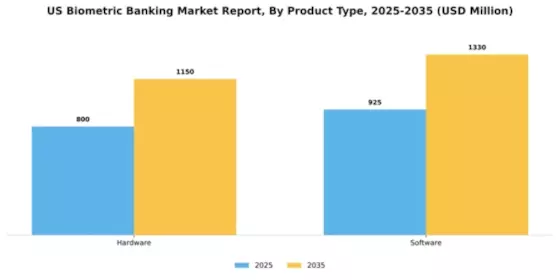
In the US biometric banking market, the distribution of market share between hardware and software reflects a robust preference for hardware solutions, which dominate the sector. With advancements in biometric technology, hardware components such as fingerprint scanners and facial recognition devices are pivotal in establishing trust and security in banking operations. This strong preference is propelled by the need for secure transactions and the adoption of contactless solutions. On the other hand, the software segment is rapidly emerging, driven by the increasing demand for seamless integration and enhancement of user experiences within banking platforms. Factors such as the rise in digital banking, regulatory compliance, and the need for advanced security features are propelling software growth. As financial institutions strive for efficiency, the role of biometric software in identity verification processes is becoming increasingly crucial, making it the fastest-growing segment.
Hardware (Dominant) vs. Software (Emerging)
The hardware segment remains the dominant force in the US biometric banking market, characterized by established technologies such as fingerprint and iris recognition systems. These hardware solutions are critical for ensuring high-security standards in banking, consolidating their position as essential components of biometric authentication systems. On the other hand, the software segment is emerging rapidly, adapting to the evolving needs of financial institutions. This software often integrates with existing bank systems, allowing for more flexibility and rapid updates in technology. With increasing focus on user experiences and fraud prevention, the software segment is gaining ground, emphasizing the need for integration with various hardware components while ensuring top-notch security measures.
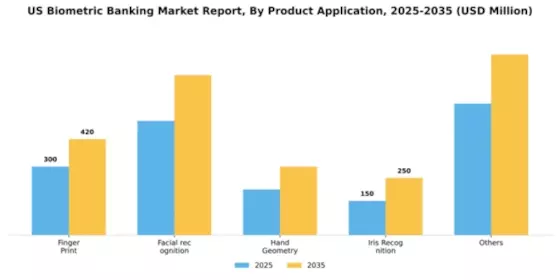
In the US biometric banking market, Finger Print technology currently holds the largest market share, dominating the landscape due to its established reliability and user acceptance. It is widely adopted across various banking applications, enabling secure access and transactions. On the other hand, Facial Recognition is rapidly gaining traction and is recognized as the fastest-growing segment, largely driven by advancements in AI and machine learning that enhance its accuracy and efficiency. The growth of the biometric banking sector is primarily fueled by increasing security concerns and the need for enhanced customer authentication methods. As banks continue to digitize and adopt innovative technologies, solutions such as Hand Geometry and Iris Recognition are steadily contributing to market expansion. Additionally, the integration of biometric systems with mobile banking apps is propelling further adoption, making biometric authentication more accessible for consumers.
Finger Print (Dominant) vs. Facial Recognition (Emerging)
Finger Print technology remains the dominant player in the biometric banking sector, praised for its speed and ease of use, ensuring that customers can quickly authenticate their identities without hassle. This technology's widespread adoption is supported by its proven track record in lowering fraud risks while enhancing customer convenience. Conversely, Facial Recognition, though emerging, is rapidly establishing its presence in the market. It offers distinct advantages such as contactless verification and real-time analytics, which are increasingly appealing to banks looking for innovative authentication methods. The ability of Facial Recognition to adapt and improve through machine learning algorithms positions it effectively for future growth, driven by the rising demand for advanced security measures.
Get more detailed insights about US Biometric Banking Market Request Free Sample
The biometric banking market is currently characterized by a dynamic competitive landscape, driven by technological advancements and increasing consumer demand for secure banking solutions. Key players such as Mastercard (US), Visa (US), and FIS (US) are at the forefront, focusing on innovation and strategic partnerships to enhance their service offerings. Mastercard (US) has been particularly active in integrating biometric authentication into its payment systems, aiming to streamline user experiences while bolstering security. Visa (US), on the other hand, emphasizes regional expansion and collaboration with fintech startups to leverage emerging technologies, thereby enhancing its competitive positioning. Collectively, these strategies contribute to a robust competitive environment, where agility and technological prowess are paramount. In terms of business tactics, companies are increasingly localizing manufacturing and optimizing supply chains to respond swiftly to market demands. The competitive structure of the biometric banking market appears moderately fragmented, with several players vying for market share. However, the influence of major companies like Mastercard (US) and Visa (US) remains substantial, as they set industry standards and drive innovation through their extensive resources and technological capabilities. In October 2025, Mastercard (US) announced a partnership with a leading AI firm to develop advanced biometric fraud detection systems. This strategic move is likely to enhance the security of transactions, addressing growing concerns over cyber threats. By integrating AI with biometric technologies, Mastercard (US) positions itself as a leader in secure payment solutions, potentially increasing customer trust and loyalty. In September 2025, Visa (US) launched a new biometric payment card that utilizes fingerprint recognition technology. This initiative not only showcases Visa's commitment to innovation but also reflects a broader trend towards contactless and secure payment methods. The introduction of such technology may significantly enhance user convenience while reducing the risk of fraud, thereby reinforcing Visa's competitive edge in the market. In August 2025, FIS (US) expanded its biometric authentication services by acquiring a startup specializing in facial recognition technology. This acquisition is indicative of FIS's strategy to diversify its offerings and enhance its technological capabilities. By integrating cutting-edge biometric solutions, FIS (US) aims to provide its clients with comprehensive security measures, which could lead to increased market penetration and customer retention. As of November 2025, the biometric banking market is witnessing trends such as digitalization, AI integration, and a growing emphasis on sustainability. Strategic alliances among key players are shaping the competitive landscape, fostering innovation and collaboration. Looking ahead, it appears that competitive differentiation will increasingly hinge on technological advancements and supply chain reliability, rather than solely on price. Companies that prioritize innovation and customer-centric solutions are likely to thrive in this evolving market.




In recent developments, the US Biometric Banking Market has witnessed increased investments and strategic partnerships aimed at enhancing security measures. Notably, in August 2023, FaceTec announced a partnership with several financial institutions to implement its 3D facial recognition technology for account security and fraud prevention. Meanwhile, JPMorgan Chase has been integrating biometric authentication into its mobile banking platform for improved user experience and security. In the realm of mergers and acquisitions, it's worth mentioning that in September 2023, IDEMIA announced the acquisition of a specialized biometric company to bolster its identity verification capabilities, enhancing services in biometric banking.
Major players like IBM and Citibank continue to invest in biometric technologies for streamlining customer interactions while ensuring high security. Growth in the market valuation of companies such as Fingerprint Cards and FIS reflects a broader acceptance of biometric solutions within financial services, driving competition and innovation. The US government has also emphasized the importance of tight security measures in financial transactions, aligning closely with advancements in biometrics for banking. These factors collectively point towards a robust evolution of biometric technology in the US financial sector.
The biometric banking market is projected to grow at a 3.35% CAGR from 2025 to 2035, driven by technological advancements, increasing security concerns, and consumer demand for seamless transactions.
New opportunities lie in:
By 2035, the biometric banking market is expected to achieve substantial growth and widespread adoption.
| MARKET SIZE 2024 | 1724.98(USD Million) |
| MARKET SIZE 2025 | 1782.77(USD Million) |
| MARKET SIZE 2035 | 2480.0(USD Million) |
| COMPOUND ANNUAL GROWTH RATE (CAGR) | 3.35% (2025 - 2035) |
| REPORT COVERAGE | Revenue Forecast, Competitive Landscape, Growth Factors, and Trends |
| BASE YEAR | 2024 |
| Market Forecast Period | 2025 - 2035 |
| Historical Data | 2019 - 2024 |
| Market Forecast Units | USD Million |
| Key Companies Profiled | Mastercard (US), Visa (US), FIS (US), Gemalto (NL), Thales Group (FR), IDEMIA (FR), Biometrics Research Group (CA), NEC Corporation (JP), SecuGen Corporation (US) |
| Segments Covered | Product Type, Product Application |
| Key Market Opportunities | Integration of advanced biometric technologies enhances security and customer experience in the biometric banking market. |
| Key Market Dynamics | Rising consumer demand for secure transactions drives innovation in biometric banking technologies and regulatory adaptations. |
| Countries Covered | US |
The market valuation was $1724.98 Million in 2024.
The projected valuation for 2035 is $2480.0 Million.
The expected CAGR is 3.35% during the forecast period 2025 - 2035.
Key players include Mastercard, Visa, FIS, Gemalto, Thales Group, IDEMIA, Biometrics Research Group, NEC Corporation, and SecuGen Corporation.
The main product types include hardware and software, with hardware valued at $800.0 Million to $1150.0 Million and software at $924.98 Million to $1330.0 Million.
Leading product applications include fingerprint recognition, facial recognition, hand geometry, iris recognition, and others.
The valuation range for fingerprint recognition was $300.0 Million to $420.0 Million.
The facial recognition segment is projected to be worth $500.0 Million to $700.0 Million by 2035.
The 'Others' category in product applications had a valuation range of $574.98 Million to $790.0 Million.
While specific comparisons are not provided, the US biometric banking market's growth appears steady, with a projected CAGR of 3.35% from 2025 - 2035.



Kindly complete the form below to receive a free sample of this Report

“This is really good guys. Excellent work on a tight deadline. I will continue to use you going forward and recommend you to others. Nice job”


“Thanks. It’s been a pleasure working with you, please use me as reference with any other Intel employees.”


“Thanks for sending the report it gives us a good global view of the Betaïne market.”


“Thank you, this will be very helpful for OQS.”


“We found the report very insightful! we found your research firm very helpful. I'm sending this email to secure our future business.”


“I am very pleased with how market segments have been defined in a relevant way for my purposes (such as "Portable Freezers & refrigerators" and "last-mile"). In general the report is well structured. Thanks very much for your efforts.”


“I have been reading the first document or the study, ,the Global HVAC and FP market report 2021 till 2026. Must say, good info! I have not gone in depth at all parts, but got a good indication of the data inside!”


“We got the report in time, we really thank you for your support in this process. I also thank to all of your team as they did a great job.”


“The Automotive 48V ECU Components Procurement Intelligence Study” was a complex project, but the Market Research Future (MRFR) team handled it with quality, agility, and customer-centricity. They delivered all requested data on time and within the agreed scope. The team, including Shubhendra Anand and Rahul Gotadki, was always readily available to clarify questions and swiftly implement necessary adjustments, driving the project to a successful conclusion within a very demanding timeframe.
I would also like to specifically commend Akshay Agarwal for his responsiveness and support at every stage—from our initial inquiry on May 6th through to final delivery on June 18th. His dedication made the entire process seamless.”



