×
Request Free Sample ×

Kindly complete the form below to receive a free sample of this Report

* Please use a valid business email

Leading companies partner with us for data-driven Insights

clients tt-cursor
Hero Background

US Butylenes Market

ID: MRFR/CnM/16921-HCR
111 Pages
Chitranshi Jaiswal
October 2025

US Butylenes Market Research Report: By Type (1-Butene, 2-Butene) and By Application (Butadiene, Methyl Ethyl Ketone, Butanol, Others) - Forecast to 2035

Share:
Download PDF ×

We do not share your information with anyone. However, we may send you emails based on your report interest from time to time. You may contact us at any time to opt-out.

US Butylenes Market Infographic
Purchase Options

US Butylenes Market Summary

As per analysis, the US butylenes market is projected to grow from USD 6.12 Billion in 2025 to USD 8.83 Billion by 2035, exhibiting a compound annual growth rate (CAGR) of 3.73% during the forecast period (2025 - 2035).

Key Market Trends & Highlights

The US butylenes market is poised for growth driven by sustainability and technological advancements.

  • The fuel additives segment remains the largest contributor to the US butylenes market, reflecting its critical role in enhancing fuel performance.
  • In contrast, the chemical intermediates segment is the fastest-growing, driven by increasing applications in various industries.
  • The automotive sector continues to be the largest consumer of butylenes, while the pharmaceuticals sector is emerging as the fastest-growing application area.
  • Key market drivers include the growing demand from the automotive sector and regulatory support for green chemistry initiatives.

Market Size & Forecast

2024 Market Size 5.9 (USD Billion)
2035 Market Size 8.83 (USD Billion)
CAGR (2025 - 2035) 3.73%

Major Players

ExxonMobil (US), LyondellBasell (US), Chevron Phillips Chemical (US), Shell Chemical (US), Braskem (US), Eastman Chemical (US), Repsol (US), Ineos (US), Mitsubishi Chemical (US)

US Butylenes Market Trends

The US butylenes market is currently experiencing a dynamic phase characterized by evolving demand patterns and shifting production capabilities. The market is primarily driven by the increasing utilization of butylenes in the production of various chemicals and fuels, which are essential for numerous applications, including the manufacturing of plastics and synthetic rubber. Additionally, the growing emphasis on sustainable practices and the transition towards greener alternatives may influence the market landscape, as stakeholders seek to reduce their carbon footprint. This transition could potentially reshape the competitive dynamics within the sector, prompting companies to innovate and adapt their strategies accordingly. Moreover, the US butylenes market is witnessing a notable trend towards the integration of advanced technologies in production processes. This integration aims to enhance efficiency and reduce operational costs, thereby improving overall profitability. Furthermore, regulatory frameworks and environmental policies are likely to play a crucial role in shaping market trends, as they may impose stricter guidelines on emissions and production practices. As the market continues to evolve, stakeholders must remain vigilant and responsive to these changes to capitalize on emerging opportunities and mitigate potential risks.

Sustainable Production Practices

The US butylenes market is increasingly focusing on sustainable production methods. Companies are exploring ways to minimize environmental impact through the adoption of cleaner technologies and processes. This shift is driven by regulatory pressures and consumer demand for eco-friendly products, prompting manufacturers to innovate in their production techniques.

Technological Advancements in Production

There is a growing trend towards the incorporation of advanced technologies in the production of butylenes. Automation and digitalization are being leveraged to enhance operational efficiency and reduce costs. This trend may lead to improved product quality and increased competitiveness within the US butylenes market.

Diversification of Applications

The applications of butylenes are diversifying within the US market. Beyond traditional uses in fuels and chemicals, there is a rising interest in utilizing butylenes in emerging sectors such as renewable energy and bioplastics. This diversification could open new avenues for growth and development in the market.

Market Segment Insights

By Application: Fuel Additives (Largest) vs. Chemical Intermediates (Fastest-Growing)

In the US butylenes market, the application segment is primarily driven by fuel additives, which hold the largest market share due to their essential role in enhancing the performance and efficiency of fuels. Fuel additives improve combustion qualities and reduce emissions, catering to an increasingly eco-conscious consumer base. Following closely are chemical intermediates, which are gaining traction in various industries, contributing to their rapid growth within this segment. Additionally, polymer production and solvents also play significant roles, albeit on a smaller scale compared to the leading segments.

Fuel Additives (Dominant) vs. Chemical Intermediates (Emerging)

Fuel additives represent the dominant force within the US butylenes market, primarily utilized for their capability to improve fuel quality and engine performance, thereby extending the life of vehicles and machinery. As automotive technology evolves, the need for high-performance fuel additives continues to rise, ensuring sustained demand. Conversely, chemical intermediates are emerging as a competitive segment, serving as critical building blocks for various chemical products. With the ongoing expansion of industries such as pharmaceuticals and agriculture, the demand for chemical intermediates is projected to surge, positioning them as a vital player in the butylenes market.

By End Use: Automotive (Largest) vs. Pharmaceuticals (Fastest-Growing)

The US butylenes market is predominantly driven by its automotive segment, which holds the largest share among various end uses. This segment greatly benefits from the increasing demand for lightweight materials and the ongoing quest for fuel efficiency in vehicles. Following the automotive segment, industrial applications also contribute significantly to market share, fueled by the rising production of polymers and chemicals. Consumer goods remain a noteworthy segment, although it represents a smaller percentage compared to automotive and industrial applications, primarily relying on the growing consumer demand for packaged products. In terms of growth trends, the pharmaceuticals segment is emerging as the fastest-growing area within the US butylenes market. This is driven by a heightened emphasis on healthcare and the increased production of pharmaceutical products to cater to an aging population. Furthermore, the automotive sector continues to evolve with advancements in electric vehicles, further propelling the demand for butylenes. Moreover, the industrial and consumer goods segments are expected to maintain steady growth, driven by innovation and sustainability initiatives that encourage the use of butylenes in diverse applications.

Automotive (Dominant) vs. Pharmaceuticals (Emerging)

The automotive segment stands as the dominant force in the US butylenes market, characterized by its extensive use in the manufacturing of various components such as tires, adhesives, and seals. This segment is not only critical for producing lightweight materials but also plays a key role in enhancing fuel efficiency through advanced polymer applications. On the other hand, the pharmaceuticals segment is marked as an emerging player, leveraging butylenes in the production of a range of medical devices and drug formulations. The rising investment in healthcare innovations and the increasing demand for effective medicinal products position pharmaceuticals to experience significant growth. Both segments are vital, yet they cater to entirely different market needs, reflecting the diversified applications of butylenes across industries.

By Type: 1-Butylene (Largest) vs. Isobutylene (Fastest-Growing)

In the US butylenes market, the distribution of market share among the three primary types shows 1-Butylene as the leading segment. It commands the largest share due to its extensive application in producing high-performance fuels and chemicals, appealing to a wide array of industrial processes. Isobutylene, while not the largest, is rapidly gaining traction as it finds increasing uses in the manufacture of synthetic rubber and performance additives, contributing to a dynamic competitive landscape.

1-Butylene (Dominant) vs. Isobutylene (Emerging)

1-Butylene stands out in the US butylenes market as a dominant player, primarily due to its versatility in several applications including the production of alkylates and other derivatives. Its well-established production processes and stable supply chain enhance its market position. Conversely, Isobutylene is emerging as a significant contender, driven by growing demand in the automotive sector, especially for synthetic rubber production. This segment experiences robust growth due to innovations and advancements in processing techniques, enabling manufacturers to meet rising demand while addressing environmental concerns. Together, these two butylene types reflect the evolving dynamics of the market.

By Production Method: Steam Cracking (Largest) vs. Dehydrogenation (Fastest-Growing)

In the US butylenes market, the production methods are crucial in shaping the supply dynamics. Steam cracking is the largest production method, substantially dominating the market share due to its efficiency and established operational framework. Catalytic cracking follows, with a significant share as well, while dehydrogenation is emerging, carving out a niche in the market. The distribution reflects the traditional reliance on steam cracking technologies, which play a foundational role in butylene production.

Steam Cracking (Dominant) vs. Dehydrogenation (Emerging)

Steam cracking remains the dominant production method in the US butylenes market, celebrated for its ability to process a variety of feedstocks, including naphtha and ethane, into high-value byproducts like butylenes. Its established infrastructure and operational efficiency ensure its prominence. In contrast, dehydrogenation is gaining traction as an emerging method, driven by advances in catalyst technology and increased demand for isobutylene and 1-butene. This shift is propelled by the growing emphasis on environmental sustainability and the desire for cleaner processing methods, making dehydrogenation an attractive option for future investments.

By Distribution Channel: Direct Sales (Largest) vs. Distributors (Fastest-Growing)

In the US butylenes market, the distribution channels exhibit varied dynamics, with direct sales holding the largest market share due to their established customer relationships and cost-effectiveness. Distributors, while currently holding a smaller share, are rapidly gaining ground as they cater to a broader range of customers and offer flexible options. Online sales remain a niche but are showing potential for growth as digital transformation reshapes purchasing behaviors in the industry. Looking towards the future, distributors are emerging as the fastest-growing segment. This growth can be attributed to the increasing demand for butylenes across various applications and industries, necessitating a more extensive distribution network. The role of e-commerce in facilitating quicker access and better pricing is also influencing this shift, as buyers increasingly seek convenience and efficiency in their procurement processes.

Direct Sales (Dominant) vs. Online Sales (Emerging)

Direct sales remain the dominant distribution channel in the US butylenes market, leveraging long-term relationships with key customers and offering customized solutions. This approach allows for better control over pricing and customer service, ensuring a steady partnership in supply. In contrast, online sales are becoming an emerging force, attracting tech-savvy buyers and those seeking streamlined purchasing experiences. While online sales currently occupy a smaller market share, their growth potential is significant as more players enter the digital marketplace and existing companies enhance their online platforms to cater to evolving consumer preferences.

Get more detailed insights about US Butylenes Market

Key Players and Competitive Insights

The butylenes market in the US is characterized by a competitive landscape that is increasingly shaped by innovation, sustainability initiatives, and strategic partnerships. Key players such as ExxonMobil (US), LyondellBasell (US), and Chevron Phillips Chemical (US) are actively pursuing strategies that emphasize technological advancements and operational efficiencies. ExxonMobil (US) has focused on enhancing its production capabilities through investments in advanced refining technologies, while LyondellBasell (US) has been expanding its product portfolio to include more sustainable options, thereby positioning itself as a leader in eco-friendly solutions. Chevron Phillips Chemical (US) is also making strides in digital transformation, which appears to be a critical factor in maintaining competitive advantage in this evolving market.

The business tactics employed by these companies reflect a concerted effort to optimize supply chains and localize manufacturing processes. The butylenes market is moderately fragmented, with a few dominant players exerting considerable influence over pricing and production standards. This competitive structure allows for a dynamic interplay between established firms and emerging players, fostering an environment where innovation and efficiency are paramount.

In November 2025, ExxonMobil (US) announced a significant investment in a new butylene production facility in Texas, aimed at increasing its output by 15%. This strategic move is expected to enhance its market share and meet the growing demand for butylenes in various applications, including the production of high-performance polymers. The investment underscores ExxonMobil's commitment to maintaining its leadership position while addressing the evolving needs of its customer base.

In October 2025, LyondellBasell (US) launched a new line of bio-based butylenes, which are derived from renewable resources. This initiative not only aligns with global sustainability trends but also positions the company as a pioneer in the development of environmentally friendly chemical solutions. The introduction of bio-based products is likely to attract a new segment of environmentally conscious consumers and businesses, thereby expanding LyondellBasell's market reach.

In September 2025, Chevron Phillips Chemical (US) entered into a strategic partnership with a leading technology firm to enhance its digital capabilities in production and supply chain management. This collaboration aims to leverage artificial intelligence and data analytics to optimize operations, reduce costs, and improve product quality. Such advancements are indicative of a broader trend within the industry, where digitalization is becoming a key differentiator among competitors.

As of December 2025, the competitive trends in the butylenes market are increasingly defined by a focus on sustainability, digital transformation, and strategic alliances. Companies are shifting from traditional price-based competition to a model that prioritizes innovation and reliability in supply chains. This evolution suggests that future competitive differentiation will hinge on the ability to integrate advanced technologies and sustainable practices into core operations, thereby meeting the demands of a rapidly changing market.


Key Companies in the US Butylenes Market market include

Industry Developments

The US Butylenes Market has seen several notable developments recently, reflecting a shift towards enhanced production and innovation. In the past few months, companies like Shell and ExxonMobil have commenced advanced projects focusing on expanding their butylene output, aiming to meet the rising demand in diverse applications, including fuel additives and plastics. In terms of market dynamics, BASF and Chevron Phillips Chemical noted significant growth in their butylenes valuations, attributed to an increase in consumer demand amid the recovering economy. Moreover, in March 2023, LyondellBasell acquired a stake in a butylene production facility, reinforcing their position in the market.

Notable mergers, such as the one between Ineos and Mitsui in early 2023, have further intensified competition, allowing for greater resource sharing and technological advancements. The US government has also implemented stringent regulations promoting sustainability in the Butylenes Market, pushing firms to innovate greener production methods. Such developments are anticipated to lead to a more competitive landscape, driving both innovation and efficiency among industry players. The ongoing investments and corporate strategies highlight the potential for growth, making the US Butylenes Market a critical focus for stakeholders in the chemical sector.

Future Outlook

US Butylenes Market Future Outlook

The US butylenes market is projected to grow at a 3.73% CAGR from 2024 to 2035, driven by increasing demand in petrochemical applications and sustainable practices.

New opportunities lie in:

  • Expansion of bio-based butylene production facilities.
  • Development of advanced catalytic processes for butylene conversion.
  • Investment in logistics for efficient butylene distribution networks.

By 2035, the butylenes market is expected to achieve robust growth, positioning itself as a key player in the chemical industry.

Market Segmentation

US Butylenes Market Type Outlook

  • 1-Butylene
  • 2-Butylene
  • Isobutylene

US Butylenes Market End Use Outlook

  • Automotive
  • Industrial
  • Consumer Goods
  • Pharmaceuticals

US Butylenes Market Application Outlook

  • Fuel Additives
  • Chemical Intermediates
  • Polymer Production
  • Solvents

US Butylenes Market Production Method Outlook

  • Steam Cracking
  • Catalytic Cracking
  • Dehydrogenation

US Butylenes Market Distribution Channel Outlook

  • Direct Sales
  • Distributors
  • Online Sales

Report Scope

MARKET SIZE 20245.9(USD Billion)
MARKET SIZE 20256.12(USD Billion)
MARKET SIZE 20358.83(USD Billion)
COMPOUND ANNUAL GROWTH RATE (CAGR)3.73% (2024 - 2035)
REPORT COVERAGERevenue Forecast, Competitive Landscape, Growth Factors, and Trends
BASE YEAR2024
Market Forecast Period2025 - 2035
Historical Data2019 - 2024
Market Forecast UnitsUSD Billion
Key Companies ProfiledExxonMobil (US), LyondellBasell (US), Chevron Phillips Chemical (US), Shell Chemical (US), Braskem (US), Eastman Chemical (US), Repsol (US), Ineos (US), Mitsubishi Chemical (US)
Segments CoveredApplication, End Use, Type, Production Method, Distribution Channel
Key Market OpportunitiesGrowing demand for sustainable butylene derivatives in the US butylenes market presents significant opportunities.
Key Market DynamicsShifts in consumer preferences drive innovation and competition in the US butylenes market.
Countries CoveredUS

Leave a Comment

FAQs

What is the current market size of the US Butylenes Market?

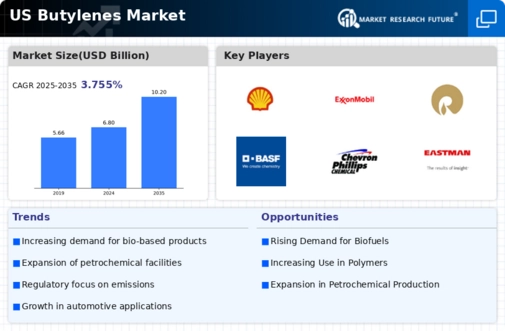
As of 2024, the US Butylenes Market is valued at approximately 6.8 USD Billion.

What is the projected market size of the US Butylenes Market by 2035?

By 2035, the US Butylenes Market is expected to reach a valuation of around 10.2 USD Billion.

What is the expected compound annual growth rate (CAGR) for the US Butylenes Market from 2025 to 2035?

The US Butylenes Market is expected to grow at a CAGR of 3.755% from 2025 to 2035.

Which types of butylene dominate the US Butylenes Market?

The market is primarily divided into 1-Butene and 2-Butene, with 1-Butene valued at 3.5 USD Billion in 2024.

What will be the market value of 1-Butene by 2035?

The market value for 1-Butene is projected to be approximately 5.3 USD Billion by 2035.

How much is the 2-Butene segment valued at in 2024?

In 2024, the 2-Butene segment is valued at around 3.3 USD Billion.

What will be the market size for 2-Butene in 2035?

The market size for 2-Butene is anticipated to reach about 4.9 USD Billion by 2035.

Who are the key players in the US Butylenes Market?

Major players in the US Butylenes Market include Shell, ExxonMobil, and BASF among others.

What are the key applications driving the US Butylenes Market growth?

Key applications include production of polymers, fuels, and chemicals that are vital for various industries.

How is the competitive landscape shaping in the US Butylenes Market?

The market is seeing increased competition due to technological advancements and strategic partnerships among leading players.

Download Free Sample

Kindly complete the form below to receive a free sample of this Report

Compare Licence

×
Features License Type
Single User Multiuser License Enterprise User
Price $4,950 $5,950 $7,250
Maximum User Access Limit 1 User Upto 10 Users Unrestricted Access Throughout the Organization
Free Customization
Direct Access to Analyst
Deliverable Format
Platform Access
Discount on Next Purchase 10% 15% 15%
Printable Versions