Download Free Sample
Kindly complete the form below to receive a free sample of this Report
US Critical Illness Insurance Market Research Report By Application (Cancer, Heart Attack, Stroke, others) - Growth & Industry Forecast 2025 To 2035.
As per Market Research Future analysis, the US critical illness-insurance market Size was estimated at 54.45 USD Billion in 2024. The US critical illness-insurance market is projected to grow from 58.13 USD Billion in 2025 to 111.83 USD Billion by 2035, exhibiting a compound annual growth rate (CAGR) of 6.7% during the forecast period 2025 - 2035
The US critical illness-insurance market is experiencing a notable shift towards consumer-centric products and heightened awareness.
| 2024 Market Size | 54.45 (USD Billion) |
| 2035 Market Size | 111.83 (USD Billion) |
| CAGR (2025 - 2035) | 6.76% |
Prudential (GB), AIA Group (HK), MetLife (US), Allianz (DE), Aviva (GB), Sun Life Financial (CA), Cigna (US), Manulife Financial (CA), Bupa (GB)
Our Impact
Enabled $4.3B Revenue Impact for Fortune 500 and Leading Multinationals
Partnering with 2000+ Global Organizations Each Year
30K+ Citations by Top-Tier Firms in the Industry
The critical illness-insurance market is currently experiencing notable shifts, driven by evolving consumer awareness and healthcare dynamics. As individuals increasingly recognize the financial implications of severe health conditions, there is a growing demand for policies that provide financial support during critical illnesses. This trend appears to be influenced by a heightened focus on preventive healthcare and the rising costs associated with medical treatments. Insurers are responding by offering more tailored products that cater to specific health risks, thereby enhancing their appeal to a broader audience. Moreover, the regulatory landscape is also shaping the critical illness-insurance market. Recent initiatives aimed at improving healthcare access and affordability may lead to increased participation in insurance programs. This evolving environment suggests that consumers are more inclined to invest in policies that offer comprehensive coverage for critical illnesses. As the market adapts to these changes, it is likely that innovation in product offerings will continue to play a crucial role in meeting the diverse needs of policyholders. The interplay between consumer demand and regulatory frameworks will likely define the future trajectory of this market.
There is a noticeable rise in consumer awareness regarding the financial risks associated with critical illnesses. Individuals are becoming more informed about the potential costs of treatment and the importance of having adequate insurance coverage. This trend is prompting more people to seek out critical illness-insurance policies that provide financial security during health crises.
Insurers are increasingly developing tailored products that address specific health risks faced by consumers. This trend reflects a shift towards personalized insurance solutions, allowing individuals to select coverage that aligns with their unique health profiles. Such customization is likely to enhance customer satisfaction and retention.
The regulatory environment is evolving, with new policies aimed at improving healthcare access and affordability. These changes may encourage more individuals to consider critical illness-insurance as a viable option for financial protection. As regulations adapt, insurers may also adjust their offerings to comply with new standards, potentially leading to a more competitive market.
The demographic shift towards an aging population in the US is a crucial factor influencing the critical illness-insurance market. By 2030, it is estimated that around 20% of the US population will be aged 65 and older. This demographic is more susceptible to chronic illnesses, which increases the demand for insurance products that provide coverage for critical health conditions. The critical illness-insurance market is likely to see a surge in demand as older adults seek financial security and peace of mind. Insurers may respond by developing tailored products that cater specifically to the needs of this demographic, further driving market growth.
The escalating costs associated with healthcare in the US are a primary driver for the critical illness-insurance market. As medical expenses continue to rise, individuals are increasingly seeking financial protection against unforeseen health issues. In 2025, healthcare spending is projected to reach approximately $4.3 trillion, which represents a significant burden on personal finances. This trend compels consumers to consider critical illness insurance as a viable option to mitigate potential financial strain. The critical illness-insurance market is thus positioned to benefit from this growing concern, as more individuals recognize the importance of safeguarding their financial future against high medical costs.
Employer-sponsored insurance initiatives are playing a pivotal role in the growth of the critical illness-insurance market. Many employers are increasingly offering critical illness insurance as part of their employee benefits packages. This trend is driven by the desire to enhance employee well-being and reduce absenteeism due to health issues. In 2025, it is estimated that over 60% of employers will provide some form of critical illness coverage to their employees. The critical illness-insurance market is thus likely to experience growth as more companies recognize the value of offering such benefits, leading to increased enrollment and awareness among employees.
The growing emphasis on preventive healthcare is significantly impacting the critical illness-insurance market. As more individuals adopt healthier lifestyles and preventive measures, there is a corresponding increase in awareness about the importance of financial protection against critical illnesses. This shift in mindset encourages consumers to consider insurance products that provide coverage for serious health conditions. In 2025, it is anticipated that spending on preventive services will account for a larger share of overall healthcare expenditures. The critical illness-insurance market is likely to benefit from this trend, as insurers may develop products that reward healthy behaviors, thus attracting a broader customer base.
Technological innovations in health monitoring and diagnostics are reshaping the landscape of the critical illness-insurance market. Wearable devices and telemedicine are becoming increasingly prevalent, allowing for early detection and management of health issues. This trend not only enhances patient outcomes but also influences insurance providers to adjust their offerings. Insurers may leverage data from these technologies to create more personalized policies, potentially leading to lower premiums for healthier individuals. The critical illness-insurance market stands to gain from these advancements, as they may encourage more consumers to invest in insurance products that align with their health management strategies.
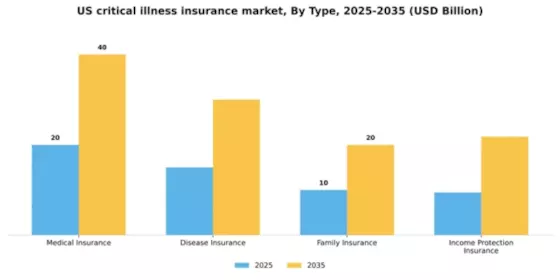
In the US critical illness-insurance market, Medical Insurance holds the largest market share among the various types of coverage available. This segment remains a cornerstone of critical illness policies, enabling individuals to access necessary medical treatments without significant financial strain. The robustness of Medical Insurance reflects a long-standing demand for comprehensive health coverage, positioning it as the front-runner in this competitive landscape. Conversely, Income Protection Insurance is gaining traction as the fastest-growing segment in the market. With rising awareness of income security during illness, this type of coverage appeals to a growing demographic. The increase in flexible working arrangements and freelance jobs further drives this trend, as individuals seek to safeguard their income against unexpected health challenges. This segment's growth is attributed to changing attitudes towards financial protection and changing workforce dynamics.
Medical Insurance (Dominant) vs. Income Protection Insurance (Emerging)
Medical Insurance is characterized by its extensive coverage of various health-related incidents, making it a dominant choice for consumers looking for security against critical health issues. It typically encompasses a wide range of medical conditions, providing essential support during challenging times. In contrast, Income Protection Insurance represents an emerging trend, focusing less on medical expenses and more on ensuring that individuals maintain their income flow, regardless of health setbacks. This type of insurance often appeals to younger professionals and self-employed individuals who may not have access to traditional employment benefits. As both segments evolve, they reflect shifting consumer priorities regarding health and financial stability, catering to diverse needs in an increasingly complex insurance landscape.
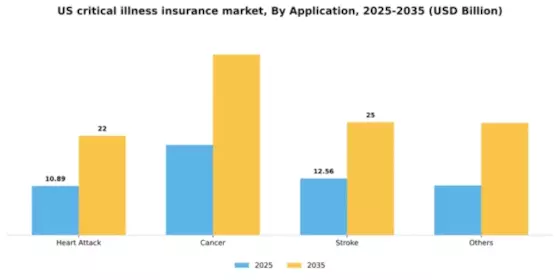
In the US critical illness-insurance market, the application segment is primarily dominated by Cancer, which captures a significant share of the total offerings. Heart Attack follows closely behind as another major contributor. Other applications, such as Stroke and Others, hold relatively smaller shares in comparison but still play a crucial role in diversifying the critical illness policies available to consumers. Growth trends within this segment are largely driven by increasing health awareness and a rise in chronic illness diagnoses. Cancer treatments advancements and early detection technologies are propelling the demand for cancer-related coverage. Meanwhile, the Heart Attack segment has emerged as the fastest-growing category, fueled by increased lifestyle-related health risks and an aging population that requires more tailored insurance solutions.
Cancer: Dominant vs. Heart Attack: Emerging
Cancer continues to be the dominant application in the critical illness-insurance market, primarily due to the high prevalence rates and substantial medical costs associated with treatment. Insurers are thus rapidly developing comprehensive policies that reflect the evolving landscape of cancer care. In contrast, Heart Attack represents an emerging category as lifestyle diseases become more prevalent; consumers are increasingly seeking financial protection for these events. The rapid growth in this area is supported by robust lifestyle modification programs and heightened public awareness about heart health, leading insurers to innovate their offerings and meet the rising demand.
Get more detailed insights about US Critical Illness Insurance Market Request Free Sample
The critical illness-insurance market is currently characterized by a dynamic competitive landscape, driven by increasing consumer awareness and a growing emphasis on health security. Major players such as MetLife (US), Cigna (US), and Prudential (GB) are actively shaping the market through strategic initiatives focused on innovation and digital transformation. MetLife (US) has positioned itself as a leader in leveraging technology to enhance customer experience, while Cigna (US) emphasizes comprehensive health solutions that integrate critical illness coverage with broader health management services. Prudential (GB) appears to be focusing on expanding its product offerings to cater to diverse consumer needs, thereby enhancing its competitive edge in this evolving market.The market structure is moderately fragmented, with a mix of established players and emerging entrants. Key business tactics include localizing product offerings to meet regional demands and optimizing supply chains to improve service delivery. The collective influence of these major players fosters a competitive environment where innovation and customer-centric strategies are paramount, allowing them to capture market share effectively.In October MetLife (US) announced a partnership with a leading telehealth provider to integrate virtual health consultations into its critical illness insurance offerings. This strategic move is likely to enhance customer engagement and streamline the claims process, reflecting a broader trend towards digital health solutions. By incorporating telehealth services, MetLife (US) not only addresses consumer preferences for convenience but also positions itself as a forward-thinking insurer in a rapidly evolving market.In September Cigna (US) launched a new critical illness insurance product that includes wellness incentives aimed at promoting preventive care among policyholders. This initiative underscores Cigna's commitment to holistic health management and aligns with the growing consumer demand for insurance products that support overall well-being. By incentivizing healthy behaviors, Cigna (US) may enhance customer loyalty and reduce claims costs over time, thereby strengthening its market position.In August Prudential (GB) expanded its critical illness insurance portfolio by introducing customizable coverage options tailored to specific demographic segments. This strategic action reflects Prudential's understanding of the diverse needs of consumers and its intent to capture a broader market share. By offering personalized solutions, Prudential (GB) is likely to differentiate itself from competitors and attract a wider customer base.As of November the critical illness-insurance market is witnessing trends such as increased digitalization, sustainability initiatives, and the integration of artificial intelligence in underwriting processes. Strategic alliances among key players are shaping the competitive landscape, fostering innovation and enhancing service delivery. Looking ahead, competitive differentiation is expected to evolve, with a shift from price-based competition towards a focus on technological advancements and supply chain reliability. This transition may redefine how companies engage with consumers, emphasizing the importance of innovation and customer experience in driving market success.





The US Critical Illness Insurance Market has recently seen significant developments. Growth in market valuation is fueled by an increasing awareness of health risks and a rising demand for supplementary insurance products. For instance, companies like Cigna and Prudential Financial have launched new policies tailored to meet the needs of different demographics, reflecting an ongoing trend towards customization in the insurance sector. In terms of mergers and acquisitions, Transamerica announced the acquisition of a smaller firm in September 2023 to expand its critical illness offerings, enhancing its competitive stance in the market.
Furthermore, in March 2022, Allianz expanded its portfolio by acquiring a regional insurance provider, strengthening its presence in the US. Companies like MetLife and Unum Group have also reported heightened competition and innovation, attributing this to the increased demand for critical illness insurance as individuals seek better financial protection against unforeseen health issues. This growing market exemplifies how insurers are adapting their strategies to cater to evolving consumer needs and economic conditions, thereby shaping the landscape of critical illness protection in the US.
The Critical Illness Insurance Market is projected to grow at a 6.76% CAGR from 2025 to 2035, driven by increasing healthcare costs, rising awareness, and demographic shifts.
New opportunities lie in:
By 2035, the market is expected to achieve robust growth, enhancing coverage options and accessibility.
| MARKET SIZE 2024 | 54.45(USD Billion) |
| MARKET SIZE 2025 | 58.13(USD Billion) |
| MARKET SIZE 2035 | 111.83(USD Billion) |
| COMPOUND ANNUAL GROWTH RATE (CAGR) | 6.76% (2025 - 2035) |
| REPORT COVERAGE | Revenue Forecast, Competitive Landscape, Growth Factors, and Trends |
| BASE YEAR | 2024 |
| Market Forecast Period | 2025 - 2035 |
| Historical Data | 2019 - 2024 |
| Market Forecast Units | USD Billion |
| Key Companies Profiled | Prudential (GB), AIA Group (HK), MetLife (US), Allianz (DE), Aviva (GB), Sun Life Financial (CA), Cigna (US), Manulife Financial (CA), Bupa (GB) |
| Segments Covered | Type, Application |
| Key Market Opportunities | Integration of telemedicine and digital health solutions enhances accessibility in the critical illness-insurance market. |
| Key Market Dynamics | Rising consumer awareness drives demand for critical illness insurance, influencing competitive strategies and regulatory frameworks. |
| Countries Covered | US |
The overall market valuation was $54.45 Billion in 2024.
The projected valuation for 2035 is $111.83 Billion.
The expected CAGR during the forecast period 2025 - 2035 is 6.76%.
In 2024, segments included Medical Insurance at $20.0 - $40.0 Billion, Disease Insurance at $15.0 - $30.0 Billion, Family Insurance at $10.0 - $20.0 Billion, and Income Protection Insurance at $9.45 - $21.83 Billion.
Key applications include Cancer at $20.0 - $40.0 Billion, Heart Attack at $10.89 - $22.0 Billion, Stroke at $12.56 - $25.0 Billion, and Others at $11.0 - $24.83 Billion.
Major players include Prudential (GB), AIA Group (HK), MetLife (US), Allianz (DE), Aviva (GB), Sun Life Financial (CA), Cigna (US), Manulife Financial (CA), and Bupa (GB).
The US critical illness-insurance market appears to be growing steadily, with a projected valuation increase from $54.45 Billion in 2024 to $111.83 Billion by 2035.
Factors influencing growth may include increasing healthcare costs, rising awareness of critical illnesses, and the expanding range of insurance products offered by key players.
The projected growth indicates a robust demand for critical illness coverage, reflecting changing consumer needs and a greater emphasis on financial security.
The competitive landscape may evolve as key players innovate and adapt their offerings, potentially leading to increased market share for companies that effectively address consumer demands.


Kindly complete the form below to receive a free sample of this Report

“This is really good guys. Excellent work on a tight deadline. I will continue to use you going forward and recommend you to others. Nice job”


“Thanks. It’s been a pleasure working with you, please use me as reference with any other Intel employees.”


“Thanks for sending the report it gives us a good global view of the Betaïne market.”


“Thank you, this will be very helpful for OQS.”


“We found the report very insightful! we found your research firm very helpful. I'm sending this email to secure our future business.”


“I am very pleased with how market segments have been defined in a relevant way for my purposes (such as "Portable Freezers & refrigerators" and "last-mile"). In general the report is well structured. Thanks very much for your efforts.”


“I have been reading the first document or the study, ,the Global HVAC and FP market report 2021 till 2026. Must say, good info! I have not gone in depth at all parts, but got a good indication of the data inside!”


“We got the report in time, we really thank you for your support in this process. I also thank to all of your team as they did a great job.”


“The Automotive 48V ECU Components Procurement Intelligence Study” was a complex project, but the Market Research Future (MRFR) team handled it with quality, agility, and customer-centricity. They delivered all requested data on time and within the agreed scope. The team, including Shubhendra Anand and Rahul Gotadki, was always readily available to clarify questions and swiftly implement necessary adjustments, driving the project to a successful conclusion within a very demanding timeframe.
I would also like to specifically commend Akshay Agarwal for his responsiveness and support at every stage—from our initial inquiry on May 6th through to final delivery on June 18th. His dedication made the entire process seamless.”



