×
Request Free Sample ×

Kindly complete the form below to receive a free sample of this Report

* Please use a valid business email

Leading companies partner with us for data-driven Insights

clients tt-cursor
Hero Background

US Dimethylformamide Market

ID: MRFR/CnM/13729-HCR
100 Pages
Chitranshi Jaiswal
October 2025

US Dimethylformamide Market Research Report By Application (Solvent, Chemical Intermediate, Reagent), By End Use Industry (Pharmaceuticals, Agriculture, Electronics, Textiles), By Formulation Type (Anhydrous, Hydrous) and By Distribution Channel (Direct Sales, Distributors, Online Sales) - Forecast to 2035

Share:
Download PDF ×

We do not share your information with anyone. However, we may send you emails based on your report interest from time to time. You may contact us at any time to opt-out.

US Dimethylformamide Market Infographic
Purchase Options

US Dimethylformamide Market Summary

As per analysis, the US dimethylformamide market is projected to grow from USD 378.72 Million in 2025 to USD 511.54 Million by 2035, exhibiting a compound annual growth rate (CAGR) of 3.05% during the forecast period (2025 - 2035).

Key Market Trends & Highlights

The US dimethylformamide market is experiencing a shift towards sustainability and regulatory compliance, driven by technological advancements.

  • The solvent segment remains the largest contributor to the US dimethylformamide market, primarily due to its extensive use in various industrial applications.
  • The pharmaceutical segment is the largest consumer of dimethylformamide, reflecting its critical role in drug formulation and production.
  • The agriculture segment is emerging as the fastest-growing area, driven by increasing demand for agrochemicals and innovative formulations.
  • Key market drivers include the growing demand in pharmaceuticals and the expansion of the chemical industry, which are fostering regulatory support for chemical safety.

Market Size & Forecast

2024 Market Size 367.5 (USD Million)
2035 Market Size 511.54 (USD Million)
CAGR (2025 - 2035) 3.05%

Major Players

BASF SE (DE), Eastman Chemical Company (US), Solvay SA (BE), Huntsman Corporation (US), Alfa Aesar (US), Merck KGaA (DE), Taminco (US), Shandong Jinling Chemical (CN)

US Dimethylformamide Market Trends

The US dimethylformamide market is currently experiencing a notable evolution, driven by various factors that influence its demand and supply dynamics. This solvent, widely utilized in the production of pharmaceuticals, agrochemicals, and plastics, has garnered attention due to its unique properties, such as high polarity and ability to dissolve a wide range of substances. As industries increasingly seek efficient and effective solvents, the relevance of dimethylformamide continues to grow. Furthermore, regulatory frameworks surrounding chemical usage are becoming more stringent, prompting manufacturers to adapt their processes and formulations to comply with safety and environmental standards. This shift may lead to innovations in production methods and the development of alternative solvents that could impact the market landscape. In addition, the US dimethylformamide market is likely to witness shifts in consumer preferences, with a growing emphasis on sustainability and eco-friendliness. Companies are exploring greener alternatives and more sustainable practices, which may reshape the competitive landscape. The interplay between traditional applications and emerging trends suggests a complex market environment where adaptability and innovation are crucial for success. As the market evolves, stakeholders must remain vigilant to navigate the challenges and opportunities that arise, ensuring they align with both regulatory requirements and consumer expectations.

Sustainability Initiatives

The US dimethylformamide market is increasingly influenced by sustainability initiatives. Companies are exploring eco-friendly alternatives and practices to reduce their environmental footprint. This trend reflects a broader shift towards greener chemistry, where the focus is on minimizing hazardous waste and emissions. As regulatory pressures mount, manufacturers are likely to invest in research and development to create more sustainable production methods.

Regulatory Compliance

Regulatory compliance is a critical factor shaping the US dimethylformamide market. Stricter regulations regarding chemical safety and environmental impact are prompting companies to reassess their practices. This trend may lead to increased costs for compliance but also encourages innovation in safer production techniques. Adapting to these regulations is essential for maintaining market access and consumer trust.

Technological Advancements

Technological advancements are playing a pivotal role in the US dimethylformamide market. Innovations in production processes and applications are enhancing efficiency and reducing costs. Companies are likely to leverage new technologies to improve the quality of dimethylformamide and expand its use in various industries. This trend indicates a potential for growth and diversification within the market.

Market Segment Insights

By Application: Solvent (Largest) vs. Reagent (Fastest-Growing)

In the US dimethylformamide market, the application segments showcase diverse roles that are crucial in various industries. Solvent holds the largest market share due to its broad application in the production of plastics, fibers, and pharmaceuticals. Following closely is the reagent segment, which, although smaller, shows promise with an increasing demand driven by advancements in chemical synthesis and pharmaceuticals. Intermediate and additive applications, while important, represent a smaller fraction of the market share compared to solvent and reagent.

Reagent (Dominant) vs. Additive (Emerging)

The reagent application of dimethylformamide is characterized by its fundamental role in chemical reactions, particularly in organic synthesis where it provides a polar, aprotic solvent environment. This position underscores its critical importance in pharmaceutical and agrochemical sectors, where high purity and performance standards are paramount. In contrast, the additive segment, though emerging, is gaining traction due to the growing demand for enhanced performance in coatings and adhesives. As industries continue to look for innovative formulations with improved properties, the role of dimethylformamide as an additive is likely to expand, but it still trails behind the established dominance of the reagent.

By End Use Industry: Pharmaceuticals (Largest) vs. Agriculture (Fastest-Growing)

In the US dimethylformamide market, the end-use industry segment is witnessing significant share distribution among various sectors. Pharmaceuticals hold the largest share due to their extensive applications in drug formulation and production processes. Agriculture follows, alongside electronics and textiles, which also contribute notably to the demand for dimethylformamide in diverse applications ranging from crop protection to fiber and film manufacturing.

Pharmaceuticals: Dominant vs. Agriculture: Emerging

Pharmaceuticals currently dominate the US dimethylformamide market, driven by their critical role in formulating various medicinal compounds and Expanding the horizons of healthcare innovations. The agriculture sector, while currently smaller, is emerging as a key growth area. This is propelled by increasing investments in agrochemicals and a growing emphasis on sustainable practices. Agriculture's reliance on dimethylformamide for pesticide formulations and herbicides is on the rise, indicating a robust growth trend as farmers seek more effective solutions to enhance crop yield and sustainability.

By Formulation Type: Liquid (Largest) vs. Aqueous (Fastest-Growing)

In the US dimethylformamide market, the formulation type segment is mainly composed of liquid, solid, and aqueous variants, with liquid dominating the market share. The substantial utility of liquid dimethylformamide in industrial applications ensures its leading position, while solid forms hold a minimal share. In contrast, aqueous formulations, although smaller now, are gaining traction among manufacturers due to their environmental benefits and suitability for specific applications. This shift represents a strategic pivot toward more sustainable practices within the industry. The growth dynamics in this segment are primarily driven by increasing demand for eco-friendly solvents and formulations. Liquid formulations continue to benefit from established industrial usage, while the aqueous segment is appealing due to its low toxicity and reduced environmental impact. The solid form remains stable but sees limited expansion, as the market transitions toward more versatile and sustainable options.

Liquid (Dominant) vs. Aqueous (Emerging)

Liquid dimethylformamide remains the dominant formulation type in the US market, known for its versatility as a solvent in various applications, including pharmaceuticals, textiles, and electronics. Its established efficacy and broad adoption across industries make it a staple choice. On the other hand, aqueous dimethylformamide formulations are emerging as a compelling alternative, particularly as sustainability concerns heighten. Their reduced toxicity and lower environmental impact are attractive to manufacturers seeking greener options, fostering interest in this segment. This shift suggests a promising future for aqueous formulations, driven by regulatory pressures and changing consumer preferences, marking a significant transition in the market landscape.

By Purity Level: High Purity (Largest) vs. Technical Grade (Fastest-Growing)

The US dimethylformamide market's purity level segment showcases a varied distribution among its categories, with High Purity leading by a significant margin. This category is preferred in high-end applications where purity is crucial, making it a staple in industries such as pharmaceuticals and electronics. Technical Grade follows, serving as a viable alternative for applications that do not demand the highest purity, thus appealing to a broader range of industrial sectors. Industrial Grade, while essential, accounts for a smaller share, primarily focusing on cost-effective applications where purity is less critical. Growth trends in the purity level segment indicate a robust demand for High Purity dimethylformamide due to increasing quality standards in pharmaceuticals and specialty chemicals. Simultaneously, Technical Grade is becoming the fastest-growing segment as manufacturers seek cost-efficiency without sacrificing quality, especially in the textile and polymer sectors. Factors like technological advancements, regulatory changes, and shifting market preferences continue to drive the growth of these segments, reflecting an evolving landscape in the US chemical market.

High Purity (Dominant) vs. Technical Grade (Emerging)

High Purity dimethylformamide is characterized by its exceptional quality, making it indispensable in applications requiring stringent purity standards, such as drug formulation and electronic component manufacturing. The dominant position of this segment is solidified by the stringent regulatory environment that compels manufacturers to use higher-purity solvents. In contrast, Technical Grade dimethylformamide is emerging as a viable option for businesses seeking balance between performance and cost. This grade caters to a wide range of applications where ultra-high purity is not a necessity, and its growing acceptance can be attributed to increasing production efficiency and the pressure on companies to reduce costs without compromising entirely on quality.

Get more detailed insights about US Dimethylformamide Market

Key Players and Competitive Insights

The dimethylformamide market exhibits a competitive landscape characterized by a blend of established players and emerging entities, driven by increasing demand across various applications, including pharmaceuticals, agrochemicals, and electronics. Key players such as BASF SE (DE), Eastman Chemical Company (US), and Huntsman Corporation (US) are strategically positioned to leverage their extensive production capabilities and innovation-driven approaches. BASF SE (DE) focuses on sustainability and efficiency in its production processes, while Eastman Chemical Company (US) emphasizes product diversification and technological advancements. Huntsman Corporation (US) is actively pursuing strategic partnerships to enhance its market reach, collectively shaping a competitive environment that is increasingly focused on innovation and sustainability.

The business tactics employed by these companies include localizing manufacturing to reduce costs and optimize supply chains, which is particularly relevant in the context of fluctuating raw material prices. The market structure appears moderately fragmented, with a few dominant players exerting considerable influence. This fragmentation allows for niche players to emerge, yet the collective strength of the key players ensures a competitive balance that drives innovation and efficiency.

In October 2025, BASF SE (DE) announced a significant investment in a new production facility aimed at enhancing its dimethylformamide output. This strategic move is expected to bolster its market position by increasing capacity and reducing production costs, thereby allowing for more competitive pricing strategies. The investment aligns with BASF's commitment to sustainability, as the new facility will incorporate advanced technologies to minimize environmental impact.

In November 2025, Eastman Chemical Company (US) launched a new line of dimethylformamide derivatives designed for use in high-performance applications. This product innovation not only expands Eastman's portfolio but also positions the company to capture a larger share of the market by addressing specific customer needs in sectors such as electronics and pharmaceuticals. The introduction of these derivatives reflects Eastman's focus on R&D and its ability to respond to evolving market demands.

In December 2025, Huntsman Corporation (US) entered into a strategic alliance with a leading technology firm to develop AI-driven solutions for optimizing dimethylformamide production processes. This collaboration is poised to enhance operational efficiency and reduce costs, thereby strengthening Huntsman's competitive edge. The integration of AI technologies signifies a broader trend within the industry towards digital transformation, which is likely to redefine operational paradigms.

As of December 2025, the dimethylformamide market is increasingly influenced by trends such as digitalization, sustainability, and the integration of advanced technologies. Strategic alliances are becoming pivotal in shaping the competitive landscape, enabling companies to pool resources and expertise. Looking ahead, competitive differentiation is expected to evolve from traditional price-based competition to a focus on innovation, technological advancements, and supply chain reliability, underscoring the importance of agility and responsiveness in a rapidly changing market.


Key Companies in the US Dimethylformamide Market market include

Industry Developments

The US Dimethylformamide Market has seen various developments in recent months. Yantai Hengyuan Chemical and Lanxess are focusing on sustainability initiatives, aiming to reduce their carbon footprint and enhance production efficiency. In July 2023, BASF announced a strategic partnership with Eastman Chemical Company to jointly explore new applications for Dimethylformamide, enhancing its market presence. Notably, in August 2023, Huntsman Corporation and Dupont revealed a collaboration to expand their operations in the specialty chemicals sector, indicating a potential shift towards increased competition within the market.

Market valuation growth has been observed as companies like Mitsubishi Gas Chemical and Shandong Hongda Xingye increase their production capabilities to meet rising demand from the pharmaceuticals and agrochemicals sectors in the US. Over the past two to three years, the market has been affected by fluctuations in raw material prices and regulatory changes aimed at environmental compliance. These dynamics are shaping the strategies of key players, including Jiangshan Chemical and Solvay, as they adapt to the evolving landscape and seek to capitalize on emerging opportunities in the US Dimethylformamide Market.

Future Outlook

US Dimethylformamide Market Future Outlook

The US dimethylformamide market is projected to grow at a 3.05% CAGR from 2024 to 2035, driven by increasing demand in pharmaceuticals, agrochemicals, and electronics.

New opportunities lie in:

  • Expansion into bio-based dimethylformamide production
  • Development of advanced recycling technologies for solvent recovery
  • Strategic partnerships with pharmaceutical companies for tailored applications

By 2035, the dimethylformamide market is expected to achieve robust growth, reflecting evolving industry needs.

Market Segmentation

US Dimethylformamide Market Application Outlook

  • Solvent
  • Reagent
  • Intermediate
  • Additive

US Dimethylformamide Market Purity Level Outlook

  • High Purity
  • Technical Grade
  • Industrial Grade

US Dimethylformamide Market End Use Industry Outlook

  • Pharmaceuticals
  • Agriculture
  • Electronics
  • Textiles

US Dimethylformamide Market Formulation Type Outlook

  • Liquid
  • Solid
  • Aqueous

Report Scope

MARKET SIZE 2024367.5(USD Million)
MARKET SIZE 2025378.72(USD Million)
MARKET SIZE 2035511.54(USD Million)
COMPOUND ANNUAL GROWTH RATE (CAGR)3.05% (2024 - 2035)
REPORT COVERAGERevenue Forecast, Competitive Landscape, Growth Factors, and Trends
BASE YEAR2024
Market Forecast Period2025 - 2035
Historical Data2019 - 2024
Market Forecast UnitsUSD Million
Key Companies ProfiledBASF SE (DE), Eastman Chemical Company (US), Solvay SA (BE), Huntsman Corporation (US), Alfa Aesar (US), Merck KGaA (DE), Taminco (US), Shandong Jinling Chemical (CN)
Segments CoveredApplication, End Use Industry, Formulation Type, Purity Level
Key Market OpportunitiesGrowing demand for sustainable solvents in the US dimethylformamide market presents significant opportunities.
Key Market DynamicsRegulatory changes and sustainability concerns drive innovation and demand in the US dimethylformamide market.
Countries CoveredUS

Leave a Comment

FAQs

What is the expected market size of the US Dimethylformamide Market in 2024?

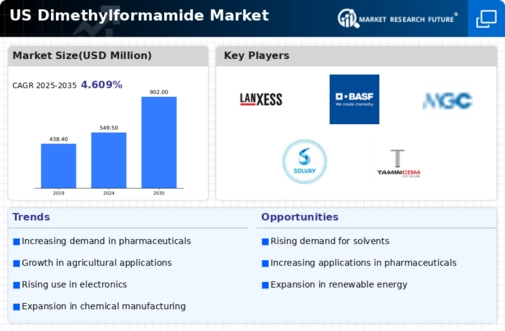
The expected market size of the US Dimethylformamide Market in 2024 is valued at 549.5 million USD.

How much is the US Dimethylformamide Market projected to be worth by 2035?

The US Dimethylformamide Market is projected to be worth 902.03 million USD by 2035.

What is the expected CAGR for the US Dimethylformamide Market from 2025 to 2035?

The expected CAGR for the US Dimethylformamide Market from 2025 to 2035 is 4.609%.

What are the key applications of Dimethylformamide in the US market?

The key applications of Dimethylformamide in the US market are as a solvent, chemical intermediate, and reagent.

What will be the market value of Dimethylformamide used as a solvent in 2035?

The market value of Dimethylformamide used as a solvent is expected to reach 365.0 million USD in 2035.

Who are the major players in the US Dimethylformamide Market?

Major players in the US Dimethylformamide Market include Yantai Hengyuan Chemical, Lanxess, BASF, and Mitsubishi Gas Chemical.

What is the projected market value for Dimethylformamide as a chemical intermediate in 2035?

The projected market value for Dimethylformamide as a chemical intermediate is 315.0 million USD in 2035.

How much is the Dimethylformamide market expected to grow in the reagent application segment by 2035?

The Dimethylformamide market in the reagent application segment is expected to grow to 222.03 million USD by 2035.

What challenges does the US Dimethylformamide Market face in the upcoming years?

The US Dimethylformamide Market may face challenges related to regulatory compliance and environmental concerns.

What trends are emerging in the US Dimethylformamide Market?

Emerging trends in the US Dimethylformamide Market include increasing demand for sustainable chemicals and expansion in various industrial applications.

Download Free Sample

Kindly complete the form below to receive a free sample of this Report

Compare Licence

×
Features License Type
Single User Multiuser License Enterprise User
Price $4,950 $5,950 $7,250
Maximum User Access Limit 1 User Upto 10 Users Unrestricted Access Throughout the Organization
Free Customization
Direct Access to Analyst
Deliverable Format
Platform Access
Discount on Next Purchase 10% 15% 15%
Printable Versions