×
Request Free Sample ×

Kindly complete the form below to receive a free sample of this Report

* Please use a valid business email

Leading companies partner with us for data-driven Insights

clients tt-cursor
Hero Background

US Drone Services Market

ID: MRFR/AD/16626-HCR
100 Pages
Garvit Vyas
October 2025

US Drone Services Market

Share:
Download PDF ×

We do not share your information with anyone. However, we may send you emails based on your report interest from time to time. You may contact us at any time to opt-out.

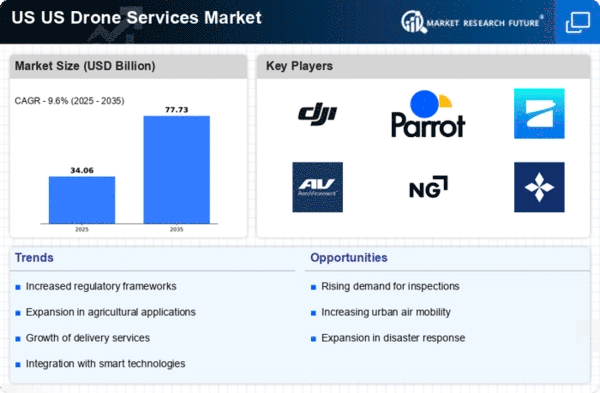
US Drone Services Market Infographic
Purchase Options

US Drone Services Market Summary

As per analysis, the US drone services market is projected to grow from USD 34.05 Billion in 2025 to USD 85.18 Billion by 2035, exhibiting a compound annual growth rate (CAGR) of 9.6% during the forecast period (2025 - 2035).

Key Market Trends & Highlights

The US drone services market is experiencing robust growth driven by technological advancements and regulatory support.

  • Aerial photography remains the largest segment, showcasing widespread adoption across various industries.
  • Agricultural monitoring is the fastest-growing segment, reflecting increasing demand for precision farming solutions.
  • Infrastructure inspection is expanding rapidly, driven by the need for efficient and safe assessments of structures.
  • Regulatory support and technological advancements are key drivers propelling the market forward.

Market Size & Forecast

2024 Market Size 31.08 (USD Billion)
2035 Market Size 85.18 (USD Billion)
CAGR (2025 - 2035) 9.6%

Major Players

DJI (US), Parrot (US), Skydio (US), AeroVironment (US), PrecisionHawk (US), DroneDeploy (US), Zipline (US), Insitu (US), senseFly (US)

US Drone Services Market Trends

The US drone services market is currently experiencing a dynamic evolution, driven by advancements in technology and increasing applications across various sectors. The integration of drones into industries such as agriculture, construction, and logistics appears to be reshaping operational efficiencies and enhancing data collection capabilities. Regulatory frameworks established by the Federal Aviation Administration (FAA) are facilitating the growth of this market, as they provide guidelines that ensure safety while promoting innovation. Furthermore, the demand for aerial imagery and surveillance is on the rise, indicating a shift towards more sophisticated uses of drone technology. In addition to commercial applications, the US drone services market is witnessing a surge in interest from governmental agencies for purposes such as disaster response and environmental monitoring. This trend suggests a growing recognition of drones as vital tools for enhancing situational awareness and improving response times in emergencies. As the market continues to mature, it is likely that new opportunities will emerge, particularly in sectors that have yet to fully embrace drone technology. Overall, the trajectory of the US drone services market indicates a promising future, characterized by ongoing innovation and expanding use cases across diverse industries.

Increased Adoption in Agriculture

The US drone services market is seeing heightened adoption within the agricultural sector. Farmers are utilizing drones for crop monitoring, precision agriculture, and soil analysis. This trend suggests that drones are becoming essential tools for enhancing productivity and sustainability in farming practices.

Expansion in Infrastructure Inspection

There is a notable expansion in the use of drones for infrastructure inspection in the US. Industries such as construction and energy are increasingly relying on drones to conduct inspections of bridges, power lines, and pipelines. This trend indicates a shift towards more efficient and safer methods of monitoring critical infrastructure.

Growth in Public Safety Applications

The US drone services market is experiencing growth in public safety applications, particularly in law enforcement and emergency response. Agencies are adopting drones for surveillance, search and rescue operations, and crowd monitoring. This trend highlights the potential of drones to enhance public safety and improve operational effectiveness.

Market Segment Insights

By Application: Aerial Photography (Largest) vs. Agricultural Monitoring (Fastest-Growing)

In the US drone services market, the application segment is diverse, with aerial photography leading in market share due to its widespread use across various industries, including real estate and media. Following closely, agricultural monitoring is gaining traction as farmers increasingly adopt drone technology to enhance crop management, leveraging aerial imagery to make informed decisions. Other applications such as infrastructure inspection, surveying and mapping, and emergency response are also growing as organizations recognize the efficiency and safety benefits that drones offer.

Aerial Photography (Dominant) vs. Agricultural Monitoring (Emerging)

Aerial photography has established itself as the dominant application within the US drone services market, catering to sectors such as entertainment, real estate, and tourism. Its popularity stems from the unique aerial perspectives that drones provide, allowing for innovative content creation and effective property marketing. On the other hand, agricultural monitoring is an emerging application that is rapidly evolving, driven by the need for precision farming practices. Drones equipped with advanced sensors and cameras enable farmers to analyze crop health and optimize resources, positioning agricultural monitoring as a key player in sustainability and efficiency.

By End Use: Construction (Largest) vs. Agriculture (Fastest-Growing)

In the US drone services market, the end-use segment showcases a diverse distribution, with construction claiming the largest share as key industry players actively integrate drone technology for site surveys, inspections, and monitoring. Agriculture follows closely, harnessing drones for precision farming, crop surveillance, and livestock monitoring, allowing it to carve out a significant niche in this rapidly evolving landscape. Other sectors like energy, public safety, and telecommunications also contribute to the overall market dynamics, enhancing service delivery through technological advancements in drone applications.

Construction (Dominant) vs. Agriculture (Emerging)

Construction has established itself as a dominant force in the US drone services market, leveraging cutting-edge drone technology for improving project efficiency, safety, and cost-effectiveness. The sector utilizes drones for a variety of applications, such as 3D mapping and aerial photography, facilitating better planning and execution. On the other hand, agriculture is becoming an emerging segment, driven by advancements in precision agriculture and data analytics. Farmers are increasingly adopting drones for tasks including crop health monitoring and soil analysis, indicating significant growth potential in this space.

By Drone Type: Fixed Wing (Largest) vs. Rotary Wing (Fastest-Growing)

In the US drone services market, the distribution among drone types shows a diversified landscape. Fixed Wing drones dominate the segment, serving a wide array of applications such as agriculture, surveying, and mapping. Their ability to cover large areas efficiently contributes significantly to their market position. On the other hand, Rotary Wing drones are rapidly gaining traction, particularly in industries requiring precision and versatility, such as aerial photography and delivery services.

Fixed Wing (Dominant) vs. Rotary Wing (Emerging)

Fixed Wing drones have established themselves as the dominant force in the US drone services market, particularly due to their long flight duration and capacity for extensive coverage. These drones are particularly favored for applications in agriculture and surveying, where large areas need to be mapped or monitored with efficiency. In contrast, Rotary Wing drones are seen as an emerging segment, exhibiting rapid growth because of their agility and suitability for tasks requiring intricate maneuvers. They are increasingly used for delivery services and precision tasks, appealing to a growing number of industries that prioritize flexibility and real-time data gathering.

By Service Type: Data Collection (Largest) vs. Training (Fastest-Growing)

The service type segment in the US drone services market is characterized by diverse offerings, with Data Collection holding the largest market share. This segment leverages the unparalleled capability of drones for high-precision data acquisition across various sectors, including agriculture, real estate, and environmental monitoring. Meanwhile, Training services, while currently smaller in share, are emerging rapidly as drone technology becomes more prevalent, necessitating skilled operators across industries.

Data Collection: Dominant vs. Training: Emerging

Data Collection stands out as the dominant player in the service type segment, mainly due to its wide applications ranging from agricultural monitoring to infrastructure inspection. Businesses utilize drones to gather real-time data, enhancing decision-making processes and operational efficiencies. On the other hand, Training services are tagged as emerging, propelled by the increasing demand for certified drone operators. As regulations around drone usage become more stringent, the need for structured training programs is expected to grow, driving innovation and educational offerings within this sector.

By Regulatory Compliance: Commercial Use (Largest) vs. Recreational Use (Fastest-Growing)

The US drone services market is experiencing varying market share dynamics across its regulatory compliance segments. Commercial Use is the largest segment, primarily driven by industries such as agriculture, construction, and real estate, where drones facilitate efficiency and cost savings. In contrast, the Recreational Use segment has been witnessing rapid growth, fueled by increasing accessibility to drone technology and a surge in hobbyist activities.

Commercial Use (Dominant) vs. Recreational Use (Emerging)

Commercial Use represents a significant portion of the US drone services market, benefitting from stringent regulatory frameworks that enable businesses to leverage drones for operational excellence. Industries such as agriculture use drones for crop monitoring, while construction firms utilize them for site surveys and inspections. Conversely, the Recreational Use segment is emerging, as regulations become more accommodating and consumer interest in personal drones rises. This segment appeals to tech-savvy individuals who enjoy flying drones for leisure, photography, and sports, presenting a unique intersection of technology and entertainment.

Get more detailed insights about US Drone Services Market

Key Players and Competitive Insights

The drone services market is currently characterized by a dynamic competitive landscape, driven by technological advancements and increasing demand across various sectors such as agriculture, logistics, and surveillance. Key players like DJI (US), Skydio (US), and Zipline (US) are at the forefront, each adopting distinct strategies to enhance their market positioning. DJI (US) continues to lead with a focus on innovation, particularly in developing advanced imaging technologies and expanding its product offerings for commercial applications. Meanwhile, Skydio (US) emphasizes autonomous flight capabilities, positioning itself as a leader in AI-driven drone solutions, which is particularly appealing to sectors requiring high levels of automation. Zipline (US), on the other hand, has carved a niche in the logistics sector, leveraging its drone delivery services to improve healthcare supply chains, thus shaping a competitive environment that prioritizes efficiency and reliability.

In terms of business tactics, companies are increasingly localizing manufacturing and optimizing supply chains to enhance operational efficiency. The market appears moderately fragmented, with several players vying for dominance, yet the collective influence of major companies like DJI (US) and Skydio (US) suggests a trend towards consolidation. This competitive structure allows for a diverse range of services, catering to various industry needs while fostering innovation through competition.

In November 2025, Skydio (US) announced a strategic partnership with a leading agricultural technology firm to integrate its drones into precision farming solutions. This collaboration is likely to enhance crop monitoring and yield prediction, showcasing Skydio's commitment to expanding its footprint in the agricultural sector. The partnership not only reinforces Skydio's position as a technology leader but also highlights the growing intersection of drone technology and agriculture, which could redefine operational efficiencies in farming.

In October 2025, Zipline (US) expanded its operations into urban areas, launching a new drone delivery service aimed at improving access to medical supplies in densely populated cities. This move is significant as it demonstrates Zipline's adaptability and commitment to addressing urban logistics challenges. By leveraging its existing infrastructure, Zipline is poised to capture a larger market share while enhancing its service offerings, which could lead to increased demand for drone services in urban environments.

In September 2025, DJI (US) unveiled a new line of drones specifically designed for industrial inspections, targeting sectors such as energy and construction. This product launch is indicative of DJI's strategy to diversify its portfolio and cater to the growing demand for drone inspections in critical infrastructure. By focusing on specialized applications, DJI is likely to strengthen its competitive edge and maintain its leadership position in the market.

As of December 2025, the competitive trends in the drone services market are increasingly defined by digitalization, sustainability, and the integration of AI technologies. Strategic alliances are becoming more prevalent, as companies recognize the value of collaboration in enhancing service offerings and expanding market reach. Looking ahead, competitive differentiation is expected to evolve, shifting from price-based competition to a focus on innovation, technological advancements, and supply chain reliability. This transition may ultimately reshape the market landscape, fostering a more sustainable and efficient drone services ecosystem.

Key Companies in the US Drone Services Market market include

Future Outlook

US Drone Services Market Future Outlook

The US drone services market is projected to grow at a 9.6% CAGR from 2024 to 2035, driven by technological advancements, regulatory support, and increasing demand across various sectors.

New opportunities lie in:

  • Development of drone delivery networks for e-commerce logistics.
  • Integration of AI for enhanced data analytics in agricultural monitoring.

  • Expansion of drone inspection services for infrastructure maintenance.

By 2035, the drone services market is expected to be a pivotal component of various industries, showcasing robust growth.

Market Segmentation

US Drone Services Market End Use Outlook

  • Construction
  • Agriculture
  • Energy
  • Public Safety
  • Telecommunications

US Drone Services Market Drone Type Outlook

  • Fixed Wing
  • Rotary Wing
  • Hybrid
  • Nano
  • Delivery

US Drone Services Market Application Outlook

  • Aerial Photography
  • Agricultural Monitoring
  • Infrastructure Inspection
  • Surveying and Mapping
  • Emergency Response

US Drone Services Market Service Type Outlook

  • Data Collection
  • Consulting
  • Training
  • Maintenance
  • Software Development

US Drone Services Market Regulatory Compliance Outlook

  • Commercial Use
  • Recreational Use
  • Research and Development
  • Public Sector Use
  • Emergency Services

Report Scope

MARKET SIZE 202431.08(USD Billion)
MARKET SIZE 202534.05(USD Billion)
MARKET SIZE 203585.18(USD Billion)
COMPOUND ANNUAL GROWTH RATE (CAGR)9.6% (2024 - 2035)
REPORT COVERAGERevenue Forecast, Competitive Landscape, Growth Factors, and Trends
BASE YEAR2024
Market Forecast Period2025 - 2035
Historical Data2019 - 2024
Market Forecast UnitsUSD Billion
Key Companies ProfiledDJI (US), Parrot (US), Skydio (US), AeroVironment (US), PrecisionHawk (US), DroneDeploy (US), Zipline (US), Insitu (US), senseFly (US)
Segments CoveredApplication, End Use, Drone Type, Service Type, Regulatory Compliance
Key Market OpportunitiesExpansion of drone delivery services driven by evolving regulations and consumer demand for faster logistics solutions.
Key Market DynamicsRegulatory advancements and technological innovations drive growth in the US drone services market.
Countries CoveredUS

Leave a Comment

Download Free Sample

Kindly complete the form below to receive a free sample of this Report

Compare Licence

×
Features License Type
Single User Multiuser License Enterprise User
Price $4,950 $5,950 $7,250
Maximum User Access Limit 1 User Upto 10 Users Unrestricted Access Throughout the Organization
Free Customization
Direct Access to Analyst
Deliverable Format
Platform Access
Discount on Next Purchase 10% 15% 15%
Printable Versions