Download Free Sample
Kindly complete the form below to receive a free sample of this Report
US Feed Additives Market Size, Share, Industry Trend & Analysis Research Report By Form Outlook ( Dry, Liquid ), Type Outlook ( Amino Acids, Vitamins, Carotenoids, Enzymes, Prebiotics & Probiotics, Minerals, Acidifiers, Lipids, Others ), and Livestock Outlook ( Poultry, Swine, Ruminants, Others )forecast by 2035
As per Market Research Future analysis, the US feed additives market size was estimated at 5.2 USD Billion in 2024. The US feed additives market is projected to grow from 5.51 USD Billion in 2025 to 9.9 USD Billion by 2035, exhibiting a compound annual growth rate (CAGR) of 6.0% during the forecast period 2025 - 2035
The US feed additives market is experiencing a transformative shift towards natural solutions and technological advancements.
| 2024 Market Size | 5.2 (USD Billion) |
| 2035 Market Size | 9.9 (USD Billion) |
| CAGR (2025 - 2035) | 6.03% |
Cargill (US), BASF (DE), ADM (US), Evonik (DE), Nutreco (NL), Alltech (US), Kemin Industries (US), Novus International (US), Phibro Animal Health (US)
Our Impact
Enabled $4.3B Revenue Impact for Fortune 500 and Leading Multinationals
Partnering with 2000+ Global Organizations Each Year
30K+ Citations by Top-Tier Firms in the Industry
The feed additives market is currently experiencing notable transformations driven by evolving consumer preferences and regulatory changes. Increasing awareness regarding animal health and nutrition is prompting producers to seek innovative solutions that enhance feed efficiency and overall livestock performance. This shift is reflected in the growing demand for natural and organic additives, as stakeholders aim to align with consumer trends favoring sustainability and health-conscious products. Furthermore, advancements in technology are facilitating the development of specialized additives that cater to specific nutritional needs, thereby improving the quality of animal products. In addition, the regulatory landscape is becoming more stringent, compelling manufacturers to adapt their formulations to comply with safety and efficacy standards. This trend is likely to foster a competitive environment where companies invest in research and development to create safer and more effective feed additives. As the market evolves, it appears that the integration of digital tools and data analytics will play a crucial role in optimizing feed formulations and enhancing supply chain efficiency. Overall, the feed additives market is poised for growth, driven by innovation, regulatory compliance, and a focus on sustainability.
There is a discernible trend towards the adoption of natural feed additives as consumers increasingly prioritize health and sustainability. This shift is influencing producers to explore alternatives that minimize synthetic ingredients, thereby enhancing the appeal of animal products in the marketplace.
The feed additives market is witnessing significant technological advancements that enable the creation of specialized products tailored to specific nutritional requirements. Innovations in formulation and delivery methods are enhancing the effectiveness of additives, leading to improved animal health and productivity.
As regulations governing feed additives become more stringent, manufacturers are compelled to ensure their products meet safety and efficacy standards. This trend is driving investment in research and development, as companies strive to innovate while adhering to compliance requirements.
The increasing consumer preference for animal protein in the US is driving the feed additives market. As the population grows, the demand for meat, dairy, and eggs rises, necessitating efficient livestock production. Feed additives play a crucial role in enhancing feed efficiency and animal health, thereby supporting higher production levels. According to recent data, the US meat consumption is projected to reach approximately 100 million metric tons by 2026. This surge in demand compels livestock producers to adopt feed additives that improve growth rates and feed conversion ratios. Consequently, the feed additives market is likely to experience substantial growth as producers seek to meet the escalating protein demand while ensuring sustainability and animal welfare.
The emphasis on animal health and welfare is becoming increasingly prominent in the feed additives market. Consumers are more aware of the conditions under which livestock are raised, leading to a demand for products that promote animal well-being. Feed additives that enhance gut health, immune function, and overall vitality are gaining traction. The US market is witnessing a shift towards additives that are not only effective but also safe and natural. This trend is reflected in the growing sales of probiotics and prebiotics, which are expected to account for a significant share of the market. As producers prioritize animal welfare, the feed additives market is likely to expand, driven by the need for products that align with consumer expectations.
The regulatory landscape surrounding the feed additives market is evolving, influencing product development and market dynamics. In the US, regulatory bodies are implementing stricter guidelines to ensure the safety and efficacy of feed additives. Compliance with these regulations is essential for manufacturers aiming to maintain market access. This environment encourages innovation, as companies invest in research and development to create compliant products that meet consumer demands. The feed additives market is likely to see a rise in products that are not only effective but also align with regulatory standards. As the regulatory framework continues to tighten, the market may experience shifts in product offerings, with a focus on transparency and safety.
Sustainability initiatives are reshaping the feed additives market as producers seek to minimize their environmental impact. The agricultural sector is under pressure to adopt practices that reduce greenhouse gas emissions and resource consumption. Feed additives that enhance feed efficiency can contribute to lower emissions per unit of animal protein produced. For instance, the use of certain enzymes and probiotics can improve nutrient absorption, thereby reducing waste. The US government has also introduced various programs to support sustainable farming practices, which may further encourage the adoption of innovative feed additives. As sustainability becomes a priority, the feed additives market is poised for growth, driven by the need for environmentally friendly solutions.
Technological innovations are transforming the feed additives market, enabling the development of more effective and targeted products. Advances in biotechnology and data analytics are facilitating the creation of additives that cater to specific nutritional needs of livestock. For example, precision fermentation techniques are being employed to produce high-quality amino acids and vitamins. This trend is likely to enhance the performance of feed additives, making them more appealing to producers. The US feed additives market is expected to benefit from these innovations, as they provide solutions that improve feed efficiency and animal health. As technology continues to evolve, the market may witness the introduction of novel additives that address emerging challenges in livestock production.
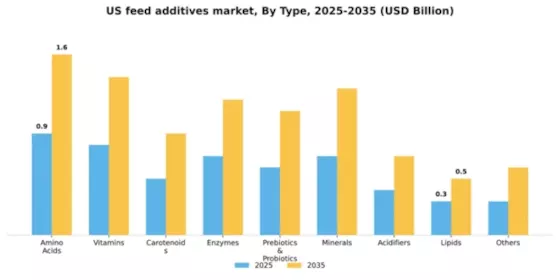
In the US feed additives market, the segment distribution reveals that amino acids hold the largest market share among different types of feed additives. This segment benefits from a wide range of applications across various animal species, leading to increased adoption by feed manufacturers seeking to improve growth rates and feed efficiency. Following amino acids, probiotics are emerging as a significant component, driving substantial interest and investment due to their role in enhancing gut health and overall animal performance. The growth trends in the US feed additives market show an upward trajectory, especially for the probiotics segment, which is now recognized as the fastest-growing category. The rising awareness of animal health, coupled with stringent regulations regarding antibiotic use in feed, is shifting focus toward natural alternatives like probiotics. Additionally, the increasing demand for high-quality animal products from consumers is propelling the growth of feed additives that promote better animal well-being and productivity.
Amino Acids (Dominant) vs. Probiotics (Emerging)
Amino acids play a dominant role in the US feed additives market, providing essential nutrients that are crucial for the growth and development of livestock. This segment is characterized by its ability to enhance protein synthesis, making it a staple in animal nutrition. In contrast, probiotics, while relatively newer in terms of market presence, are emerging as a vital ingredient due to their proven benefits in promoting gut health and immunity. The innovative formulations and increasing awareness of the health benefits associated with probiotics are rapidly capturing market share, positioning them as a significant growth driver in the feed additives landscape.
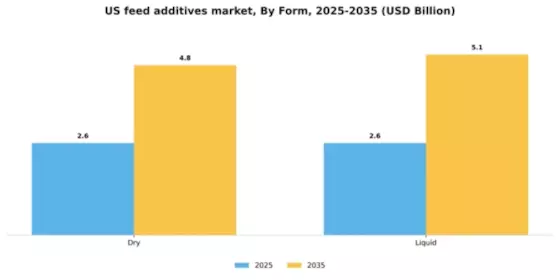
In the US feed additives market, the form segment is characterized by a significant distribution between dry and liquid forms. Currently, dry feed additives hold the largest share, appealing to a broad range of livestock due to their convenience and effectiveness. Meanwhile, liquid additives are rapidly gaining traction, especially among specialty feed manufacturers looking to enhance specific feed characteristics. This diversity in form availability caters to the distinct needs of various livestock producers, contributing to market competitiveness. Growth trends in this segment show a marked increase in the adoption of liquid feed additives, driven by their ease of incorporation into feed mixes and potential for improving nutrient absorption. On the other hand, dry forms continue to dominate due to established production practices and cost-effectiveness. Factors such as evolving livestock nutrition needs and regulatory changes are propelling the innovation of both forms, creating a dynamic landscape in the US feed additives market.
Form: Dry (Dominant) vs. Liquid (Emerging)
Dry feed additives are currently the dominant category in the US feed additives market, benefiting from their long shelf life and ease of use. They are widely favored for their stability and cost-effectiveness, making them a staple for many livestock operations. On the other hand, liquid feed additives are positioned as the emerging alternative, appealing to producers looking to enhance feed palatability and nutrient bioavailability. This category is growing quickly, as enhancements in formulation technologies allow for more targeted nutrition solutions. As livestock operations evolve, the competitive dynamics between dry and liquid forms will push innovation and adaptability, catering to the changing demands of animal health and nutrition.
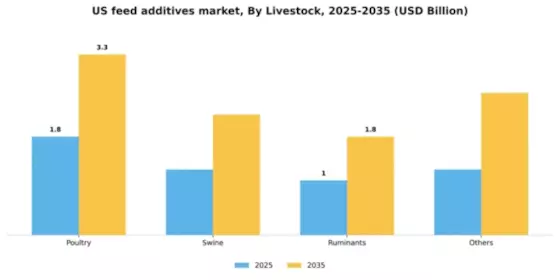
In the US feed additives market, the livestock segment displays a diverse distribution among its categories, with poultry holding the largest share. This sector benefits from the growing demand for poultry meat, driving the adoption of various feed additives tailored for enhancing growth and health. Swine is another significant category, known for its substantial market presence, but also shows rapid growth as more producers invest in innovative additives to improve feed efficiency and animal health. Growth trends in this market are influenced by evolving consumer preferences and health regulations. The increasing focus on animal welfare and the shift towards high-quality feed additives are key drivers for the swine segment, which is becoming the fastest-growing area. Additionally, initiatives aimed at improving livestock yield and sustainability further propel the demand for both poultry and swine feed additives, ensuring continued expansion in the years to come.
Poultry (Dominant) vs. Ruminants (Emerging)
Poultry additives are characterized by their ability to enhance growth rates and feed conversion efficiency, making them essential for commercial poultry operations. Dominating the market, they are formulated to meet the specific nutritional requirements of birds at various life stages. In contrast, the ruminants segment, while emerging, is gaining attention for its potential to optimize digestion and improve overall herd health. Innovations in ruminant feed additives focus on probiotics and prebiotics that promote gut health, addressing the rising concerns over health and productivity. Both segments are integral to the market, with poultry leading in volume, while ruminants are seen as a promising area for future investment.
Get more detailed insights about US Feed Additives Market Request Free Sample
The feed additives market is currently characterized by a dynamic competitive landscape, driven by increasing demand for animal protein and a growing emphasis on sustainable agricultural practices. Key players such as Cargill (US), ADM (US), and Alltech (US) are strategically positioning themselves through innovation and partnerships to enhance their market presence. Cargill (US) focuses on developing advanced nutritional solutions, while ADM (US) emphasizes its commitment to sustainability and efficiency in production processes. Alltech (US) leverages its expertise in fermentation technology to create unique feed additives that promote animal health and performance. Collectively, these strategies contribute to a competitive environment that prioritizes innovation and sustainability, shaping the future of the market. In terms of business tactics, companies are increasingly localizing manufacturing to reduce supply chain vulnerabilities and enhance responsiveness to regional demands. The market structure appears moderately fragmented, with several key players holding substantial market shares. This fragmentation allows for diverse product offerings and fosters competition, as companies strive to differentiate themselves through unique formulations and value-added services. In October 2025, Cargill (US) announced a partnership with a leading biotechnology firm to develop next-generation feed additives aimed at improving livestock health and reducing environmental impact. This collaboration is significant as it underscores Cargill's commitment to innovation and sustainability, potentially positioning the company as a leader in eco-friendly feed solutions. The strategic importance of this partnership lies in its potential to enhance product efficacy while addressing growing consumer concerns regarding the environmental footprint of animal agriculture. In September 2025, ADM (US) launched a new line of plant-based feed additives designed to meet the rising demand for alternative protein sources in animal nutrition. This initiative reflects ADM's strategic focus on sustainability and aligns with current market trends favoring plant-based solutions. The introduction of these products is likely to strengthen ADM's competitive position by appealing to environmentally conscious consumers and livestock producers. In August 2025, Alltech (US) expanded its research and development capabilities by opening a new innovation center dedicated to feed additives. This investment highlights Alltech's commitment to advancing its product offerings through scientific research and innovation. The establishment of this center is expected to enhance the company's ability to develop cutting-edge solutions that address the evolving needs of the livestock industry. As of November 2025, current trends in the feed additives market include a pronounced shift towards digitalization, sustainability, and the integration of artificial intelligence in product development. Strategic alliances among key players are increasingly shaping the competitive landscape, fostering collaboration that enhances innovation and market responsiveness. Looking ahead, competitive differentiation is likely to evolve from traditional price-based competition to a focus on technological advancements, supply chain reliability, and sustainable practices. This shift indicates a transformative phase in the market, where companies that prioritize innovation and sustainability may gain a competitive edge.

The Feed Additives Market is projected to grow at a 6.03% CAGR from 2025 to 2035, driven by increasing livestock production, rising consumer demand for quality meat, and regulatory support for animal health.
New opportunities lie in:
By 2035, the feed additives market is expected to achieve robust growth, reflecting evolving industry dynamics.
| MARKET SIZE 2024 | 5.2(USD Billion) |
| MARKET SIZE 2025 | 5.51(USD Billion) |
| MARKET SIZE 2035 | 9.9(USD Billion) |
| COMPOUND ANNUAL GROWTH RATE (CAGR) | 6.03% (2025 - 2035) |
| REPORT COVERAGE | Revenue Forecast, Competitive Landscape, Growth Factors, and Trends |
| BASE YEAR | 2024 |
| Market Forecast Period | 2025 - 2035 |
| Historical Data | 2019 - 2024 |
| Market Forecast Units | USD Billion |
| Key Companies Profiled | Cargill (US), BASF (DE), ADM (US), Evonik (DE), Nutreco (NL), Alltech (US), Kemin Industries (US), Novus International (US), Phibro Animal Health (US) |
| Segments Covered | Type, Form, Livestock |
| Key Market Opportunities | Growing demand for natural feed additives driven by consumer preference for sustainable livestock production. |
| Key Market Dynamics | Rising demand for natural feed additives driven by consumer preference for healthier livestock products. |
| Countries Covered | US |
The overall market valuation was $5.2 Billion in 2024.
The projected valuation for 2035 is $9.9 Billion.
The expected CAGR during the forecast period 2025 - 2035 is 6.03%.
The segments include Amino Acids, Vitamins, Carotenoids, Enzymes, Prebiotics & Probiotics, Minerals, Acidifiers, Lipids, and Others.
The Amino Acids segment was valued at $0.9 Billion in 2024.
The Liquid form is projected to reach $5.1 Billion by 2035.
The Poultry segment was valued at $1.8 Billion in 2024.
Cargill is one of the key players in the US feed additives market.
The Minerals segment is projected to grow to $1.3 Billion by 2035.
The Dry form of feed additives was valued at $2.6 Billion in 2024.



Kindly complete the form below to receive a free sample of this Report

“This is really good guys. Excellent work on a tight deadline. I will continue to use you going forward and recommend you to others. Nice job”


“Thanks. It’s been a pleasure working with you, please use me as reference with any other Intel employees.”


“Thanks for sending the report it gives us a good global view of the Betaïne market.”


“Thank you, this will be very helpful for OQS.”


“We found the report very insightful! we found your research firm very helpful. I'm sending this email to secure our future business.”


“I am very pleased with how market segments have been defined in a relevant way for my purposes (such as "Portable Freezers & refrigerators" and "last-mile"). In general the report is well structured. Thanks very much for your efforts.”


“I have been reading the first document or the study, ,the Global HVAC and FP market report 2021 till 2026. Must say, good info! I have not gone in depth at all parts, but got a good indication of the data inside!”


“We got the report in time, we really thank you for your support in this process. I also thank to all of your team as they did a great job.”


“The Automotive 48V ECU Components Procurement Intelligence Study” was a complex project, but the Market Research Future (MRFR) team handled it with quality, agility, and customer-centricity. They delivered all requested data on time and within the agreed scope. The team, including Shubhendra Anand and Rahul Gotadki, was always readily available to clarify questions and swiftly implement necessary adjustments, driving the project to a successful conclusion within a very demanding timeframe.
I would also like to specifically commend Akshay Agarwal for his responsiveness and support at every stage—from our initial inquiry on May 6th through to final delivery on June 18th. His dedication made the entire process seamless.”



