×
Request Free Sample ×

Kindly complete the form below to receive a free sample of this Report

* Please use a valid business email

Leading companies partner with us for data-driven Insights

clients tt-cursor
Hero Background

US Glycine Market

ID: MRFR/CnM/18900-HCR
100 Pages
Garvit Vyas
October 2025

US Glycine Market

Share:
Download PDF ×

We do not share your information with anyone. However, we may send you emails based on your report interest from time to time. You may contact us at any time to opt-out.

US Glycine Market Infographic
Purchase Options

US Glycine Market Summary

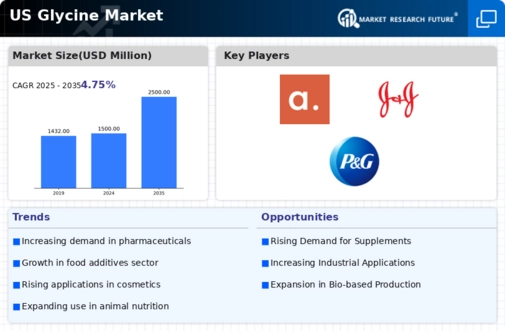
As per analysis, the US glycine market is projected to grow from USD 986.65 Million in 2024 to USD 1,038.16 Million in 2025, exhibiting a compound annual growth rate (CAGR) of 5.22% during the forecast period (2025 - 2035).

Key Market Trends & Highlights

The US glycine market is experiencing robust growth driven by diverse applications and technological advancements.

  • The pharmaceuticals segment remains the largest contributor to the US glycine market, reflecting its critical role in drug formulation.
  • Nutraceuticals emerge as the fastest-growing segment, driven by increasing consumer health awareness and demand for dietary supplements.
  • Human consumption continues to dominate the market, while animal nutrition is rapidly gaining traction as a significant growth area.
  • Key market drivers include the rising demand in the food and beverage industry and technological innovations in production processes.

Market Size & Forecast

2024 Market Size 986.65 (USD Million)
2035 Market Size 1726.86 (USD Million)
CAGR (2025 - 2035) 5.22%

Major Players

Ajinomoto Co Inc (US), Showa Denko K.K. (JP), Evonik Industries AG (DE), BASF SE (DE), China National Chemical Corporation (CN), Hefei TNJ Chemical Industry Co Ltd (CN), Nippon Shokubai Co Ltd (JP), Hubei Nanjin Pharmaceutical Co Ltd (CN)

US Glycine Market Trends

The US glycine market is currently experiencing a notable transformation, driven by various factors that influence demand and supply dynamics. Glycine, an amino acid, finds extensive applications in diverse sectors, including pharmaceuticals, food and beverages, and cosmetics. The increasing awareness regarding health and nutrition is propelling the demand for glycine in dietary supplements and functional foods. Furthermore, the pharmaceutical industry is leveraging glycine for its role in drug formulation, which appears to be a significant driver of market growth. As consumer preferences shift towards natural and organic products, glycine's appeal as a safe and effective ingredient is likely to enhance its market presence. In addition to the rising demand, the US glycine market is also witnessing advancements in production technologies. Manufacturers are focusing on optimizing production processes to improve efficiency and reduce costs. This trend may lead to increased availability of glycine in the market, catering to the growing needs of various industries. Moreover, regulatory frameworks surrounding food safety and pharmaceutical products are evolving, which could impact the market landscape. Overall, the US glycine market seems poised for growth, with a combination of increasing applications and technological innovations shaping its future.

Rising Demand in Nutraceuticals

The US glycine market is experiencing heightened interest from the nutraceutical sector. As consumers become more health-conscious, the incorporation of glycine in dietary supplements is on the rise. This trend is likely driven by the amino acid's potential benefits, including its role in promoting better sleep and supporting muscle recovery.

Technological Advancements in Production

Innovations in production techniques are transforming the US glycine market. Manufacturers are adopting more efficient methods to produce glycine, which may lead to cost reductions and improved product quality. This shift could enhance the competitive landscape, allowing for greater market penetration.

Regulatory Influences on Market Dynamics

The evolving regulatory environment in the US is impacting the glycine market. Stricter guidelines regarding food safety and pharmaceutical applications are prompting manufacturers to adapt their practices. This trend may result in increased compliance costs but could also enhance consumer trust in glycine products.

Market Segment Insights

By Application: Pharmaceuticals (Largest) vs. Nutraceuticals (Fastest-Growing)

In the US glycine market, pharmaceuticals dominate the application segment, constituting the largest share due to the extensive use of glycine in various therapeutic formulations. This is followed by significant contributions from food and beverages, cosmetics, nutraceuticals, and animal feed, each vying for an increased market presence. The demand for glycine in pharmaceutical applications is driven by its multifaceted role in drug synthesis and as a buffering agent, positioning this segment as a critical pillar of the market.

Pharmaceuticals (Dominant) vs. Nutraceuticals (Emerging)

The pharmaceuticals sector stands as the dominant application of glycine, characterized by its critical role in drug formulations and therapeutic processes. Glycine's properties as a sweetener and stabilizer enhance its applicability in various medicinal products, thereby solidifying its market position. In contrast, the nutraceuticals segment is emerging rapidly, propelled by growing consumer interest in health supplements and functional foods. This segment benefits from increasing awareness regarding health and wellness, leading to a rising demand for glycine-based products. Both sectors are poised for growth, with pharmaceuticals firmly established and nutraceuticals experiencing a notable rise.

By End Use: Human Consumption (Largest) vs. Animal Nutrition (Fastest-Growing)

In the US glycine market, the segment distribution showcases Human Consumption as the largest contributor, primarily due to its extensive use in food and beverage applications, nutritional supplements, and pharmaceuticals. Meanwhile, Animal Nutrition is rapidly gaining traction, driven by the increasing demand for high-quality feed additives that enhance animal growth and health. As consumers become more health-conscious, the preference for glycine in dietary supplements continues to rise, solidifying its dominance in the market. Growth trends in the US glycine market are significantly influenced by changing consumer behaviors and the rising focus on health and wellness. The surge in the popularity of protein supplements and functional foods is propelling the Human Consumption segment to new heights. On the other hand, the Animal Nutrition segment is fueled by the rise in livestock production and the need for sustainable, nutritious feed options, making it the fastest-growing segment. The ongoing advancements in the application of glycine in animal diets are further driving this growth, as stakeholders seek to meet the evolving demands of the agriculture sector.

Human Consumption (Dominant) vs. Industrial Applications (Emerging)

The Human Consumption segment stands out as the dominant force in the US glycine market, characterized by its multifaceted applications in food, beverages, and dietary supplements. The demand for glycine is propelled by its recognized benefits in promoting health and well-being, especially among fitness enthusiasts and aging populations. Additionally, its ability to enhance flavor profiles in various culinary applications further cements its leading position. Conversely, the Industrial Applications segment is emerging as a significant player, primarily driven by the increasing use of glycine in manufacturing processes, including cosmetics, pharmaceuticals, and various chemical productions. As businesses continue to innovate and seek efficient solutions in sustainable product development, the Industrial Applications segment is expected to gain more prominence, contributing to the overall dynamics of the glycine market.

By Form: Powder (Largest) vs. Granules (Fastest-Growing)

In the US glycine market, the form segment showcases a varied distribution among powder, granules, liquid, and tablets. Powder dominates the market due to its versatility and ease of incorporation in various applications, including food, supplements, and pharmaceuticals. Granules are quickly gaining traction, favored for their convenience and potential efficiency in certain formulations, making them a significant player in this sector. Growth trends indicate that the granules form is on an upward trajectory, attributed to rising consumer preference for user-friendly and precise product formats. The industry's focus on clean-label products also spurs growth, as granules align well with this trend by providing a straightforward dosing method. Market innovation in developing specialized glycine formulations further enhances the growth potential for both powder and granules in the upcoming years.

Powder (Dominant) vs. Liquid (Emerging)

The powder form of glycine is the dominant segment within the US market, primarily due to its widespread applicability across diverse industries such as food and beverage, pharmaceuticals, and nutraceuticals. It is perceived as a reliable source of amino acids, making it essential for product formulations that appeal to health-conscious consumers. In contrast, the liquid form is emerging rapidly, driven by advancements in formulation technologies that enhance product stability and solubility. This format caters particularly to the pharmaceutical sector, where precise dosing and quick absorption are paramount. The growth of liquid glycine is bolstered by increasing demand in dietary supplements and health beverages, thus positioning it as a noteworthy segment with promising expansion opportunities.

By Source: Synthetic Glycine (Largest) vs. Natural Glycine (Fastest-Growing)

In the US glycine market, Synthetic Glycine takes the lead, representing the largest share, owing to its cost-effectiveness and widespread industrial applications. This segment is primarily utilized in diverse sectors including cosmetics, food and beverages, and pharmaceuticals. Natural Glycine, while smaller in market share, is emerging rapidly as consumers gravitate towards clean-label and organic products, driving its popularity and expansion in the market.

Synthetic Glycine (Dominant) vs. Natural Glycine (Emerging)

Synthetic Glycine dominates the US glycine market due to its affordability and scalability in production, making it a preferred choice for manufacturers. Its characteristics include high purity levels and versatility, suitable for applications ranging from animal feed to industrial processes. On the other hand, Natural Glycine is making significant inroads, driven by the increasing consumer preference for naturally-sourced ingredients. This segment appeals particularly to health-conscious shoppers and those seeking sustainable options. The shift towards more eco-friendly products positions Natural Glycine as a prominent player, anticipating accelerated growth in the coming years.

Get more detailed insights about US Glycine Market

Key Players and Competitive Insights

The glycine market exhibits a competitive landscape characterized by a blend of established players and emerging companies, driven by increasing demand across various sectors, including pharmaceuticals, food and feed additives, and personal care products. Key players such as Ajinomoto Co Inc (US), Showa Denko K.K. (JP), and Evonik Industries AG (DE) are strategically positioned to leverage their extensive research and development capabilities, focusing on innovation and sustainability. These companies are actively pursuing partnerships and collaborations to enhance their product offerings and expand their market reach, thereby shaping a dynamic competitive environment.

In terms of business tactics, companies are increasingly localizing manufacturing to reduce lead times and optimize supply chains. The glycine market appears moderately fragmented, with a mix of large multinational corporations and smaller regional players. This structure allows for competitive pricing strategies while also fostering innovation as companies strive to differentiate their products in a crowded marketplace.

In November 2025, Ajinomoto Co Inc (US) announced the launch of a new line of bio-based glycine products aimed at reducing environmental impact. This strategic move not only aligns with global sustainability trends but also positions the company as a leader in eco-friendly solutions within the glycine sector. The introduction of these products is likely to attract environmentally conscious consumers and businesses, enhancing Ajinomoto's competitive edge.

In October 2025, Evonik Industries AG (DE) expanded its production capacity for glycine derivatives in the United States, responding to the growing demand from the pharmaceutical industry. This expansion is significant as it underscores Evonik's commitment to meeting customer needs while also enhancing its operational efficiency. By increasing production capabilities, Evonik is poised to capture a larger market share and strengthen its position against competitors.

In September 2025, Showa Denko K.K. (JP) entered into a strategic partnership with a leading biotechnology firm to develop innovative glycine-based products for the nutraceutical market. This collaboration is indicative of Showa Denko's focus on diversifying its product portfolio and tapping into new growth areas. The partnership may facilitate the development of cutting-edge solutions that cater to the evolving preferences of health-conscious consumers.

As of December 2025, the glycine market is witnessing trends such as digitalization, sustainability, and the integration of artificial intelligence in production processes. Strategic alliances among key players are increasingly shaping the competitive landscape, fostering innovation and enhancing supply chain reliability. Moving forward, competitive differentiation is likely to evolve from traditional price-based competition to a focus on technological advancements and sustainable practices, reflecting the changing priorities of consumers and businesses alike.


Key Companies in the US Glycine Market market include

Future Outlook

US Glycine Market Future Outlook

The US glycine market is projected to grow at a 5.22% CAGR from 2024 to 2035, driven by increasing demand in pharmaceuticals, food additives, and agriculture.

New opportunities lie in:

  • Expansion into bio-based glycine production methods.
  • Development of glycine-based nutraceuticals targeting health-conscious consumers.
  • Strategic partnerships with pharmaceutical companies for specialized formulations.

By 2035, the glycine market is expected to achieve robust growth, solidifying its position in various industries.

Market Segmentation

US Glycine Market Form Outlook

  • Powder
  • Granules
  • Liquid
  • Tablets

US Glycine Market Source Outlook

  • Synthetic Glycine
  • Natural Glycine
  • Biotechnological Glycine

US Glycine Market End Use Outlook

  • Human Consumption
  • Animal Nutrition
  • Industrial Applications
  • Research and Development

US Glycine Market Application Outlook

  • Pharmaceuticals
  • Food and Beverages
  • Cosmetics
  • Nutraceuticals
  • Animal Feed

Report Scope

MARKET SIZE 2024986.65(USD Million)
MARKET SIZE 20251038.16(USD Million)
MARKET SIZE 20351726.86(USD Million)
COMPOUND ANNUAL GROWTH RATE (CAGR)5.22% (2024 - 2035)
REPORT COVERAGERevenue Forecast, Competitive Landscape, Growth Factors, and Trends
BASE YEAR2024
Market Forecast Period2025 - 2035
Historical Data2019 - 2024
Market Forecast UnitsUSD Million
Key Companies ProfiledAjinomoto Co Inc (US), Showa Denko K.K. (JP), Evonik Industries AG (DE), BASF SE (DE), China National Chemical Corporation (CN), Hefei TNJ Chemical Industry Co Ltd (CN), Nippon Shokubai Co Ltd (JP), Hubei Nanjin Pharmaceutical Co Ltd (CN)
Segments CoveredApplication, End Use, Form, Source
Key Market OpportunitiesGrowing demand for glycine in pharmaceuticals and food industries presents substantial opportunities in the US glycine market.
Key Market DynamicsRising demand for glycine in pharmaceuticals and food sectors drives competitive dynamics in the US market.
Countries CoveredUS

Leave a Comment

FAQs

What is the projected market size of the US Glycine Market in 2024?

The US Glycine Market is expected to be valued at 841.6 million USD in 2024.

What will be the market value of the US Glycine Market by 2035?

By 2035, the market is projected to reach a value of 1528.0 million USD.

What is the expected CAGR for the US Glycine Market from 2025 to 2035?

The expected CAGR for the US Glycine Market during this period is 5.572 percent.

Which grade of glycine holds the largest market share in 2024?

In 2024, the Pharmaceutical Grade glycine is valued at 368.0 million USD, holding a significant market share.

What will the Food Grade glycine market size be in 2035?

The Food Grade glycine market is expected to reach 511.5 million USD by 2035.

Who are the key players in the US Glycine Market?

Key players include Nippon Soda, Fufeng Group, Givaudan, BASF, and Evonik Industries among others.

What market value will Technical Grade glycine reach in 2035?

The Technical Grade glycine market is projected to reach 333.5 million USD by 2035.

How much is the Pharmaceutical Grade glycine market expected to grow by 2035?

The Pharmaceutical Grade glycine market is expected to grow to 683.0 million USD by 2035.

What are the major applications driving the growth of the US Glycine Market?

Major applications include food, pharmaceuticals, and industrial uses, contributing to overall market growth.

What challenges are affecting the US Glycine Market currently?

Challenges include fluctuating raw material prices and regulatory constraints impacting production.

Download Free Sample

Kindly complete the form below to receive a free sample of this Report

Compare Licence

×
Features License Type
Single User Multiuser License Enterprise User
Price $4,950 $5,950 $7,250
Maximum User Access Limit 1 User Upto 10 Users Unrestricted Access Throughout the Organization
Free Customization
Direct Access to Analyst
Deliverable Format
Platform Access
Discount on Next Purchase 10% 15% 15%
Printable Versions