×
Request Free Sample ×

Kindly complete the form below to receive a free sample of this Report

* Please use a valid business email

Leading companies partner with us for data-driven Insights

clients tt-cursor
Hero Background

US Hospital Gowns Market

ID: MRFR/HS/18123-HCR
100 Pages
Garvit Vyas
October 2025

US Hospital Gowns Market Research Report By Usability (Disposable Gowns, Reusable Gowns), By Type (Surgical Gowns, Non-surgical Gowns, Patient Gowns) and By Risk Type (Minimal Risk, Low Risk, Moderate Risk, High Risk) - Forecast to 2035

Share:
Download PDF ×

We do not share your information with anyone. However, we may send you emails based on your report interest from time to time. You may contact us at any time to opt-out.

US Hospital Gowns Market Infographic
Purchase Options

US Hospital Gowns Market Summary

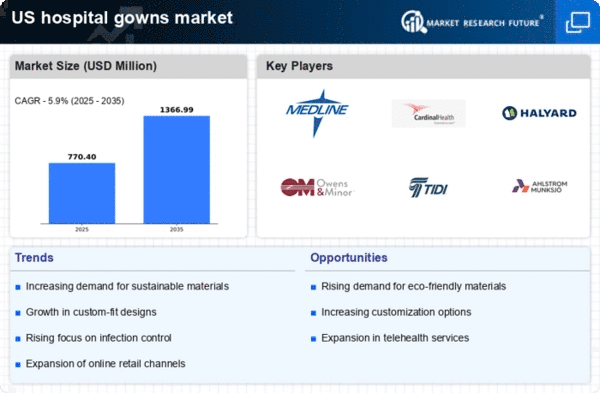
As per MRFR analysis, the US hospital gowns market size was estimated at 727.48 USD Million in 2024. The US hospital gowns market is projected to grow from 770.4 USD Million in 2025 to 1366.99 USD Million by 2035, exhibiting a compound annual growth rate (CAGR) of 5.9% during the forecast period 2025 - 2035.

Key Market Trends & Highlights

The US The US hospital gowns market is shifting towards sustainability and technological advancements.

  • Sustainability initiatives are increasingly influencing the design and production of hospital gowns.
  • Technological innovations are enhancing the functionality and comfort of hospital gowns, catering to patient needs.
  • Customization and personalization are becoming essential trends, allowing for tailored solutions in patient care.
  • Rising demand for patient comfort and increased regulatory standards are driving growth in the hospital gowns market.

Market Size & Forecast

2024 Market Size 727.48 (USD Million)
2035 Market Size 1366.99 (USD Million)
CAGR (2025 - 2035) 5.9%

Major Players

Medline Industries Inc (US), Cardinal Health Inc (US), Halyard Health Inc (US), Owens & Minor Inc (US), TIDI Products LLC (US), Ahlstrom-Munksjö (FI), B. Braun Melsungen AG (DE), Mölnlycke Health Care AB (SE), Kimberly-Clark Corporation (US)

US Hospital Gowns Market Trends

The hospital gowns market is experiencing notable transformations driven by various factors. Increasing awareness regarding patient safety and comfort is influencing the design and material choices for hospital gowns. Healthcare facilities are prioritizing the use of high-quality, breathable fabrics that enhance patient experience while ensuring compliance with safety standards. Additionally, the rise in surgical procedures and outpatient services is contributing to a steady demand for hospital gowns, as these garments are essential for maintaining hygiene and preventing infection in clinical settings. Furthermore, the emphasis on sustainable practices is prompting manufacturers to explore eco-friendly materials, which may reshape the market landscape in the coming years. Moreover, technological advancements are playing a crucial role in the evolution of the hospital gowns market. Innovations in fabric technology, such as antimicrobial properties and moisture-wicking capabilities, are becoming increasingly prevalent. These features not only improve patient comfort but also address infection control concerns. As healthcare providers seek to enhance operational efficiency, the integration of smart textiles into hospital gowns could emerge as a potential trend, offering functionalities like temperature regulation and real-time monitoring. Overall, the hospital gowns market appears poised for growth, driven by a combination of patient-centric approaches and technological innovations.

Sustainability Initiatives

There is a growing trend towards sustainability within the hospital gowns market. Manufacturers are increasingly adopting eco-friendly materials and production processes to reduce environmental impact. This shift is likely influenced by both regulatory pressures and consumer demand for greener products.

Technological Innovations

Advancements in fabric technology are reshaping the hospital gowns market. Innovations such as antimicrobial fabrics and moisture-wicking materials are becoming more common, enhancing patient comfort and safety. These developments may lead to a more competitive landscape as healthcare providers seek superior options.

Customization and Personalization

The trend towards customization in the hospital gowns market is gaining traction. Healthcare facilities are exploring options for personalized gowns that cater to individual patient needs, which could improve patient satisfaction and comfort during their hospital stay.

US Hospital Gowns Market Drivers

Increased Regulatory Standards

The hospital gowns market is significantly influenced by the evolving regulatory landscape in the healthcare sector. Regulatory bodies are implementing stricter guidelines regarding the quality and safety of medical textiles, including hospital gowns. These regulations aim to ensure that gowns meet specific standards for infection control and patient safety. Compliance with these standards often necessitates investment in higher-quality materials and manufacturing processes, which can drive up costs but ultimately enhance the reliability of products in the hospital gowns market. As hospitals and healthcare facilities adapt to these regulations, the demand for compliant and high-quality gowns is expected to rise, potentially leading to a market growth rate of around 4.8% in the coming years.

Rising Demand for Patient Comfort

The hospital gowns market is experiencing a notable increase in demand driven by the growing emphasis on patient comfort during hospital stays. Healthcare providers are increasingly recognizing that comfortable gowns can enhance patient satisfaction and overall experience. This shift is reflected in the design and material choices made by manufacturers, who are now prioritizing soft, breathable fabrics that allow for ease of movement. According to recent data, the market for hospital gowns is projected to grow at a CAGR of approximately 5.2% over the next few years, indicating a robust demand for products that prioritize patient comfort. As hospitals strive to improve their service quality, the focus on patient-centric designs in the hospital gowns market is likely to continue to gain traction.

Expansion of Healthcare Facilities

The hospital gowns market benefits from the expansion of healthcare facilities across the United States. As new hospitals and outpatient centers are established, the demand for essential medical supplies, including hospital gowns, is on the rise. This expansion is driven by factors such as an aging population and increased healthcare access, which necessitate a larger inventory of medical textiles. Recent estimates suggest that the number of hospitals in the U.S. is projected to increase by approximately 3% over the next few years, further fueling the need for hospital gowns. Consequently, manufacturers are likely to ramp up production to meet this growing demand, contributing to a positive outlook for the hospital gowns market.

Growing Focus on Infection Control

The hospital gowns market is experiencing a surge in demand due to the heightened focus on infection control within healthcare settings. Hospitals are increasingly adopting stringent protocols to minimize the risk of hospital-acquired infections (HAIs), which has led to a greater emphasis on the use of high-quality, disposable gowns. This trend is supported by data indicating that HAIs affect approximately 1 in 31 hospital patients on any given day, underscoring the need for effective infection prevention measures. As healthcare facilities prioritize safety and hygiene, the demand for specialized hospital gowns designed for infection control is expected to grow, potentially driving market expansion at a rate of 5.5% in the near future.

Technological Advancements in Fabric Production

Technological advancements in fabric production are playing a crucial role in shaping the hospital gowns market. Innovations such as antimicrobial treatments and moisture-wicking fabrics are becoming increasingly prevalent, enhancing the functionality and safety of hospital gowns. These advancements not only improve the comfort and hygiene of gowns but also contribute to better patient outcomes. The integration of smart textiles, which can monitor vital signs or provide temperature regulation, is also on the horizon. As these technologies become more accessible, they are likely to drive a shift in consumer preferences towards more advanced hospital gowns, potentially increasing market growth by an estimated 6% over the next few years.


Market Segment Insights

By Usability: Disposable Gowns (Largest) vs. Reusable Gowns (Fastest-Growing)

In the US hospital gowns market, the distribution of market share is largely in favor of disposable gowns, which are favored for their convenience, hygiene, and ease of use. Their predominant position in the market stems from the increasing emphasis on infection control in healthcare settings. Reusable gowns, while having a smaller share, are gaining traction due to their sustainability and cost-effectiveness over time, appealing to hospitals aiming to reduce waste. Growth trends indicate a significant shift towards reusable gowns as hospitals prioritize eco-friendly solutions alongside patient safety. This evolving landscape is driven by regulations encouraging sustainable practices and the growing awareness of the environmental impact of disposable products. As a result, reusable gowns are set to experience rapid growth as they adapt to meet the demands for safety and sustainability in healthcare environments.

Disposable Gowns (Dominant) vs. Reusable Gowns (Emerging)

Disposable gowns are characterized by their single-use nature, offering high levels of hygiene and convenience, making them a popular choice in the US hospital gowns market. They play a crucial role in infection control protocols, especially in surgical and isolation procedures. On the other hand, reusable gowns are emerging as a viable alternative, promoted as more sustainable options that can be washed and reused multiple times. While they require an initial investment in laundering infrastructure, the long-term cost savings and reduced environmental footprint are driving their adoption. As the healthcare sector evolves, both segments will likely continue to innovate, balancing functionality with safety and sustainability.

By Type: Surgical Gowns (Largest) vs. Non-surgical Gowns (Fastest-Growing)

The US hospital gowns market demonstrates a diverse distribution across different gown types. Surgical gowns represent the largest segment, commanding significant market share due to their critical role in infection prevention during surgical procedures. Conversely, non-surgical gowns, which include isolation and procedure gowns, are increasingly gaining traction as healthcare facilities prioritize patient safety and comfort, leading to a growing demand for these garments. Growth trends in this segment are influenced by several factors, including increasing surgical procedures, heightened awareness regarding infection control, and innovations in gown materials for enhanced comfort and protection. Patient gowns are also witnessing renewed interest, as they are essential for inpatient care. Overall, the landscape is evolving, with non-surgical gowns emerging as a key player driven by patient-centric healthcare practices.

Gowns: Surgical (Dominant) vs. Non-surgical (Emerging)

Surgical gowns are crafted from high-performance materials to ensure optimal barrier protection during invasive procedures, making them indispensable in surgical settings. This segment's dominance stems from stringent regulatory standards and the need for reliable infection control measures in hospitals. In contrast, non-surgical gowns are gaining prominence as emerging garments that cater to various healthcare scenarios where protection is necessary but does not involve surgical procedures. Their adaptability and focus on comfort are appealing in patient care environments, thus positioning them as vital components within the US hospital gowns market.

By Risk Type: High Risk (Largest) vs. Moderate Risk (Fastest-Growing)

In the US hospital gowns market, the distribution of market share across the different risk types is notable, with the High Risk segment commanding a significant share due to the increasing need for protective garments in critical care environments. The Minimal Risk and Low Risk segments, while substantial, have a smaller portion of the market, largely due to lesser demand in standard usage environments where basic protection is sufficient. Growth trends in the risk type segment show that the Moderate Risk sector is emerging as the fastest-growing area, driven by heightened awareness of infection control and increased hospital policies around protective wear. The High Risk segment continues to be stable, supported by consistent demand in surgical and high-alert medical settings, but the Moderate Risk segment is expected to expand rapidly as healthcare facilities prepare for a broader range of scenarios requiring advanced protection.

High Risk (Dominant) vs. Moderate Risk (Emerging)

The High Risk segment in the US hospital gowns market is characterized by its reliance on advanced materials and design tailored for critical care situations, where the likelihood of exposure to pathogens is significantly higher. These gowns are strict in terms of compliance and are favored in surgical settings. On the other hand, the Moderate Risk segment presents an emerging opportunity for growth, appealing to facilities looking for balance between protection and cost. Gowns in this category provide essential coverage with adequate durability, optimizing resources while still addressing infection control. Both segments reflect the evolving standards in hospital protocols and emphasize the importance of appropriate gown selection based on the risk level involved.

Get more detailed insights about US Hospital Gowns Market

Key Players and Competitive Insights

The hospital gowns market in the US is characterized by a competitive landscape that is increasingly shaped by innovation, sustainability, and strategic partnerships. Key players such as Medline Industries Inc (US), Cardinal Health Inc (US), and Halyard Health Inc (US) are actively pursuing strategies that emphasize product differentiation and operational efficiency. Medline Industries Inc (US) has focused on expanding its product line to include eco-friendly options, which aligns with the growing demand for sustainable healthcare solutions. Cardinal Health Inc (US) has been enhancing its supply chain capabilities, aiming to improve delivery times and reduce costs, thereby strengthening its market position. Halyard Health Inc (US) appears to be concentrating on technological advancements in manufacturing processes, which may enhance product quality and reduce waste, collectively shaping a competitive environment that prioritizes innovation and sustainability.

The business tactics employed by these companies reflect a moderately fragmented market structure, where localizing manufacturing and optimizing supply chains are pivotal. This fragmentation allows for a diverse range of products and services, catering to various healthcare facilities across the US. The collective influence of these key players is significant, as they not only drive competition but also set industry standards that smaller companies may strive to meet.

In October 2025, Medline Industries Inc (US) announced a partnership with a leading textile manufacturer to develop a new line of biodegradable hospital gowns. This strategic move is indicative of the company's commitment to sustainability and may position it favorably among environmentally conscious healthcare providers. The introduction of biodegradable options could potentially capture a growing segment of the market that prioritizes eco-friendly practices.

In September 2025, Cardinal Health Inc (US) launched an advanced logistics platform designed to streamline the distribution of medical supplies, including hospital gowns. This initiative is likely to enhance operational efficiency and improve customer satisfaction by ensuring timely deliveries. The integration of technology into logistics may also provide Cardinal Health with a competitive edge in a market where speed and reliability are increasingly critical.

In August 2025, Halyard Health Inc (US) unveiled a new manufacturing facility equipped with state-of-the-art automation technology. This facility is expected to increase production capacity and reduce costs, allowing Halyard to respond more effectively to market demands. The investment in automation reflects a broader trend within the industry towards leveraging technology to enhance productivity and maintain competitive pricing.

As of November 2025, the hospital gowns market is witnessing trends that emphasize digitalization, sustainability, and the integration of artificial intelligence in manufacturing processes. Strategic alliances among key players are shaping the competitive landscape, fostering innovation and collaboration. The shift from price-based competition to a focus on technological advancements and supply chain reliability is becoming increasingly evident. Moving forward, companies that prioritize innovation and sustainability are likely to differentiate themselves in a market that is evolving rapidly.

Key Companies in the US Hospital Gowns Market market include

Industry Developments

The US Hospital Gowns Market has been experiencing notable developments and changes in recent months. Medline Industries and Cardinal Health continue to lead the market amidst rising demands for personal protective equipment, especially following heightened awareness of infection control practices due to the COVID-19 pandemic. In August 2023, Alpha Pro Tech announced a substantial increase in production capacity to meet surging requirements from healthcare facilities. Additionally, Baxter International has reported a significant growth in revenues attributed to their medical apparel segment, reinforcing their position in the market.

Recent merger and acquisition activity includes First Quality Healthcare acquiring a competitive firm in July 2023, aimed at bolstering their product offerings. The market has seen consistent growth, with estimates projecting an increase in market size due to the rise in healthcare-associated infections and the ongoing need for protective clothing. Historically, developments such as TIDI Products expanding their operating capacity in June 2022 further highlight the industry's adaptive measures to ongoing public health concerns. The dynamics in the US Hospital Gowns Market continue to evolve, driven by demand, innovation, and strategic business maneuvers among key players.

Future Outlook

US Hospital Gowns Market Future Outlook

The Hospital Gowns Market is projected to grow at a 5.9% CAGR from 2024 to 2035, driven by technological advancements, increasing healthcare demands, and sustainability initiatives.

New opportunities lie in:

  • Development of eco-friendly gown materials for sustainability-focused hospitals.
  • Integration of smart textiles for enhanced patient monitoring.
  • Expansion of direct-to-consumer sales channels for home healthcare markets.

By 2035, the hospital gowns market is expected to achieve robust growth, reflecting evolving healthcare needs.

Market Segmentation

US Hospital Gowns Market Type Outlook

  • Surgical Gowns
  • Non-surgical Gowns
  • Patient Gowns

US Hospital Gowns Market Risk Type Outlook

  • Minimal Risk
  • Low Risk
  • Moderate Risk
  • High Risk

US Hospital Gowns Market Usability Outlook

  • Disposable Gowns
  • Reusable Gowns

Report Scope

MARKET SIZE 2024 727.48(USD Million)
MARKET SIZE 2025 770.4(USD Million)
MARKET SIZE 2035 1366.99(USD Million)
COMPOUND ANNUAL GROWTH RATE (CAGR) 5.9% (2024 - 2035)
REPORT COVERAGE Revenue Forecast, Competitive Landscape, Growth Factors, and Trends
BASE YEAR 2024
Market Forecast Period 2025 - 2035
Historical Data 2019 - 2024
Market Forecast Units USD Million
Key Companies Profiled Medline Industries Inc (US), Cardinal Health Inc (US), Halyard Health Inc (US), Owens & Minor Inc (US), TIDI Products LLC (US), Ahlstrom-Munksjö (FI), B. Braun Melsungen AG (DE), Mölnlycke Health Care AB (SE), Kimberly-Clark Corporation (US)
Segments Covered Usability, Type, Risk Type
Key Market Opportunities Integration of sustainable materials and smart textiles in the hospital gowns market presents a growth opportunity.
Key Market Dynamics Rising demand for sustainable materials drives innovation in hospital gown production and design.
Countries Covered US

Leave a Comment

FAQs

What is the expected market size of the US Hospital Gowns Market in 2024?

The US Hospital Gowns Market is expected to be valued at 800.0 million USD in 2024.

How is the US Hospital Gowns Market anticipated to grow by 2035?

By 2035, the market is expected to reach a valuation of 1500.0 million USD.

What is the projected compound annual growth rate (CAGR) for the US Hospital Gowns Market from 2025 to 2035?

The expected CAGR for the US Hospital Gowns Market from 2025 to 2035 is 5.881%.

Which segment of the US Hospital Gowns Market holds the greatest value in 2024?

The Disposable Gowns segment is valued at 480.0 million USD in 2024.

What is the market value for Reusable Gowns in 2024?

The Reusable Gowns segment is valued at 320.0 million USD in 2024.

Who are the key players in the US Hospital Gowns Market?

Major players include Medline Industries, Alpha Pro Tech, and Cardinal Health among others.

What is the expected market size for Disposable Gowns by 2035?

The market for Disposable Gowns is expected to grow to 900.0 million USD by 2035.

What is the projected market size for Reusable Gowns by 2035?

The market for Reusable Gowns is anticipated to reach 600.0 million USD by 2035.

What are the growth opportunities in the US Hospital Gowns Market?

The market presents growth opportunities driven by advancements in material technology and increasing healthcare regulations.

How does the US Hospital Gowns Market fare in terms of regionality?

The US Hospital Gowns Market is one of the leading sectors in the global healthcare apparel segment, demonstrating significant growth potential.

Download Free Sample

Kindly complete the form below to receive a free sample of this Report

Compare Licence

×
Features License Type
Single User Multiuser License Enterprise User
Price $4,950 $5,950 $7,250
Maximum User Access Limit 1 User Upto 10 Users Unrestricted Access Throughout the Organization
Free Customization
Direct Access to Analyst
Deliverable Format
Platform Access
Discount on Next Purchase 10% 15% 15%
Printable Versions