Download Free Sample
Kindly complete the form below to receive a free sample of this Report
US Hydrophobic Interaction Chromatography Market Research Report: Size, Share, Trend Analysis By Product and Service (Resins, Columns, Services, Others) - Growth Outlook & Industry Forecast 2025 To 2035
As per Market Research Future analysis, the Hydrophobic Interaction-chromatography market was estimated at 133.73 USD Million in 2024. The hydrophobic interaction-chromatography market is projected to grow from 145.32 USD Million in 2025 to 333.82 USD Million by 2035, exhibiting a compound annual growth rate (CAGR) of 8.6% during the forecast period 2025 - 2035
The US hydrophobic interaction-chromatography market is poised for growth driven by technological advancements and increasing demand for biopharmaceuticals.
| 2024 Market Size | 133.73 (USD Million) |
| 2035 Market Size | 333.82 (USD Million) |
| CAGR (2025 - 2035) | 8.67% |
GE Healthcare (US), Thermo Fisher Scientific (US), Merck KGaA (DE), Bio-Rad Laboratories (US), Agilent Technologies (US), Waters Corporation (US), Pall Corporation (US), Repligen Corporation (US)
Our Impact
Enabled $4.3B Revenue Impact for Fortune 500 and Leading Multinationals
Partnering with 2000+ Global Organizations Each Year
30K+ Citations by Top-Tier Firms in the Industry
The hydrophobic interaction-chromatography market is currently experiencing notable growth, driven by advancements in biopharmaceutical manufacturing and increasing demand for purification processes. This technique, which separates biomolecules based on their hydrophobicity, is becoming essential in the production of therapeutic proteins and monoclonal antibodies. The rising focus on bioprocess optimization and the need for high-purity products are propelling investments in this area. Furthermore, regulatory bodies are emphasizing stringent quality standards, which further necessitates the adoption of effective purification methods. As a result, companies are increasingly integrating hydrophobic interaction-chromatography into their workflows to enhance efficiency and product quality. In addition, the hydrophobic interaction-chromatography market is witnessing a shift towards automation and advanced technologies. Automation not only improves throughput but also reduces human error, thereby ensuring consistent results. The integration of artificial intelligence and machine learning into chromatographic processes is also emerging, allowing for better data analysis and process control. This trend indicates a broader movement towards smart manufacturing in the biopharmaceutical sector, where precision and efficiency are paramount. Overall, the hydrophobic interaction-chromatography market is poised for continued expansion, driven by technological innovations and the increasing complexity of biopharmaceutical products.
The hydrophobic interaction-chromatography market is benefiting from rapid technological advancements. Innovations in column design and resin development are enhancing separation efficiency and capacity. These improvements are crucial for meeting the growing demands of biopharmaceutical production, where high purity and yield are essential.
Regulatory compliance is becoming increasingly stringent in the hydrophobic interaction-chromatography market. Companies are required to adhere to rigorous quality standards set by authorities, which drives the need for reliable purification methods. This trend emphasizes the importance of adopting advanced chromatographic techniques to ensure product safety and efficacy.
The rising demand for biopharmaceuticals is significantly impacting the hydrophobic interaction-chromatography market. As the biopharmaceutical sector expands, the need for effective purification processes becomes more pronounced. This trend highlights the critical role of hydrophobic interaction-chromatography in the development and production of therapeutic proteins and monoclonal antibodies.
Quality control remains a pivotal aspect of the hydrophobic interaction-chromatography market, particularly in the biopharmaceutical industry. With stringent regulatory requirements in place, companies are compelled to implement robust purification processes to ensure product safety and efficacy. The hydrophobic interaction-chromatography market is likely to thrive as organizations prioritize compliance with Good Manufacturing Practices (GMP) and other quality standards. In 2025, the emphasis on quality assurance is expected to drive investments in advanced chromatographic systems, which can provide reproducible results and high purity levels. This focus on quality control not only enhances product integrity but also strengthens consumer trust, thereby supporting the growth of the hydrophobic interaction-chromatography market.
The hydrophobic interaction-chromatography market is experiencing growth due to the increasing production of biopharmaceuticals. As the demand for biologics rises, manufacturers are seeking efficient purification methods to ensure product quality. In 2025, the biopharmaceutical sector is projected to reach a valuation of over $300 billion in the US, driving the need for advanced chromatographic techniques. Hydrophobic interaction-chromatography offers a reliable solution for separating proteins and other biomolecules, which is essential for the development of therapeutics. This trend indicates a robust market for hydrophobic interaction-chromatography systems, as companies invest in technologies that enhance yield and purity. Furthermore, the shift towards personalized medicine necessitates the use of sophisticated purification methods, further propelling the hydrophobic interaction-chromatography market.
The hydrophobic interaction-chromatography market is witnessing new opportunities due to emerging applications in diagnostics. As the healthcare landscape evolves, there is a growing need for precise and efficient methods to analyze biomolecules. Hydrophobic interaction-chromatography is increasingly utilized in diagnostic assays, particularly for protein characterization and biomarker discovery. The US diagnostic market is projected to reach $100 billion by 2025, indicating a substantial demand for reliable purification techniques. This trend suggests that the hydrophobic interaction-chromatography market could expand as diagnostic companies seek to enhance their analytical capabilities. The integration of these techniques into diagnostic workflows may lead to improved patient outcomes and more effective disease management.
Technological advancements play a crucial role in shaping the hydrophobic interaction-chromatography market. Innovations in chromatography equipment and methodologies are enhancing the efficiency and effectiveness of purification processes. In 2025, the introduction of next-generation chromatographic systems is expected to streamline workflows and reduce operational costs for manufacturers. These advancements may include improved resin technologies, automation, and real-time monitoring capabilities, which collectively enhance the performance of hydrophobic interaction-chromatography. As companies strive for higher throughput and lower production costs, the adoption of these advanced technologies is likely to drive growth in the hydrophobic interaction-chromatography market. This trend indicates a dynamic landscape where continuous improvement is essential for maintaining competitive advantage.
The hydrophobic interaction-chromatography market is benefiting from heightened research and development activities across various sectors, particularly in pharmaceuticals and biotechnology. In 2025, R&D spending in the US is expected to exceed $600 billion, with a significant portion allocated to drug development and protein engineering. This surge in investment fosters innovation in purification technologies, including hydrophobic interaction-chromatography, which is crucial for isolating complex biomolecules. As researchers strive to develop novel therapeutics, the demand for efficient and scalable purification methods is likely to increase. Consequently, the hydrophobic interaction-chromatography market is positioned to expand as laboratories and manufacturing facilities adopt these advanced techniques to meet their R&D objectives.
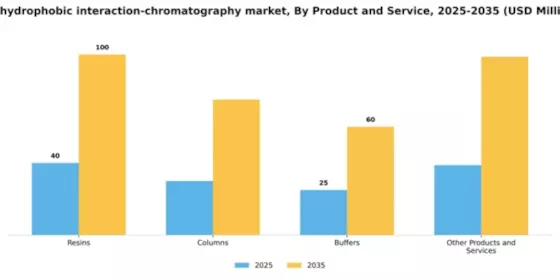
In the US hydrophobic interaction-chromatography market, resins dominate the product and service segment, commanding a significant share due to their critical role in purification processes. Other key contributors include columns and buffers, each contributing to the overall efficiency and effectiveness of chromatography. Notably, buffers are emerging as a rapidly growing segment, driven by innovations in formulation and an increased demand for high-quality separation processes. The growth trends in this market segment are primarily influenced by advancements in biopharmaceutical development, requiring robust and reliable chromatography solutions. Furthermore, the increasing adoption of automation and efficient workflows in laboratories is facilitating the expansion of various products, particularly buffers which enhance process performance. As regulatory standards become more stringent, the necessity for high-performance reagents is propelling this segment forward, ensuring continual growth and innovation.
Resins (Dominant) vs. Buffers (Emerging)
Resins are recognized as the dominant force within the product and service segment of the US hydrophobic interaction-chromatography market, providing essential functionalities for various purification applications. Their versatile nature allows them to be employed in a wide range of processes, contributing to their strong market presence. These materials often exhibit high binding capacities and specialized attributes tailored for specific target molecules. On the other hand, buffers are emerging as a vital component in the chromatography process, particularly due to their role in maintaining optimal pH and ionic strength, which are crucial for effective separation. The growing emphasis on bioproduction efficiency is enhancing the popularity of purpose-developed buffers, leading to a dynamic shift in market demand and opportunity.
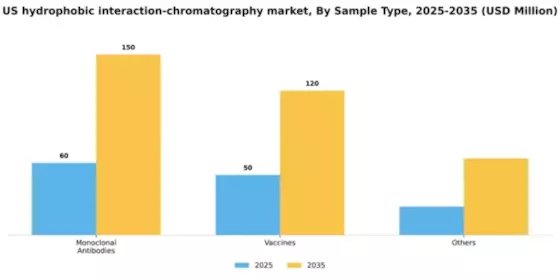
The market share distribution in the US hydrophobic interaction-chromatography market reveals that monoclonal antibodies hold the largest share, reflecting a strong demand from biopharmaceuticals and therapeutics. This segment's dominance is fueled by the increasing investment in antibody therapies and the need for high-purity proteins in research and development. Conversely, vaccines are gaining traction, representing a rapidly growing segment as public health initiatives and new vaccine formulations push for innovative processes that enhance yield and purity. As growth trends indicate, the monoclonal antibodies segment is showing steady increases, driven by robust pipeline developments and commercialization activities. The vaccines segment, however, is projected to grow at the fastest rate, motivated by advancements in vaccine technologies and heightened public interest in vaccination programs. This growth is further supported by increased funding for research and development, coupled with the ongoing need for effective vaccines which can result in a significant expansion of production capabilities.
Monoclonal Antibodies (Dominant) vs. Vaccines (Emerging)
Monoclonal antibodies dominate the US hydrophobic interaction-chromatography market due to their widespread use in therapeutic applications and extensive research backing. Highly specific in their action, they provide significant therapeutic advantages, thereby driving high demand. The emerging vaccines segment, on the other hand, is characterized by rapid innovation, focusing on novel delivery systems and adjuvants to enhance efficacy. While monoclonal antibodies are recognized for their proven track record, vaccines are gaining momentum as they adapt to meet contemporary health challenges, indicating a dynamic landscape where both segments play crucial roles in biopharmaceutical progress.
The US hydrophobic interaction-chromatography market exhibits a diverse range of end-users, with Pharmaceutical & Biopharmaceutical Companies currently holding the largest market share. This segment is primarily driven by the increasing demand for innovative therapies and biologics that necessitate effective purification processes. In contrast, Contract Research Organizations & Contract Manufacturing Organizations constitute the fastest-growing segment due to the rising trend of outsourcing in drug development and manufacturing, which significantly boosts the usage of advanced methodologies like hydrophobic interaction-chromatography. The growth trends within this sector indicate a robust expansion driven by technological advancements and increasing R&D investments. Pharmaceutical & Biopharmaceutical Companies are focusing on enhancing production efficiency and product purity, fueling the demand for sophisticated chromatography solutions. Meanwhile, the growing awareness and adoption of process optimization by Contract Research Organizations & Contract Manufacturing Organizations are propelling their growth, leading to a significant shift in market dynamics favoring these entities.
Pharmaceutical & Biopharmaceutical Companies (Dominant) vs. Contract Research Organizations & Contract Manufacturing Organizations (Emerging)
Pharmaceutical & Biopharmaceutical Companies are the dominant force in the US hydrophobic interaction-chromatography market, leveraging advanced techniques to ensure the purification of complex biomolecules. This segment emphasizes quality and efficiency, implementing innovative chromatography solutions to meet regulatory standards. On the other hand, Contract Research Organizations & Contract Manufacturing Organizations are emerging as key players, driven by an increase in outsourcing practices. These organizations focus on providing specialized services, adopting hydrophobic interaction-chromatography to enhance the purification process in drug development. The adaptability and responsiveness of these emerging entities towards market needs position them well for rapid growth, making them critical contributors to the evolving landscape of the hydrophobic interaction-chromatography sector.
Get more detailed insights about US Hydrophobic Interaction Chromatography Market Request Free Sample
The hydrophobic interaction-chromatography market is currently characterized by a dynamic competitive landscape, driven by increasing demand for biopharmaceuticals and advancements in protein purification technologies. Key players such as GE Healthcare (US), Thermo Fisher Scientific (US), and Bio-Rad Laboratories (US) are strategically positioned to leverage their extensive product portfolios and innovative capabilities. GE Healthcare (US) focuses on enhancing its chromatography systems through continuous innovation, while Thermo Fisher Scientific (US) emphasizes strategic partnerships to expand its market reach. Bio-Rad Laboratories (US) is actively investing in R&D to develop next-generation chromatography solutions, thereby shaping a competitive environment that prioritizes technological advancement and customer-centric solutions.In terms of business tactics, companies are increasingly localizing manufacturing and optimizing supply chains to enhance operational efficiency. The market appears moderately fragmented, with several players vying for market share. However, the collective influence of major companies is significant, as they drive trends in product development and market expansion. This competitive structure suggests that while individual companies may have distinct strategies, their actions collectively influence market dynamics and customer preferences.
In October Thermo Fisher Scientific (US) announced a collaboration with a leading biopharmaceutical company to develop a new line of chromatography resins tailored for monoclonal antibody purification. This strategic move is likely to enhance Thermo Fisher's product offerings and strengthen its position in the biopharmaceutical sector, where demand for efficient purification processes is surging. The collaboration underscores the importance of partnerships in driving innovation and meeting evolving customer needs.
In September Bio-Rad Laboratories (US) launched a new high-performance chromatography system designed to improve the efficiency of protein purification workflows. This introduction is significant as it reflects Bio-Rad's commitment to advancing chromatography technology and addressing the growing need for faster and more reliable purification methods. The launch is expected to attract a diverse customer base, further solidifying Bio-Rad's competitive stance in the market.
In November GE Healthcare (US) unveiled a new digital platform that integrates AI-driven analytics into its chromatography systems. This development is indicative of the ongoing trend towards digitalization in the industry, as companies seek to enhance operational efficiency and provide data-driven insights to customers. The integration of AI is likely to set GE Healthcare apart from competitors, positioning it as a leader in the digital transformation of chromatography solutions.
As of November current competitive trends in the hydrophobic interaction-chromatography market include a strong emphasis on digitalization, sustainability, and AI integration. Strategic alliances are increasingly shaping the landscape, enabling companies to pool resources and expertise to drive innovation. Looking ahead, competitive differentiation is expected to evolve, with a shift from price-based competition to a focus on innovation, technology, and supply chain reliability. This transition suggests that companies that prioritize these aspects will likely gain a competitive edge in the market.



The US Hydrophobic Interaction Chromatography Market has witnessed significant developments recently. Agilent Technologies and Merck KGaA have been involved in expanding their product portfolios, enhancing their market positions with new offerings aimed at improving efficiency in biomolecule separation. In September 2023, Cytiva announced advancements in their chromatography solutions, which are designed to promote better scalability for therapeutic protein production. Moreover, in August 2023, a noteworthy merger occurred as Thermo Fisher Scientific acquired a biotechnology firm specializing in nanotechnology, further broadening their chromatography capabilities.
Recent market valuations indicate a steady growth trajectory of approximately 8% annually, driven by increased demand for biopharmaceutical production, notably in monoclonal antibodies and vaccines. Waters Corporation and BioRad Laboratories are also investing heavily in Research and Development to innovate product offerings catering to regulatory requirements. Between 2021 and 2023, the market has been influenced by a growing focus on precision medicine, which has been gradually reshaping the chromatography landscape, increasing the importance of hydrophobic interaction chromatography as a key separation technique.
This trend has been marked by rising collaborations between leading firms to advance their technological capabilities and customer outreach.
The Hydrophobic Interaction Chromatography Market is projected to grow at an 8.67% CAGR from 2025 to 2035, driven by increasing demand for biopharmaceuticals and advancements in chromatography technologies.
New opportunities lie in:
By 2035, the market is expected to achieve substantial growth, driven by innovation and strategic advancements.
| MARKET SIZE 2024 | 133.73(USD Million) |
| MARKET SIZE 2025 | 145.32(USD Million) |
| MARKET SIZE 2035 | 333.82(USD Million) |
| COMPOUND ANNUAL GROWTH RATE (CAGR) | 8.67% (2025 - 2035) |
| REPORT COVERAGE | Revenue Forecast, Competitive Landscape, Growth Factors, and Trends |
| BASE YEAR | 2024 |
| Market Forecast Period | 2025 - 2035 |
| Historical Data | 2019 - 2024 |
| Market Forecast Units | USD Million |
| Key Companies Profiled | GE Healthcare (US), Thermo Fisher Scientific (US), Merck KGaA (DE), Bio-Rad Laboratories (US), Agilent Technologies (US), Waters Corporation (US), Pall Corporation (US), Repligen Corporation (US) |
| Segments Covered | Product and Service, Sample Type, End-User |
| Key Market Opportunities | Advancements in biopharmaceuticals drive demand for innovative hydrophobic interaction-chromatography solutions. |
| Key Market Dynamics | Rising demand for biopharmaceuticals drives innovation and competition in hydrophobic interaction-chromatography technologies. |
| Countries Covered | US |
The market valuation was $133.73 Million in 2024.
The projected valuation for 2035 is $333.82 Million.
The expected CAGR is 8.67% during the forecast period 2025 - 2035.
Key players include GE Healthcare, Thermo Fisher Scientific, Merck KGaA, Bio-Rad Laboratories, Agilent Technologies, Waters Corporation, Pall Corporation, and Repligen Corporation.
Main product segments include Resins, Columns, Buffers, and Other Products and Services.
The valuation range for Resins was $40.0 Million to $100.0 Million.
Primary sample types include Monoclonal Antibodies, Vaccines, and Others.
The valuation range for Monoclonal Antibodies was $60.0 Million to $150.0 Million.
Primary end-users include Pharmaceutical & Biopharmaceutical Companies, Contract Research Organizations, and Research & Academic Institutes.
The valuation range for Pharmaceutical & Biopharmaceutical Companies was $60.0 Million to $150.0 Million.


Kindly complete the form below to receive a free sample of this Report

“This is really good guys. Excellent work on a tight deadline. I will continue to use you going forward and recommend you to others. Nice job”


“Thanks. It’s been a pleasure working with you, please use me as reference with any other Intel employees.”


“Thanks for sending the report it gives us a good global view of the Betaïne market.”


“Thank you, this will be very helpful for OQS.”


“We found the report very insightful! we found your research firm very helpful. I'm sending this email to secure our future business.”


“I am very pleased with how market segments have been defined in a relevant way for my purposes (such as "Portable Freezers & refrigerators" and "last-mile"). In general the report is well structured. Thanks very much for your efforts.”


“I have been reading the first document or the study, ,the Global HVAC and FP market report 2021 till 2026. Must say, good info! I have not gone in depth at all parts, but got a good indication of the data inside!”


“We got the report in time, we really thank you for your support in this process. I also thank to all of your team as they did a great job.”


“The Automotive 48V ECU Components Procurement Intelligence Study” was a complex project, but the Market Research Future (MRFR) team handled it with quality, agility, and customer-centricity. They delivered all requested data on time and within the agreed scope. The team, including Shubhendra Anand and Rahul Gotadki, was always readily available to clarify questions and swiftly implement necessary adjustments, driving the project to a successful conclusion within a very demanding timeframe.
I would also like to specifically commend Akshay Agarwal for his responsiveness and support at every stage—from our initial inquiry on May 6th through to final delivery on June 18th. His dedication made the entire process seamless.”



