×
Request Free Sample ×

Kindly complete the form below to receive a free sample of this Report

Leading companies partner with us for data-driven Insights

clients tt-cursor
Hero Background

US Nanosensors Market

ID: MRFR/SEM/17125-HCR
200 Pages
Garvit Vyas
October 2025

US Nanosensors Market Research Report By Type (Chemical and Bacterial, Optical, Synthetic, Electrochemical, Mechanical), By Application (Robotics, Healthcare, Food Beverage, Automotive, Petroleum) and By Technology (Wind Turbines, Fuel Cells, Micro Turbines) - Forecast to 2035

Share:
Download PDF ×

We do not share your information with anyone. However, we may send you emails based on your report interest from time to time. You may contact us at any time to opt-out.

US Nanosensors Market Infographic
Purchase Options

US Nanosensors Market Summary

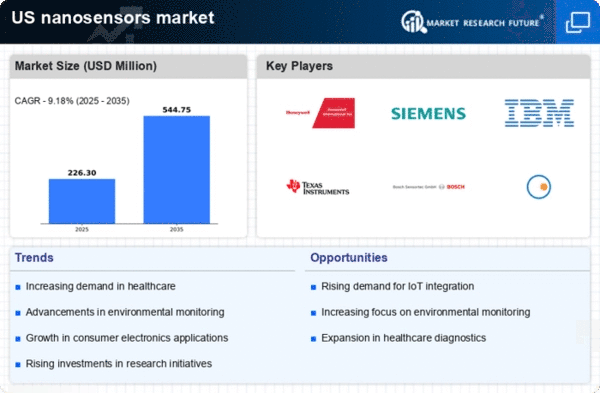
As per MRFR analysis, the US nanosensors market Size was estimated at 207.27 USD Million in 2024. The US nanosensors market is projected to grow from 226.3 USD Million in 2025 to 544.75 USD Million by 2035, exhibiting a compound annual growth rate (CAGR) of 9.18% during the forecast period 2025 - 2035.

Key Market Trends & Highlights

The US nanosensors market is poised for substantial growth driven by technological advancements and increasing applications across various sectors.

  • Healthcare innovations are leading the way in the adoption of nanosensors, particularly in diagnostics and monitoring.
  • Environmental monitoring applications are expanding, reflecting a growing emphasis on sustainability and pollution control.
  • Industrial applications are witnessing a surge, with nanosensors enhancing efficiency and safety in manufacturing processes.
  • Technological advancements in nanosensors and rising demand for smart devices are key drivers propelling market growth.

Market Size & Forecast

2024 Market Size 207.27 (USD Million)
2035 Market Size 544.75 (USD Million)

Major Players

Honeywell International Inc. (US), Siemens AG (DE), IBM Corporation (US), Texas Instruments Incorporated (US), Bosch Sensortec GmbH (DE), Nanosys Inc. (US), NanoSensors Inc. (US), STMicroelectronics N.V. (CH)

US Nanosensors Market Trends

The nanosensors market is currently experiencing a transformative phase, driven by advancements in technology and increasing demand across various sectors. The integration of nanosensors into healthcare, environmental monitoring, and industrial applications appears to be reshaping the landscape. These devices, characterized by their ability to detect and measure minute quantities of substances, are becoming essential tools in diagnostics and real-time monitoring. As industries seek to enhance efficiency and accuracy, the adoption of nanosensors is likely to accelerate, fostering innovation and creating new opportunities. Moreover, the regulatory environment in the US is evolving to accommodate the rapid growth of the nanosensors market. Government initiatives aimed at promoting research and development in nanotechnology are expected to bolster the market further. Collaboration between public and private sectors may lead to breakthroughs that enhance the functionality and applicability of nanosensors. As the market matures, it seems poised for sustained growth, with potential applications expanding into new fields, thereby indicating a promising future for stakeholders involved in this dynamic sector.

Healthcare Innovations

The integration of nanosensors in healthcare is revolutionizing diagnostics and patient monitoring. These devices enable real-time tracking of biomarkers, facilitating early disease detection and personalized treatment plans. As healthcare providers increasingly adopt these technologies, the demand for nanosensors is likely to rise, enhancing patient outcomes.

Environmental Monitoring

Nanosensors are becoming pivotal in environmental monitoring, providing precise data on pollutants and hazardous substances. Their ability to detect minute concentrations of contaminants allows for timely interventions, promoting public health and safety. This trend suggests a growing reliance on nanosensors for sustainable environmental practices.

Industrial Applications

In industrial settings, nanosensors are enhancing operational efficiency by enabling real-time monitoring of processes and materials. Their application in quality control and predictive maintenance is likely to reduce downtime and improve productivity. This trend indicates a shift towards smarter manufacturing practices, driven by the capabilities of nanosensors.

US Nanosensors Market Drivers

Rising Demand for Smart Devices

The increasing integration of smart devices in everyday life is significantly influencing the nanosensors market. As consumers and industries alike seek more intelligent solutions, the demand for nanosensors that can be embedded in these devices is on the rise. For instance, nanosensors are being incorporated into smartphones, wearables, and home automation systems to provide real-time data and enhance user experience. The market for smart devices is expected to grow at a CAGR of 20% over the next five years, which will likely drive the adoption of nanosensors. This trend indicates a shift towards more interconnected systems, where nanosensors play a crucial role in data collection and analysis, thereby fostering innovation in the nanosensors market.

Government Initiatives and Funding

Government support and funding for research and development in nanotechnology are vital drivers for the nanosensors market. Various federal agencies in the US are investing in nanotechnology initiatives, recognizing its potential to revolutionize multiple sectors, including healthcare, environmental monitoring, and manufacturing. For example, the National Nanotechnology Initiative (NNI) has allocated substantial resources to promote advancements in nanosensor technologies. This financial backing not only stimulates innovation but also encourages collaboration between academia and industry. As a result, the nanosensors market is likely to benefit from enhanced research capabilities and the commercialization of new technologies, potentially leading to a market valuation exceeding $4 billion by 2027.

Growing Applications in Food Safety

The rising concerns regarding food safety and quality are propelling the growth of the nanosensors market. Nanosensors are increasingly being utilized in the food industry to monitor contamination and ensure product integrity. These sensors can detect pathogens, toxins, and spoilage indicators at very low concentrations, providing critical information to manufacturers and consumers alike. The food safety market is expected to expand at a CAGR of 10% in the coming years, which will likely enhance the demand for nanosensors. As food safety regulations become more stringent, the adoption of advanced monitoring technologies, such as nanosensors, is anticipated to increase, thereby driving growth in the nanosensors market.

Technological Advancements in Nanosensors

The rapid evolution of technology is a primary driver for the nanosensors market. Innovations in nanotechnology have led to the development of highly sensitive and specific sensors that can detect minute quantities of substances. This advancement is particularly evident in sectors such as healthcare, where nanosensors are utilized for early disease detection and monitoring. The market is projected to reach approximately $3 billion by 2026, reflecting a compound annual growth rate (CAGR) of around 15%. As these technologies continue to improve, they are likely to enhance the capabilities of nanosensors, thereby expanding their applications across various industries. The increasing demand for precision and efficiency in monitoring systems further propels the growth of the nanosensors market.

Increased Focus on Environmental Sustainability

The growing emphasis on environmental sustainability is driving the demand for nanosensors in various applications. Industries are increasingly adopting nanosensors for environmental monitoring to detect pollutants and assess ecological health. This trend is particularly relevant in the context of regulatory compliance, as companies strive to meet stringent environmental standards. The market for environmental monitoring is projected to grow at a CAGR of 12% over the next few years, which will likely boost the adoption of nanosensors. By providing accurate and real-time data, nanosensors can help organizations minimize their environmental impact, thereby reinforcing their commitment to sustainability. This shift towards greener practices is a significant factor influencing the nanosensors market.


Market Segment Insights

By Product Type: Electrochemical Nanosensor (Largest) vs. Optical Nanosensor (Fastest-Growing)

The market share distribution within the US nanosensors market reveals that electrochemical nanosensors hold the largest share, reflecting their widespread adoption across various applications such as environmental monitoring, medical diagnostics, and food safety. In contrast, optical nanosensors are rapidly gaining traction, driven by advancements in nanotechnology and increasing demand for non-invasive detection methods in healthcare and environmental applications. Growth trends in this segment are largely influenced by the increasing need for real-time monitoring and detection capabilities. Electrochemical nanosensors are recognized for their accuracy and ease of integration into existing systems, while optical nanosensors are emerging due to their potential for miniaturization and enhanced sensitivity. The overall development in nanotechnology propels both segments, meeting the evolving needs of various industries.

Electrochemical Nanosensor (Dominant) vs. Optical Nanosensor (Emerging)

Electrochemical nanosensors are a dominant force in the US nanosensors market, characterized by their reliability and accuracy in detecting chemical substances at minute levels. They have found extensive applications in sectors such as environmental monitoring and health diagnostics, contributing to their prevailing market position. Conversely, optical nanosensors are positioned as an emerging technology, capitalizing on innovation to offer non-invasive alternatives for detection. Their ability to provide real-time data and enhanced sensitivity makes them particularly appealing in medical and environmental sectors, reflecting a shift towards advanced sensing solutions. As both technologies evolve, their applications will significantly expand, catering to increasing demands for precision and efficiency.

By Application: Healthcare (Largest) vs. Automotive (Fastest-Growing)

In the US nanosensors market, the distribution of market share among application segments reveals that healthcare leads with a significant share, driven by its need for advanced diagnostic and monitoring solutions. Following healthcare, the automotive sector is experiencing noteworthy growth, attributed to the increasing integration of nanosensors in smart vehicle technologies and safety features, enhancing their market presence significantly. The growth trends within the US nanosensors market indicate a robust expansion trajectory for automotive applications, as they adapt to smart technology demands, while healthcare applications continue to innovate with more precise and efficient solutions. Additionally, consumer electronics and food & beverages sectors are also emerging, yet they currently hold smaller shares compared to healthcare and automotive applications, indicating diverse growth possibilities in various industries.

Healthcare (Dominant) vs. Automotive (Emerging)

Healthcare applications in the US nanosensors market remain dominant due to their critical role in improving patient outcomes and advancing medical technologies. These nanosensors are integral in diagnostics, patient monitoring, and therapeutic delivery systems. The market is witnessing a surge in demand for wearable health devices that utilize nanosensors for real-time monitoring. In contrast, the automotive sector is an emerging application area, leveraging nanosensors for enhancing vehicle safety and functionality. Innovations like smart tires and environmental sensors are reshaping automotive designs, responding to increasing consumer safety demands. Both segments showcase distinct characteristics, with healthcare focusing on life sciences and patient care, while automotive emphasizes technology-driven advancements and safety integrations.

Get more detailed insights about US Nanosensors Market

Key Players and Competitive Insights

The nanosensors market exhibits a dynamic competitive landscape characterized by rapid technological advancements and increasing applications across various sectors, including healthcare, environmental monitoring, and industrial automation. Key players such as Honeywell International Inc. (US), IBM Corporation (US), and Texas Instruments Incorporated (US) are strategically positioned to leverage their extensive R&D capabilities and established market presence. These companies focus on innovation and partnerships to enhance their product offerings, thereby shaping a competitive environment that emphasizes technological differentiation and customer-centric solutions.

In terms of business tactics, companies are increasingly localizing manufacturing to reduce lead times and optimize supply chains. The market structure appears moderately fragmented, with several players vying for market share. However, the collective influence of major companies like Siemens AG (DE) and Nanosys Inc. (US) suggests a trend towards consolidation, as these firms seek to enhance their competitive edge through strategic collaborations and acquisitions.

In October 2025, Honeywell International Inc. (US) announced a partnership with a leading biotech firm to develop nanosensors for real-time health monitoring. This collaboration is poised to enhance Honeywell's capabilities in the healthcare sector, aligning with the growing demand for personalized medical solutions. The strategic importance of this partnership lies in its potential to position Honeywell as a frontrunner in the integration of nanosensors within wearable health technologies.

In September 2025, IBM Corporation (US) unveiled a new line of nanosensors designed for environmental applications, particularly in air quality monitoring. This launch reflects IBM's commitment to sustainability and innovation, as it aims to address pressing environmental challenges. The introduction of these sensors is significant, as it not only expands IBM's product portfolio but also reinforces its position as a leader in the intersection of technology and environmental stewardship.

In August 2025, Texas Instruments Incorporated (US) expanded its manufacturing capabilities by investing in a new facility dedicated to nanosensor production. This strategic move is indicative of Texas Instruments' focus on enhancing supply chain reliability and meeting the increasing demand for advanced sensor technologies. The establishment of this facility is likely to bolster the company's competitive position by enabling faster production cycles and improved product availability.

As of November 2025, current competitive trends in the nanosensors market are heavily influenced by digitalization, sustainability initiatives, and the integration of artificial intelligence (AI) into sensor technologies. Strategic alliances are increasingly shaping the landscape, as companies recognize the value of collaboration in driving innovation. Looking ahead, competitive differentiation is expected to evolve, with a notable shift from price-based competition towards a focus on technological innovation, reliability in supply chains, and sustainable practices. This transition underscores the importance of adaptability and forward-thinking strategies in maintaining a competitive edge in the nanosensors market.

Key Companies in the US Nanosensors Market market include

Industry Developments

Recent developments in the US Nanosensors Market have been significant, driven by advancements in technology and increasing applications across various sectors. Micron Technology and Intel are expanding their Research and Development activities to enhance nanosensor capabilities, focusing on enhancing performance and sensitivity for applications in health and environmental monitoring. Texas Instruments and Honeywell International are also advancing their offerings, targeting the aerospace and automotive sectors. In terms of mergers and acquisitions, in July 2023, IBM announced its acquisition of NanoSemi to bolster its capabilities in artificial intelligence and machine learning sensors, an important advancement for the nanosensors market.

This move is expected to enhance IBM's product offerings while solidifying its position in the growing industry. The market valuation of Nanosensors in the US has seen considerable growth, projected to reach new heights due to increasing investment in smart technology solutions, particularly in industries like healthcare and manufacturing. In recent years, there has been a rising trend toward integrating nanosensors in the Internet of Things (IoT) devices, which has greatly influenced market dynamics, particularly since mid-2022. With ongoing investment and innovation, the prospects for the US Nanosensors Market remain robust.

Future Outlook

US Nanosensors Market Future Outlook

The nanosensors market is projected to grow at a 9.18% CAGR from 2024 to 2035, driven by advancements in technology, increasing demand for smart devices, and environmental monitoring needs.

New opportunities lie in:

  • Development of nanosensor-integrated smart home devices
  • Expansion into agricultural monitoring solutions
  • Partnerships with healthcare providers for real-time patient monitoring systems

By 2035, the nanosensors market is expected to achieve substantial growth and innovation.

Market Segmentation

US Nanosensors Market Application Outlook

  • Healthcare
  • Defense & Military
  • Automotive
  • Consumer Electronics
  • Food & Beverages
  • Others

US Nanosensors Market Product Type Outlook

  • Electrochemical Nanosensor
  • Optical Nanosensor
  • Electromagnetic Nanosensor

Report Scope

MARKET SIZE 2024 207.27(USD Million)
MARKET SIZE 2025 226.3(USD Million)
MARKET SIZE 2035 544.75(USD Million)
COMPOUND ANNUAL GROWTH RATE (CAGR) 9.18% (2024 - 2035)
REPORT COVERAGE Revenue Forecast, Competitive Landscape, Growth Factors, and Trends
BASE YEAR 2024
Market Forecast Period 2025 - 2035
Historical Data 2019 - 2024
Market Forecast Units USD Million
Key Companies Profiled Honeywell International Inc. (US), Siemens AG (DE), IBM Corporation (US), Texas Instruments Incorporated (US), Bosch Sensortec GmbH (DE), Nanosys Inc. (US), NanoSensors Inc. (US), STMicroelectronics N.V. (CH)
Segments Covered Product Type, Application
Key Market Opportunities Advancements in environmental monitoring technologies drive growth in the nanosensors market.

Key Market Dynamics Technological advancements drive innovation in nanosensors, enhancing applications across various industries in the US.
Countries Covered US

Leave a Comment

FAQs

What is the expected market size of the US Nanosensors Market in 2024?

The US Nanosensors Market is expected to be valued at 238.0 million USD in 2024.

What will be the market valuation of the US Nanosensors Market by 2035?

By 2035, the market valuation of the US Nanosensors Market is projected to reach 696.0 million USD.

What is the expected compound annual growth rate (CAGR) for the US Nanosensors Market from 2025 to 2035?

The US Nanosensors Market is anticipated to experience a CAGR of 10.247% from 2025 to 2035.

Which segment of the US Nanosensors Market will have the highest value in 2035?

The Chemical and Bacterial segment is expected to be valued at 230.0 million USD in 2035, making it the highest valued segment.

Who are the major players in the US Nanosensors Market?

Key players in the US Nanosensors Market include Micron Technology, Texas Instruments, TE Connectivity, and Honeywell International.

What is the projected market size for the Optical segment in 2035?

The Optical segment of the US Nanosensors Market is projected to reach 164.0 million USD by 2035.

What challenges are currently faced by the US Nanosensors Market?

The US Nanosensors Market faces challenges related to regulatory compliance and technological advancements.

What growth opportunities exist for the US Nanosensors Market?

Growth opportunities in the US Nanosensors Market include advancements in nanotechnology applications and rising demand for smart sensors.

How does the US Nanosensors Market contribute to various industries?

The US Nanosensors Market plays a critical role in industries such as healthcare, environmental monitoring, and agriculture.

What is the expected market value for the Electrochemical segment in 2035?

The Electrochemical segment is expected to be valued at 90.0 million USD in 2035.

Download Free Sample

Kindly complete the form below to receive a free sample of this Report

Compare Licence

×
Features License Type
Single User Multiuser License Enterprise User
Price $4,950 $5,950 $7,250
Maximum User Access Limit 1 User Upto 10 Users Unrestricted Access Throughout the Organization
Free Customization
Direct Access to Analyst
Deliverable Format
Platform Access
Discount on Next Purchase 10% 15% 15%
Printable Versions