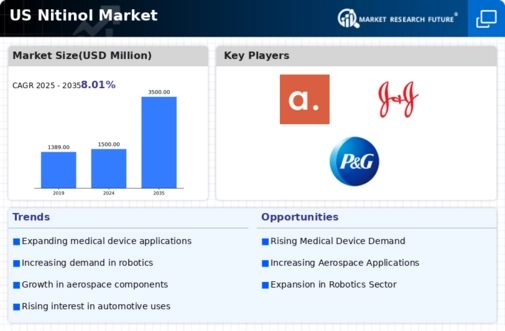
The nitinol market exhibits a dynamic competitive landscape characterized by innovation and strategic partnerships. Key players such as Memry Corporation (US), Johnson & Johnson (US), and Stryker Corporation (US) are at the forefront, leveraging their technological expertise and market presence to drive growth. Memry Corporation (US) focuses on advanced manufacturing techniques, enhancing product quality and reducing costs, while Johnson & Johnson (US) emphasizes research and development to expand its product portfolio in the medical device sector. Stryker Corporation (US) is actively pursuing mergers and acquisitions to bolster its market position, indicating a trend towards consolidation in the industry. Collectively, these strategies foster a competitive environment that prioritizes technological advancement and operational efficiency.
In terms of business tactics, companies are increasingly localizing manufacturing to mitigate supply chain disruptions and optimize logistics. The market structure appears moderately fragmented, with several players vying for market share. However, the influence of major companies is substantial, as they set industry standards and drive innovation. This competitive structure suggests that while smaller firms may struggle to compete on scale, they can still carve out niches through specialized offerings or regional expertise.
In November 2025, Memry Corporation (US) announced a strategic partnership with a leading medical device manufacturer to co-develop next-generation nitinol stents. This collaboration is poised to enhance product offerings and accelerate time-to-market, reflecting a broader trend of companies seeking synergies to innovate more rapidly. Such partnerships may also allow Memry Corporation (US) to leverage the partner's distribution channels, thereby expanding its market reach.
In October 2025, Johnson & Johnson (US) unveiled a new line of nitinol-based surgical instruments designed to improve precision in minimally invasive procedures. This launch underscores the company's commitment to innovation and its strategy to address the growing demand for advanced surgical solutions. By focusing on product differentiation, Johnson & Johnson (US) aims to strengthen its competitive edge in the medical device market.
In September 2025, Stryker Corporation (US) completed the acquisition of a niche player specializing in nitinol-based orthopedic implants. This acquisition not only diversifies Stryker Corporation's (US) product portfolio but also enhances its capabilities in a high-growth segment. The move illustrates a strategic shift towards expanding into specialized markets, which may yield higher margins and foster long-term growth.
As of December 2025, the nitinol market is increasingly influenced by trends such as digitalization, sustainability, and the integration of AI technologies. Companies are forming strategic alliances to enhance their technological capabilities and address evolving consumer demands. The competitive landscape is shifting from price-based competition to a focus on innovation, technology, and supply chain reliability. This evolution suggests that future differentiation will hinge on the ability to deliver cutting-edge solutions that meet the complex needs of the healthcare sector.



















Leave a Comment