×
Request Free Sample ×

Kindly complete the form below to receive a free sample of this Report

* Please use a valid business email

Leading companies partner with us for data-driven Insights

clients tt-cursor
Hero Background

US OEM Insulation Market

ID: MRFR/CnM/16072-HCR
100 Pages
Snehal Singh
October 2025

US OEM Insulation Market Research Report: By Material Type (Mineral Wool, Polyurethane Foam, Flexible Elastomeric Foam, Other Insulations) and By End Use (Building & Construction, Industrial, Transportation, Consumer) - Forecast to 2035

Share:
Download PDF ×

We do not share your information with anyone. However, we may send you emails based on your report interest from time to time. You may contact us at any time to opt-out.

US OEM Insulation Market Infographic
Purchase Options

US OEM Insulation Market Summary

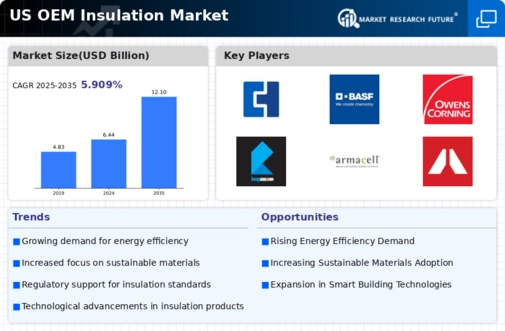
As per analysis, the US OEM Insulation Market is projected to grow from USD 8.53 Billion in 2025 to USD 15.13 Billion by 2035, exhibiting a compound annual growth rate (CAGR) of 5.9% during the forecast period (2025 - 2035).

Key Market Trends & Highlights

The US OEM insulation market is experiencing a shift towards sustainability and technological innovation.

  • The thermal insulation segment remains the largest, driven by its widespread application in various industries.
  • Acoustic insulation is the fastest-growing segment, reflecting an increasing emphasis on noise reduction in urban environments.
  • Fiberglass insulation continues to dominate the market, while foam insulation is rapidly gaining traction due to its superior performance characteristics.
  • Rising energy efficiency standards and growing demand for sustainable materials are key drivers propelling market growth.

Market Size & Forecast

2024 Market Size 8.05 (USD Billion)
2035 Market Size 15.13 (USD Billion)
CAGR (2025 - 2035) 5.9%

Major Players

Owens Corning (US), Johns Manville (US), Rockwool International (DK), Knauf Insulation (DE), CertainTeed (US), BASF Corporation (US), Mineral Wool (US), Thermafiber (US)

US OEM Insulation Market Trends

The US OEM Insulation Market is currently experiencing a dynamic evolution, driven by various factors including regulatory changes, technological advancements, and shifting consumer preferences. Manufacturers are increasingly focusing on enhancing the thermal performance and sustainability of insulation materials. This shift is largely influenced by the growing emphasis on energy efficiency and environmental responsibility. As a result, there is a noticeable trend towards the adoption of eco-friendly materials, which not only meet regulatory standards but also appeal to a more environmentally conscious consumer base. Furthermore, the integration of advanced manufacturing techniques is enabling producers to create insulation products that are lighter, more effective, and easier to install, thereby enhancing overall market competitiveness. In addition, the US OEM Insulation Market is witnessing a rise in demand across various sectors, including automotive, construction, and appliances. This diversification is indicative of the market's adaptability and resilience. The construction sector, in particular, is a significant driver, as new building codes and standards increasingly require higher insulation performance. Consequently, manufacturers are compelled to innovate continuously, ensuring that their products align with these evolving requirements. Overall, the US oem insulation market appears poised for sustained growth, with opportunities for companies that can effectively navigate the complexities of consumer demands and regulatory landscapes.

Sustainability Focus

There is a growing emphasis on sustainable insulation materials within the US oem insulation market. Manufacturers are increasingly adopting eco-friendly practices and materials, responding to consumer demand for environmentally responsible products. This trend is likely to continue as regulations become stricter and consumers prioritize sustainability.

Technological Advancements

Innovations in manufacturing processes are transforming the US oem insulation market. Advanced technologies are enabling the production of insulation materials that offer superior thermal performance and ease of installation. This trend suggests that companies investing in technology will gain a competitive edge.

Regulatory Compliance

The US oem insulation market is heavily influenced by evolving building codes and regulations. As these standards become more stringent, manufacturers must adapt their products to meet new requirements. This trend indicates a potential for increased innovation and product development in response to regulatory changes.

Market Segment Insights

By Application: Thermal Insulation (Largest) vs. Acoustic Insulation (Fastest-Growing)

In the US OEM insulation market, the application segment is characterized by a diverse range of insulation types, with Thermal Insulation commanding the largest share. Thermal Insulation is critical for maintaining energy efficiency in buildings and equipment, leading to its widespread adoption across various industries. Conversely, Acoustic Insulation is rapidly gaining traction due to increasing noise pollution concerns and tighter regulations for soundproofing in residential and commercial establishments. This trend highlights a market shift towards more specialized insulation solutions that cater to specific needs. Growth in the US OEM insulation market is driven by regulatory standards, technological advancements, and heightened energy efficiency awareness. The thermal insulation segment benefits from rising energy costs and stringent building codes promoting insulation use to enhance energy efficiency. Meanwhile, the acoustic insulation segment is powered by increasing investments in infrastructure and a growing emphasis on creating healthier indoor environments. As noise control becomes a priority in urban planning, Acoustic Insulation is expected to maintain its fastest growth rate across the application segment.

Thermal Insulation (Dominant) vs. Fire Protection (Emerging)

Thermal Insulation serves as the dominant force in the US OEM insulation market, offering essential benefits such as energy efficiency and temperature regulation. Its widespread applications in residential, commercial, and industrial sectors enable it to maintain a strong market position. On the other hand, Fire Protection is emerging as a vital segment due to increasing awareness around safety and compliance with fire regulations. Fire Protection insulation materials are designed to withstand high temperatures and prevent fire spread, making them indispensable in construction and manufacturing. With a growing focus on safety standards and innovative fire protection technologies, this segment is gaining traction, positioning itself as a crucial player in the insulation market alongside the established Thermal Insulation.

By Material Type: Fiberglass (Largest) vs. Foam (Fastest-Growing)

In the US OEM insulation market, Fiberglass remains the largest material type due to its widespread use across various applications including construction and automotive industries. The segment captures a significant portion of the market, attributed to its excellent thermal properties, affordability, and easy installation. Foam, on the other hand, is rapidly gaining traction as an alternative insulation material, suitable for both residential and commercial uses. This material's ability to offer superior insulating performance and energy efficiency makes it an attractive choice, particularly in a market increasingly focused on sustainable building practices. The growth trends within the Material Type segment highlight an increasing demand for Foam insulation products, driven by a rising emphasis on energy efficiency and regulatory compliance for building standards. Meanwhile, the Fiberglass segment is evolving with technological advancements aimed at improving its thermal performance and lightweight properties. As building codes become more stringent and consumers seek greener products, the insulation materials landscape continues to shift, presenting opportunities for innovation and expansion across all material types.

Insulation: Fiberglass (Dominant) vs. Foam (Emerging)

Fiberglass insulation is recognized as the dominant player in the US OEM insulation market, primarily due to its cost-effectiveness and effective thermal resistance. It is favored for a range of applications due to its durability and performance consistency. The production of Fiberglass is well-established, which facilitates supply and contributes to its market strength. In contrast, Foam insulation is emerging as a competitive and increasingly preferred alternative, particularly among environmentally conscious consumers. This material offers high R-value per inch, enhancing energy efficiency while providing moisture resistance. Its lightweight nature and ease of installation further expand its appeal in both residential and commercial sectors. As trends evolve, the market is likely to see Foam capture a larger share of energy-efficient projects, despite Fiberglass's current dominance.

By End Use Industry: Automotive (Largest) vs. Aerospace (Fastest-Growing)

In the US OEM insulation market, the automotive sector holds the largest share, reflecting its significant demand for thermal and acoustic insulation solutions. This segment primarily benefits from increasing automotive production and stringent regulations on emissions and noise reduction, leading manufacturers to invest in advanced insulation technologies. Meanwhile, the aerospace sector is rapidly emerging with innovations in materials and design, capturing attention due to the rising need for lightweight and efficient insulation systems in aircraft manufacturing.

Automotive: Dominant vs. Aerospace: Emerging

The Automotive segment remains dominant in the US OEM insulation market, driven by the need for improved thermal management and sound attenuation in vehicles. As manufacturers increasingly focus on fuel efficiency and sustainability, the demand for advanced insulation materials that can withstand high temperatures while reducing weight is on the rise. In contrast, the Aerospace segment is emerging rapidly, characterized by game-changing developments in composite materials and insulation technologies aimed at enhancing safety and reducing overall aircraft weight. The overlap of these two segments highlights a market increasingly shaped by advances in technology and a shift towards more sustainable practices.

By Product Form: Blanket (Largest) vs. Spray (Fastest-Growing)

In the US OEM insulation market, the product form segment showcases noteworthy distribution, with blanket insulation leading the charge in market share. Notably, blanket insulation is favored for its versatility and effectiveness in providing thermal and acoustic insulation across various industries. In contrast, spray insulation is emerging rapidly, driven by its application efficiency and growing popularity in energy-efficient building designs. As these industries evolve, the preferences for insulation forms directly reflect technological advancements and building regulations. The growth trends within this segment underscore a shift towards innovative insulation solutions that cater to sustainability goals. The demand for spray insulation is surging as it offers superior air sealing and minimizes energy loss, making it an attractive option for modern construction. Meanwhile, blanket insulation remains essential for traditional applications, balancing cost-effectiveness and performance. Improvements in material technology are expected to further enhance these product forms, sustaining their relevance in the evolving market landscape.

Blanket (Dominant) vs. Spray (Emerging)

Blanket insulation stands out as the dominant product form in the US OEM insulation market. Known for its broad applicability across both residential and commercial sectors, blanket insulation is favored for its ease of installation and effective thermal resistance. It typically features materials such as fiberglass or mineral wool, providing reliable insulation solutions that meet varying regulatory standards. On the other hand, spray insulation represents an emerging trend, gaining traction due to its ability to create comprehensive air barriers and reduce energy consumption effectively. Spray foam insulation expands upon application, filling gaps and voids that traditional insulation methods might miss. This dynamic duo highlights the balance between the established reliability of blanket insulation and the innovative capabilities of spray insulation, shaping future market direction.

By Performance Characteristics: Fire Resistance (Largest) vs. Moisture Resistance (Fastest-Growing)

In the US OEM insulation market, performance characteristics play a crucial role in determining consumer preference and market share. Fire resistance stands out as the largest segment value, reflecting the growing need for safety and compliance with stringent regulations in industries such as construction and manufacturing. Moisture resistance is rapidly gaining traction as an essential feature, especially with the rising emphasis on durability and energy efficiency in insulation products.

Sound Absorption (Dominant) vs. High Temperature Resistance (Emerging)

Sound absorption is currently a dominant characteristic in the US OEM insulation market, primarily driven by its importance in residential and commercial applications for noise reduction. Consumers value products that enhance comfort and privacy, leading to a robust demand for sound-absorbing materials. In contrast, high temperature resistance is an emerging characteristic gaining attention, particularly in industries that require insulation to withstand extreme conditions. As manufacturing processes evolve and energy efficiency becomes a focal point, products emphasizing high temperature resistance are likely to see increased adoption, although currently, they hold a smaller market share compared to sound absorption solutions.

Get more detailed insights about US OEM Insulation Market

Key Players and Competitive Insights

The OEM insulation market is characterized by a competitive landscape that is increasingly shaped by innovation, sustainability, and strategic partnerships. Key players such as Owens Corning (US), Johns Manville (US), and Rockwool International (DK) are actively pursuing strategies that emphasize product development and market expansion. Owens Corning (US) has focused on enhancing its product portfolio through sustainable materials, while Johns Manville (US) has been investing in advanced manufacturing technologies to improve efficiency and reduce environmental impact. Rockwool International (DK) appears to be leveraging its global presence to penetrate new markets, thereby intensifying competition among these major players.

In terms of business tactics, companies are increasingly localizing manufacturing to reduce supply chain vulnerabilities and enhance responsiveness to market demands. The market structure is moderately fragmented, with several key players holding substantial market shares. This fragmentation allows for a diverse range of products and innovations, yet the collective influence of these major companies drives a competitive environment that is both dynamic and challenging.

In November 2025, Owens Corning (US) announced a partnership with a leading technology firm to develop smart insulation solutions that integrate IoT capabilities. This strategic move is likely to position the company at the forefront of the digital transformation trend within the insulation sector, potentially enhancing energy efficiency and user experience. Such innovations may redefine customer expectations and set new benchmarks for product performance.

In October 2025, Johns Manville (US) unveiled a new line of eco-friendly insulation products made from recycled materials. This initiative not only aligns with the growing consumer demand for sustainable building materials but also reinforces the company's commitment to environmental stewardship. By tapping into this niche market, Johns Manville (US) could enhance its competitive edge and appeal to environmentally conscious consumers.

In September 2025, Rockwool International (DK) expanded its manufacturing capabilities in the US by opening a new facility dedicated to producing high-performance insulation products. This expansion is indicative of the company's strategy to meet the increasing demand for energy-efficient solutions in the North American market. The new facility is expected to bolster production capacity and improve supply chain efficiency, thereby enhancing Rockwool's competitive positioning.

As of December 2025, the competitive trends in the OEM insulation market are increasingly defined by digitalization, sustainability, and the integration of advanced technologies such as AI. Strategic alliances are becoming more prevalent, as companies seek to leverage complementary strengths to enhance their market offerings. The shift from price-based competition to a focus on innovation, technology, and supply chain reliability is evident, suggesting that future competitive differentiation will hinge on the ability to deliver superior products and services that meet evolving consumer needs.


Key Companies in the US OEM Insulation Market market include

Industry Developments

The US OEM Insulation Market has seen notable developments recently, with a focus on sustainability and energy efficiency. Companies like Owens Corning and CertainTeed are leveraging innovation to create advanced insulation solutions that comply with new energy regulations. In September 2023, Owens Corning announced an expansion of its fiberglass insulation manufacturing facility in the Midwest, aiming to enhance production capacity in response to increased demand.

Furthermore, in October 2022, Dupont acquired a leading insulation product line from a competitor, which enhanced its market foothold. The growth trajectory of the US OEM Insulation Market is further influenced by rising construction activities and stringent building codes favoring energy-efficient materials. The market valuation for insulation products is expected to experience significant growth as the trend towards green building practices continues to gain traction.

Additionally, advancements in mineral wool and other innovative materials from providers like Rockwool and BASF are addressing both thermal and acoustic insulation needs, thus broadening market applications. The environment-conscious narrative is reshaping investment in the insulation sector as firms strive for technological advancements while responding to evolving customer expectations.

Future Outlook

US OEM Insulation Market Future Outlook

The US OEM insulation market is projected to grow at a 5.9% CAGR from 2024 to 2035, driven by energy efficiency regulations, technological advancements, and increasing demand for sustainable materials.

New opportunities lie in:

  • Development of advanced thermal insulation materials for automotive applications.
  • Expansion into eco-friendly insulation solutions targeting green building certifications.
  • Implementation of smart insulation technologies integrating IoT for energy management.

By 2035, the US OEM insulation market is expected to be robust, driven by innovation and sustainability.

Market Segmentation

US OEM Insulation Market Application Outlook

  • Thermal Insulation
  • Acoustic Insulation
  • Fire Protection
  • Vibration Damping

US OEM Insulation Market Product Form Outlook

  • Blanket
  • Board
  • Spray
  • Roll

US OEM Insulation Market Material Type Outlook

  • Fiberglass
  • Foam
  • Mineral Wool
  • Cellulose

US OEM Insulation Market End Use Industry Outlook

  • Automotive
  • Aerospace
  • Construction
  • Industrial Equipment

US OEM Insulation Market Performance Characteristics Outlook

  • High Temperature Resistance
  • Sound Absorption
  • Fire Resistance
  • Moisture Resistance

Report Scope

MARKET SIZE 20248.05(USD Billion)
MARKET SIZE 20258.53(USD Billion)
MARKET SIZE 203515.13(USD Billion)
COMPOUND ANNUAL GROWTH RATE (CAGR)5.9% (2024 - 2035)
REPORT COVERAGERevenue Forecast, Competitive Landscape, Growth Factors, and Trends
BASE YEAR2024
Market Forecast Period2025 - 2035
Historical Data2019 - 2024
Market Forecast UnitsUSD Billion
Key Companies ProfiledOwens Corning (US), Johns Manville (US), Rockwool International (DK), Knauf Insulation (DE), CertainTeed (US), BASF Corporation (US), Mineral Wool (US), Thermafiber (US)
Segments CoveredApplication, Material Type, End Use Industry, Product Form, Performance Characteristics
Key Market OpportunitiesGrowing demand for energy-efficient insulation solutions in the US oem insulation market.
Key Market DynamicsRising demand for energy-efficient solutions drives innovation and competition in the US OEM insulation market.
Countries CoveredUS

Leave a Comment

FAQs

What is the expected market size of the US OEM Insulation Market by 2024?

The US OEM Insulation Market is expected to be valued at 6.44 billion USD in 2024.

What is the projected market valuation for the US OEM Insulation Market by 2035?

By 2035, the US OEM Insulation Market is projected to reach a valuation of 12.11 billion USD.

What is the expected CAGR for the US OEM Insulation Market from 2025 to 2035?

The expected CAGR for the US OEM Insulation Market from 2025 to 2035 is 5.909 percent.

Which material type will lead the US OEM Insulation Market in 2024?

In 2024, Polyurethane Foam is anticipated to lead the market with a value of 2.12 billion USD.

How does the market value for Mineral Wool change from 2024 to 2035?

The market value for Mineral Wool is expected to grow from 1.92 billion USD in 2024 to 3.56 billion USD by 2035.

What major players are contributing to the US OEM Insulation Market?

Key players in the market include Owens Corning, BASF, Rockwool, and Johns Manville.

What is the projected market value for Flexible Elastomeric Foam by 2035?

By 2035, the market value for Flexible Elastomeric Foam is expected to reach 2.43 billion USD.

What are the growth drivers for the US OEM Insulation Market?

Key growth drivers include rising energy efficiency demands and increased building and construction activities.

What is the anticipated value for 'Other Insulations' by the end of 2035?

The anticipated market value for 'Other Insulations' is expected to reach 2.02 billion USD by 2035.

How has the US OEM Insulation Market been impacted by recent global conflicts?

Recent global conflicts have led to supply chain disruptions, impacting production and distribution in the US OEM Insulation Market.

Download Free Sample

Kindly complete the form below to receive a free sample of this Report

Compare Licence

×
Features License Type
Single User Multiuser License Enterprise User
Price $4,950 $5,950 $7,250
Maximum User Access Limit 1 User Upto 10 Users Unrestricted Access Throughout the Organization
Free Customization
Direct Access to Analyst
Deliverable Format
Platform Access
Discount on Next Purchase 10% 15% 15%
Printable Versions