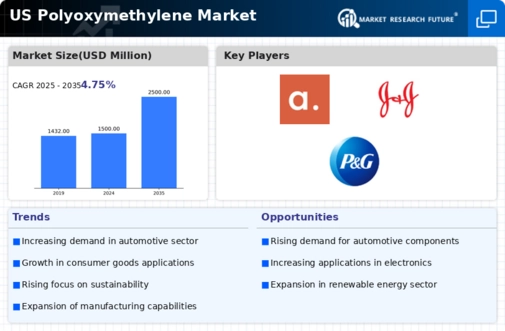
The polyoxymethylene market exhibits a dynamic competitive landscape characterized by innovation and strategic partnerships. Key players such as DuPont (US), BASF (US), and Celanese (US) are actively shaping the market through their distinct operational focuses. DuPont (US) emphasizes sustainability and advanced material solutions, while BASF (US) leverages its extensive research capabilities to enhance product performance. Celanese (US) is concentrating on expanding its production capacity to meet rising demand, particularly in automotive and consumer goods sectors. Collectively, these strategies foster a competitive environment that prioritizes technological advancement and responsiveness to market needs.
In terms of business tactics, companies are increasingly localizing manufacturing to reduce lead times and enhance supply chain efficiency. The market structure appears moderately fragmented, with several players vying for market share. However, the influence of major companies is substantial, as they set benchmarks for quality and innovation. This competitive structure encourages smaller firms to adopt niche strategies or collaborate with larger entities to enhance their market presence.
In November 2025, DuPont (US) announced a partnership with a leading automotive manufacturer to develop a new line of polyoxymethylene products aimed at reducing vehicle weight and improving fuel efficiency. This strategic move underscores DuPont's commitment to sustainability and positions it favorably within the automotive sector, which is increasingly focused on eco-friendly materials. The collaboration is expected to yield significant advancements in material science, potentially setting new industry standards.
In October 2025, BASF (US) unveiled a new production facility dedicated to polyoxymethylene in Texas, aimed at increasing its output by 30%. This expansion reflects BASF's strategy to capitalize on the growing demand for high-performance engineering plastics. The facility is expected to enhance supply chain reliability and reduce production costs, thereby strengthening BASF's competitive edge in the market.
In September 2025, Celanese (US) completed the acquisition of a specialty chemical company, which is anticipated to bolster its polyoxymethylene product offerings. This acquisition aligns with Celanese's strategy to diversify its portfolio and enhance its technological capabilities. By integrating the acquired company's innovations, Celanese aims to deliver more advanced solutions to its customers, thereby reinforcing its market position.
As of December 2025, the competitive trends in the polyoxymethylene market are increasingly defined by digitalization, sustainability, and the integration of AI technologies. Strategic alliances are becoming more prevalent, as companies recognize the value of collaboration in driving innovation. The competitive differentiation is likely to evolve from traditional price-based competition towards a focus on technological advancements, supply chain reliability, and sustainable practices. This shift suggests that companies prioritizing innovation and strategic partnerships will be better positioned to thrive in the evolving market landscape.



















Leave a Comment