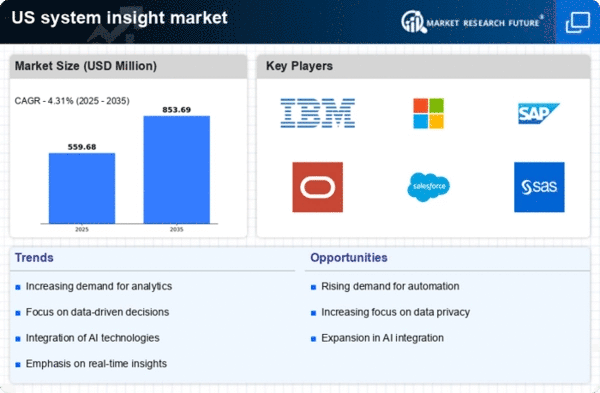
The system insight market is currently characterized by a dynamic competitive landscape, driven by rapid technological advancements and an increasing demand for data-driven decision-making. Major players such as IBM (US), Microsoft (US), and Oracle (US) are at the forefront, each adopting distinct strategies to enhance their market positioning. IBM (US) focuses on integrating AI capabilities into its analytics platforms, thereby facilitating deeper insights and predictive analytics. Meanwhile, Microsoft (US) emphasizes cloud-based solutions, leveraging its Azure platform to provide scalable and flexible data management services. Oracle (US) is concentrating on expanding its cloud infrastructure, aiming to enhance its enterprise resource planning (ERP) solutions with advanced analytics features. Collectively, these strategies not only intensify competition but also foster innovation within the market, as companies strive to meet the evolving needs of their clients.
In terms of business tactics, companies are increasingly localizing their operations and optimizing supply chains to enhance efficiency and responsiveness. The competitive structure of the market appears moderately fragmented, with a mix of established players and emerging startups. This fragmentation allows for diverse offerings and innovation, as smaller firms often introduce niche solutions that challenge the status quo. The collective influence of key players, however, remains substantial, as they set industry standards and drive technological advancements.
In October 2025, IBM (US) announced a strategic partnership with a leading AI research institute to develop next-generation analytics tools. This collaboration is poised to enhance IBM's capabilities in machine learning and data processing, potentially positioning the company as a leader in AI-driven insights. The strategic importance of this partnership lies in its potential to accelerate product development and improve customer offerings, thereby solidifying IBM's competitive edge in the market.
In September 2025, Microsoft (US) launched a new suite of analytics tools integrated with its existing cloud services. This initiative aims to provide businesses with real-time insights and predictive analytics capabilities. The strategic significance of this launch is multifaceted; it not only strengthens Microsoft's position in the cloud analytics space but also enhances customer engagement by offering tailored solutions that meet specific business needs. This move reflects a broader trend towards personalization in data analytics.
In August 2025, Oracle (US) unveiled an upgraded version of its cloud-based ERP system, incorporating advanced analytics features designed to streamline business operations. This upgrade is strategically important as it aligns with the growing demand for integrated solutions that combine operational efficiency with data-driven insights. By enhancing its ERP offerings, Oracle (US) aims to attract a broader customer base, particularly among mid-sized enterprises seeking comprehensive solutions.
As of November 2025, current competitive trends in the system insight market are heavily influenced by digitalization, sustainability, and the integration of AI technologies. Strategic alliances are increasingly shaping the landscape, as companies recognize the value of collaboration in driving innovation and expanding market reach. Looking ahead, competitive differentiation is likely to evolve, with a pronounced shift from price-based competition to a focus on innovation, technological advancement, and supply chain reliability. This evolution suggests that companies that prioritize these aspects will be better positioned to thrive in an increasingly complex market.




















Leave a Comment