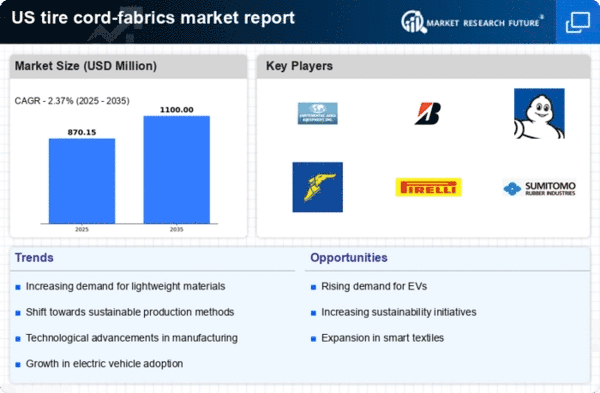
The tire cord-fabrics market is characterized by a competitive landscape that is both dynamic and multifaceted. Key growth drivers include the increasing demand for high-performance tires, advancements in material technology, and a growing emphasis on sustainability. Major players such as Goodyear Tire & Rubber Company (US), Bridgestone Corporation (JP), and Kordsa Teknik Tekstil A.S. (TR) are strategically positioning themselves through innovation and partnerships. For instance, Goodyear Tire & Rubber Company (US) has focused on enhancing its product offerings by investing in advanced materials that improve tire durability and performance, thereby shaping the competitive environment towards a more technology-driven approach.In terms of business tactics, companies are increasingly localizing manufacturing to reduce lead times and optimize supply chains. The market structure appears moderately fragmented, with several key players exerting considerable influence. This fragmentation allows for niche players to thrive, while larger corporations leverage economies of scale to maintain competitive pricing. The collective influence of these key players fosters a competitive atmosphere where innovation and operational efficiency are paramount.
In October Bridgestone Corporation (JP) announced a strategic partnership with a leading technology firm to develop AI-driven solutions for tire performance monitoring. This initiative is expected to enhance customer engagement and provide real-time data analytics, thereby improving the overall customer experience. Such a move underscores Bridgestone's commitment to integrating technology into its product offerings, potentially setting a new standard in the industry.
In September Kordsa Teknik Tekstil A.S. (TR) expanded its production capacity in the US by investing $50 million in a new facility. This expansion is aimed at meeting the rising demand for high-quality tire cord fabrics, particularly in the electric vehicle segment. The strategic importance of this investment lies in Kordsa's ability to enhance its market presence and respond swiftly to evolving consumer preferences, particularly as the automotive industry shifts towards electrification.
In November Goodyear Tire & Rubber Company (US) launched a new line of eco-friendly tire cord fabrics made from recycled materials. This initiative aligns with the growing trend towards sustainability and positions Goodyear as a leader in environmentally responsible manufacturing practices. The strategic importance of this launch is significant, as it not only addresses consumer demand for sustainable products but also enhances Goodyear's brand reputation in a competitive market.
As of November current competitive trends are increasingly defined by digitalization, sustainability, and the integration of AI technologies. Strategic alliances are playing a crucial role in shaping the landscape, enabling companies to leverage shared resources and expertise. Looking ahead, competitive differentiation is likely to evolve from traditional price-based competition to a focus on innovation, technological advancements, and supply chain reliability. This shift suggests that companies that prioritize these areas will be better positioned to thrive in an increasingly complex market.