×
Request Free Sample ×

Kindly complete the form below to receive a free sample of this Report

* Please use a valid business email

Leading companies partner with us for data-driven Insights

clients tt-cursor
Hero Background

US Viscosity Index Improvers Market

ID: MRFR/CnM/16889-HCR
100 Pages
Chitranshi Jaiswal
October 2025

US Viscosity Index Improvers Market Research Report: By Type (Polymethacrylate, Olefin Copolymer, Polyisobutylene) and By End User (Manufacturing, Food Processing, Mining, Construction, Power generation) - Forecast to 2035

Share:
Download PDF ×

We do not share your information with anyone. However, we may send you emails based on your report interest from time to time. You may contact us at any time to opt-out.

US Viscosity Index Improvers Market Infographic
Purchase Options

US Viscosity Index Improvers Market Summary

As per analysis, the US viscosity index improvers market is projected to grow from USD 29.91 Million in 2024 to USD 61.67 Million by 2035, exhibiting a compound annual growth rate (CAGR) of 6.8% during the forecast period (2025 - 2035).

Key Market Trends & Highlights

The US viscosity index improvers market is experiencing a notable shift towards synthetic formulations driven by sustainability and performance demands.

  • The automotive segment remains the largest contributor to the viscosity index improvers market, particularly in passenger vehicles.
  • The industrial segment is identified as the fastest-growing area, reflecting increasing demand for high-performance lubricants.
  • Technological advancements in formulations are enhancing the efficiency and effectiveness of viscosity index improvers.
  • Key market drivers include the rising awareness of energy efficiency and the need for regulatory compliance with environmental standards.

Market Size & Forecast

2024 Market Size 29.91 (USD Million)
2035 Market Size 61.67 (USD Million)
CAGR (2025 - 2035) 6.8%

Major Players

Chevron Oronite (US), Afton Chemical (US), Infineum (US), Evonik Industries (US), BASF (US), Lubrizol (US), SABIC (US), ExxonMobil (US), TotalEnergies (US)

US Viscosity Index Improvers Market Trends

The US viscosity index improvers market is currently experiencing a dynamic phase characterized by evolving consumer preferences and regulatory changes. The demand for high-performance lubricants is on the rise, driven by the automotive and industrial sectors seeking enhanced efficiency and sustainability. This shift is likely influenced by the increasing focus on fuel economy and emissions reduction, prompting manufacturers to innovate and develop advanced formulations. Furthermore, the market appears to be adapting to the growing trend of synthetic lubricants, which often incorporate viscosity index improvers to achieve superior performance under varying temperature conditions. In addition, the US viscosity index improvers market is witnessing a notable shift towards environmentally friendly products. Regulatory bodies are emphasizing the need for sustainable practices, which may lead to a greater emphasis on bio-based and biodegradable viscosity index improvers. This trend suggests that manufacturers are likely to invest in research and development to create products that not only meet performance standards but also align with environmental regulations. As the market evolves, it seems poised for growth, driven by innovation and a commitment to sustainability.

Shift Towards Synthetic Lubricants

The US viscosity index improvers market is increasingly leaning towards synthetic lubricants, which are known for their superior performance characteristics. This trend is likely driven by the automotive industry's demand for products that enhance fuel efficiency and reduce emissions. Synthetic lubricants often require advanced viscosity index improvers to maintain optimal performance across a range of temperatures, indicating a potential growth area for manufacturers.

Emphasis on Sustainability

There is a growing emphasis on sustainability within the US viscosity index improvers market, as regulatory bodies push for environmentally friendly products. This trend suggests that manufacturers may focus on developing bio-based and biodegradable viscosity index improvers, aligning with the increasing consumer demand for sustainable solutions. Such a shift could redefine product offerings and market strategies.

Technological Advancements in Formulations

Technological advancements are playing a crucial role in shaping the US viscosity index improvers market. Innovations in chemical formulations are enabling the development of more efficient and effective viscosity index improvers. This trend indicates that companies are likely to invest in research and development to enhance product performance, thereby meeting the evolving needs of various industries.

Market Segment Insights

By Application: Automotive (Largest) vs. Industrial (Fastest-Growing)

In the US viscosity index improvers market, the automotive application holds the largest share, driven by the increasing demand for high-performance vehicles. This segment relies on viscosity index improvers to enhance engine performance and fuel efficiency. Meanwhile, the industrial segment is experiencing rapid growth, reflecting rising investments in manufacturing and machinery, which require advanced lubricants. Other segments like marine, aerospace, and agricultural are relatively smaller but contribute to the overall market dynamics with specialized applications.

Automotive: Dominant vs. Industrial: Emerging

The automotive application stands as the dominant force in the viscosity index improvers market, primarily due to the stringent performance requirements of modern engines. Automakers are adopting advanced technologies to meet environmental regulations and consumer expectations for efficiency. On the other hand, the industrial segment is emerging quickly as manufacturers transition to using high-performance lubricants to improve operational efficiency. This shift is based on the need for better reliability and performance in heavy machinery and equipment. As industries modernize, the demand for viscosity index improvers that enhance lubricant properties is expected to rise, positioning both segments strategically in the market.

By End Use: Passenger Vehicles (Largest) vs. Commercial Vehicles (Fastest-Growing)

In the US viscosity index improvers market, the end-use segment is primarily dominated by passenger vehicles, reflecting their significant contribution to the automotive industry. This category's well-established infrastructure and widespread consumer adoption have positioned it as a leading segment, capturing a substantial share of the market. Conversely, commercial vehicles are emerging rapidly, benefiting from the increasing demand for freight and goods transportation, coupled with advancements in vehicle technology that necessitate efficient lubricants.

Passenger Vehicles (Dominant) vs. Heavy Machinery (Emerging)

Passenger vehicles represent the dominant force in the US viscosity index improvers market, driven by consumer preference for enhanced vehicle performance and fuel efficiency. Automakers are increasingly integrating advanced lubricants to meet stringent emissions standards while maintaining engine reliability. In contrast, heavy machinery is an emerging segment, gaining traction as infrastructure projects and construction activities escalate in the country. This sector requires high-performance lubricants to withstand extreme conditions and provide optimal equipment functionality. Both segments reflect a shift towards improved operational efficiencies and environmental compliance.

By Type: Polymer-Based (Largest) vs. Synthetic (Fastest-Growing)

In the US viscosity index improvers market, the 'Type' segment reveals a clear leader in the form of Polymer-Based improvers, commanding significant market share due to their widespread application across various industries, including automotive and industrial lubricants. This segment benefits from their superior performance in enhancing viscosity stability and overall lubricant longevity, making them a preferred choice among manufacturers. In contrast, Synthetic improvers are emerging rapidly, sought for their advanced features and environmental benefits, driving their adoption in performance-oriented applications. The growth trends in this segment are driven notably by increasing demand for high-performance lubricants which allow for improved fuel efficiency and reduced emissions in automotive applications. As environmental regulations continue to tighten, the shift towards synthetic solutions is propelled further by manufacturers seeking eco-friendly alternatives. Innovations in formulation technology and the rising trend of synthetic lubricants ensuring robust viscosity characteristics also support the expanding footprint of Synthetic improvers in the market, thereby captivating the attention of end-users striving for enhanced performance and sustainability.

Polymer-Based (Dominant) vs. Organic (Emerging)

Within the US viscosity index improvers market, Polymer-Based improvers solidify their position as the dominant force due to their established efficacy and versatility. Known for their remarkable ability to maintain stability across a range of temperatures, Polymer-Based solutions cater equally to automotive and industrial requirements, making them invaluable in high-demand applications. Additionally, they often exhibit compatibility with various base oils, enhancing their attractiveness for lubricant formulations. On the other hand, Organic improvers present an emerging alternative, gaining traction mainly due to their renewable components and economic feasibility. They are increasingly being developed to meet specific performance criteria while offering sustainable benefits. As the market progresses, the competition between these types could reshape preferences and drive further innovation in formulations.

By Viscosity Grade: Medium Viscosity (Largest) vs. Low Viscosity (Fastest-Growing)

In the US viscosity index improvers market, the distribution among viscosity grades reveals that medium viscosity products currently hold the largest market share. They cater to a wide range of applications, including automotive lubricants and industrial fluids, making them highly sought after by manufacturers and end-users alike. Meanwhile, low viscosity products, which are increasingly being adopted for their energy-saving benefits, are emerging as the fastest-growing segment, indicating a shift in consumer preference towards more efficient solutions.

Medium Viscosity (Dominant) vs. Low Viscosity (Emerging)

Medium viscosity index improvers dominate the market due to their balanced performance characteristics, offering excellent lubrication properties while maintaining engine efficiency. This segment is vital for high-performance applications, providing enhanced stability across various temperature ranges. On the other hand, low viscosity index improvers are gaining traction, driven by the demand for more efficient engines that require lighter lubricants. The emerging preference for low viscosity products is primarily influenced by stringent environmental regulations and the automotive industry's push towards fuel economy, positioning them as a significant contender in the growing market.

By Formulation Type: Multi-Grade (Largest) vs. Single-Grade (Fastest-Growing)

In the US viscosity index improvers market, the formulation type segment is characterized by a distinct distribution of market shares among Multi-Grade, Single-Grade, and Additive Packages. Multi-Grade viscosity index improvers hold the largest share, favored for their versatility in different temperature ranges and their ability to enhance engine performance. In contrast, Single-Grade products, although currently a smaller segment, are gaining traction as they cater to specific applications requiring consistent viscosity at a defined temperature. Additive packages complete this trio, providing tailored solutions that integrate with various base oils, allowing formulators to achieve desired performance characteristics. Growth trends in this segment are shaped by evolving automotive industry standards, where the demand for fuel-efficient and high-performance lubricants is on the rise. Multi-Grade viscosity improvers are driven by the push for multi-functional engine oils, while Single-Grade formulations are becoming increasingly relevant in niche markets and for specific vehicle types. The accelerating shift towards eco-friendly and high-performance products is leading formulators to prioritize innovative additives, contributing to a dynamic competitive landscape. Overall, the demand for high-quality viscosity index improvers will continue to be influenced by advancements in technology and changes in consumer preferences.

Formulation Type: Multi-Grade (Dominant) vs. Single-Grade (Emerging)

The formulation landscape in the US viscosity index improvers market features Multi-Grade products as the dominant segment due to their extensive applicability across a range of temperatures and engine types. These products not only improve oil flow at low temperatures but also maintain stability at high temperatures, making them ideal for modern vehicles. On the other hand, Single-Grade viscosity index improvers are emerging as a specialized choice, particularly in applications that demand precise viscosity control. This segment is finding its niche within specific agricultural and industrial machinery, where consistency and reliability at specific temperatures are crucial. As the market evolves, both segments will need to address the growing emphasis on performance and environmental impacts, ensuring they meet the stringent regulations and consumer expectations.

Get more detailed insights about US Viscosity Index Improvers Market

Key Players and Competitive Insights

The viscosity index improvers market is characterized by a competitive landscape that is increasingly shaped by innovation, sustainability, and strategic partnerships. Key players such as Chevron Oronite (US), Afton Chemical (US), and Infineum (US) are actively pursuing strategies that emphasize technological advancements and regional expansion. Chevron Oronite (US) has focused on enhancing its product portfolio through research and development, aiming to meet the evolving demands of the automotive and industrial sectors. Afton Chemical (US) appears to be leveraging its expertise in formulating high-performance additives, while Infineum (US) is likely concentrating on sustainability initiatives to align with global environmental standards. Collectively, these strategies contribute to a dynamic competitive environment where differentiation is increasingly reliant on innovation and sustainability.

In terms of business tactics, companies are localizing manufacturing and optimizing supply chains to enhance operational efficiency. The market structure is moderately fragmented, with several key players exerting considerable influence. This fragmentation allows for a diverse range of products and services, yet the presence of major companies ensures a competitive atmosphere where innovation is paramount. The collective influence of these players shapes market dynamics, as they strive to capture market share through strategic initiatives.

In November 2025, Chevron Oronite (US) announced a partnership with a leading automotive manufacturer to develop next-generation viscosity index improvers tailored for electric vehicles. This strategic move underscores the company's commitment to innovation and positions it favorably within the growing electric vehicle market. By aligning its product offerings with the needs of this emerging sector, Chevron Oronite (US) is likely to enhance its competitive edge and drive future growth.

In October 2025, Afton Chemical (US) launched a new line of biodegradable viscosity index improvers, reflecting its dedication to sustainability. This initiative not only addresses environmental concerns but also caters to a market increasingly focused on eco-friendly solutions. The introduction of these products may enable Afton Chemical (US) to capture a segment of environmentally conscious consumers, thereby strengthening its market position.

In September 2025, Infineum (US) expanded its research facilities to enhance its capabilities in developing advanced additives. This expansion is indicative of the company's long-term strategy to invest in innovation and maintain a competitive advantage. By bolstering its research and development efforts, Infineum (US) is likely to accelerate the introduction of cutting-edge products that meet the evolving needs of the market.

As of December 2025, current competitive trends are heavily influenced by digitalization, sustainability, and the integration of artificial intelligence in product development. Strategic alliances are becoming increasingly important, as companies seek to pool resources and expertise to drive innovation. The competitive landscape is shifting from price-based competition to a focus on technological advancements and supply chain reliability. This evolution suggests that companies that prioritize innovation and sustainability will likely emerge as leaders in the viscosity index improvers market.


Key Companies in the US Viscosity Index Improvers Market market include

Industry Developments

The US Viscosity Index Improvers Market has seen several important developments recently. A notable growth in market valuation is attributed to increasing demands for high-performance lubricants in the automotive and industrial sectors, with companies like Exxon Mobil, BASF, and Innospec actively enhancing their product portfolios to meet strict regulatory standards. As of September 2023, Valvoline announced plans to innovate their lubricant formulations, emphasizing the incorporation of advanced Viscosity Index Improvers. Additionally, TotalEnergies has been investing heavily in sustainable lubricants, reflecting a shift towards eco-friendly products.

In terms of mergers and acquisitions, in March 2023, Evonik Industries announced the acquisition of a specialty chemical business from a competitor, aiming to expand its reach in the viscosity index improvers segment. This acquisition is expected to enhance Evonik's ability to supply high-performance products within the US market. Over the last two years, significant market fluctuations have encouraged companies like Lubrizol and Afton Chemical to ramp up their Research and Development efforts, focusing on high-efficiency viscosity index improvers to keep pace with evolving industry standards.

Such trends point to a dynamic market environment where innovation and strategic partnerships are critical.

Future Outlook

US Viscosity Index Improvers Market Future Outlook

The US viscosity index improvers market is projected to grow at a 6.8% CAGR from 2024 to 2035, driven by increasing demand for high-performance lubricants and stringent environmental regulations.

New opportunities lie in:

  • Development of bio-based viscosity index improvers for eco-friendly applications.
  • Expansion into emerging markets with tailored product offerings.
  • Investment in R&D for advanced polymer technologies to enhance performance.

By 2035, the market is expected to achieve robust growth, positioning itself as a leader in innovative lubricant solutions.

Market Segmentation

US Viscosity Index Improvers Market Type Outlook

  • Polymer-Based
  • Organic
  • Inorganic
  • Synthetic

US Viscosity Index Improvers Market End Use Outlook

  • Passenger Vehicles
  • Commercial Vehicles
  • Heavy Machinery
  • Two-Wheelers

US Viscosity Index Improvers Market Application Outlook

  • Automotive
  • Industrial
  • Marine
  • Aerospace
  • Agricultural

US Viscosity Index Improvers Market Viscosity Grade Outlook

  • Low Viscosity
  • Medium Viscosity
  • High Viscosity

US Viscosity Index Improvers Market Formulation Type Outlook

  • Multi-Grade
  • Single-Grade
  • Additive Packages

Report Scope

MARKET SIZE 202429.91(USD Million)
MARKET SIZE 202531.94(USD Million)
MARKET SIZE 203561.67(USD Million)
COMPOUND ANNUAL GROWTH RATE (CAGR)6.8% (2024 - 2035)
REPORT COVERAGERevenue Forecast, Competitive Landscape, Growth Factors, and Trends
BASE YEAR2024
Market Forecast Period2025 - 2035
Historical Data2019 - 2024
Market Forecast UnitsUSD Million
Key Companies ProfiledChevron Oronite (US), Afton Chemical (US), Infineum (US), Evonik Industries (US), BASF (US), Lubrizol (US), SABIC (US), ExxonMobil (US), TotalEnergies (US)
Segments CoveredApplication, End Use, Type, Viscosity Grade, Formulation Type
Key Market OpportunitiesGrowing demand for high-performance lubricants drives innovation in the US viscosity index improvers market.
Key Market DynamicsRising demand for high-performance lubricants drives innovation in viscosity index improvers within the US market.
Countries CoveredUS

Leave a Comment

FAQs

What is the expected market size of the US Viscosity Index Improvers Market in 2024?

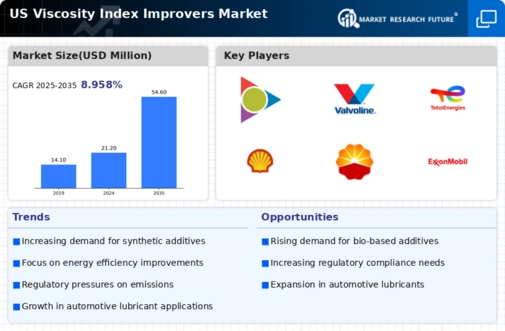
The US Viscosity Index Improvers Market is expected to be valued at 21.25 million USD in 2024.

What will be the market size of the US Viscosity Index Improvers Market by 2035?

By 2035, the US Viscosity Index Improvers Market is projected to reach 54.6 million USD.

What is the expected compound annual growth rate (CAGR) for the US Viscosity Index Improvers Market from 2025 to 2035?

The expected CAGR for the US Viscosity Index Improvers Market from 2025 to 2035 is 8.958%.

Which segment types dominate the US Viscosity Index Improvers Market?

The market is divided into three main types: Polymethacrylate, Olefin Copolymer, and Polyisobutylene.

What is the market value of the Polymethacrylate segment in 2024?

The Polymethacrylate segment is valued at 7.5 million USD in 2024.

What will the market value of Olefin Copolymer be by 2035?

The Olefin Copolymer segment is expected to reach a value of 16.0 million USD by 2035.

Who are the key players in the US Viscosity Index Improvers Market?

Major players in the market include Innospec, Valvoline, TotalEnergies, and Shell.

What is the projected market value for Polyisobutylene in 2024?

The Polyisobutylene segment is projected to be valued at 7.5 million USD in 2024.

What is a key opportunity driving the growth of the US Viscosity Index Improvers Market?

Growing demand for high-performance lubricants is a significant opportunity for market growth.

What challenges might affect the US Viscosity Index Improvers Market in the coming years?

Regulatory changes and fluctuations in raw material prices could challenge market growth.

Download Free Sample

Kindly complete the form below to receive a free sample of this Report

Compare Licence

×
Features License Type
Single User Multiuser License Enterprise User
Price $4,950 $5,950 $7,250
Maximum User Access Limit 1 User Upto 10 Users Unrestricted Access Throughout the Organization
Free Customization
Direct Access to Analyst
Deliverable Format
Platform Access
Discount on Next Purchase 10% 15% 15%
Printable Versions