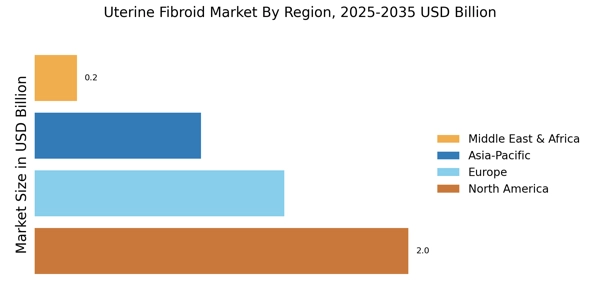
According to Market Research Future analysis, the Uterine Fibroid Market Size was valued at USD 4.5 Billion in 2024 & the market is projected to grow from USD 4.856 Billion in 2025 to USD 10.41 Billion by 2035, registering a CAGR of 7.92% during the forecast period 2025–2035. North America led the market with over 45% share, generating around USD 2.03 billion in revenue.
Increasing prevalence of uterine fibroids and rising demand for minimally invasive treatment options are key growth drivers. Advancements in diagnostic imaging and therapeutic technologies are improving early detection and patient outcomes, accelerating adoption of effective fibroid management solutions globally.
- According to WHO, women represent nearly 49.6% of the global population, while studies indicate up to 70–80% of women develop fibroids by age 50. IHME reports gynecological disorders contribute significantly to global disease burden, supporting demand for advanced diagnosis and minimally invasive treatment solutions.
Key Market Trends & Highlights
The Uterine Fibroid Market is experiencing a transformative shift towards non-invasive treatment options and personalized care.
- North America leads with over 45% share supported by 600,000 annual hysterectomies and high healthcare expenditure levels.
- Europe holds USD 1.35 billion market size with 30% share driven by aging population and strong healthcare system investments.
- Up to 70–80% women develop fibroids by age 50, driving strong demand for advanced diagnosis and treatment solutions globally.
- Ultrasound dominates with 68% share, while MRI grows rapidly due to superior imaging precision and increasing diagnostic accuracy demand.
Market Size & Forecast
| 2024 Market Size | 4.5 (USD Billion) |
| 2035 Market Size | 10.41 (USD Billion) |
| CAGR (2025 - 2035) | 7.92% |
Major Players
Companies such as Medtronic (US), Boston Scientific (US), Johnson & Johnson (US), Abbott Laboratories (US), Hologic (US), Stryker (US), Bayer (DE), Merck (DE), Ferring Pharmaceuticals (CH), AstraZeneca (GB) are some of the major participants in the global market.