Vendor Risk Management Market (2025 - 2035)

Vendor Risk Management Market Size, Share and Research Report By Type (Solutions, Services), By Deployment Type (On-Premises, Cloud), By Organization Size (Small and Medium-Sized Enterprises, Large Enterprises), By Industry Vertical (Banking, Financial Services, and Insurance, Telecom and IT, Manufacturing, Government, Healthcare, Others) and By Regional (North America, Europe, South America, Asia Pacific, Middle East and Africa) - Industry Forecast to 2035.
ID: MRFR/ICT/4488-HCR
100 Pages
Nirmit Biswas, Aarti Dhapte
Last Updated: July 24, 2026
Vendor Risk Management Market
Market Size
Forecast Period2025-2035
CAGR (2025-2035)11.0%
2025 Market SizeUSD 14.52 Billion
2035 Market SizeUSD 41.23 Billion
Key Players
BitSight Technologies
OneTrust
Prevalent Inc.
ServiceNow
SAP Ariba
MetricStream
Opportunities
  • AI-Powered Continuous Monitoring Platforms
  • Emerging-Market Regulatory Catalysts
  • Fourth-Party Risk Visibility

Vendor Risk Management Market Summary

The Vendor Risk Management Market reached an estimated USD 14.52 billion in 2025 and is projected to grow from USD 16.12 billion in 2026 to USD 41.23 billion by 2035, registering a CAGR of 11.0% during the forecast period. Escalating regulatory pressure—particularly the EU's Digital Operational Resilience Act (DORA) and evolving SEC cybersecurity disclosure mandates—has made structured oversight of external partners a board-level priority across industries [1]. Global spending on governance, risk, and compliance technologies exceeded USD 63 billion in 2024, signaling sustained capital commitment to this domain [2].

The Vendor Risk Management Market is undergoing a fundamental technology shift. Legacy spreadsheet-driven assessments and periodic audit cycles are giving way to continuous-monitoring platforms powered by AI-driven risk scoring, real-time threat intelligence feeds, and automated questionnaire workflows. A 2024 survey found that 71% of enterprises planned to adopt integrated risk-platform suites by 2026, consolidating point solutions into unified dashboards that link procurement, security, and compliance teams [3].

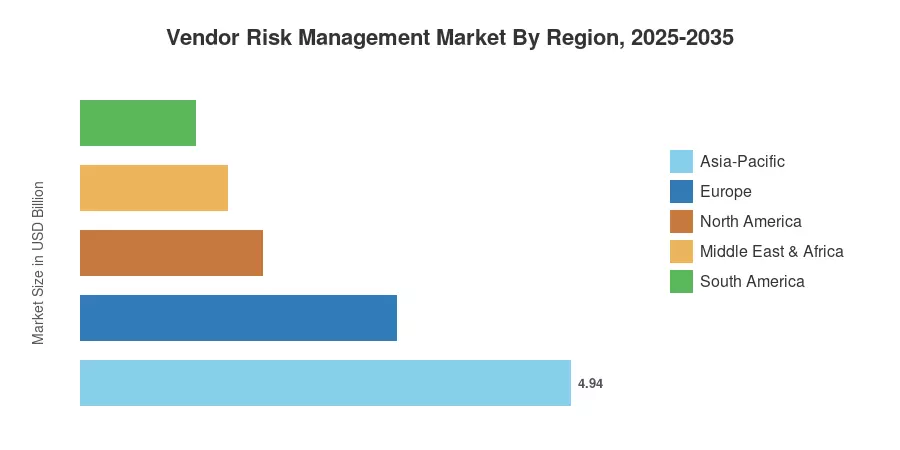
Asia-Pacific commands the largest share of the Vendor Risk Management Market at roughly 34%, driven by rapid digital banking expansion in India and China and mandatory data-localization rules across ASEAN economies. North America is the fastest-growing region, with a projected CAGR of 12.6%, propelled by federal zero-trust mandates and heightened supply-chain scrutiny following high-profile breaches. Europe holds approximately 22% of global value, anchored by DORA enforcement and NIS2 compliance timelines. As organizations worldwide deepen their reliance on cloud-hosted services and fourth-party subcontractors, the Vendor Risk Management Market is positioned for accelerated expansion through 2035.


Key Report Takeaways

• By Type

  • Solutions accounted for approximately 62% of global revenue in 2025, reflecting enterprise demand for integrated risk-scoring engines and automated onboarding workflows.
  • Services are expanding at a CAGR of 12.4% as managed-service and advisory offerings gain traction among mid-market buyers lacking in-house risk teams.

• By Deployment & Organization Size

  • Cloud deployment captured roughly USD 10.1 billion in 2025, supported by the Vendor Risk Management Market's migration toward SaaS-first architectures.
  • Large enterprises represent the dominant buyer segment, though small and medium-sized enterprises are closing the gap at a CAGR of 13.1%.

• By Region

  • Asia-Pacific leads the Vendor Risk Management Market with a 34% share, driven by mandatory cybersecurity frameworks in India, China, and Japan.
  • North America is forecast to grow at the highest CAGR (12.6%), fueled by federal procurement security requirements and CMMC rollout.


Market Size and Forecast (2021–2035)

Market Research Future's estimates combine top-down revenue analysis of leading platform vendors with bottom-up demand modeling across deployment types, organization sizes, and industry verticals. Historical figures (2021–2024) are derived from company filings and verified against third-party IT spending benchmarks [4]. Forecast projections (2026–2035) apply the calibrated 11.0% CAGR with adjustments for regulatory adoption curves and technology refresh cycles.
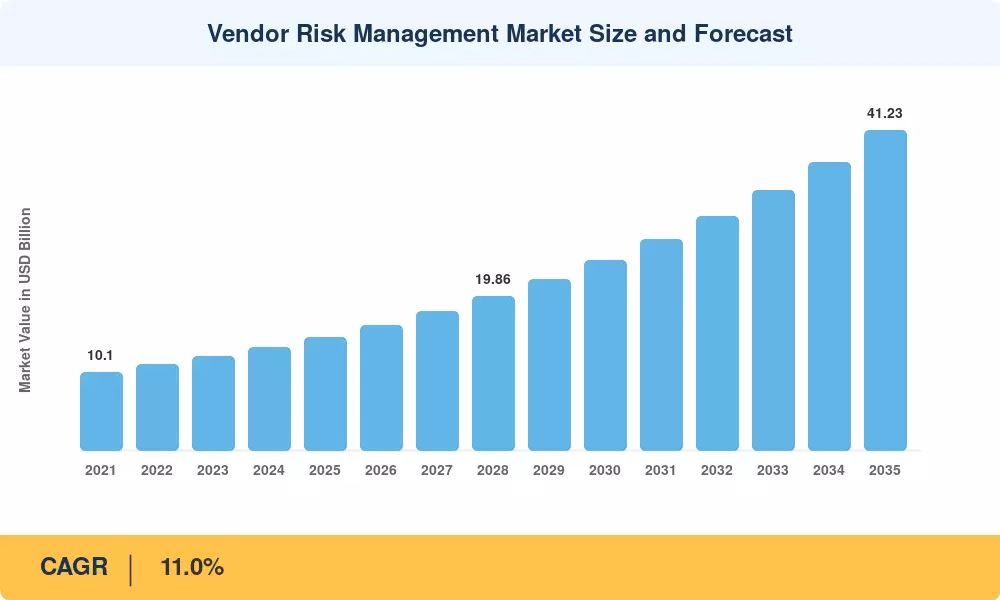
Vendor Risk Management Market Size and Forecast
Our Impact
Enabled $4.3B Revenue Impact for Fortune 500 and Leading Multinationals
Partnering with 2000+ Global Organizations Each Year
30K+ Citations by Top-Tier Firms in the Industry

Driver Impact Analysis

Driver ~% Impact on CAGR Geographic Relevance Impact Timeline
Regulatory mandates (DORA, NIS2, CMMC) 2.8 Global Short-term (≤2 yr)
Expansion of cloud and SaaS ecosystems 2.3 Global Medium-term (2–4 yr)
AI and machine-learning risk analytics 1.9 North America, Europe Medium-term (2–4 yr)
Rising frequency of supply-chain cyberattacks 1.5 Global Short-term (≤2 yr)
Fourth-party and Nth-party risk visibility 1.1 North America, APAC Long-term (≥4 yr)
ESG and sustainability due diligence 0.8 Europe, APAC Long-term (≥4 yr)
Digital transformation in BFSI and healthcare 0.6 APAC, MEA Medium-term (2–4 yr)


Regulatory Mandates Reshaping Procurement Risk

DORA, which entered full enforcement in January 2025, requires all EU financial entities to maintain continuous ICT risk oversight of critical vendors, with penalties reaching up to 1% of average daily global turnover [1]. In the United States, the Department of Defense's CMMC 2.0 framework mandates that over 220,000 defense contractors demonstrate verified cybersecurity controls across their subcontractor networks by 2026 [14]. These binding requirements create non-discretionary budget allocations for the Vendor Risk Management Market and compress sales cycles for platform providers.

Cloud Ecosystem Expansion

Organizations now average 130 SaaS applications per enterprise, up from 80 in 2020, according to Productiv's 2024 SaaS benchmark report [15]. Each application represents a potential data-exposure vector. The Vendor Risk Management Market benefits directly because cloud-service proliferation multiplies the number of vendors requiring onboarding, continuous monitoring, and offboarding controls.

AI-Driven Risk Scoring

Machine-learning models trained on breach-intelligence feeds, financial-health indicators, and dark-web mentions can compress traditional 45-day vendor assessments into near-real-time scores [10]. Platforms such as BitSight and SecurityScorecard have reported that AI-augmented scoring reduces false-positive rates by approximately 35%, freeing analyst capacity and accelerating the Vendor Risk Management Market's shift from periodic to continuous assurance.


Restraints Impact Analysis

Restraint ~% Impact on CAGR Geographic Relevance Impact Timeline
Integration complexity with legacy GRC stacks –1.2 Global Medium-term
Budget constraints in SMEs –0.9 APAC, South America Short-term
Data-privacy fragmentation across jurisdictions –0.7 Global Long-term
Vendor assessment fatigue and questionnaire overload –0.5 North America, Europe Short-term
Shortage of qualified GRC professionals –0.4 Global Medium-term


Integration Complexity with Legacy Systems

Many enterprises have disjointed GRC architectures that have grown organically over years of point solution buying. Indeed, a poll in 2024 revealed that 58% of risk teams regarded system integration as the major barrier to implementing a consolidated vendor-oversight platform [16]. This complexity extends the average deployment timeline from eight weeks for cloud-native buyers to more than 26 weeks for organizations with deeply entrenched on-premises ERP and procurement systems.


SME Budget Constraints

The average SME spends around USD 42,000 each year on vendor risk initiatives – around one-tenth what large organizations spend [17]. However, the vendor risk management market penetration depth is limited in price-sensitive segments. Many SMEs do not have dedicated risk personnel, which forces reliance on manual processes, despite the lower entry barriers provided by SaaS pricing models.


Vendor Risk Management Market Opportunities

AI-Powered Continuous Monitoring Platforms

The Vendor Risk Management Market offers a high-growth opportunity for platforms that consolidate external threat intelligence, financial-health signals, and operational-resilience indicators into a single, real-time dashboard. Succeeding early adopters are reporting a 40 percent reduction in mean-time-to-detect for vendor-related events, offering compelling ROI stories for procurement teams.


Emerging-Market Regulatory Catalysts

The increasing implementation of India’s DPDP Act (2023) and Brazil’s LGPD is prompting local companies to formalize the control of vendors for the first time [18]. The Vendor Risk Management Market will attract greenfield demand across these economies as regulators move from guidance-based to penalty-based enforcement models.


Fourth-Party Risk Visibility

Organizations increasingly recognize that their direct vendors rely on sub-contractors who introduce opaque risk exposures. Platforms offering automated Nth-party mapping—tracking data flows two and three tiers deep—address a capability gap that fewer than 15% of enterprises have solved today [8].

Risk-as-a-Service for Mid-Market Buyers

Managed-service models that bundle vendor assessment, remediation tracking, and regulatory reporting into subscription packages lower the expertise barrier for mid-market organizations, opening a segment worth an estimated USD 3.8 billion by 2030 within the Vendor Risk Management Market.

ESG and Sustainability Vendor Screening

The EU Corporate Sustainability Due Diligence Directive (CSDDD) requires large companies to evaluate environmental and human-rights practices across their value chains [12]. Vendors that embed ESG scoring modules alongside cybersecurity assessments can capture dual-mandate budgets and differentiate within the Vendor Risk Management Market.


Vendor Risk Management Market Future Outlook

AI-Native Risk Orchestration

By 2030, generative AI is expected to automate up to 60% of initial vendor risk assessments, according to Research [10]. The Vendor Risk Management Market will evolve from dashboard-centric platforms to autonomous orchestration engines that draft risk reports, trigger remediation workflows, and adjust risk scores without manual intervention.

Platform Convergence and Ecosystem Economics

Stand-alone vendor risk tools are consolidating into broader integrated risk management (IRM) suites. Projects that by 2028, 45% of enterprises will purchase vendor risk capabilities as embedded modules within ERP or procurement platforms rather than as independent products [3]. This convergence reshapes competitive dynamics across the Vendor Risk Management Market, favoring vendors with broad platform ecosystems.

Regulatory Harmonization and Cross-Border Reciprocity

International initiatives such as the G7 Cyber Expert Group's push for mutual-recognition frameworks could reduce duplicative compliance burdens by 2032 [22]. If realized, harmonized standards would lower assessment costs and accelerate the Vendor Risk Management Market's expansion in regions currently held back by jurisdictional fragmentation.

Climate and Operational Resilience Integration

As climate-related supply-chain disruptions intensify, vendor risk platforms will increasingly incorporate physical-risk and ESG-resilience scoring alongside cybersecurity metrics. The Task Force on Climate-related Financial Disclosures (TCFD) successor framework under the ISSB is expected to formalize vendor-level environmental risk reporting by 2029 [12], creating a new data layer within the Vendor Risk Management Market.


Vendor Risk Management Market Segmentation

By Type

Segment Key Metric Primary Demand Driver
Solutions ~62% share (2025) Demand for integrated risk platforms
Services CAGR 12.4% Managed-service and advisory adoption


Solutions dominate the Vendor Risk Management Market because enterprises increasingly prefer unified platforms that handle vendor onboarding, risk scoring, contract analysis, and remediation tracking in a single environment. Continuous-monitoring engines and API-driven integrations with procurement systems have raised switching costs, reinforcing platform stickiness. Services are growing faster as mid-market organizations outsource assessment operations to specialized providers rather than building internal teams, creating a robust managed-services segment within the Vendor Risk Management Market.

By Deployment Type

Segment Key Metric Primary Demand Driver
Cloud ~USD 10.1 B (2025) SaaS-first enterprise strategy
On-Premises ~30% share (2025) Regulated industries with data-sovereignty rules


Cloud deployment leads the Vendor Risk Management Market as organizations pursue faster implementation, automatic updates, and scalable multi-tenant architectures. On-premises deployments retain a meaningful share in government defense agencies and financial institutions subject to strict data-residency requirements, though hybrid models are eroding this segment's growth trajectory.

By Organization Size

Segment Key Metric Primary Demand Driver
Large Enterprises ~68% share (2025) Complex vendor ecosystems exceeding 500 partners
Small and Medium-Sized Enterprises CAGR 13.1% Affordable SaaS tiers and regulatory pressure


Large enterprises remain the primary revenue contributors to the Vendor Risk Management Market, managing vendor portfolios that often exceed 1,000 active relationships. SMEs represent the fastest-growing buyer segment as subscription pricing below USD 5,000 per month and pre-built compliance templates reduce adoption friction.

By Industry Vertical

Segment Key Metric Primary Demand Driver
Banking, Financial Services, and Insurance ~31% share (2025) DORA, SOX, OCC guidance
Telecom and IT CAGR 12.0% Cloud-vendor proliferation
Manufacturing ~USD 1.74 B (2025) Supply-chain digitization
Government CAGR 11.3% CMMC and zero-trust mandates
Healthcare ~9% share (2025) HIPAA business-associate agreements
Others ~USD 1.02 B (2025) Retail, energy, education


BFSI is the anchor vertical for the Vendor Risk Management Market, driven by layered regulatory obligations that mandate documented risk assessments for every outsourced function. Telecom and IT companies are the fastest-growing adopters as their vendor ecosystems expand with each new cloud service, API partner, and managed-security provider added to operational stacks.


Regional Market Share Analysis

Region Key Metric Primary Investment Themes
Asia-Pacific ~34% global share Data-localization mandates, digital banking expansion
North America CAGR 12.6% Zero-trust mandates, CMMC rollout
Europe ~22% global share DORA / NIS2 compliance, cross-border data governance
South America ~USD 1.16 B (2025) LGPD enforcement, fintech growth
Middle East & Africa CAGR 10.2% Smart-city initiatives, financial-sector modernization
Total USD 14.52 B (2025)

The Vendor Risk Management Market exhibits distinct regional adoption curves shaped by regulatory maturity, cloud penetration, and enterprise density.


North America

Country Key Metric Key Driver
US ~82% of regional share Federal zero-trust executive order, CMMC 2.0
Canada CAGR 11.8% OSFI B-10 guideline updates
Mexico ~USD 0.18 B (2025) Fintech regulation (Ley Fintech)


The US dominates the North American Vendor Risk Management Market, propelled by Executive Order 14028 on cybersecurity and SEC disclosure rules that compel publicly traded firms to demonstrate structured vendor oversight. Canada's Office of the Superintendent of Financial Institutions (OSFI) tightened its B-10 outsourcing guidelines in 2024, creating compliance-driven procurement cycles among the country's major banks [14].

Europe

Country Key Metric Key Driver
Germany ~24% of regional share BaFin DORA enforcement
UK CAGR 11.4% FCA operational resilience framework
France ~USD 0.48 B (2025) ANSSI critical-operator mandates
Italy CAGR 10.5% Banking digitization push
Spain ~7% of regional share Financial-sector modernization
Nordic Countries CAGR 10.8% Early-adopter cloud culture
Russia ~3% of regional share Import-substitution software mandates
Rest of Europe ~USD 0.29 B (2025) EU-wide NIS2 transposition


DORA's January 2025 enforcement deadline triggered a compliance wave across European financial institutions, directly benefiting the Vendor Risk Management Market. Germany and the UK account for the largest combined spend, with Germany's BaFin requiring quarterly ICT vendor risk reports and the UK's FCA mandating operational-resilience testing of critical outsourcing arrangements [7].

Asia-Pacific

Country Key Metric Key Driver
China ~28% of regional share PIPL enforcement, state-owned enterprise digitization
India CAGR 13.5% DPDP Act, UPI ecosystem vendor growth
Japan ~USD 0.91 B (2025) FISC guidelines, supply-chain security legislation
South Korea CAGR 11.9% PIPA amendments, semiconductor supply oversight
ASEAN ~14% of regional share Cross-border data frameworks
Rest of Asia-Pacific ~USD 0.38 B (2025) Emerging digital governance


Asia-Pacific's leadership in the Vendor Risk Management Market reflects the region's combination of aggressive data-protection legislation and massive third-party ecosystems supporting digital payments, e-commerce, and cloud infrastructure. India alone added over 15,000 regulated fintech entities between 2022 and 2024, each requiring structured risk assessments from banking partners [13].

South America

Country Key Metric Key Driver
Brazil ~61% of regional share LGPD enforcement, open-banking expansion
Argentina CAGR 10.3% Financial digitization
Rest of South America ~USD 0.22 B (2025) Emerging compliance frameworks


Brazil anchors the South American Vendor Risk Management Market as LGPD penalties and the country's open-banking mandate push financial institutions to automate vendor onboarding and ongoing monitoring. Argentine fintech growth adds incremental demand, though currency volatility tempers enterprise software investment cycles [18].

Middle East & Africa

Country Key Metric Key Driver
Saudi Arabia ~31% of regional share Vision 2030 digital government
UAE CAGR 11.6% DIFC/ADGM regulatory frameworks
South Africa ~USD 0.14 B (2025) POPIA enforcement
Egypt CAGR 9.8% Banking modernization
Rest of MEA ~22% of regional share Emerging digital-identity projects


Saudi Arabia and the UAE drive MEA demand within the Vendor Risk Management Market as sovereign wealth–funded digital transformation programs mandate structured vendor oversight across government IT procurement. South Africa's Protection of Personal Information Act (POPIA) enforcement has spurred adoption among financial-services firms seeking to demonstrate processor-level accountability [21].


Vendor Risk Management Market By Region, 2025-2035

Competitive Benchmarking

The Vendor Risk Management Market exhibits medium concentration, with the top five players holding an estimated 32–38% combined revenue share. The competitive field spans pure-play risk-intelligence firms, broad GRC platform vendors, and large enterprise software companies embedding vendor risk modules into wider suites. Merger-and-acquisition activity has intensified since 2023, with platform consolidation reshaping market positions [23].

Company Est. Revenue Share Range Key Offerings Strategic Positioning
BitSight Technologies ~6–9% Security ratings, continuous monitoring Data-driven risk intelligence leader
OneTrust ~5–8% GRC platform with VRM module Privacy-first integrated suite
Prevalent Inc. ~4–7% Vendor assessment network, managed services Assessment-as-a-service pioneer
ServiceNow ~4–6% VRM module within Now Platform Enterprise workflow integration
SAP Ariba ~3–6% Procurement-embedded risk scoring ERP ecosystem leverage
MetricStream ~3–5% Connected GRC, VRM module Broad GRC framework provider
ProcessUnity ~2–4% Third-party risk lifecycle platform Mid-market specialization
Venminder ~2–4% Managed assessments, risk intelligence SME-focused managed services
LogicGate ~2–3% Risk Cloud platform, VRM workflows No-code risk automation
Resolver (Kroll) ~2–3% Incident management, risk analytics Investigation-backed insights


Recent News & Developments

  • BitSight Technologies (March 2025): Launched fourth-party risk mapping module enabling automated sub-vendor discovery across supply chains [23].


  • ServiceNow (November 2024): Integrated generative-AI risk summarization into its VRM module, reducing assessment review time by 40% [10].


  • SAP Ariba (June 2024): Embedded continuous cyber-risk scores from SecurityScorecard directly into procurement workflows [15].


  • EU Commission (January 2024): Published DORA regulatory technical standards, setting a January 2025 enforcement deadline for ICT third-party risk oversight [1].


Vendor Risk Management Market Report Scope

Parameter Detail
Market Scope Global Vendor Risk Management Market by Type, Deployment, Organization Size, Industry Vertical, Geography
Study Period 2021–2035
CAGR (2026–2035) 11.0%
Market Size (2025) USD 14.52 Billion
Market Size (2035) USD 41.23 Billion
Fastest Growing Segments Services (by Type); SMEs (by Organization Size); North America (by Region)
Companies Profiled 10 (BitSight, OneTrust, Prevalent, ServiceNow, SAP Ariba, MetricStream, ProcessUnity, Venminder, LogicGate, Resolver)
Valuation Currency USD (Billion)


FAQs

How should procurement teams evaluate vendor risk platform ROI before purchase?
Measure reduction in assessment cycle time and incident-response costs against platform subscription fees. Most organizations achieve payback within 14 months by cutting manual assessment hours by 50–60% [16].
What differentiates continuous-monitoring platforms from traditional questionnaire-based tools?
Continuous-monitoring platforms ingest real-time external signals—breach feeds, financial filings, dark-web data—rather than relying on periodic self-reported questionnaires. This reduces detection lag from months to hours [10].
How does DORA affect vendor risk programs outside the EU?
Non-EU technology providers serving EU financial entities must comply with DORA's ICT concentration-risk and subcontracting disclosure requirements. This extends the regulation's operational reach globally [1].
What role does fourth-party risk mapping play in mature programs?
It identifies hidden dependencies where a direct vendor's sub-contractors create concentration or compliance exposure. Fewer than 15% of enterprises currently map beyond their direct vendor tier [8].
Are open-source risk-scoring models viable alternatives to commercial platforms?
Open-source frameworks like FAIR provide risk quantification methodology but lack integrated data feeds, automated workflows, and regulatory templates that commercial Vendor Risk Management Market platforms deliver at scale [19].
How do data-residency laws complicate global vendor risk programs?
Divergent localization rules across 40+ jurisdictions force multinational programs to maintain region-specific assessment criteria and data-handling clauses, increasing operational complexity [18].
What skills gaps most constrain enterprise adoption of vendor risk platforms?
The (ISC)² 2024 workforce study identified a 4.8-million-person global cybersecurity talent gap, with GRC analysts among the hardest roles to fill [20]. Managed-service models help bridge this shortfall.    
Author
Author
Author Profile
Nirmit Biswas LinkedIn
Senior Research Analyst
With 5+ years of expertise in Market Intelligence and Strategic Research, Nirmit Biswas specializes in ICT, Semiconductors, and BFSI. Backed by an MBA in Financial Services and a Computer Science foundation, Nirmit blends technical depth with business acumen. He has successfully led 100+ projects for global enterprises and startups, including Amazon, Cisco, L&T and Huawei, delivering market estimations, competitive benchmarking, and GTM strategies. His focus lies in transforming complex data into clear, actionable insights that drive growth, innovation, and investment decisions. Recognized for bridging engineering innovation with executive strategy, Nirmit helps businesses navigate dynamic markets with confidence.
Co-Author
Co-Author Profile
Aarti Dhapte LinkedIn
AVP - Research
A consulting professional focused on helping businesses navigate complex markets through structured research and strategic insights. I partner with clients to solve high-impact business problems across market entry strategy, competitive intelligence, and opportunity assessment. Over the course of my experience, I have led and contributed to 100+ market research and consulting engagements, delivering insights across multiple industries and geographies, and supporting strategic decisions linked to $500M+ market opportunities. My core expertise lies in building robust market sizing, forecasting, and commercial models (top-down and bottom-up), alongside deep-dive competitive and industry analysis. I have played a key role in shaping go-to-market strategies, investment cases, and growth roadmaps, enabling clients to make confident, data-backed decisions in dynamic markets.

Research Approach


Secondary Research

The secondary research process involved comprehensive analysis of regulatory databases, cybersecurity frameworks, compliance publications, and authoritative IT security organizations. Key sources included the National Institute of Standards and Technology (NIST), Cybersecurity and Infrastructure Security Agency (CISA), International Organization for Standardization (ISO 27001, ISO 31000), Information Systems Audit and Control Association (ISACA), European Union Agency for Cybersecurity (ENISA), European Banking Authority (EBA), Financial Industry Regulatory Authority (FINRA), Office of the Comptroller of the Currency (OCC), Federal Financial Institutions Examination Council (FFIEC), Securities and Exchange Commission (SEC) EDGAR Database, General Data Protection Regulation (GDPR) Enforcement Tracker, California Consumer Privacy Act (CCPA) Enforcement Reports, U.S. Department of Health and Human Services (HHS) Breach Portal, UK Information Commissioner's Office (ICO), Australian Cyber Security Centre (ACSC), and national cybersecurity agency reports from key markets.

The following sources were employed to compile regulatory enforcement statistics, compliance framework adoption rates, third-party data breach incidents, vendor risk assessment standards, and market landscape analysis for assessment management, quality management, and contract management solutions across cloud and on-premise deployments.


Primary Research

Qualitative and quantitative insights were obtained by interviewing supply-side and demand-side stakeholders during the primary research process. The supply-side sources consisted of CEOs, Chief Technology Officers (CTOs), Chief Information Security Officers (CISOs), VPs of Product Development, and Chief Risk Officers from vendor risk management software providers, cybersecurity firms, and enterprise risk management solution vendors. Demand-side sources included CISOs, Chief Risk Officers (CROs), Chief Information Officers (CIOs), Vice Presidents of Procurement, compliance directors, and third-party risk management leads from financial services institutions (banks, insurance, asset management), healthcare systems, manufacturing enterprises, and retail organizations. Primary research verified market segmentation by solution type and deployment mode, verified product pipeline timelines, and collected insights on enterprise adoption patterns, SaaS vs. on-premise migration trends, regulatory compliance expenditure, and cyber risk quantification methodologies.

Primary Respondent Breakdown:

By Designation: C-level Primaries (40%), Director Level (30%), Others (30%)

By Region: North America (38%), Europe (25%), Asia-Pacific (28%), Rest of World (9%)


Market Size Estimation

Revenue mapping and enterprise adoption analysis were employed to determine the global market valuation. The methodology comprised the following:

Identification of over 50 significant VRM solution providers and consultancies in North America, Europe, Asia-Pacific, and Latin America

Product mapping encompasses professional/managed services, contract management solutions, quality management, and assessment management.

Examination of annual revenues that are reported and modeled with respect to vendor risk management software portfolios and the corresponding implementation services

Provider coverage that accounts for 75-80% of the global market share in 2024

For cloud-based and on-premise deployments, segment-specific valuations are derived through extrapolation using bottom-up (enterprise license volumes × ARR by deployment type and organization size) and top-down (vendor revenue validation against total addressable market calculations) approach.

Download Free Sample

Kindly complete the form below to receive a free sample of this Report

Download PDF ×

We do not share your information with anyone. However, we may send you emails based on your report interest from time to time. You may contact us at any time to opt-out.