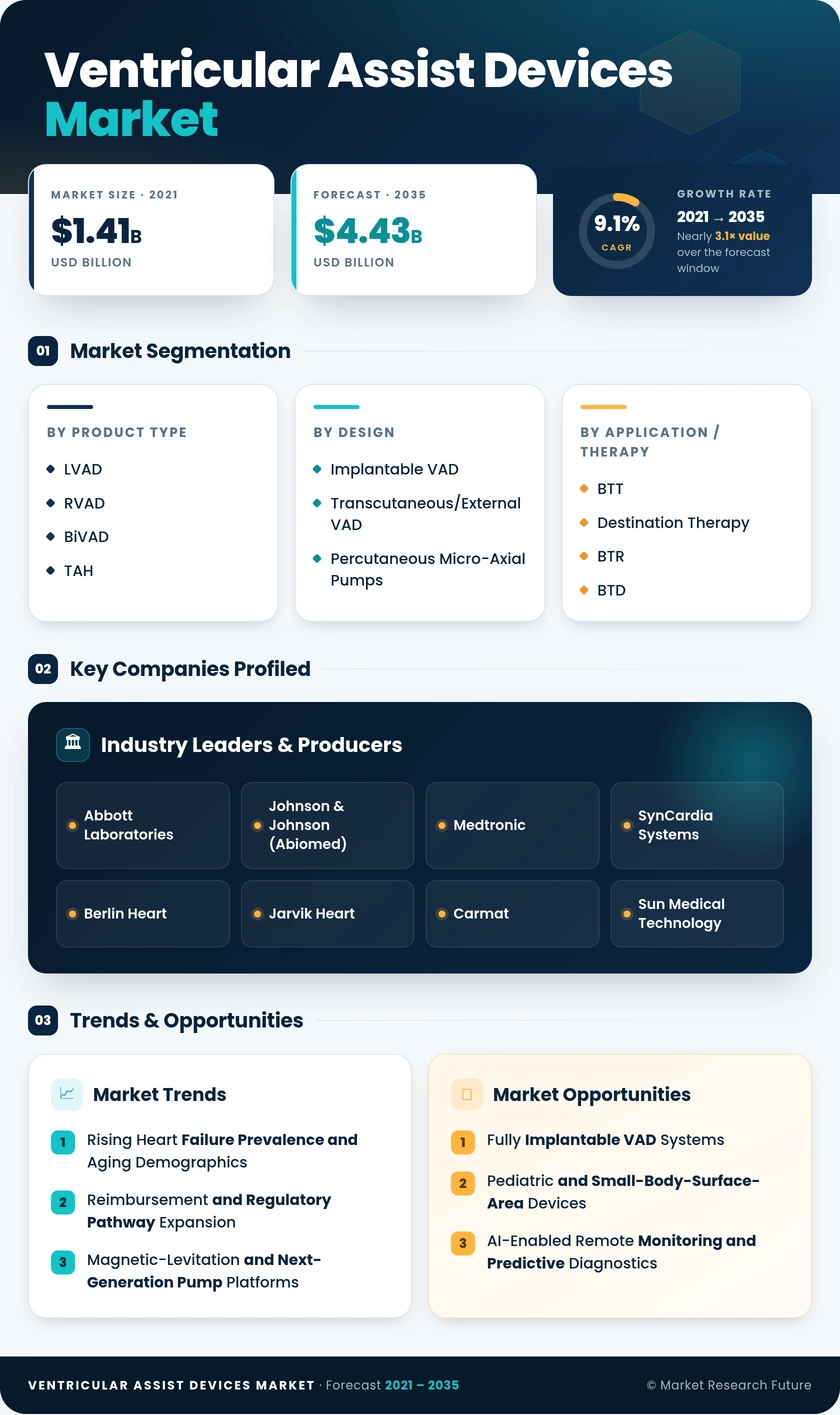
Ventricular Assist Devices Market (2025 - 2035)

ID: MRFR/HC/8299-HCR
120 Pages
Vikita Thakur
Last Updated: July 22, 2026
Ventricular Assist Devices Market Research Report Information By Product Type (Left Ventricular Assist Device, Right Ventricular Assist Device, Biventricular Assist Device), By Type of Flow (Continuous Flow, Pulsatile Flow), By Design (Implantable Ventricular Assist Device, Transcutaneous Ventricular Assist Device) and By Application (Destination Therapy, Bridging Therapy) – Forecast to 2035
Ventricular Assist Devices Market
Market Size
Forecast Period2025-2035
CAGR (2025-2035)9.1%
2025 Market SizeUSD 1.85 Billion
2035 Market SizeUSD 4.43 Billion
Key Players
Abbott Laboratories
Johnson & Johnson
Medtronic
SynCardia Systems
Berlin Heart
Jarvik Heart
Opportunities
  • Fully Implantable VAD Systems
  • Pediatric and Small-Body-Surface-Area Devices
  • AI-Enabled Remote Monitoring and Predictive Diagnostics
  1. 1 Market Overview |
    1. 1.1 Study Assumptions & Market Definition |
    2. 1.2 Scope of the Study |
    3. 1.3 Research Methodology
  2. 2 Market Summary & Key Takeaways
  3. 3 Market Dynamics |
    1. 3.1 Market Drivers Analysis | |
      1. 3.1.1 Rising Advanced Heart Failure Prevalence | |
      2. 3.1.2 Reimbursement and Regulatory Pathway Expansion | |
      3. 3.1.3 Magnetic-Levitation Pump Adoption | |
      4. 3.1.4 Wireless Transcutaneous Energy Transfer | |
      5. 3.1.5 Aging Global Population Demographics | |
      6. 3.1.6 Registry-Driven Evidence Expansion (INTERMACS) | |
      7. 3.1.7 Miniaturization Enabling Pediatric Applications |
    2. 3.2 Market Restraints Analysis | |
      1. 3.2.1 High Device and Procedural Costs | |
      2. 3.2.2 Post-Implant Adverse Events and Complications | |
      3. 3.2.3 Limited Implanting-Center Infrastructure | |
      4. 3.2.4 Shortage of Trained Cardiac Surgeons | |
      5. 3.2.5 Regulatory Approval Timelines for New Devices |
    3. 3.3 Market Opportunity Analysis | |
      1. 3.3.1 Fully Implantable VAD Systems | |
      2. 3.3.2 Pediatric and Small-Body-Surface-Area Devices | |
      3. 3.3.3 AI-Enabled Remote Monitoring and Predictive Diagnostics | |
      4. 3.3.4 Emerging-Market Public-Private Partnership Models | |
      5. 3.3.5 Data Monetization Through Real-World Evidence Platforms |
    4. 3.4 Industry Value Chain Analysis |
    5. 3.5 Porter's Five Forces Analysis
  4. 4 Global Ventricular Assist Devices Market Size & Forecast (2021–2035) |
    1. 4.1 Historical Market Size (2021–2025) |
    2. 4.2 Current & Forecast Market Size (2026–2035) |
    3. 4.3 Market Size by Revenue (USD Billion) |
    4. 4.4 Year-over-Year Growth Analysis
  5. 5 Segmentation Analysis |
    1. 5.1 By Product Type | |
      1. 5.1.1 Left Ventricular Assist Device (LVAD) | |
      2. 5.1.2 Right Ventricular Assist Device (RVAD) | |
      3. 5.1.3 Biventricular Assist Device (BiVAD) | |
      4. 5.1.4 Total Artificial Heart (TAH) |
    2. 5.2 By Design | |
      1. 5.2.1 Implantable VAD | |
      2. 5.2.2 Transcutaneous/External VAD | |
      3. 5.2.3 Percutaneous Micro-Axial Pumps |
    3. 5.3 By Application / Therapy | |
      1. 5.3.1 Bridge-to-Transplant (BTT) | |
      2. 5.3.2 Destination Therapy (DT) | |
      3. 5.3.3 Bridge-to-Recovery (BTR) | |
      4. 5.3.4 Bridge-to-Decision (BTD)
  6. 6 Regional Analysis |
    1. 6.1 North America | |
      1. 6.1.1 United States | |
      2. 6.1.2 Canada | |
      3. 6.1.3 Mexico |
    2. 6.2 Europe | |
      1. 6.2.1 Germany | |
      2. 6.2.2 United Kingdom | |
      3. 6.2.3 France | |
      4. 6.2.4 Italy | |
      5. 6.2.5 Spain | |
      6. 6.2.6 Nordic Countries | |
      7. 6.2.7 Russia | |
      8. 6.2.8 Rest of Europe |
    3. 6.3 Asia-Pacific | |
      1. 6.3.1 China | |
      2. 6.3.2 India | |
      3. 6.3.3 Japan | |
      4. 6.3.4 South Korea | |
      5. 6.3.5 ASEAN | |
      6. 6.3.6 Rest of Asia-Pacific |
    4. 6.4 South America | |
      1. 6.4.1 Brazil | |
      2. 6.4.2 Argentina | |
      3. 6.4.3 Rest of South America |
    5. 6.5 Middle East & Africa | |
      1. 6.5.1 Saudi Arabia | |
      2. 6.5.2 UAE | |
      3. 6.5.3 South Africa | |
      4. 6.5.4 Egypt | |
      5. 6.5.5 Rest of MEA
  7. 7 Competitive Landscape |
    1. 7.1 Market Share Analysis (2025) |
    2. 7.2 Competitive Benchmarking Matrix |
    3. 7.3 Company Profiles | |
      1. 7.3.1 Abbott Laboratories | |
      2. 7.3.2 Johnson & Johnson (Abiomed) | |
      3. 7.3.3 Medtronic | |
      4. 7.3.4 SynCardia Systems | |
      5. 7.3.5 Berlin Heart | |
      6. 7.3.6 Jarvik Heart | |
      7. 7.3.7 Carmat | |
      8. 7.3.8 Sun Medical Technology | |
      9. 7.3.9 CorWave | |
      10. 7.3.10 ReliantHeart
  8. 8 Future Outlook & Strategic Recommendations (2026–2035) |
    1. 8.1 Fully Implantable Platforms and the End of the Driveline Era |
    2. 8.2 AI-Driven Patient Management and Autonomous Device Control |
    3. 8.3 Biocompatible Surface Engineering and Hemocompatibility Advances |
    4. 8.4 Value-Based Contracting and Outcomes-Linked Reimbursement
  9. 9 Recent Developments & News
  10. 10 Frequently Asked Questions (FAQs)
  11. 11 Report Scope & Methodology |
    1. 11.1 Study Period & Base Year |
    2. 11.2 Data Sources & Citations |
    3. 11.3 Abbreviations
  12. 12 LIST OF TABLES |
  13. TABLE 1 Global Ventricular Assist Devices Market Size & Forecast, by Revenue (USD Billion), 2021–2035 |
  14. TABLE 2 Global Ventricular Assist Devices Market — Year-over-Year Growth Analysis, 2021–2035 |
  15. TABLE 3 Global Ventricular Assist Devices Market — Driver Impact Analysis |
  16. TABLE 4 Global Ventricular Assist Devices Market — Restraint Impact Analysis |
  17. TABLE 5 Global Ventricular Assist Devices Market Size, by Product Type, 2021–2035 (USD Billion) |
  18. TABLE 6 Global Ventricular Assist Devices Market Size, by Design, 2021–2035 (USD Billion) |
  19. TABLE 7 Global Ventricular Assist Devices Market Size, by Application/Therapy, 2021–2035 (USD Billion) |
  20. TABLE 8 Global Ventricular Assist Devices Market Size, by Region, 2021–2035 (USD Billion) |
  21. TABLE 9 North America Ventricular Assist Devices Market Size, by Country, 2021–2035 (USD Billion) |
  22. TABLE 10 Europe Ventricular Assist Devices Market Size, by Country, 2021–2035 (USD Billion) |
  23. TABLE 11 Asia-Pacific Ventricular Assist Devices Market Size, by Country, 2021–2035 (USD Billion) |
  24. TABLE 12 South America Ventricular Assist Devices Market Size, by Country, 2021–2035 (USD Billion) |
  25. TABLE 13 Middle East & Africa Ventricular Assist Devices Market Size, by Country, 2021–2035 (USD Billion) |
  26. TABLE 14 Competitive Benchmarking Matrix — Global Ventricular Assist Devices Market, 2025 |
  27. TABLE 15 Company Profiles — Key Players, Global Ventricular Assist Devices Market |
  28. TABLE 16 Recent Developments & Strategic Announcements, 2023–2025 |
  29. TABLE 17 North America Ventricular Assist Devices Market Size, by Product Type, 2021–2035 (USD Billion) |
  30. TABLE 18 North America Ventricular Assist Devices Market Size, by Design, 2021–2035 (USD Billion) |
  31. TABLE 19 North America Ventricular Assist Devices Market Size, by Application/Therapy, 2021–2035 (USD Billion) |
  32. TABLE 20 Europe Ventricular Assist Devices Market Size, by Product Type, 2021–2035 (USD Billion) |
  33. TABLE 21 Europe Ventricular Assist Devices Market Size, by Design, 2021–2035 (USD Billion) |
  34. TABLE 22 Europe Ventricular Assist Devices Market Size, by Application/Therapy, 2021–2035 (USD Billion) |
  35. TABLE 23 Asia-Pacific Ventricular Assist Devices Market Size, by Product Type, 2021–2035 (USD Billion) |
  36. TABLE 24 Asia-Pacific Ventricular Assist Devices Market Size, by Design, 2021–2035 (USD Billion) |
  37. TABLE 25 Asia-Pacific Ventricular Assist Devices Market Size, by Application/Therapy, 2021–2035 (USD Billion) |
  38. TABLE 26 South America Ventricular Assist Devices Market Size, by Product Type, 2021–2035 (USD Billion) |
  39. TABLE 27 South America Ventricular Assist Devices Market Size, by Design, 2021–2035 (USD Billion) |
  40. TABLE 28 South America Ventricular Assist Devices Market Size, by Application/Therapy, 2021–2035 (USD Billion) |
  41. TABLE 29 Middle East & Africa Ventricular Assist Devices Market Size, by Product Type, 2021–2035 (USD Billion) |
  42. TABLE 30 Middle East & Africa Ventricular Assist Devices Market Size, by Design, 2021–2035 (USD Billion) |
  43. TABLE 31 Middle East & Africa Ventricular Assist Devices Market Size, by Application/Therapy, 2021–2035 (USD Billion) |
  44. TABLE 32 Report Scope & Methodology Summary |
  45. TABLE 33 Detailed Sources and Citations
  46. 13 LIST OF FIGURES |
  47. FIGURE 1 Ventricular Assist Devices Market Dynamics — Drivers, Restraints, Opportunities |
  48. FIGURE 2 Industry Value Chain Analysis — Ventricular Assist Devices Market |
  49. FIGURE 3 Porter's Five Forces Analysis — Ventricular Assist Devices Market |
  50. FIGURE 4 Global Ventricular Assist Devices Market Size Trend (USD Billion), 2021–2035 |
  51. FIGURE 5 Global Ventricular Assist Devices Market Share, by Product Type (2025) |
  52. FIGURE 6 Global Ventricular Assist Devices Market Share, by Design (2025) |
  53. FIGURE 7 Global Ventricular Assist Devices Market Share, by Application/Therapy (2025) |
  54. FIGURE 8 Global Ventricular Assist Devices Market Share, by Region (2025) |
  55. FIGURE 9 North America Ventricular Assist Devices Market Share, by Country (2025) |
  56. FIGURE 10 Europe Ventricular Assist Devices Market Share, by Country (2025) |
  57. FIGURE 11 Asia-Pacific Ventricular Assist Devices Market Share, by Country (2025) |
  58. FIGURE 12 South America Ventricular Assist Devices Market Share, by Country (2025) |
  59. FIGURE 13 Middle East & Africa Ventricular Assist Devices Market Share, by Country (2025) |
  60. FIGURE 14 Competitive Landscape — Market Share Analysis (2025)

Segmentation Quick Reference

DimensionSub-SegmentsDominant SegmentFastest Growing Segment
Product TypeLVAD, RVAD, BiVAD, TAHLVAD (67.5% share, 2025)RVAD (7.8% CAGR)
DesignImplantable VAD, Transcutaneous/External VAD, Percutaneous Micro-Axial PumpsImplantable VAD (85.7% share, 2025)Percutaneous Micro-Axial Pumps (12.7% CAGR)
Application / TherapyBTT, Destination Therapy, BTR, BTDBTT (52.4% share, 2025)Destination Therapy (12.1% CAGR)
GeographyNorth America, Europe, Asia-Pacific, South America, MEANorth America (45.0% share, 2025)Asia-Pacific (11.2% CAGR)


Market Segmentation Overview

By Product Type

Sub-SegmentKey Trend
Left Ventricular Assist Device (LVAD)MagLev centrifugal-flow platforms replacing axial-flow predecessors
Right Ventricular Assist Device (RVAD)Increasing recognition of RV failure as a predictor of poor LVAD outcomes
Biventricular Assist Device (BiVAD)Deployed in complex end-stage patients; small but stable demand
Total Artificial Heart (TAH)Bioprosthetic TAH designs (Carmat Aeson) entering European commercial use


LVADs represent the clinical workhorse of the market, with continuous-flow MagLev devices now the standard implant across major centers. Growth in the RVAD and BiVAD segments reflects evolving surgical philosophies that emphasize proactive biventricular support rather than reactive rescue.

By Design

Sub-SegmentKey Trend
Implantable VADTransition toward fully sealed designs eliminating percutaneous driveline
Transcutaneous/External VADConfined to short-duration acute support and post-cardiotomy applications
Percutaneous Micro-Axial PumpsRapid expansion in catheterization-lab settings for cardiogenic shock


Implantable platforms dominate due to their ability to support ambulatory patient discharge. Percutaneous micro-axial pumps are the fastest-growing design category as interventional cardiologists adopt them for acute hemodynamic stabilization without open surgery.

By Application / Therapy

Sub-SegmentKey Trend
Bridge-to-Transplant (BTT)Largest therapy segment; driven by chronic donor organ scarcity
Destination Therapy (DT)Fastest-growing therapy; improving five-year survival data support permanent implantation
Bridge-to-Recovery (BTR)Niche applications in reversible cardiomyopathies
Bridge-to-Decision (BTD)Growing use in undifferentiated cardiogenic shock for patient stabilization


BTT remains the primary indication, but Destination Therapy is closing the gap as long-term clinical evidence matures and payer frameworks expand to cover permanent mechanical support for transplant-ineligible patients.


 

Download PDF ×

We do not share your information with anyone. However, we may send you emails based on your report interest from time to time. You may contact us at any time to opt-out.