×
Request Free Sample ×

Kindly complete the form below to receive a free sample of this Report

* Please use a valid business email

Leading companies partner with us for data-driven Insights

clients tt-cursor
Hero Background

Veterinary Monitoring Equipment Market

ID: MRFR/HC/40597-HCR
200 Pages
Rahul Gotadki
October 2025

Veterinary Monitoring Equipment Market Research Report By Type (Vital Signs Monitoring Devices, Anesthesia Monitoring Devices, Diagnostic Equipment, Telemedicine Equipment), By Animal Type (Large Animals, Small Animals, Exotic Animals), By End User (Veterinary Hospitals, Veterinary Clinics, Research Laboratories, Home Care), By Technology (Analog Technology, Digital Technology) and By Regional (North America, Europe, South America, Asia Pacific, Middle East and Africa)- Forecast to 2035

Share:
Download PDF ×

We do not share your information with anyone. However, we may send you emails based on your report interest from time to time. You may contact us at any time to opt-out.

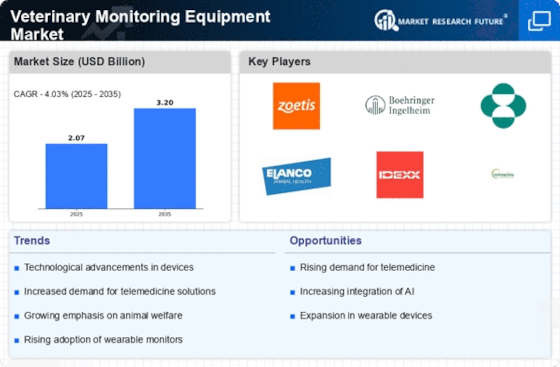
Veterinary Monitoring Equipment Market Infographic
Purchase Options

Veterinary Monitoring Equipment Market Summary

As per MRFR analysis, the Veterinary Monitoring Equipment Market Size was estimated at 2.07 USD Billion in 2024. The Veterinary Monitoring Equipment industry is projected to grow from 2.154 USD Billion in 2025 to 3.197 USD Billion by 2035, exhibiting a compound annual growth rate (CAGR) of 4.03 during the forecast period 2025 - 2035.

Key Market Trends & Highlights

The Veterinary Monitoring Equipment Market is experiencing robust growth driven by technological advancements and an increasing focus on preventive care.

  • North America remains the largest market for veterinary monitoring equipment, driven by high pet ownership rates and advanced healthcare practices.
  • The Asia-Pacific region is emerging as the fastest-growing market, fueled by rising disposable incomes and a growing awareness of pet health.
  • Vital signs monitoring devices dominate the market, while anesthesia monitoring devices are witnessing the fastest growth due to advancements in technology.
  • Key market drivers include technological advancements in veterinary monitoring equipment and an increased focus on preventive care, reflecting changing consumer preferences.

Market Size & Forecast

2024 Market Size 2.07 (USD Billion)
2035 Market Size 3.197 (USD Billion)
CAGR (2025 - 2035) 4.03%

Major Players

Zoetis (US), Boehringer Ingelheim (DE), Merck Animal Health (US), Elanco Animal Health (US), IDEXX Laboratories (US), NexGen Veterinary Solutions (US), Vetoquinol (FR), Vetronic Services (GB), DRE Veterinary (US)

Veterinary Monitoring Equipment Market Trends

The Veterinary Monitoring Equipment Market is currently experiencing a notable evolution, driven by advancements in technology and an increasing emphasis on animal health. The integration of sophisticated monitoring systems into veterinary practices appears to enhance the quality of care provided to animals. This trend is likely influenced by a growing awareness among pet owners regarding the importance of regular health assessments and the role of technology in facilitating timely interventions. Furthermore, the rise in pet ownership and the corresponding demand for veterinary services may contribute to the expansion of this market. As veterinary professionals seek to adopt innovative solutions, the market is poised for continued growth. In addition, the Veterinary Monitoring Equipment Market seems to be benefiting from the increasing prevalence of chronic diseases in animals, which necessitates ongoing monitoring and management. This situation may lead to a greater reliance on advanced monitoring devices that can provide real-time data and insights into an animal's health status. Moreover, the potential for telemedicine in veterinary care could further transform the landscape, allowing for remote monitoring and consultations. Overall, the Veterinary Monitoring Equipment Market is likely to evolve in response to these trends, reflecting the changing dynamics of animal healthcare and the integration of technology into veterinary practices.

Technological Advancements

The Veterinary Monitoring Equipment Market is witnessing a surge in technological innovations, including the development of wearable devices and remote monitoring systems. These advancements enable veterinarians to track vital signs and health metrics in real-time, enhancing the ability to respond to medical needs promptly.

Increased Focus on Preventive Care

There is a growing emphasis on preventive healthcare in the Veterinary Monitoring Equipment Market. Pet owners are becoming more proactive in seeking regular health check-ups and monitoring solutions, which may lead to improved outcomes and reduced healthcare costs for animals.

Rise of Telemedicine

The emergence of telemedicine in veterinary practices is reshaping the Veterinary Monitoring Equipment Market. This trend allows for remote consultations and monitoring, making veterinary care more accessible and convenient for pet owners, while also expanding the reach of veterinary services.

Veterinary Monitoring Equipment Market Drivers

Regulatory Support and Standards

The Veterinary Monitoring Equipment Market is bolstered by increasing regulatory support and the establishment of standards for veterinary practices. Governments and regulatory bodies are recognizing the importance of animal health and are implementing guidelines that promote the use of advanced monitoring equipment. This regulatory framework not only ensures the safety and efficacy of veterinary products but also encourages innovation within the industry. As compliance with these standards becomes essential, manufacturers are likely to invest in research and development to meet regulatory requirements. Market projections indicate that this supportive environment could lead to a growth rate of approximately 9% in the Veterinary Monitoring Equipment Market. The establishment of clear standards is expected to enhance consumer confidence and drive the adoption of advanced monitoring technologies.

Growing Pet Ownership and Spending

The Veterinary Monitoring Equipment Market is significantly impacted by the growing trend of pet ownership and the corresponding increase in spending on pet healthcare. As more households adopt pets, there is a heightened demand for veterinary services and monitoring equipment. Market data indicates that pet owners are willing to invest in advanced monitoring solutions to ensure the health and well-being of their animals. This trend is particularly evident in urban areas, where pet ownership rates have surged. The Veterinary Monitoring Equipment Market is projected to benefit from this increase in spending, with estimates suggesting a growth trajectory that could reach 12% annually. This rise in pet ownership and expenditure underscores the importance of veterinary monitoring equipment in maintaining the health of pets.

Increased Focus on Preventive Care

The Veterinary Monitoring Equipment Market is witnessing a paradigm shift towards preventive care, driven by a growing awareness of animal health and wellness. Pet owners are increasingly seeking regular health check-ups and monitoring solutions to preemptively address potential health issues. This trend is reflected in the rising demand for veterinary monitoring equipment that enables continuous health assessments, such as heart rate monitors and blood pressure devices. The market data indicates that preventive care services are expected to account for a substantial portion of veterinary expenditures, with estimates suggesting a growth rate of approximately 10% annually. This focus on preventive care not only enhances the quality of life for pets but also reduces long-term healthcare costs, thereby propelling the Veterinary Monitoring Equipment Market forward.

Rise of Telemedicine in Veterinary Care

The Veterinary Monitoring Equipment Market is increasingly influenced by the rise of telemedicine, which has transformed how veterinary care is delivered. Telemedicine allows veterinarians to monitor patients remotely, providing convenience for pet owners and improving access to care. This trend has led to the development of specialized monitoring equipment that can transmit vital health data in real-time, enabling veterinarians to make informed decisions without the need for in-person visits. Market analysis suggests that the telemedicine segment within the Veterinary Monitoring Equipment Market is expected to grow at a rate of 15% annually, reflecting the increasing acceptance of remote consultations and monitoring. This shift not only enhances the efficiency of veterinary practices but also aligns with the modern pet owner's preference for accessible and flexible healthcare solutions.

Technological Advancements in Veterinary Monitoring Equipment

The Veterinary Monitoring Equipment Market is experiencing a surge in technological advancements that enhance diagnostic capabilities and patient care. Innovations such as real-time monitoring systems, advanced imaging technologies, and portable diagnostic devices are becoming increasingly prevalent. These advancements not only improve the accuracy of diagnoses but also facilitate timely interventions, which are crucial in veterinary medicine. The integration of artificial intelligence and machine learning into monitoring equipment is also noteworthy, as it allows for predictive analytics that can foresee potential health issues in animals. As a result, the Veterinary Monitoring Equipment Market is projected to grow significantly, with estimates suggesting a compound annual growth rate of over 8% in the coming years. This growth is indicative of the industry's response to the evolving needs of veterinary professionals and pet owners alike.


Market Segment Insights

By Type: Vital Signs Monitoring Devices (Largest) vs. Anesthesia Monitoring Devices (Fastest-Growing)

The Veterinary Monitoring Equipment Market is characterized by a diverse range of devices, of which Vital Signs Monitoring Devices hold the largest market share. These devices are essential for continuous assessment and management of critical animal health parameters, ensuring timely interventions. In contrast, Anesthesia Monitoring Devices are emerging as the fastest-growing segment, fueled by the increasing demand for surgical procedures and the need for enhanced safety and efficacy during anesthesia. As veterinary practices adopt more advanced technology, the market share dynamics are evolving.

Vital Signs Monitoring Devices (Dominant) vs. Diagnostic Equipment (Emerging)

Vital Signs Monitoring Devices are crucial for monitoring essential physiological parameters in various animal species, thereby playing a supporting role in acute and chronic health management. They ensure quick responses to critical changes and are considered a staple in veterinary clinics and hospitals. On the other hand, Diagnostic Equipment is emerging with innovative features like point-of-care testing and rapid results, catering to the growing need for immediate diagnosis. As animal care becomes more sophisticated, tools like portable diagnostic devices are gaining traction, enhancing veterinary capabilities and meeting client demands for expedited health assessments.

By Animal Type: Large Animals (Largest) vs. Small Animals (Fastest-Growing)

In the Veterinary Monitoring Equipment Market, the distribution of market share among animal types is notably skewed towards large animals, which account for a significant portion of the market due to their higher monitoring needs in farm and production settings. Small animals also form a considerable segment, driven primarily by the increasing pet ownership and demand for home veterinary services. Exotic animals, while a niche market, comprise a smaller proportion and are often catered to by specialized veterinary clinics.

Large Animals (Dominant) vs. Small Animals (Emerging)

Large animals, primarily horses, cattle, and other livestock, represent the dominant segment in the Veterinary Monitoring Equipment Market. Their care often necessitates advanced monitoring systems due to their size and the economic importance in agricultural settings. Conversely, small animals, mainly pets like cats and dogs, are an emerging segment driven by the surge in pet ownership and a growing trend towards personalized care. This segment is experiencing rapid growth as veterinary practices enhance their capabilities to cater to both preventive health monitoring and advanced diagnostics, ultimately fostering innovation in equipment targeted for these smaller patients.

By End User: Veterinary Hospitals (Largest) vs. Veterinary Clinics (Fastest-Growing)

The veterinary monitoring equipment market exhibits a diverse array of end users, with veterinary hospitals leading the sector significantly due to their comprehensive service offerings and need for advanced monitoring solutions. This segment is characterized by a high adoption rate of technology, as these facilities prioritize patient care and surgical outcomes, translating to a larger market presence. Veterinary clinics also showcase substantial growth, primarily driven by the rising awareness of animal health and wellness. As pet ownership increases globally, clinics are investing more in advanced monitoring technologies to provide better services, thereby expanding their market share within the veterinary sector.

Veterinary Hospitals (Dominant) vs. Research Laboratories (Emerging)

Veterinary hospitals play a dominant role in the veterinary monitoring equipment market, owing to their extensive facilities that cater to a wide variety of animal health needs, including surgeries and critical care. Their reliance on advanced monitoring equipment ensures rapid response to fluctuating animal health conditions, making them leaders in equipment adoption. Research laboratories, although emerging, are gaining traction due to a growing emphasis on veterinary research, drug development, and the need for precise monitoring in studies. These labs are increasingly adopting sophisticated monitoring tools to support their research objectives, carving out a niche within the market that prioritizes innovation and highly specialized equipment.

By Technology: Digital Technology (Largest) vs. Analog Technology (Fastest-Growing)

The Veterinary Monitoring Equipment Market is currently dominated by digital technology, which holds the largest share among the various technological segments. Digital technologies, including advanced monitoring systems and data analytics tools, have become prevalent due to their ability to offer precise and real-time data, which improves patient outcomes and operational efficiency. Analog technology while still relevant in certain applications, has gradually taken a backseat, contributing less to overall market share. However, it retains a niche market where its simplicity and reliability are preferred.

Technology: Digital (Dominant) vs. Analog (Emerging)

Digital technology in the Veterinary Monitoring Equipment Market is recognized as the dominant force, characterized by its sophisticated features, real-time data accuracy, and seamless integration with other digital systems. It includes tools such as digital thermometers, pulse oximeters, and electronic stethoscopes. Conversely, analog technology is seen as an emerging option, valued for its straightforwardness and reliability, particularly among smaller veterinary practices and in certain traditional applications. As veterinary professionals increasingly seek cost-effective solutions, analog devices are witnessing a slow resurgence, complementing the comprehensive capabilities of digital equipment.

Get more detailed insights about Veterinary Monitoring Equipment Market

Regional Insights

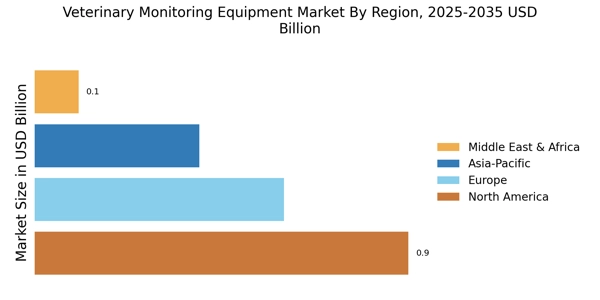
The Veterinary Monitoring Equipment Market is poised for growth, with notable valuations across its regional segments. In 2024, North America holds the majority, valued at 0.92 USD Billion, and is expected to reach 1.42 USD Billion by 2035, largely driven by advanced veterinary practices and technology adoption.

Europe follows, holding a significant share at 0.64 USD Billion in 2024 and projected to grow to 0.93 USD Billion by 2035, reflecting strong healthcare infrastructure and increasing pet ownership. The APAC region demonstrates steady potential with a valuation of 0.37 USD Billion in 2024, rising to 0.57 USD Billion by 2035, influenced by improving veterinary services and a growing awareness of animal health.

South America and MEA present smaller yet noteworthy markets, with South America valued at 0.09 USD Billion in 2024 and MEA at 0.05 USD Billion. Both regions are characterized by emerging veterinary needs and expanding market access, underlining the Veterinary Monitoring Equipment Market's diverse landscape. Overall, the market reflects robust trends influenced by technological advancements, increased pet ownership, and growing public interest in animal welfare across these regional segments.

Veterinary Monitoring Equipment Market Regional Image

Key Players and Competitive Insights

The Veterinary Monitoring Equipment Market is characterized by rapid technological advancements, an increasing focus on animal health and welfare and a growing pet ownership trend. This market encompasses a wide range of devices and services, including monitoring systems for vital signs, anesthesia systems and diagnostic imaging equipment. Due to the rising adoption of companion animals, the demand for effective veterinary care has led to a competitive ecosystem comprising various established players and emerging companies striving to innovate and capture market share.

The competitive landscape is continuously evolving, fueled by advancements in technology, regulatory changes, and escalating consumer expectations for superior veterinary services. Understanding the competitive dynamics of this market is essential for stakeholders seeking to develop strategies for growth and market penetration while staying ahead of the competition.MediPaw has carved out a significant niche within the Veterinary Monitoring Equipment Market, leveraging its strengths in product innovation and customer-centric solutions.

The company is renowned for developing advanced veterinary monitoring devices that offer real-time data analysis and integration capabilities, thereby enhancing veterinary practices. MediPaw's commitment to quality and reliability has fostered strong relationships with veterinary practitioners, enabling the company to enhance its brand trust. Moreover, the company has invested heavily in research and development, ensuring that its product offerings remain at the forefront of technological advancements.

This commitment to innovation allows MediPaw to provide monitoring solutions that improve patient outcomes and facilitate better clinical decision-making, thus solidifying its competitive position in the market.Hugo Scientific is also a key player in the Veterinary Monitoring Equipment Market, recognized for its robust portfolio of veterinary monitoring tools designed to cater to various animal types and sizes.

The company excels in delivering high-quality, precision-driven monitoring solutions that are both user-friendly and efficient for veterinary professionals. Hugo Scientific has established a reputation for combining cutting-edge technology with practical applications, resulting in equipment that not only meets but exceeds industry standards.

Their focus on customer feedback ensures that products are tailored to the specific needs of veterinarians, fostering a loyal customer base. Additionally, Hugo Scientific's proactive approach to training and support enhances the overall user experience, positioning the company as a trusted partner in animal health management within the competitive landscape of veterinary monitoring equipment.

Key Companies in the Veterinary Monitoring Equipment Market market include

Industry Developments

  • Q2 2024: Masimo Launches Rad-G Pulse Oximeter for Veterinary Use Masimo announced the launch of its Rad-G Pulse Oximeter, specifically designed for veterinary applications, expanding its portfolio of animal health monitoring solutions.
  • Q2 2024: VETSCAN IMAGYST Receives CE Mark Approval for Expanded Diagnostic Capabilities Zoetis announced that its VETSCAN IMAGYST platform received CE Mark approval for new diagnostic features, enabling broader use in European veterinary clinics.
  • Q3 2024: IDEXX Laboratories Announces Opening of New Veterinary Diagnostics Facility in Germany IDEXX Laboratories opened a new facility in Germany to enhance its manufacturing and distribution capacity for veterinary monitoring and diagnostic equipment.
  • Q3 2024: VetMeasure Secures $5 Million Series A Funding to Accelerate Wearable Monitoring Device Development VetMeasure raised $5 million in Series A funding to support the development and commercialization of its wearable monitoring devices for companion animals.
  • Q4 2024: Antech Diagnostics Partners with SignalPET to Integrate AI-Powered Monitoring into Veterinary Clinics Antech Diagnostics announced a partnership with SignalPET to integrate AI-powered monitoring and diagnostic tools into veterinary clinics across North America.
  • Q4 2024: Bionet Launches New BM5Vet Pro Multi-Parameter Monitor for Veterinary Hospitals Bionet introduced the BM5Vet Pro, a multi-parameter monitor designed for use in veterinary hospitals, featuring enhanced connectivity and real-time data analytics.
  • Q1 2025: VetGuardian Receives FDA 510(k) Clearance for Non-Contact Vital Signs Monitor VetGuardian announced FDA 510(k) clearance for its non-contact vital signs monitor, enabling wider adoption in U.S. veterinary practices.
  • Q1 2025: Esaote Appoints New CEO to Lead Veterinary Imaging Expansion Esaote appointed a new CEO to drive the company's strategic expansion in veterinary imaging and monitoring equipment markets.
  • Q2 2025: Mindray Launches BeneHeart D6 Vet Defibrillator for Animal Emergency Care Mindray launched the BeneHeart D6 Vet, a defibrillator tailored for animal emergency care, expanding its veterinary product portfolio.
  • Q2 2025: Companion Animal Health Announces Partnership with Vetcorder for Wireless Monitoring Solutions Companion Animal Health entered a partnership with Vetcorder to offer wireless monitoring solutions for veterinary clinics, enhancing patient care and workflow efficiency.
  • Q3 2025: SonoScape Unveils New Portable Ultrasound System for Veterinary Use SonoScape launched a new portable ultrasound system designed for veterinary applications, improving diagnostic capabilities in animal health.
  • Q3 2025: VetMeasure Expands Manufacturing Operations with New Facility in Iowa VetMeasure announced the opening of a new manufacturing facility in Iowa to scale production of its wearable veterinary monitoring devices.

Future Outlook

Veterinary Monitoring Equipment Market Future Outlook

The Veterinary Monitoring Equipment Market is projected to grow at a 4.03% CAGR from 2024 to 2035, driven by technological advancements, increasing pet ownership, and rising demand for veterinary care.

New opportunities lie in:

  • Integration of AI-driven diagnostic tools for real-time monitoring.
  • Development of portable monitoring devices for remote veterinary services.
  • Expansion of telemedicine platforms for veterinary consultations and follow-ups.

By 2035, the market is expected to be robust, reflecting substantial growth and innovation.

Market Segmentation

Veterinary Monitoring Equipment Market Type Outlook

  • Vital Signs Monitoring Devices
  • Anesthesia Monitoring Devices
  • Diagnostic Equipment
  • Telemedicine Equipment

Veterinary Monitoring Equipment Market End User Outlook

  • Veterinary Hospitals
  • Veterinary Clinics
  • Research Laboratories
  • Home Care

Veterinary Monitoring Equipment Market Technology Outlook

  • Analog Technology
  • Digital Technology

Veterinary Monitoring Equipment Market Animal Type Outlook

  • Large Animals
  • Small Animals
  • Exotic Animals

Report Scope

MARKET SIZE 20242.07(USD Billion)
MARKET SIZE 20252.154(USD Billion)
MARKET SIZE 20353.197(USD Billion)
COMPOUND ANNUAL GROWTH RATE (CAGR)4.03% (2024 - 2035)
REPORT COVERAGERevenue Forecast, Competitive Landscape, Growth Factors, and Trends
BASE YEAR2024
Market Forecast Period2025 - 2035
Historical Data2019 - 2024
Market Forecast UnitsUSD Billion
Key Companies ProfiledMarket analysis in progress
Segments CoveredMarket segmentation analysis in progress
Key Market OpportunitiesIntegration of advanced telemedicine solutions enhances remote monitoring capabilities in the Veterinary Monitoring Equipment Market.
Key Market DynamicsTechnological advancements and regulatory changes drive innovation and competition in the Veterinary Monitoring Equipment Market.
Countries CoveredNorth America, Europe, APAC, South America, MEA

Leave a Comment

FAQs

What is the projected market valuation of the Veterinary Monitoring Equipment Market in 2035?

The Veterinary Monitoring Equipment Market is projected to reach approximately 3.197 USD Billion by 2035.

What was the market valuation of the Veterinary Monitoring Equipment Market in 2024?

In 2024, the market valuation of the Veterinary Monitoring Equipment Market was 2.07 USD Billion.

What is the expected CAGR for the Veterinary Monitoring Equipment Market from 2025 to 2035?

The expected CAGR for the Veterinary Monitoring Equipment Market during the forecast period 2025 - 2035 is 4.03%.

Which segment of Veterinary Monitoring Equipment is expected to grow the most by 2035?

The Digital Technology segment, valued at 1.57 USD Billion in 2024, is anticipated to grow significantly, potentially reaching 2.447 USD Billion by 2035.

How do the valuations of monitoring devices for small animals compare to those for large animals?

In 2024, the valuation for small animal monitoring devices was 1.04 USD Billion, while large animal devices were valued at 0.83 USD Billion.

What are the key players in the Veterinary Monitoring Equipment Market?

Key players in the market include Zoetis, Boehringer Ingelheim, Merck Animal Health, and Elanco Animal Health, among others.

What is the projected valuation for Anesthesia Monitoring Devices by 2035?

Anesthesia Monitoring Devices, valued at 0.52 USD Billion in 2024, is expected to reach approximately 0.78 USD Billion by 2035.

Which end-user segment is anticipated to have the highest growth by 2035?

Veterinary Hospitals, with a valuation of 0.83 USD Billion in 2024, are likely to experience substantial growth, potentially reaching 1.25 USD Billion by 2035.

What is the expected growth for Telemedicine Equipment in the Veterinary Monitoring Equipment Market?

Telemedicine Equipment, valued at 0.3 USD Billion in 2024, is projected to grow to approximately 0.53 USD Billion by 2035.

How does the market for Exotic Animals compare to that of Small Animals?

In 2024, the market for Exotic Animals was valued at 0.2 USD Billion, significantly lower than the 1.04 USD Billion valuation for Small Animals.

Download Free Sample

Kindly complete the form below to receive a free sample of this Report

Compare Licence

×
Features License Type
Single User Multiuser License Enterprise User
Price $4,950 $5,950 $7,250
Maximum User Access Limit 1 User Upto 10 Users Unrestricted Access Throughout the Organization
Free Customization
Direct Access to Analyst
Deliverable Format
Platform Access
Discount on Next Purchase 10% 15% 15%
Printable Versions