×
Request Free Sample ×

Kindly complete the form below to receive a free sample of this Report

* Please use a valid business email

Leading companies partner with us for data-driven Insights

clients tt-cursor
Hero Background

Virology Specimen Collection Market

ID: MRFR/HC/9314-HCR
120 Pages
Rahul Gotadki
October 2025

Virology Specimen Collection Market Size, Growth Research Report By Product Type (Swabs, Viral Transport Media, Blood Collection Kits, and Others), By Application (Diagnostics and Research), By End User (Hospitals & Clinics, Diagnostic Centers, and Others), and By Region (North America, Europe, Asia-Pacific, and Rest Of The World) – Competitor Industry Analysis and Trends Forecast Till 2035

Share:
Download PDF ×

We do not share your information with anyone. However, we may send you emails based on your report interest from time to time. You may contact us at any time to opt-out.

Virology Specimen Collection Market Infographic
Purchase Options

Virology Specimen Collection Market Summary

As per MRFR analysis, the Virology Specimen Collection Market Size was estimated at 6.42 USD Billion in 2024. The Virology Specimen Collection industry is projected to grow from 6.76 USD Billion in 2025 to 11.34 USD Billion by 2035, exhibiting a compound annual growth rate (CAGR) of 5.3 during the forecast period 2025 - 2035.

Key Market Trends & Highlights

The Virology Specimen Collection Market is experiencing robust growth driven by technological advancements and increasing public health initiatives.

  • Technological advancements in collection devices are enhancing the efficiency and accuracy of specimen collection processes.
  • North America remains the largest market, while Asia-Pacific is emerging as the fastest-growing region in virology specimen collection.
  • The diagnostic testing segment dominates the market, whereas the research and development segment is witnessing the fastest growth.
  • Rising incidence of viral infections and advancements in diagnostic technologies are key drivers propelling market expansion.

Market Size & Forecast

2024 Market Size 6.42 (USD Billion)
2035 Market Size 11.34 (USD Billion)
CAGR (2025 - 2035) 5.3%

Major Players

Thermo Fisher Scientific (US), BD (US), Roche Diagnostics (CH), Abbott Laboratories (US), Qiagen (DE), PerkinElmer (US), Merck KGaA (DE), Bio-Rad Laboratories (US), Hologic (US)

Virology Specimen Collection Market Trends

The Virology Specimen Collection Market is currently experiencing a notable evolution, driven by advancements in technology and an increasing emphasis on accurate diagnostics. The demand for efficient specimen collection methods is rising, as healthcare providers seek to enhance patient outcomes and streamline laboratory processes. Innovations in collection devices, such as swabs and vials, are being developed to ensure optimal sample integrity and ease of use. Furthermore, the integration of automation in specimen handling is likely to improve efficiency and reduce the risk of contamination, thereby fostering a more reliable testing environment. In addition, the growing awareness of infectious diseases and the need for rapid response capabilities are shaping the landscape of the Virology Specimen Collection Market. As public health initiatives expand, there is a heightened focus on the importance of timely and accurate specimen collection. This trend is further supported by collaborations between healthcare organizations and technology firms, which aim to develop advanced solutions for specimen management. Overall, the market appears poised for growth, with ongoing innovations and a commitment to improving diagnostic accuracy and patient care.

Technological Advancements in Collection Devices

The Virology Specimen Collection Market is witnessing a surge in the development of innovative collection devices. These advancements aim to enhance sample integrity and user experience, thereby facilitating more accurate diagnostics. Manufacturers are focusing on creating swabs and vials that are not only efficient but also user-friendly, which could potentially lead to improved patient compliance and satisfaction.

Increased Focus on Automation

Automation is becoming a pivotal trend within the Virology Specimen Collection Market. The integration of automated systems in specimen handling processes is likely to streamline operations, reduce human error, and minimize contamination risks. This shift towards automation may enhance laboratory efficiency and ensure that specimens are processed in a timely manner.

Growing Public Health Initiatives

The emphasis on public health initiatives is shaping the Virology Specimen Collection Market. As awareness of infectious diseases rises, there is a corresponding demand for effective specimen collection methods. Collaborative efforts between healthcare providers and technology developers are expected to drive innovations that support rapid and accurate specimen collection, ultimately improving health outcomes.

Virology Specimen Collection Market Drivers

Market Growth Projections

The Global Virology Specimen Collection Market Industry is projected to experience substantial growth over the next decade. With a market value anticipated to reach 6.42 USD Billion in 2024 and further escalate to 11.3 USD Billion by 2035, the industry is poised for a robust expansion. The compound annual growth rate (CAGR) of 5.31% from 2025 to 2035 indicates a sustained upward trajectory, driven by factors such as technological advancements, increased demand for testing, and enhanced government support. This growth reflects the critical role of specimen collection in addressing global health challenges and improving disease management.

Growing Focus on Personalized Medicine

The shift towards personalized medicine is influencing the Global Virology Specimen Collection Market Industry, as healthcare providers seek tailored treatment approaches based on individual patient profiles. This trend necessitates precise specimen collection methods to ensure accurate diagnostics and treatment plans. As healthcare systems increasingly adopt personalized strategies, the demand for high-quality specimens is expected to rise. This evolution in medical practice underscores the importance of reliable specimen collection, which is essential for the successful implementation of personalized therapies. Consequently, this focus on individualized care may drive market expansion in the coming years.

Increased Government Initiatives and Funding

Government initiatives aimed at improving public health infrastructure are significantly impacting the Global Virology Specimen Collection Market Industry. Increased funding for virology research and specimen collection programs is being observed globally, as governments recognize the importance of preparedness against viral outbreaks. This financial support facilitates the development of better collection protocols and training for healthcare professionals. Furthermore, public health campaigns are raising awareness about the importance of specimen collection in disease management. Such initiatives are likely to bolster market growth, as they enhance the capacity for effective viral surveillance and response.

Rising Demand for Infectious Disease Testing

The Global Virology Specimen Collection Market Industry is experiencing heightened demand for infectious disease testing, driven by the increasing prevalence of viral infections. As healthcare systems worldwide prioritize early detection and diagnosis, the market is projected to reach 6.42 USD Billion in 2024. This surge is indicative of a broader trend towards proactive healthcare measures, where timely specimen collection plays a crucial role in managing outbreaks and ensuring public health safety. Enhanced awareness among populations regarding viral diseases further fuels this demand, suggesting a sustained growth trajectory for the industry.

Emerging Markets and Global Health Initiatives

Emerging markets are playing a pivotal role in the Global Virology Specimen Collection Market Industry, as global health initiatives aim to enhance disease surveillance and response capabilities. Countries in regions such as Africa and Southeast Asia are receiving increased attention due to their vulnerability to viral outbreaks. International collaborations and funding are being directed towards improving specimen collection infrastructure in these areas, which is crucial for effective disease monitoring. As these markets develop their healthcare systems, the demand for virology specimen collection is likely to grow, contributing to the overall expansion of the industry.

Technological Advancements in Collection Methods

Technological innovations are transforming the Global Virology Specimen Collection Market Industry, with advancements in collection methods enhancing efficiency and accuracy. Novel devices and automated systems are being developed to streamline specimen collection processes, thereby reducing the risk of contamination and improving sample integrity. For instance, the introduction of self-collection kits has empowered patients to participate in their own healthcare, potentially increasing testing rates. As these technologies continue to evolve, they are likely to contribute to the market's growth, which is expected to reach 11.3 USD Billion by 2035, reflecting a robust CAGR of 5.31% from 2025 to 2035.

Market Segment Insights

By Application: Diagnostic Testing (Largest) vs. Research and Development (Fastest-Growing)

In the Virology Specimen Collection Market, the application segment is primarily driven by Diagnostic Testing, which commands the largest market share. It encompasses various methodologies for the detection of viral pathogens, significantly influencing collection techniques and consumable utilization. On the other hand, Research and Development constitutes a growing part of the market dynamic. Its share is increasingly being recognized due to heightened focus on innovation in virology, leading to specialized specimen collection methods tailored for advanced testing contexts.

Diagnostic Testing (Dominant) vs. Research and Development (Emerging)

Diagnostic Testing is the dominant application in the Virology Specimen Collection Market, characterized by its extensive integration in healthcare settings. It involves standardized procedures and tools aimed at ensuring the accurate and timely identification of viral infections. In contrast, Research and Development represents an emerging segment that is fast catching up. This area focuses on creating advanced methodologies for specimen collection that support innovative research on viral pathogens, catering to a more diverse range of studies and trials that extend beyond conventional diagnostics.

By Type of Specimen: Blood (Largest) vs. Saliva (Fastest-Growing)

The Virology Specimen Collection Market is distinctly characterized by its diverse specimen types, with blood being the largest segment due to its wide applicability in virology testing and diagnostics. Saliva, while smaller in traditional usage, has garnered significant attention as an efficient, non-invasive alternative for viral specimen collection, thus demonstrating its potential for rapid growth in the market. In contrast, other sample types like urine, tissue, and nasal swabs hold varying degrees of market presence, primarily driven by specific virological applications. As the demand for efficient and patient-friendly diagnostic options rises, saliva specimens are emerging as the fastest-growing choice among healthcare providers. Growth drivers include technological advancements in saliva collection kits, increasing awareness of non-invasive testing, and the flexibility of saliva specimens in screening and monitoring viral infections. Consequently, this upward trend in saliva usage is expected to reshape the landscape of virology specimen collection over the coming years.

Blood (Dominant) vs. Saliva (Emerging)

Blood specimens hold a dominant position in the Virology Specimen Collection Market due to their established reliability and utility in detecting a wide array of viral infections. The thoroughness of viral load measurements achievable through blood samples solidifies their preference among laboratories and healthcare providers. In contrast, saliva specimens represent an emerging market segment, gaining traction because of their ease of collection and reduced patient discomfort. These factors are driving innovations in saliva-based testing approaches, making it an attractive option for at-home testing and population-wide screening initiatives. As the healthcare landscape evolves, both specimen types are likely to coexist, catering to different segments of the market, with blood continuing to lead while saliva demonstrates robust growth.

By Collection Method: Automated Collection (Largest) vs. Self-Collection (Fastest-Growing)

The virology specimen collection market is characterized by diverse collection methods, with Automated Collection taking a significant share due to its efficiency and accuracy. Traditional methods, while still valuable, are gradually being overshadowed by innovations in automation. Self-Collection is gaining traction, particularly among patients seeking convenience and quicker results, thereby enhancing its position in this competitive market. Manual Collection remains relevant but is challenged by the evolving preferences for more efficient solutions. Growth trends in the collection method segment are influenced by technological advancements and changing patient behaviors. Automation is being adopted for its reliability and reduced risk of contamination, whereas Self-Collection is being driven by the increasing demand for home testing options. Healthcare providers are also exploring ways to improve operational efficiency, further fueling the rise of these collection methods in various settings.

Automated Collection (Dominant) vs. Self-Collection (Emerging)

Automated Collection currently dominates the virology specimen collection market due to its streamlined processes, enhanced accuracy, and ability to handle a higher volume of samples with consistency. This method minimizes human error and is favored in clinical laboratories for its efficiency in processing specimens. In contrast, Self-Collection is emerging as a preferred alternative, advocated by its convenience and the growing trend of at-home health testing. This method allows patients to collect specimens at their convenience, which is particularly appealing in a post-pandemic world. With empowered consumers and healthcare innovations pushing boundaries, both segments are evolving but with distinct characteristics that cater to different market needs.

By End User: Hospitals (Largest) vs. Diagnostic Laboratories (Fastest-Growing)

In the Virology Specimen Collection Market, Hospitals dominate the landscape, servicing a significant portion of the overall specimen collection needs. They cater to a large patient base, supported by infrastructure that emphasizes rapid and reliable specimen collection methods. On the other hand, Diagnostic Laboratories are quickly gaining traction, accounting for an increasing share of the market as they become more integral in providing accurate diagnoses through specialized testing.

End Users: Hospitals (Dominant) vs. Diagnostic Laboratories (Emerging)

Hospitals are the dominant end user in the Virology Specimen Collection Market due to their extensive resources and the critical need for efficient specimen collection from patients undergoing testing. They leverage advanced technologies and trained personnel to handle a high volume of specimen collection effectively. Conversely, Diagnostic Laboratories are emerging as a key player, primarily due to the rising demand for precise diagnostic services. Their rapid growth is fueled by technological advancements and an increasing focus on specialized virology tests, making them a vital component of the healthcare ecosystem.

Get more detailed insights about Virology Specimen Collection Market

Regional Insights

North America : Market Leader in Virology

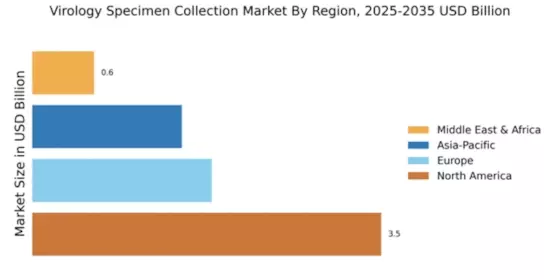
North America continues to lead the Virology Specimen Collection Market, holding a significant market share of 3.5 billion. The region's growth is driven by increasing healthcare expenditure, advancements in diagnostic technologies, and a robust regulatory framework that supports innovation. The demand for efficient specimen collection methods is further fueled by the rising incidence of viral infections and the need for rapid testing solutions. The competitive landscape in North America is characterized by the presence of major players such as Thermo Fisher Scientific, BD, and Abbott Laboratories. These companies are investing heavily in R&D to enhance their product offerings and maintain market leadership. The U.S. is the primary contributor to this market, supported by a well-established healthcare infrastructure and a focus on improving patient outcomes through advanced diagnostic solutions.

Europe : Emerging Market Dynamics

Europe's Virology Specimen Collection Market is valued at 1.8 billion, reflecting a growing demand for innovative diagnostic solutions. Key growth drivers include increasing awareness of viral diseases, supportive government initiatives, and a strong emphasis on research and development. The region is witnessing a shift towards more efficient specimen collection methods, driven by the need for rapid and accurate testing in response to public health challenges. Leading countries in this market include Germany, France, and the UK, where major players like Roche Diagnostics and Qiagen are actively expanding their product portfolios. The competitive landscape is marked by strategic partnerships and collaborations aimed at enhancing technological capabilities. According to the European Centre for Disease Prevention and Control, "The need for effective virology testing is paramount in managing public health threats."

Asia-Pacific : Rapidly Growing Market

The Asia-Pacific region is witnessing significant growth in the Virology Specimen Collection Market, currently valued at 0.9 billion. This growth is driven by increasing healthcare investments, rising awareness of viral infections, and the expansion of healthcare infrastructure. Governments in countries like China and India are implementing policies to enhance diagnostic capabilities, which is further propelling market demand. Key players in this region include PerkinElmer and Merck KGaA, who are focusing on expanding their presence through strategic collaborations and product innovations. The competitive landscape is evolving, with local companies also entering the market, thereby increasing competition. The region's diverse healthcare needs present unique opportunities for growth, particularly in rural and underserved areas.

Middle East and Africa : Emerging Healthcare Solutions

The Middle East and Africa (MEA) region's Virology Specimen Collection Market is valued at 0.22 billion, reflecting a nascent but growing market. The growth is driven by increasing investments in healthcare infrastructure, rising awareness of viral diseases, and the need for improved diagnostic solutions. Governments are focusing on enhancing healthcare access, which is expected to boost demand for specimen collection products. Countries like South Africa and the UAE are leading the market, with key players such as Hologic and Bio-Rad Laboratories actively participating. The competitive landscape is characterized by a mix of local and international companies, all striving to meet the growing demand for effective virology testing solutions. The region's unique challenges present opportunities for innovative approaches to specimen collection and diagnostics.

Key Players and Competitive Insights

The Virology Specimen Collection Market is characterized by a dynamic competitive landscape, driven by the increasing demand for efficient and accurate diagnostic solutions. Key players such as Thermo Fisher Scientific (US), BD (US), and Roche Diagnostics (CH) are at the forefront, leveraging their extensive portfolios and innovative capabilities. Thermo Fisher Scientific (US) focuses on enhancing its product offerings through continuous innovation and strategic partnerships, which positions it favorably in the market. Similarly, BD (US) emphasizes its commitment to expanding its global footprint, particularly in emerging markets, thereby enhancing its competitive edge. Roche Diagnostics (CH) is also notable for its investment in digital transformation, which is reshaping its operational focus and improving customer engagement.

The business tactics employed by these companies include localizing manufacturing and optimizing supply chains to enhance efficiency and reduce costs. The market structure appears moderately fragmented, with several players vying for market share. However, the collective influence of major companies like Abbott Laboratories (US) and Qiagen (DE) suggests a trend towards consolidation, as these firms seek to leverage synergies and enhance their competitive positioning.

In November 2025, Abbott Laboratories (US) announced the launch of a new line of rapid virology specimen collection kits designed to streamline the testing process. This strategic move is significant as it not only addresses the growing demand for rapid testing solutions but also reinforces Abbott's commitment to innovation in the virology space. The introduction of these kits is likely to enhance Abbott's market share and strengthen its position against competitors.

In October 2025, Qiagen (DE) expanded its collaboration with a leading healthcare provider to enhance its specimen collection capabilities. This partnership aims to integrate advanced technologies into the specimen collection process, thereby improving accuracy and efficiency. Such collaborations are indicative of Qiagen's strategy to remain competitive by leveraging external expertise and resources, which may lead to enhanced product offerings and market penetration.

In September 2025, Merck KGaA (DE) unveiled a new digital platform aimed at optimizing specimen collection workflows. This initiative reflects the growing trend towards digitalization in the market, as companies seek to improve operational efficiencies and customer experiences. By investing in digital solutions, Merck KGaA is positioning itself as a forward-thinking player in the virology specimen collection sector, potentially attracting new customers and retaining existing ones.

As of December 2025, the competitive trends in the Virology Specimen Collection Market are increasingly defined by digitalization, sustainability, and the integration of artificial intelligence (AI). Strategic alliances among key players are shaping the landscape, fostering innovation and enhancing product offerings. The shift from price-based competition to a focus on technological advancement and supply chain reliability is evident, suggesting that future competitive differentiation will hinge on the ability to innovate and adapt to changing market demands.

Key Companies in the Virology Specimen Collection Market market include

Industry Developments

  • Q2 2024: BD Launches New Swab Collection System for Viral Diagnostics BD announced the launch of its new BD ESwab™ 2.0 Collection and Transport System, designed to improve the stability and recovery of viral specimens for diagnostic testing, expanding its virology specimen collection portfolio.
  • Q1 2024: Thermo Fisher Scientific Expands Viral Transport Media Production Facility in North Carolina Thermo Fisher Scientific opened a new production line at its North Carolina facility to increase output of viral transport media, supporting global demand for virology specimen collection products.
  • Q2 2024: Roche Receives CE Mark for New Cobas PCR Media Dual Swab Kit Roche announced it has received CE Mark approval for its Cobas PCR Media Dual Swab Kit, enabling more efficient collection and transport of virology specimens for molecular testing in Europe.
  • Q3 2024: QIAGEN Launches QIAstat-Dx Viral Panel with Enhanced Specimen Collection Kit QIAGEN introduced an upgraded QIAstat-Dx Viral Panel, featuring a new specimen collection kit designed to improve sample integrity and workflow for virology diagnostics.
  • Q2 2024: FDA Authorizes New Self-Collection Swab for At-Home Viral Testing The FDA granted Emergency Use Authorization to a new self-collection swab device for at-home collection of virology specimens, expanding access to diagnostic testing.
  • Q1 2024: Puritan Medical Products Announces $25 Million Expansion for Swab Manufacturing Puritan Medical Products announced a $25 million investment to expand its manufacturing capacity for viral specimen collection swabs at its Maine facility.
  • Q2 2024: Copan Diagnostics Partners with NHS to Supply Virology Collection Kits Copan Diagnostics entered a partnership with the UK National Health Service to supply advanced virology specimen collection kits for use in public health laboratories.
  • Q3 2024: Greiner Bio-One Launches New Saliva Collection Device for Viral Testing Greiner Bio-One launched a new saliva collection device aimed at improving the ease and accuracy of virology specimen collection for both clinical and research applications.
  • Q2 2024: Roche Acquires Minority Stake in SwabTech, a Virology Collection Device Startup Roche announced the acquisition of a minority stake in SwabTech, a startup specializing in innovative virology specimen collection devices, to accelerate product development.
  • Q1 2025: Thermo Fisher Scientific Appoints New VP of Global Specimen Collection Business Thermo Fisher Scientific named Dr. Lisa Chen as Vice President of its Global Specimen Collection Business, overseeing strategy and operations for virology specimen collection products.
  • Q2 2025: BD Receives FDA Clearance for Next-Generation Viral Transport Medium BD received FDA clearance for its next-generation viral transport medium, designed to enhance the stability and safety of virology specimen collection and transport.
  • Q2 2024: Copan Diagnostics Opens New European Distribution Center Copan Diagnostics opened a new distribution center in the Netherlands to streamline delivery of virology specimen collection kits across Europe.
.webp

Future Outlook

Virology Specimen Collection Market Future Outlook

The Virology Specimen Collection Market is projected to grow at a 5.3% CAGR from 2024 to 2035, driven by technological advancements, increasing demand for diagnostics, and enhanced healthcare infrastructure.

New opportunities lie in:

  • Development of mobile specimen collection units for remote areas.
  • Integration of AI-driven analytics for specimen processing efficiency.
  • Expansion of partnerships with telehealth platforms for specimen collection services.

By 2035, the market is expected to be robust, reflecting substantial growth and innovation.

Market Segmentation

Virology Specimen Collection Market End User Outlook

  • Hospitals
  • Diagnostic Laboratories
  • Research Institutions
  • Pharmaceutical Companies

Virology Specimen Collection Market Application Outlook

  • Diagnostic Testing
  • Research and Development
  • Clinical Trials
  • Epidemiological Studies

Virology Specimen Collection Market Type of Specimen Outlook

  • Blood
  • Saliva
  • Urine
  • Tissue
  • Nasal Swabs

Virology Specimen Collection Market Collection Method Outlook

  • Manual Collection
  • Automated Collection
  • Self-Collection
  • Transport Media

Report Scope

MARKET SIZE 20246.42(USD Billion)
MARKET SIZE 20256.76(USD Billion)
MARKET SIZE 203511.34(USD Billion)
COMPOUND ANNUAL GROWTH RATE (CAGR)5.3% (2024 - 2035)
REPORT COVERAGERevenue Forecast, Competitive Landscape, Growth Factors, and Trends
BASE YEAR2024
Market Forecast Period2025 - 2035
Historical Data2019 - 2024
Market Forecast UnitsUSD Billion
Key Companies ProfiledThermo Fisher Scientific (US), BD (US), Roche Diagnostics (CH), Abbott Laboratories (US), Qiagen (DE), PerkinElmer (US), Merck KGaA (DE), Bio-Rad Laboratories (US), Hologic (US)
Segments CoveredApplication, Type of Specimen, Collection Method, End User
Key Market OpportunitiesIntegration of advanced automation technologies enhances efficiency in the Virology Specimen Collection Market.
Key Market DynamicsTechnological advancements and regulatory changes drive innovation in virology specimen collection methods and practices.
Countries CoveredNorth America, Europe, APAC, South America, MEA

Market Highlights

Author
Rahul Gotadki
Assistant Manager

He holds an experience of about 7+ years in Market Research and Business Consulting, working under the spectrum of Life Sciences and Healthcare domains. Rahul conceptualizes and implements a scalable business strategy and provides strategic leadership to the clients. His expertise lies in market estimation, competitive intelligence, pipeline analysis, customer assessment, etc. In addition to the above, his other responsibility includes strategic tracking of high growth markets & advising clients on the potential areas of focus they could direct their business initiatives

Leave a Comment

FAQs

What is the projected growth of the Virology Specimen Collection market?

The Virology Specimen Collection market is the expected increase in total market value of 11.34 USD billion over a defined forecast period 2025–2035. It is driven by factors such as demand trends, technological advances, regulatory changes, and geographic expansion.

What is the size of the Virology Specimen Collection market?

Virology Specimen Collection market size was valued at approximately 6.42 billion USD in 2024. This figure will reach 11.34 billion USD covering all regions (America, Europe, Asia, MEA and ROW), focusing its segments / services / distribution channels till 2035.

What is the CAGR of the Virology Specimen Collection market?

Virology Specimen Collection market is expected to grow at a CAGR of 5.3% between 2025 and 2035.

How much will the Virology Specimen Collection market be worth by 2035?

Virology Specimen Collection market is expected to be worth of 11.34 billion USD, reflecting growth driven by usage, technology and global demands by the end of 2035.

How will the Virology Specimen Collection market perform over the next 10 years?

Over the next 10 years the Virology Specimen Collection market is expected to shift from usd billion 6.42 to 11.34 billion USD, led by adoption of advanced tech, demographic trends, regulatory approvals, with potential headwinds from 2025 to 2035.

Download Free Sample

Kindly complete the form below to receive a free sample of this Report

Compare Licence

×
Features License Type
Single User Multiuser License Enterprise User
Price $4,950 $5,950 $7,250
Maximum User Access Limit 1 User Upto 10 Users Unrestricted Access Throughout the Organization
Free Customization
Direct Access to Analyst
Deliverable Format
Platform Access
Discount on Next Purchase 10% 15% 15%
Printable Versions