Download Free Sample
Kindly complete the form below to receive a free sample of this Report
Virtual Classroom and Distance Learning Services Market Size, Share and Trends Analysis Research Report Information By End User (Educational Institutions, Corporate, Government, Non-Profits), By Technology (Video Conferencing, LMS, Virtual Reality, Augmented Reality), By Application (Corporate Training, Higher Education, K-12, Professional Development, Language Learning), By Delivery Mode (Synchronous, Asynchronous, Blended, Mobile Learning), And By Region – Market Forecast Till 2035.
As per MRFR analysis, the Virtual Classroom and Distance Learning Services Market was estimated at 205.5 USD Billion in 2024. The Virtual Classroom and Distance Learning Services industry is projected to grow from 218.34 USD Billion in 2025 to 400.2 USD Billion by 2035, exhibiting a compound annual growth rate (CAGR) of 6.25% during the forecast period 2025 - 2035.
The Virtual Classroom and Distance Learning Services Market is experiencing robust growth driven by technological advancements and evolving educational needs.
| 2024 Market Size | 205.5 (USD Billion) |
| 2035 Market Size | 400.2 (USD Billion) |
| CAGR (2025 - 2035) | 6.25% |
Google (US), Microsoft (US), Adobe (US), Blackboard (US), Coursera (US), Udacity (US), Zoom Video Communications (US), Moodle (AU), Kaltura (US), Skillshare (US)
Our Impact
Enabled $4.3B Revenue Impact for Fortune 500 and Leading Multinationals
Partnering with 2000+ Global Organizations Each Year
30K+ Citations by Top-Tier Firms in the Industry
The Virtual Classroom and Distance Learning Services Market is currently experiencing a transformative phase, characterized by the integration of advanced technologies and innovative pedagogical approaches. This market appears to be driven by a growing demand for flexible learning solutions that cater to diverse learner needs. Institutions and organizations are increasingly adopting virtual classrooms to enhance accessibility and engagement, thereby fostering a more inclusive educational environment. Furthermore, the rise of mobile learning applications and interactive platforms suggests a shift towards more personalized and adaptive learning experiences, which may significantly influence the market landscape. In addition, the emphasis on lifelong learning and professional development is likely to propel the Virtual Classroom and Distance Learning Services Market forward. As individuals seek to upskill and reskill in an ever-evolving job market, the availability of online courses and training programs becomes increasingly vital. This trend indicates a potential for growth in partnerships between educational institutions and corporate entities, aiming to bridge the skills gap and meet the demands of the workforce. Overall, the market appears poised for continued expansion, driven by technological advancements and changing educational paradigms.
The integration of artificial intelligence in virtual classrooms is becoming more prevalent. AI tools are being utilized to personalize learning experiences, automate administrative tasks, and provide real-time feedback to learners. This trend suggests that educational institutions may enhance their operational efficiency and improve student outcomes through tailored learning pathways.
There is a noticeable shift towards fostering collaborative learning experiences within virtual classrooms. Platforms are increasingly incorporating features that facilitate group work, peer-to-peer interaction, and community building. This trend indicates a recognition of the importance of social learning in enhancing student engagement and retention.
The Virtual Classroom and Distance Learning Services Market is witnessing the emergence of global learning networks that connect learners and educators across geographical boundaries. This trend suggests a growing emphasis on cultural exchange and diverse perspectives, which may enrich the educational experience and prepare learners for a globalized workforce.
The Virtual Classroom and Distance Learning Services Market is significantly influenced by the globalization of education. As educational institutions seek to attract international students, the demand for online learning solutions that transcend geographical boundaries is on the rise. This trend is evidenced by the increasing number of partnerships between institutions across different countries, facilitating cross-border learning opportunities. Moreover, the market is expected to expand as more learners seek access to diverse educational resources and expertise from around the world. This globalization fosters a rich exchange of ideas and knowledge, enhancing the overall quality of education and making it more accessible to a broader audience.
The Virtual Classroom and Distance Learning Services Market is witnessing an increased focus on lifelong learning, reflecting a cultural shift towards continuous education. As industries evolve and job requirements change, professionals are increasingly seeking opportunities to upskill and reskill. This trend is supported by data indicating that over 60% of employees believe that ongoing education is essential for career advancement. Consequently, educational institutions and training providers are expanding their offerings to include a wider array of courses and certifications that cater to adult learners. This emphasis on lifelong learning not only drives market growth but also encourages a more adaptable workforce, capable of meeting the demands of a rapidly changing job market.
The Virtual Classroom and Distance Learning Services Market is characterized by a growing emphasis on cost-effective education solutions. As educational institutions and learners alike seek to minimize expenses, online learning presents a viable alternative to traditional classroom settings. Data suggests that online courses can reduce educational costs by up to 50%, making them an attractive option for budget-conscious students. This financial incentive drives both institutions and learners to explore distance learning options, leading to increased enrollment in online programs. As a result, educational providers are compelled to develop affordable yet high-quality courses that meet the needs of a diverse student population, further propelling market growth.
The Virtual Classroom and Distance Learning Services Market experiences a notable surge in demand for flexible learning solutions. As educational institutions and corporate entities seek to accommodate diverse learning preferences, the need for adaptable learning environments becomes paramount. This trend is underscored by a report indicating that approximately 70% of learners prefer online courses due to their convenience and accessibility. The ability to learn at one's own pace and schedule is increasingly appealing, particularly for working professionals and non-traditional students. Consequently, educational providers are compelled to innovate and enhance their offerings, ensuring they meet the evolving expectations of learners. This shift towards flexibility not only broadens the market reach but also fosters a more inclusive educational landscape.
Technological advancements play a pivotal role in shaping the Virtual Classroom and Distance Learning Services Market. The integration of cutting-edge technologies such as artificial intelligence, virtual reality, and augmented reality enhances the learning experience, making it more interactive and engaging. For instance, AI-driven analytics can provide personalized learning paths, catering to individual student needs. Furthermore, the market is projected to grow at a compound annual growth rate of 20% over the next five years, driven by these innovations. As educational institutions adopt more sophisticated platforms, the demand for high-quality content and user-friendly interfaces intensifies, compelling service providers to invest in technology that supports immersive learning experiences.
In the Virtual Classroom and Distance Learning Services Market, the application segments are witnessing a diverse distribution of market share. Higher Education emerges as the largest segment due to institutions increasingly adopting online platforms for course delivery. Meanwhile, Corporate Training is gaining traction, reflecting a fundamental shift in workforce development strategies towards digital solutions that enhance skills acquisition and employee training efficiency. Growth trends are significantly driven by technological advancements and the need for flexible learning solutions. The post-pandemic era has accelerated demand for distance education, with K-12 Education adapting rapidly to hybrid models. Moreover, Professional Development and Language Learning are carving their niches, promoting lifelong learning and catering to global communication needs, respectively.
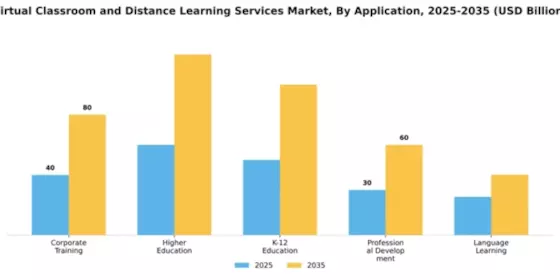
Higher Education: Dominant vs. Corporate Training: Emerging
Within the Virtual Classroom and Distance Learning Services Market, Higher Education stands as a dominant force, characterized by established institutions embracing comprehensive digital curricula and a robust infrastructure to support online learning. This segment thrives on tailored courses, interactive tools, and global accessibility, making quality education available to a broader audience. On the other hand, Corporate Training is identified as an emerging segment, reflecting companies' ongoing investment in employee development. This segment stands out for its adaptability, integrating customized training modules and leveraging analytics to measure learning outcomes. The blend of flexibility and targeted learning solutions positions Corporate Training as a critical player in workplace advancement.
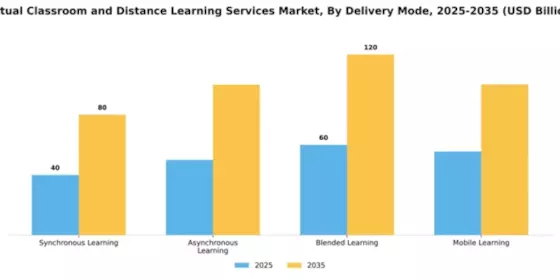
In the Virtual Classroom and Distance Learning Services Market, Synchronous Learning holds the largest market share among different delivery modes. This segment allows real-time interaction between instructors and students, facilitating engagement and collaboration. As a result, many educational institutions have widely adopted this approach, making it a preferred option for facilitating live classes and interactive sessions. Meanwhile, Asynchronous Learning is gaining momentum as it offers flexibility, enabling learners to access materials at their convenience and engage with content at their own pace. This mode is particularly popular among adult learners and professionals seeking to balance education with work commitments, contributing to its rapid growth.
Synchronous Learning (Dominant) vs. Asynchronous Learning (Emerging)
Synchronous Learning is characterized by real-time interactions, allowing students toparticipate in live classes led by instructors. This mode fosters immediate feedback and collaboration, making it ideal for courses requiring active participation. Educational institutions favor this method to maintain engagement and enhance learning experiences. In contrast, Asynchronous Learning has emerged as a flexible alternative, enabling learners to study at their own pace. It appeals to a diverse audience, especially working professionals who require a more adaptable approach to education. While Synchronous Learning remains the dominant mode, Asynchronous Learning's advantage of flexibility enhances its appeal, especially as more learners seek personalized educational experiences in a fast-paced world.
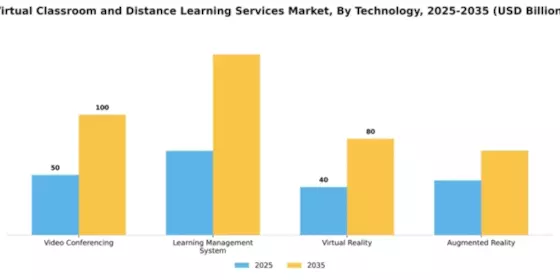
In the Virtual Classroom and Distance Learning Services Market, the technology segment is primarily driven by Video Conferencing, which holds the largest market share due to its widespread adoption across educational institutions and corporate environments. Learning Management Systems (LMS) follow closely, providing a structured approach to educational content delivery and management. These two technologies complement each other, reflecting a growing trend towards integrated digital learning solutions.
Technology: Video Conferencing (Dominant) vs. Learning Management System (Emerging)
Video Conferencing technology plays a pivotal role in the Virtual Classroom, enabling real-time communication and interaction between educators and students. It is marked by features such as screen sharing, breakout rooms, and chat functions, making virtual classes interactive and engaging. On the other hand, Learning Management Systems stand out as emerging solutions that offer a comprehensive platform for course management, content delivery, and learner assessment. They are being rapidly adopted by institutions seeking to digitize their programs efficiently, responding to the growing demand for hybrid learning solutions.
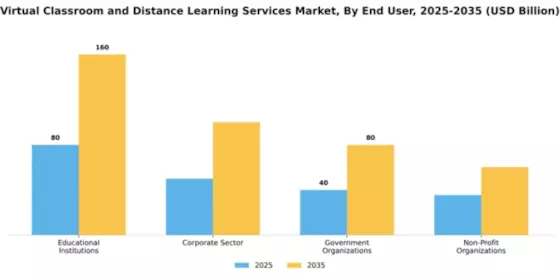
In the Virtual Classroom and Distance Learning Services Market, educational institutions hold a substantial share, driven by the increasing need for innovative teaching methods and remote learning solutions. The expansion of online courses and programs significantly contributes to this dominance, as schools and universities seamlessly integrate technology into their curricula. Meanwhile, the corporate sector, while smaller in market share, is rapidly gaining traction due to the rising demand for continuous professional development and employee training through digital platforms.
Educational Institutions (Dominant) vs. Corporate Sector (Emerging)
Educational institutions are the cornerstone of the Virtual Classroom and Distance Learning Services Market, leveraging technology to enhance learning experiences and expand accessibility. This segment encompasses K-12 schools, colleges, and universities offering diverse online programs to meet various educational needs. Corporate sector participation, on the other hand, is emerging with a pronounced focus on workforce development and skill enhancement through virtual training modules. Corporate learning platforms are evolving to deliver engaging content tailored to specific industry requirements, marking a significant shift from traditional training methods to more flexible, tech-driven solutions.
Get more detailed insights about Virtual Classroom and Distance Learning Services Market Request Free Sample
North America is the largest market for Virtual Classroom and Distance Learning Services, holding a significant share of 102.75M in 2025. The growth is driven by increasing adoption of digital learning solutions, especially in K-12 and higher education sectors. Regulatory support for online education and the push for remote learning solutions have further accelerated this trend. The region's advanced technological infrastructure and high internet penetration rates are key enablers of this growth. The competitive landscape is dominated by major players such as Google, Microsoft, and Adobe, which are continuously innovating to enhance user experience. The presence of established platforms like Coursera and Udacity also contributes to a robust ecosystem. With a focus on personalized learning and accessibility, North America is set to maintain its leadership in the virtual learning market.
Europe is witnessing a rapid expansion in the Virtual Classroom and Distance Learning Services market, valued at 55.0M in 2025. The growth is fueled by increasing demand for flexible learning solutions and government initiatives promoting digital education. Regulatory frameworks across various countries are encouraging the integration of technology in education, which is vital for meeting the needs of diverse learners. The region's commitment to enhancing digital skills is a significant driver of this market. Leading countries such as Germany, the UK, and France are at the forefront of this transformation, with a competitive landscape featuring key players like Blackboard and Moodle. The presence of innovative startups alongside established companies fosters a dynamic environment for growth. As educational institutions increasingly adopt blended learning models, Europe is poised to become a central hub for virtual education services.
Asia-Pacific is emerging as a significant player in the Virtual Classroom and Distance Learning Services market, with a valuation of 40.0M in 2025. The region's growth is driven by a large population of young learners and increasing smartphone penetration, which facilitates access to online education. Government initiatives aimed at improving digital literacy and educational access are also pivotal in driving demand for virtual learning solutions. The shift towards online education is further accelerated by the ongoing digital transformation in the region. Countries like China, India, and Australia are leading the charge, with a competitive landscape that includes both local and international players. Companies such as Kaltura and Moodle are making strides in providing tailored solutions for diverse educational needs. As the region continues to invest in technology and infrastructure, Asia-Pacific is set to become a powerhouse in the virtual learning market.
The Middle East and Africa region is gradually developing its Virtual Classroom and Distance Learning Services market, valued at 7.75M in 2025. The growth is primarily driven by increasing internet connectivity and a rising demand for accessible education solutions. Governments are recognizing the importance of digital education, leading to initiatives aimed at enhancing online learning infrastructure. The region's diverse educational needs are prompting a shift towards more flexible learning options, which is crucial for addressing various socio-economic challenges. Countries like South Africa and the UAE are at the forefront of this transformation, with a growing presence of both local and international educational platforms. The competitive landscape is evolving, with key players beginning to establish a foothold in the market. As investments in technology and educational resources increase, the Middle East and Africa are poised for significant growth in virtual learning services.
The Virtual Classroom and Distance Learning Services Market is currently characterized by a dynamic competitive landscape, driven by rapid technological advancements and an increasing demand for flexible learning solutions. Major players such as Google (US), Microsoft (US), and Coursera (US) are strategically positioned to leverage their extensive technological capabilities and vast user bases. Google (US) focuses on integrating its suite of educational tools with artificial intelligence (AI) to enhance user engagement and learning outcomes. Meanwhile, Microsoft (US) emphasizes partnerships with educational institutions to expand its reach and improve its offerings through localized content and tailored solutions. Coursera (US) has adopted a strategy of diversifying its course offerings by collaborating with top universities and industry leaders, thereby enhancing its value proposition in the market.The business tactics employed by these companies reflect a moderately fragmented market structure, where competition is not solely based on pricing but increasingly on innovation and service quality. Key players are optimizing their supply chains and localizing their services to cater to diverse educational needs across different regions. This collective influence of major companies shapes a competitive environment that encourages continuous improvement and adaptation to emerging trends.In November Google (US) announced the launch of its AI-driven learning analytics platform, designed to provide educators with insights into student performance and engagement. This strategic move is likely to enhance the effectiveness of virtual classrooms by enabling personalized learning experiences, thereby positioning Google (US) as a leader in educational technology. The integration of AI into their offerings may also attract more educational institutions seeking to improve learning outcomes.In October Microsoft (US) expanded its partnership with several universities to provide customized training programs that align with industry needs. This initiative not only strengthens Microsoft's foothold in the education sector but also addresses the skills gap in the workforce. By tailoring educational content to meet specific market demands, Microsoft (US) enhances its competitive edge and fosters long-term relationships with educational institutions.In September Coursera (US) launched a new initiative aimed at increasing access to online learning for underserved communities. This program, which includes subsidized courses and scholarships, reflects Coursera's commitment to social responsibility and inclusivity. By broadening its reach, Coursera (US) not only enhances its brand reputation but also positions itself as a socially conscious leader in the virtual learning space.As of December the competitive trends in the Virtual Classroom and Distance Learning Services Market are increasingly defined by digitalization, sustainability, and AI integration. Strategic alliances among key players are shaping the landscape, fostering innovation and enhancing service delivery. The shift from price-based competition to a focus on technological advancement and supply chain reliability is evident, suggesting that future competitive differentiation will hinge on the ability to innovate and adapt to the evolving educational needs of learners worldwide.






The Virtual Classroom and Distance Learning Services Market is projected to grow at a 6.25% CAGR from 2025 to 2035, driven by technological advancements and increasing demand for flexible learning solutions.
New opportunities lie in:
By 2035, the market is expected to be robust, reflecting substantial growth and innovation.
| MARKET SIZE 2024 | 205.5(USD Billion) |
| MARKET SIZE 2025 | 218.34(USD Billion) |
| MARKET SIZE 2035 | 400.2(USD Billion) |
| COMPOUND ANNUAL GROWTH RATE (CAGR) | 6.25% (2025 - 2035) |
| REPORT COVERAGE | Revenue Forecast, Competitive Landscape, Growth Factors, and Trends |
| BASE YEAR | 2024 |
| Market Forecast Period | 2025 - 2035 |
| Historical Data | 2019 - 2024 |
| Market Forecast Units | USD Billion |
| Key Companies Profiled | Google (US), Microsoft (US), Adobe (US), Blackboard (US), Coursera (US), Udacity (US), Zoom Video Communications (US), Moodle (AU), Kaltura (US), Skillshare (US) |
| Segments Covered | Application, Delivery Mode, Technology, End User |
| Key Market Opportunities | Integration of artificial intelligence to enhance personalized learning experiences in the Virtual Classroom and Distance Learning Services Market. |
| Key Market Dynamics | Rising demand for interactive learning tools drives innovation and competition in the Virtual Classroom and Distance Learning Services Market. |
| Countries Covered | North America, Europe, APAC, South America, MEA |
As of 2024, the market valuation was 205.5 USD Billion.
The market is projected to reach 400.2 USD Billion by 2035.
The expected CAGR for the market during this period is 6.25%.
Key segments include Corporate Training, Higher Education, K-12 Education, Professional Development, and Language Learning.
The K-12 Education segment is projected to grow from 50.0 USD Billion to 100.0 USD Billion.
The Blended Learning segment is expected to grow from 60.0 USD Billion to 120.0 USD Billion by 2035.
Key players include Google, Microsoft, Adobe, Blackboard, Coursera, and Zoom Video Communications.
The Learning Management System segment is projected to increase from 70.0 USD Billion to 150.0 USD Billion.
The Corporate Sector is expected to grow from 50.0 USD Billion to 100.0 USD Billion by 2035.
Mobile Learning is projected to grow from 55.5 USD Billion to 100.2 USD Billion, indicating strong demand.


Kindly complete the form below to receive a free sample of this Report

“This is really good guys. Excellent work on a tight deadline. I will continue to use you going forward and recommend you to others. Nice job”


“Thanks. It’s been a pleasure working with you, please use me as reference with any other Intel employees.”


“Thanks for sending the report it gives us a good global view of the Betaïne market.”


“Thank you, this will be very helpful for OQS.”


“We found the report very insightful! we found your research firm very helpful. I'm sending this email to secure our future business.”


“I am very pleased with how market segments have been defined in a relevant way for my purposes (such as "Portable Freezers & refrigerators" and "last-mile"). In general the report is well structured. Thanks very much for your efforts.”


“I have been reading the first document or the study, ,the Global HVAC and FP market report 2021 till 2026. Must say, good info! I have not gone in depth at all parts, but got a good indication of the data inside!”


“We got the report in time, we really thank you for your support in this process. I also thank to all of your team as they did a great job.”


“The Automotive 48V ECU Components Procurement Intelligence Study” was a complex project, but the Market Research Future (MRFR) team handled it with quality, agility, and customer-centricity. They delivered all requested data on time and within the agreed scope. The team, including Shubhendra Anand and Rahul Gotadki, was always readily available to clarify questions and swiftly implement necessary adjustments, driving the project to a successful conclusion within a very demanding timeframe.
I would also like to specifically commend Akshay Agarwal for his responsiveness and support at every stage—from our initial inquiry on May 6th through to final delivery on June 18th. His dedication made the entire process seamless.”



