×
Request Free Sample ×

Kindly complete the form below to receive a free sample of this Report

* Please use a valid business email

Leading companies partner with us for data-driven Insights

clients tt-cursor
Hero Background

Voyage Data Recorder Market

ID: MRFR/AD/2492-CR
134 Pages
Swapnil Palwe
July 2019

Voyage Data Recorder (VDR) Market Research Report Information by Type (General Voyage Data Recorder and Simplified Voyage Data Recorder), Application (Cargo Ship, Naval Ship and Passenger Ship) and Region (North America, Europe, Asia-Pacific, Middle East Africa and Latin America) - Forecast till 2030

Share:
Download PDF ×

We do not share your information with anyone. However, we may send you emails based on your report interest from time to time. You may contact us at any time to opt-out.

Voyage Data Recorder Market Infographic
Purchase Options

Voyage Data Recorder Market Summary

As per MRFR analysis, the Voyage Data Recorder Market Size was estimated at 9.54 USD Million in 2024. The Voyage Data Recorder industry is projected to grow from 9.94 USD Million in 2025 to 15.29 USD Million by 2035, exhibiting a compound annual growth rate (CAGR) of 4.4 during the forecast period 2025 - 2035.

Key Market Trends & Highlights

The Voyage Data Recorder Market is poised for substantial growth driven by technological advancements and regulatory compliance.

  • North America remains the largest market for Voyage Data Recorders, reflecting a strong emphasis on maritime safety.
  • The Asia-Pacific region is emerging as the fastest-growing market, driven by increasing maritime traffic and investment in shipping infrastructure.
  • The Marine Safety segment dominates the market, while the Data Analysis segment is experiencing rapid growth due to advancements in data processing technologies.
  • Key market drivers include enhanced safety measures and regulatory compliance, which are crucial for both commercial shipping and passenger ships.

Market Size & Forecast

2024 Market Size 9.54 (USD Million)
2035 Market Size 15.29 (USD Million)
CAGR (2025 - 2035) 4.4%

Major Players

Kongsberg Gruppen (NO), Raytheon Technologies (US), Mitsubishi Heavy Industries (JP), Furuno Electric Co., Ltd. (JP), Wärtsilä Corporation (FI), Northrop Grumman Corporation (US), Thales Group (FR), Inmarsat Global Limited (GB), Sperry Marine (US)

Voyage Data Recorder Market Trends

The Voyage Data Recorder Market is currently experiencing a notable evolution, driven by advancements in technology and increasing regulatory requirements. As maritime safety becomes a focal point for governments and organizations worldwide, the demand for sophisticated data recording systems is on the rise. These devices, often referred to as 'black boxes', are essential for capturing critical information during maritime operations, thereby enhancing safety protocols and facilitating investigations in the event of incidents. The integration of modern technologies, such as artificial intelligence and machine learning, appears to be transforming the capabilities of these recorders, allowing for more efficient data analysis and retrieval. Moreover, the growing emphasis on environmental sustainability is influencing the Voyage Data Recorder Market. Stakeholders are increasingly recognizing the importance of monitoring emissions and operational efficiency, which these recorders can support. As the industry shifts towards greener practices, the role of data recorders in ensuring compliance with environmental regulations is likely to expand. This trend suggests a future where Voyage Data Recorders not only serve safety purposes but also contribute to the broader goals of sustainability and operational excellence within the maritime sector.

Technological Advancements

The integration of cutting-edge technologies, such as artificial intelligence and machine learning, is reshaping the capabilities of Voyage Data Recorders. These innovations enhance data analysis, enabling quicker retrieval and interpretation of critical information.

Regulatory Compliance

Increasing regulatory requirements are driving the demand for advanced Voyage Data Recorders. Governments and maritime organizations are emphasizing the need for robust data recording systems to ensure safety and facilitate investigations.

Sustainability Focus

The growing emphasis on environmental sustainability is influencing the Voyage Data Recorder Market. These devices are becoming essential for monitoring emissions and operational efficiency, aligning with the industry's shift towards greener practices.

Voyage Data Recorder Market Drivers

Regulatory Compliance

The Global Voyage Data Recorder Market (VDR) Industry is significantly driven by stringent regulatory requirements imposed by maritime authorities. These regulations mandate the installation of VDRs on various types of vessels to enhance safety and accountability. For instance, the International Maritime Organization (IMO) has established guidelines that require VDRs to be operational on all passenger ships and cargo vessels over a certain size. This regulatory landscape ensures that the demand for VDRs remains robust, as compliance is non-negotiable. As a result, the market is projected to reach 1500 USD Million in 2024, reflecting the industry's commitment to safety and operational integrity.

Market Growth Projections

The Global Voyage Data Recorder Market (VDR) Industry is projected to experience significant growth over the coming years. With a market value expected to reach 1500 USD Million in 2024 and potentially expanding to 3500 USD Million by 2035, the industry is poised for a robust trajectory. The anticipated CAGR of 8.01% from 2025 to 2035 suggests a sustained demand for VDRs driven by regulatory compliance, technological advancements, and increasing maritime traffic. This growth reflects the evolving needs of the maritime sector and the critical role that VDRs play in enhancing safety, security, and operational efficiency.

Technological Advancements

Technological innovations play a pivotal role in shaping the Global Voyage Data Recorder Market (VDR) Industry. The integration of advanced features such as real-time data transmission, enhanced data storage capabilities, and improved user interfaces has made modern VDRs more appealing to ship operators. These advancements not only enhance the functionality of VDRs but also contribute to better decision-making during maritime operations. As the industry evolves, the demand for technologically sophisticated VDRs is expected to rise, potentially driving the market value to 3500 USD Million by 2035. This growth underscores the importance of continuous innovation in maintaining competitive advantage.

Increasing Maritime Traffic

The Global Voyage Data Recorder Market (VDR) Industry is also influenced by the rising volume of maritime traffic worldwide. As global trade expands, the number of vessels operating in international waters increases, necessitating the use of VDRs for safety and compliance. According to maritime statistics, the number of commercial vessels has been steadily increasing, with projections indicating that this trend will continue. This surge in maritime activity creates a substantial market for VDRs, as ship operators seek to enhance safety measures and adhere to regulatory standards. Consequently, the market is poised for growth, with a projected CAGR of 8.01% from 2025 to 2035.

Focus on Safety and Security

The emphasis on safety and security within the maritime sector significantly propels the Global Voyage Data Recorder Market (VDR) Industry. Incidents such as maritime accidents and piracy have heightened awareness regarding the need for effective monitoring and data recording systems. VDRs serve as critical tools for investigating incidents and ensuring accountability among operators. The increasing focus on safety protocols and risk management strategies among shipping companies further drives the demand for VDRs. As a result, the market is expected to experience substantial growth, reflecting the industry's commitment to enhancing safety standards and operational transparency.

Environmental Concerns and Sustainability

Environmental considerations are becoming increasingly relevant in the Global Voyage Data Recorder Market (VDR) Industry. As the maritime sector faces pressure to reduce its environmental footprint, VDRs are being recognized for their role in monitoring compliance with environmental regulations. These devices can record data related to emissions and fuel consumption, enabling operators to optimize their operations and minimize environmental impact. The growing emphasis on sustainability is likely to drive the adoption of VDRs, as shipping companies seek to align with global environmental standards and practices. This trend indicates a potential shift in the market landscape, as sustainability becomes a key driver of growth.

Market Segment Insights

By Application: Marine Safety (Largest) vs. Data Analysis (Fastest-Growing)

In the Voyage Data Recorder Market, the application segment showcases a diverse distribution, with marine safety representing the largest portion due to its critical importance in ensuring the safety of maritime operations. This application not only draws significant investment but also mandates regulatory compliance, substantially influencing market dynamics. Following closely is data analysis, which is rapidly gaining traction as organizations seek to leverage recorded data for insights and operational improvements. Incident investigation and regulatory compliance, while essential, occupy smaller segments in comparison to marine safety and data analysis.

Marine Safety (Dominant) vs. Data Analysis (Emerging)

Marine safety remains a dominant application in the Voyage Data Recorder Market, driven by stringent regulations and an overarching need for safety in maritime operations. It encompasses functionalities that help in monitoring ship behavior, ensuring compliance with safety protocols, and acting as a critical resource during incidents. In contrast, data analysis is emerging as a key application, fueled by advancements in data analytics and machine learning technologies. Companies are beginning to recognize the invaluable insights derived from voyage data, enabling them to optimize routes, enhance operational efficiency, and respond proactively to potential safety issues.

By End Use: Commercial Shipping (Largest) vs. Passenger Ships (Fastest-Growing)

In the Voyage Data Recorder Market, the end-use segment is primarily dominated by commercial shipping, which holds the largest market share due to the significant adoption of advanced safety measures and regulatory compliance. This sector encompasses a broad range of vessels, including cargo ships and tankers, underscoring its critical role in global trade and transportation. Meanwhile, passenger ships, witnessing a growing share, are increasingly equipped with advanced data recording technologies aimed at enhancing passenger safety and experience.

Commercial Shipping (Dominant) vs. Fishing Vessels (Emerging)

Commercial shipping remains the dominant end-use segment in the Voyage Data Recorder Market, driven by stringent regulations concerning maritime safety and operational efficiency. The extensive fleet of cargo vessels necessitates advanced monitoring and management solutions, positioning commercial shipping as a key driver of market innovations. In contrast, fishing vessels represent an emerging segment, characterized by a gradual but notable increase in the adoption of voyage data recorders. As sustainability and compliance with marine regulations gain importance for fishing operations, more vessels are being retrofitted or built with these technologies, thus expanding their market presence.

By Technology: Digital Voyage Data Recorder (Largest) vs. Hybrid Voyage Data Recorder (Fastest-Growing)

In the Voyage Data Recorder Market, the Digital Voyage Data Recorder holds the largest market share, thriving due to its advanced features such as real-time data monitoring and enhanced data storage capabilities. This segment significantly benefits from regulatory mandates for real-time tracking and reporting, leading to higher demand among ship owners aiming to comply with safety and operational standards. Meanwhile, the Hybrid Voyage Data Recorder is witnessing rapid growth, driven by its ability to combine benefits from both digital and analog systems, catering to diverse customer preferences and operational needs. The growth trends in this segment are significant, with digital recorders not only dominating the market but also innovating with integrated eco-friendly technologies. Meanwhile, the rise of hybrid recorders reflects a shift in customer preferences toward adaptable and versatile solutions. Factors such as increasing deployment of smart shipping technologies, regulatory compliance, and the emphasis on sustainability are propelling the demand for these advanced recording systems, transforming the maritime industry's approach toward data management.

Technology: Digital Voyage Data Recorder (Dominant) vs. Hybrid Voyage Data Recorder (Emerging)

The Digital Voyage Data Recorder is characterized by its sophisticated data acquisition and storage systems, making it essential for modern maritime operations. This segment's dominance is attributed to its ability to provide comprehensive insights and analytics that help in safety, efficiency, and compliance. The technology supports various functions, from incident analysis to performance benchmarking, making it a crucial asset for vessel management. On the other hand, the Hybrid Voyage Data Recorder combines analog and digital technologies, offering flexibility that appeals to a wider range of vessels and operational models. This emerging technology not only meets the demands of traditional maritime operations but also adapts to the increasingly digital nature of shipping, positioning itself as a compelling alternative, particularly for vessels transitioning towards digital solutions.

Get more detailed insights about Voyage Data Recorder Market

Regional Insights

North America : Market Leader in VDR Technology

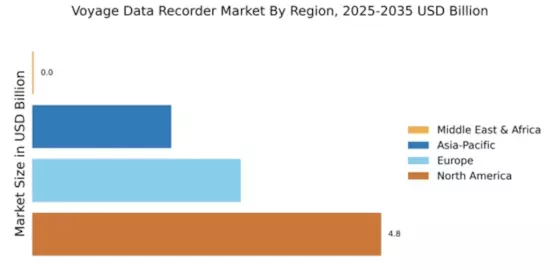
North America is poised to maintain its leadership in the Voyage Data Recorder (VDR) market, holding a significant share of 4.77 in 2024. The region's growth is driven by stringent maritime regulations and increasing demand for safety and compliance in shipping operations. The U.S. Coast Guard and other regulatory bodies are enforcing robust standards, which further propels the adoption of VDR systems across commercial and military vessels. The competitive landscape in North America is characterized by the presence of key players such as Raytheon Technologies and Northrop Grumman Corporation. These companies are at the forefront of technological advancements, focusing on integrating AI and IoT capabilities into VDR systems. The U.S. market is also witnessing collaborations between manufacturers and shipping companies to enhance data analytics and improve operational efficiency, solidifying its position as a global leader in VDR technology.

Europe : Regulatory Framework Driving Growth

Europe is experiencing significant growth in the Voyage Data Recorder (VDR) market, with a market size of 2.85. The region benefits from stringent maritime regulations set by the European Maritime Safety Agency (EMSA), which mandates the installation of VDRs on various vessels. This regulatory framework is a key driver for market expansion, as it enhances safety and accountability in maritime operations. Additionally, the increasing focus on environmental sustainability is pushing for advanced VDR technologies that comply with new regulations. Leading countries in Europe, such as Germany, France, and the UK, are home to major players like Thales Group and Wärtsilä Corporation. The competitive landscape is marked by innovation and collaboration among manufacturers to develop next-generation VDR systems. The presence of established maritime industries in these countries further supports the growth of the VDR market, making Europe a vital region for technological advancements in maritime safety.

Asia-Pacific : Emerging Market with Growth Potential

The Asia-Pacific region is emerging as a significant player in the Voyage Data Recorder (VDR) market, with a market size of 1.9. The growth is driven by increasing maritime trade and the rising number of vessels in operation. Countries like Japan and China are investing heavily in maritime safety technologies, spurred by regulatory requirements and a growing awareness of safety protocols. The region's expanding shipping industry is a catalyst for the adoption of VDR systems, ensuring compliance with international standards. Japan and Australia are leading the charge in the Asia-Pacific VDR market, with key players such as Mitsubishi Heavy Industries and Furuno Electric Co., Ltd. actively participating in the sector. The competitive landscape is characterized by technological innovation and partnerships aimed at enhancing VDR functionalities. As the region continues to develop its maritime infrastructure, the demand for advanced VDR systems is expected to rise significantly, positioning Asia-Pacific as a vital market for future growth.

Middle East and Africa : Nascent Market with Challenges

The Middle East and Africa region represents a nascent market for Voyage Data Recorders (VDR), with a market size of only 0.02. The growth in this region is hindered by limited maritime infrastructure and regulatory frameworks. However, there is a growing recognition of the importance of maritime safety, which could drive future demand for VDR systems. The region's strategic location for The Voyage Data Recorder expansion as investments in maritime safety increase. Countries like South Africa and the UAE are beginning to adopt VDR technologies, albeit at a slower pace compared to other regions. The competitive landscape is still developing, with few key players actively participating. As awareness of maritime safety regulations grows, the potential for VDR adoption in the Middle East and Africa could increase, paving the way for future growth in this sector.

Key Players and Competitive Insights

The Voyage Data Recorder Market is currently characterized by a competitive landscape that is both dynamic and multifaceted. Key growth drivers include the increasing regulatory requirements for maritime safety, advancements in technology, and the rising emphasis on data analytics for operational efficiency. Major players such as Kongsberg Gruppen (Norway), Raytheon Technologies (US), and Thales Group (France) are strategically positioned to leverage these trends. Kongsberg Gruppen (Norway) focuses on innovation in digital solutions, enhancing their VDR offerings with advanced data analytics capabilities. Meanwhile, Raytheon Technologies (US) emphasizes partnerships with shipping companies to integrate their systems into broader maritime safety frameworks, thereby enhancing their market presence. Thales Group (France) is actively pursuing regional expansion, particularly in Asia-Pacific, to capitalize on the growing demand for VDR systems in emerging markets. Collectively, these strategies contribute to a competitive environment that is increasingly shaped by technological advancements and regulatory compliance.

In terms of business tactics, companies are localizing manufacturing to reduce costs and optimize supply chains, which is particularly relevant in the context of global trade dynamics. The market structure appears moderately fragmented, with several key players holding substantial market shares while also facing competition from smaller, specialized firms. This fragmentation allows for a diverse range of offerings, catering to various segments of the maritime industry.

In November 2025, Kongsberg Gruppen (Norway) announced a strategic partnership with a leading shipping consortium to develop next-generation VDR systems that incorporate AI-driven analytics. This move is significant as it not only enhances Kongsberg's technological capabilities but also positions the company as a leader in the integration of AI within maritime safety solutions. The partnership is expected to yield innovative products that could redefine data utilization in the shipping industry.

In October 2025, Raytheon Technologies (US) launched a new VDR model that features enhanced data storage capacity and real-time data transmission capabilities. This development is crucial as it addresses the growing need for efficient data management in maritime operations. By improving the functionality of their VDR systems, Raytheon Technologies aims to solidify its competitive edge in a market that increasingly values technological sophistication.

In September 2025, Thales Group (France) expanded its VDR product line to include solutions tailored for the offshore oil and gas sector. This strategic diversification is indicative of Thales's commitment to addressing the unique challenges faced by different maritime segments. By broadening its product offerings, Thales not only enhances its market reach but also mitigates risks associated with reliance on a single market segment.

As of December 2025, current competitive trends in the Voyage Data Recorder Market are heavily influenced by digitalization, sustainability initiatives, and the integration of AI technologies. Strategic alliances are becoming increasingly pivotal, as companies recognize the value of collaborative innovation in enhancing product offerings. Looking ahead, it is likely that competitive differentiation will evolve from traditional price-based strategies to a focus on innovation, technological advancement, and supply chain reliability. This shift underscores the importance of adaptability and forward-thinking in maintaining a competitive edge in the rapidly changing maritime landscape.

Key Companies in the Voyage Data Recorder Market market include

Industry Developments

  • The key players of the market are launching high speed and efficient data recorders for aircraft. 
  • The key players of the market are developing a variety of data recorders. Some of the key players are integrating the five major data recorders into one product.

The key players are taking market expansion procedure in the forecast period.  

Future Outlook

Voyage Data Recorder Market Future Outlook

The Voyage Data Recorder Market is projected to grow at a 4.4% CAGR from 2024 to 2035, driven by regulatory mandates, technological advancements, and increasing maritime safety concerns.

New opportunities lie in:

  • Integration of AI analytics for predictive maintenance solutions.
  • Development of cloud-based data storage for enhanced accessibility.
  • Expansion into emerging markets with tailored VDR solutions.

By 2035, the market is expected to be robust, driven by innovation and regulatory compliance.

Market Segmentation

Voyage Data Recorder Market End Use Outlook

  • Commercial Shipping
  • Fishing Vessels
  • Passenger Ships
  • Naval Vessels

Voyage Data Recorder Market Technology Outlook

  • Digital Voyage Data Recorder
  • Analog Voyage Data Recorder
  • Hybrid Voyage Data Recorder

Voyage Data Recorder Market Application Outlook

  • Marine Safety
  • Data Analysis
  • Incident Investigation
  • Regulatory Compliance

Report Scope

MARKET SIZE 20249.54(USD Million)
MARKET SIZE 20259.94(USD Million)
MARKET SIZE 203515.29(USD Million)
COMPOUND ANNUAL GROWTH RATE (CAGR)4.4% (2024 - 2035)
REPORT COVERAGERevenue Forecast, Competitive Landscape, Growth Factors, and Trends
BASE YEAR2024
Market Forecast Period2025 - 2035
Historical Data2019 - 2024
Market Forecast UnitsUSD Million
Key Companies ProfiledKongsberg Gruppen (NO), Raytheon Technologies (US), Mitsubishi Heavy Industries (JP), Furuno Electric Co., Ltd. (JP), Wärtsilä Corporation (FI), Northrop Grumman Corporation (US), Thales Group (FR), Inmarsat Global Limited (GB), Sperry Marine (US)
Segments CoveredApplication, End Use, Technology
Key Market OpportunitiesIntegration of advanced analytics and artificial intelligence in the Voyage Data Recorder Market.
Key Market DynamicsRising regulatory requirements drive demand for advanced Voyage Data Recorders in maritime safety and operational efficiency.
Countries CoveredNorth America, Europe, APAC, South America, MEA

Market Highlights

Author
Swapnil Palwe
Team Lead - Research

With a technical background as Bachelor's in Mechanical Engineering, with MBA in Operations Management , Swapnil has 6+ years of experience in market research, consulting and analytics with the tasks of data mining, analysis, and project execution. He is the POC for our clients, for their consulting projects running under the Automotive/A&D domain. Swapnil has worked on major projects in verticals such as Aerospace & Defense, Automotive and many other domain projects. He has worked on projects for fortune 500 companies' syndicate and consulting projects along with several government projects.

Leave a Comment

FAQs

Which region will dictate the pace for voyage data recorder market development in the coming period?

The North American region is estimated to decide the course of the global market in the upcoming years.

What earning potential is foreseen for the voyage data recorder market?

USD 18.74 billion earnings are estimated to foster the future growth of the market.

What CAGR backing is estimated to be perceived in the global voyage data recorder market?

By 2030, a 3% CAGR will ensure steady progress for the market.

Which voyage data recorder market contributors are predicted to be seen at the forefront of the growth?

Orolia Maritime (France), Japan Radio Co., Ltd (Japan), and Northrop Grumman Sperry Marine BV (UK) are estimated to open up avenues for the market.

Which dynamic will stimulate the voyage data recorder market in the future?

The expansion of the application of progressive VDR technologies is assessed to reshape the overall market.

Download Free Sample

Kindly complete the form below to receive a free sample of this Report

Compare Licence

×
Features License Type
Single User Multiuser License Enterprise User
Price $4,950 $5,950 $7,250
Maximum User Access Limit 1 User Upto 10 Users Unrestricted Access Throughout the Organization
Free Customization
Direct Access to Analyst
Deliverable Format
Platform Access
Discount on Next Purchase 10% 15% 15%
Printable Versions