Download Free Sample
Kindly complete the form below to receive a free sample of this Report
Warehouse Equipment Maintenance MRO Services Market Research Report By End Use (Retail Warehousing, Manufacturing Facilities, Distribution Centers, E-commerce Fulfillment Centers, Cold Storage Facilities), By Application (Material Handling, Storage Solutions, Conveyor Systems, Automated Guided Vehicles, Forklifts), By Service Type (Preventive Maintenance, Corrective Maintenance, Predictive Maintenance, Emergency Repairs, Equipment Overhaul), By Equipment Type (Pallet Racking Systems, Dock Levelers, Warehouse Management Systems, Automated Storage and Retrieval Systems, Material Handling Equipment), By Maintenance Strategy (In-House Maintenance, Outsourced Maintenance, Scheduled Maintenance, On-Demand Maintenance, Contractual Maintenance) And By Region (North America, Europe, Asia-Pacific, And Rest Of The World) – Market Forecast Till 2035.
As per MRFR analysis, the Warehouse equipment maintenance MRO services Market was estimated at 25.0 USD Billion in 2024. The Warehouse equipment maintenance MRO services industry is projected to grow from 26.09 USD Billion in 2025 to 40.0 USD Billion by 2035, exhibiting a compound annual growth rate (CAGR) of 4.37% during the forecast period 2025 - 2035.
The Warehouse equipment maintenance MRO services Market. is experiencing a dynamic shift towards technological integration and sustainability.
| 2024 Market Size | 25.0 (USD Billion) |
| 2035 Market Size | 40.0 (USD Billion) |
| CAGR (2025 - 2035) | 4.37% |
The Warehouse equipment maintenance MRO services Market. is currently experiencing a dynamic evolution, driven by the increasing complexity of warehouse operations and the growing emphasis on operational efficiency. As businesses strive to optimize their supply chains, the demand for reliable maintenance, repair, and operations services has surged. This market appears to be influenced by technological advancements, which facilitate predictive maintenance and enhance equipment longevity. Moreover, the integration of automation in warehouses necessitates a more sophisticated approach to maintenance, thereby reshaping service offerings in this sector. In addition, sustainability considerations are becoming increasingly prominent within the Warehouse equipment maintenance MRO services Market. Companies are recognizing the importance of environmentally friendly practices, which may lead to a shift towards more sustainable maintenance solutions. This trend suggests that service providers will need to adapt their strategies to meet the evolving expectations of clients who prioritize eco-friendly operations. Overall, the market landscape is characterized by a blend of technological innovation and a commitment to sustainability, indicating a transformative period ahead for warehouse maintenance services.
The Warehouse equipment maintenance MRO services Market is witnessing a notable trend towards the integration of advanced technologies. Innovations such as IoT and AI are being utilized to enhance predictive maintenance capabilities, allowing for timely interventions and reducing downtime. This technological shift appears to be reshaping service delivery models, as companies increasingly rely on data-driven insights to optimize maintenance schedules.
A growing emphasis on sustainability is emerging within the Warehouse equipment maintenance MRO services Market. Organizations are increasingly prioritizing eco-friendly practices, which may lead to the adoption of greener maintenance solutions. This trend suggests that service providers will need to align their offerings with the sustainability goals of their clients, potentially reshaping the competitive landscape.
The demand for tailored maintenance solutions is rising within the Warehouse equipment maintenance MRO services Market. As businesses face unique operational challenges, there is a clear indication that one-size-fits-all approaches are becoming less effective. This trend highlights the necessity for service providers to develop customized offerings that address specific client needs, thereby enhancing customer satisfaction and loyalty.
Regulatory compliance is a critical driver in the Warehouse equipment maintenance MRO services Market. Companies are increasingly required to adhere to stringent safety and operational standards, which necessitates regular maintenance and inspections of warehouse equipment. Failure to comply with these regulations can result in significant penalties and operational disruptions. As a result, businesses are investing more in MRO services to ensure compliance and mitigate risks. Recent statistics suggest that the cost of non-compliance can exceed 10% of a company's annual revenue, highlighting the importance of effective maintenance strategies in the Warehouse equipment maintenance MRO services Market.
The surge in e-commerce activities has significantly impacted the Warehouse equipment maintenance MRO services Market. As online shopping continues to expand, warehouses are under pressure to enhance their operational capabilities. This has led to an increased focus on maintaining equipment to ensure seamless order fulfillment and inventory management. Data indicates that e-commerce sales have risen by approximately 30% in recent years, necessitating more robust maintenance strategies for warehouse equipment. Consequently, the demand for MRO services is expected to rise, as businesses strive to keep their equipment in optimal condition to meet the growing consumer expectations.
The Warehouse equipment maintenance MRO services Market is experiencing a notable shift due to rapid technological advancements. Automation and IoT integration are becoming increasingly prevalent, allowing for real-time monitoring and predictive maintenance. This shift not only enhances operational efficiency but also reduces downtime, which is critical for maintaining productivity in warehouses. According to recent data, the adoption of automated maintenance solutions is projected to grow by over 25% in the next few years. As companies seek to optimize their operations, the demand for technologically advanced MRO services is likely to increase, driving growth in the Warehouse equipment maintenance MRO services Market.
The emphasis on operational efficiency is a driving force in the Warehouse equipment maintenance MRO services Market. Companies are continually seeking ways to streamline their operations and reduce costs, which often involves optimizing equipment performance. Regular maintenance is essential to achieving these goals, as it minimizes the risk of equipment failure and enhances productivity. Research indicates that organizations that prioritize maintenance can achieve up to a 20% increase in operational efficiency. This trend is likely to propel the demand for MRO services, as businesses recognize the value of investing in their equipment to maintain a competitive edge in the market.
Investment in supply chain infrastructure is a significant driver of the Warehouse equipment maintenance MRO services Market. As businesses expand their operations and seek to improve logistics, there is a growing need for reliable warehouse equipment. This has led to increased spending on maintenance services to ensure that equipment remains functional and efficient. Recent data shows that supply chain investments are projected to grow by 15% annually, further fueling the demand for MRO services. Companies are recognizing that a well-maintained warehouse is crucial for meeting customer demands and achieving long-term success in a competitive landscape.
In the Warehouse equipment maintenance MRO services Market, the application segment showcases a diverse array of equipment, with forklifts leading the market share significantly. Forklifts play a pivotal role in material handling across warehouses, providing essential support in moving goods swiftly and effectively. In contrast, automated storage and retrieval systems, while currently holding a smaller share, are rapidly increasing their presence in the market, attracting attention due to their efficiency and technological advancements. The growth trends in this segment are largely driven by the need for optimized warehouse operations and increased automation. As companies seek to enhance productivity and reduce labor costs, investments in automated systems are on the rise. Forklifts remain a vital component due to their versatility, but the advent of automation promises to redefine the operational landscape, leading to an exciting evolution in warehouse equipment maintenance services.
Forklifts (Dominant) vs. Automated Storage and Retrieval Systems (Emerging)
Forklifts maintain their status as the dominant application in warehouse equipment maintenance, owing to their essential function in material transportation within warehouses. Their versatility allows them to cater to a variety of lifting tasks, making them indispensable for operations ranging from small to large scale. On the other hand, automated storage and retrieval systems are the emerging star in this segment, capturing attention with their ability to significantly improve operational efficiency and accuracy. Their integration into warehouse environments promises to streamline processes by reducing human error and optimizing space. As advancements in robotics and software converge, the demand for automated systems is anticipated to rise, positioning them as a critical player in the future of warehouse operations.
In the Warehouse equipment maintenance MRO services market, the segmentation by service type reveals that preventive maintenance holds the largest market share, attributed to its widespread adoption for ensuring equipment longevity and reducing downtime. Corrective maintenance and emergency repairs also contribute significantly, responding to equipment failures and urgent repair needs. However, predictive maintenance is rapidly gaining traction among industry players due to advancements in technology, enabling predictive analytics that assess equipment condition and predict failures before they occur. As businesses emphasize efficiency and cost-effectiveness, the trend towards predictive maintenance strengthens, driven by the growing internet of things (IoT) integration and big data analytics. Furthermore, emergency repairs remain critical for operations that rely heavily on uptime, while equipment overhaul services can enhance operational efficiency. The evolving landscape suggests that companies investing in proactive maintenance strategies will experience enhanced equipment reliability and reduced operational interruptions in the coming years.
Preventive Maintenance (Dominant) vs. Emergency Repairs (Emerging)
Preventive maintenance stands as the dominant force in the Warehouse equipment maintenance MRO services market due to its proactive approach, which allows organizations to maintain their equipment regularly, thus minimizing the risk of malfunctions and ensuring operational efficiency. This service type focuses on scheduled servicing to avoid unexpected breakdowns. On the other hand, emergency repairs are emerging as a vital segment, especially in environments where equipment failure can result in significant downtime. As such, businesses increasingly value rapid response solutions to rectify breakdowns promptly. Both segments showcase the necessity of balancing scheduled maintenance with immediate support measures, ensuring that operations are consistently streamlined and performance goals are met efficiently.
The warehouse equipment maintenance MRO services market is shaped significantly by its various end-use applications. Retail warehousing stands out as the largest segment, capturing a substantial share, driven by the need for efficient inventory management and order fulfillment. Its prominence is complemented by manufacturing facilities and distribution centers, which also contribute meaningfully to overall market dynamics. In contrast, cold storage facilities cater to specific industries, reflecting a niche yet vital market presence.
Retail Warehousing (Dominant) vs. E-commerce Fulfillment Centers (Emerging)
Retail warehousing is characterized by its expansive infrastructure that supports large-scale retail operations. This segment utilizes advanced technologies to streamline logistics and ensure timely delivery of products. With solid maintenance programs, these facilities can minimize downtime and enhance operational efficiency. On the other hand, e-commerce fulfillment centers have rapidly emerged as crucial players in the current market landscape, seeking to meet the rising demand for online shopping. They focus on agility and efficiency, often incorporating automated systems to maintain a competitive edge. The contrasting nature of these segments underscores the dynamic shifts within the warehouse equipment maintenance MRO services market.
In the Warehouse Equipment Maintenance MRO services market, forklifts dominate the segment with substantial market share, reflecting their essential role in material handling and warehouse operations. Conveyors and pallet racking systems also command notable market presence, catering to the increasing demand for efficient storage and movement within warehouses. Furthermore, automated guided vehicles are increasingly gaining traction as they streamline operations and reduce labor costs, marking a shift toward more advanced equipment utilization.
Forklifts (Dominant) vs. Automated Guided Vehicles (Emerging)
Forklifts have established themselves as the dominant equipment type in the Warehouse Equipment Maintenance MRO services market due to their versatility and indispensable role in various warehouse applications. They facilitate manual handling of goods, offering flexibility in operations. In contrast, automated guided vehicles represent an emerging segment, characterized by their ability to enhance efficiency and safety while reducing operational costs. These vehicles are gaining popularity as warehouses adopt more automation to optimize productivity and supply chain dynamics. As companies strive for leaner operations, both segments are poised for continued relevance, albeit in differing capacities.
In the Warehouse equipment maintenance MRO services market, the segment distribution indicates that In-House Maintenance holds the largest share as it allows companies to maintain control over their operations and ensure quick response times. Meanwhile, Outsourced Maintenance is emerging as the fastest-growing segment, driven by businesses seeking to reduce costs and leverage expert capabilities. Both segments play crucial roles in shaping maintenance strategies across various warehouse operations. Growth trends illustrate that In-House Maintenance remains preferred among larger organizations, offering a tailored approach to their specific needs. However, the shift towards Outsourced Maintenance reflects companies' increasing focus on efficiency and flexibility. As logistics operations expand, outsourcing maintenance to specialized service providers optimizes turnaround times and maintenance practices, fostering significant growth in this segment.
In-House Maintenance (Dominant) vs. Outsourced Maintenance (Emerging)
In-House Maintenance is characterized by its direct management of maintenance tasks, allowing companies to align maintenance strategies closely with operational needs. This approach enables warehouses to develop customized processes, emphasizing quick responses to equipment issues, thus minimizing downtime. Conversely, Outsourced Maintenance represents an emerging trend, appealing to businesses looking to enhance operational efficiency without the overhead of maintaining a full-time in-house team. This model often results in access to advanced technology and expertise, driving rapid growth as organizations increasingly recognize the benefits of focusing on core business activities while outsourcing specialized maintenance functions.
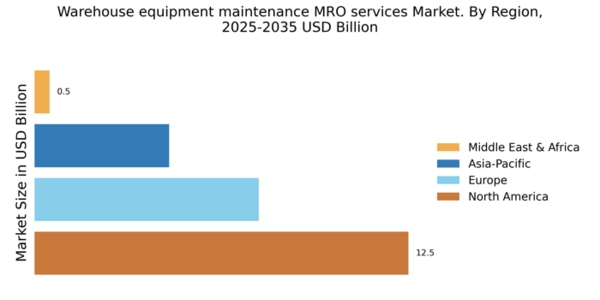
North America is poised to maintain its leadership in the Warehouse equipment maintenance MRO services market, holding a significant market share of 12.5 in 2024. The region's growth is driven by increasing automation in warehouses, stringent safety regulations, and a rising demand for efficient supply chain management. The adoption of advanced technologies, such as IoT and AI, further propels market expansion, ensuring compliance with regulatory standards and enhancing operational efficiency. The competitive landscape in North America is robust, featuring key players like Honeywell, Rockwell Automation, and Emerson Electric. These companies leverage innovative solutions to meet the growing demand for maintenance services. The U.S. stands out as the leading country, supported by a strong industrial base and significant investments in warehouse infrastructure. The presence of established firms fosters a dynamic environment, driving continuous improvements in service delivery and customer satisfaction.
Europe's Warehouse equipment maintenance MRO services market is on an upward trajectory, with a market size of 7.5 in 2024. The region benefits from a strong regulatory framework promoting safety and efficiency in warehouse operations. Increasing investments in automation and digitalization are key growth drivers, alongside a growing emphasis on sustainability and energy efficiency. These factors are expected to enhance service demand, aligning with EU regulations aimed at improving operational standards across industries. Leading countries in Europe include Germany, France, and the UK, where major players like Siemens and Schneider Electric are actively expanding their service offerings. The competitive landscape is characterized by a mix of established firms and emerging startups, fostering innovation and collaboration. The presence of key players ensures a diverse range of services, catering to the evolving needs of the market, thereby enhancing overall service quality and customer satisfaction.
The Asia-Pacific region is experiencing rapid growth in the Warehouse equipment maintenance MRO services market, with a market size of 4.5 in 2024. This growth is fueled by increasing industrialization, urbanization, and a rising demand for efficient logistics solutions. Governments are implementing supportive policies to enhance infrastructure development, which is expected to further drive the demand for maintenance services in warehouses. The focus on improving supply chain efficiency is a key catalyst for market expansion in this region. Countries like Japan, China, and Australia are leading the charge in this market, with significant investments in warehouse automation and maintenance technologies. Key players such as Mitsubishi Electric and Konecranes are actively involved in providing innovative solutions tailored to local market needs. The competitive landscape is evolving, with both The Warehouse equipment maintenance MRO services share, ensuring a dynamic environment for service delivery and innovation.
The Middle East and Africa region presents an emerging market for Warehouse equipment maintenance MRO services, with a market size of 0.5 in 2024. The growth in this region is primarily driven by increasing investments in infrastructure and logistics, alongside a growing emphasis on operational efficiency. Governments are recognizing the importance of modernizing warehouse facilities, which is expected to create new opportunities for maintenance services. The region's strategic location also enhances its appeal as a logistics hub, further driving demand for MRO services. Leading countries in this region include South Africa and the UAE, where there is a growing presence of international players looking to capitalize on the market potential. The competitive landscape is characterized by a mix of local and global firms, fostering innovation and service diversification. As the market matures, the focus will shift towards enhancing service quality and meeting the evolving needs of customers, paving the way for sustainable growth in the MRO sector.
The Warehouse equipment maintenance MRO services Market is currently characterized by a dynamic competitive landscape, driven by technological advancements and increasing demand for operational efficiency. Key players such as Honeywell (US), Siemens (DE), and Rockwell Automation (US) are strategically positioning themselves through innovation and digital transformation initiatives. These companies are focusing on enhancing their service offerings and integrating advanced technologies, which collectively shapes a competitive environment that is increasingly reliant on automation and data analytics.In terms of business tactics, companies are localizing manufacturing and optimizing supply chains to enhance responsiveness and reduce costs. The market appears moderately fragmented, with a mix of established players and emerging firms. The collective influence of these key players is significant, as they drive trends in service quality and technological integration, thereby influencing customer expectations and competitive dynamics.
In November Honeywell (US) announced the launch of its new predictive maintenance software, which leverages AI to enhance equipment reliability and reduce downtime. This strategic move is likely to position Honeywell as a leader in the digital maintenance space, as it addresses the growing need for proactive maintenance solutions in warehouse operations. The integration of AI into their offerings may also enhance customer loyalty and operational efficiency.
In October Siemens (DE) expanded its partnership with a leading logistics provider to implement IoT solutions across multiple warehouses. This collaboration aims to optimize inventory management and streamline operations through real-time data analytics. The strategic importance of this partnership lies in Siemens' ability to leverage its technological expertise to enhance operational efficiencies, thereby solidifying its market position in the MRO services sector.
In September Rockwell Automation (US) acquired a software company specializing in cloud-based maintenance solutions. This acquisition is expected to bolster Rockwell's capabilities in providing comprehensive maintenance solutions that integrate seamlessly with existing warehouse management systems. The strategic significance of this move is that it enhances Rockwell's portfolio, allowing it to offer more robust solutions that cater to the evolving needs of its customers.
As of December current competitive trends indicate a strong emphasis on digitalization, sustainability, and AI integration within the Warehouse equipment maintenance MRO services Market. Strategic alliances are increasingly shaping the landscape, as companies seek to combine their strengths to deliver innovative solutions. Looking ahead, competitive differentiation is likely to evolve from traditional price-based competition to a focus on innovation, technology, and supply chain reliability, reflecting the changing demands of the market.





The Warehouse equipment maintenance MRO services market is projected to grow at a 4.37% CAGR from 2025 to 2035, driven by technological advancements and increasing automation.
New opportunities lie in:
By 2035, the market is expected to be robust, reflecting sustained growth and innovation.
| MARKET SIZE 2024 | 25.0(USD Billion) |
| MARKET SIZE 2025 | 26.09(USD Billion) |
| MARKET SIZE 2035 | 40.0(USD Billion) |
| COMPOUND ANNUAL GROWTH RATE (CAGR) | 4.37% (2025 - 2035) |
| REPORT COVERAGE | Revenue Forecast, Competitive Landscape, Growth Factors, and Trends |
| BASE YEAR | 2024 |
| Market Forecast Period | 2025 - 2035 |
| Historical Data | 2019 - 2024 |
| Market Forecast Units | USD Billion |
| Key Companies Profiled | Honeywell (US), Siemens (DE), Rockwell Automation (US), Emerson Electric (US), Schneider Electric (FR), Konecranes (FI), Mitsubishi Electric (JP), SICK AG (DE), Cognex Corporation (US) |
| Segments Covered | Application, Service Type, End Use, Equipment Type, Maintenance Strategy |
| Key Market Opportunities | Integration of predictive maintenance technologies enhances efficiency in the Warehouse equipment maintenance MRO services Market. |
| Key Market Dynamics | Rising demand for automated solutions drives innovation in warehouse equipment maintenance and MRO services. |
| Countries Covered | North America, Europe, APAC, South America, MEA |
The projected market valuation for the Warehouse equipment maintenance MRO services Market in 2035 is expected to reach 40.0 USD Billion.
The overall market valuation for the Warehouse equipment maintenance MRO services Market was 25.0 USD Billion in 2024.
The expected CAGR for the Warehouse equipment maintenance MRO services Market during the forecast period 2025 - 2035 is 4.37%.
Key players in the Warehouse equipment maintenance MRO services Market include Honeywell, Siemens, Rockwell Automation, Emerson Electric, and Schneider Electric.
The projected valuations for Material Handling Equipment in the Warehouse equipment maintenance MRO services Market range from 8.0 to 12.0 USD Billion.
The projected valuation for Preventive Maintenance ranges from 5.0 to 8.0 USD Billion, whereas Corrective Maintenance is projected to range from 7.0 to 11.0 USD Billion.
The expected valuation range for Distribution Centers in the Warehouse equipment maintenance MRO services Market is between 7.0 and 11.0 USD Billion.
The projected valuations for Forklifts in the Warehouse equipment maintenance MRO services Market range from 8.0 to 12.0 USD Billion.
The maintenance strategies included in the analysis are In-House Maintenance, Outsourced Maintenance, Scheduled Maintenance, On-Demand Maintenance, and Contractual Maintenance.
The projected valuation for Outsourced Maintenance in the Warehouse equipment maintenance MRO services Market ranges from 7.0 to 11.0 USD Billion.


Kindly complete the form below to receive a free sample of this Report

“This is really good guys. Excellent work on a tight deadline. I will continue to use you going forward and recommend you to others. Nice job”


“Thanks. It’s been a pleasure working with you, please use me as reference with any other Intel employees.”


“Thanks for sending the report it gives us a good global view of the Betaïne market.”


“Thank you, this will be very helpful for OQS.”


“We found the report very insightful! we found your research firm very helpful. I'm sending this email to secure our future business.”


“I am very pleased with how market segments have been defined in a relevant way for my purposes (such as "Portable Freezers & refrigerators" and "last-mile"). In general the report is well structured. Thanks very much for your efforts.”


“I have been reading the first document or the study, ,the Global HVAC and FP market report 2021 till 2026. Must say, good info! I have not gone in depth at all parts, but got a good indication of the data inside!”


“We got the report in time, we really thank you for your support in this process. I also thank to all of your team as they did a great job.”


“The Automotive 48V ECU Components Procurement Intelligence Study” was a complex project, but the Market Research Future (MRFR) team handled it with quality, agility, and customer-centricity. They delivered all requested data on time and within the agreed scope. The team, including Shubhendra Anand and Rahul Gotadki, was always readily available to clarify questions and swiftly implement necessary adjustments, driving the project to a successful conclusion within a very demanding timeframe.
I would also like to specifically commend Akshay Agarwal for his responsiveness and support at every stage—from our initial inquiry on May 6th through to final delivery on June 18th. His dedication made the entire process seamless.”



