Download Free Sample
Kindly complete the form below to receive a free sample of this Report
Wealth Tax Consulting Services Market Size, Share and Trends Analysis Research Report Information By Industry (Financial, Real Estate, Philanthropy, Legal), By Client Type (HNWIs, UHNWIs, Family Offices, Trusts), By Service Type (Tax Planning, Compliance, Estate Planning, Investment Advisory), By Engagement Model (Retainer, Project, Hourly Consulting), And By Region – Market Forecast Till 2035.
As per MRFR analysis, the Wealth Tax Consulting Services Market Size was estimated at 3.5 USD Billion in 2024. The Wealth Tax Consulting Services industry is projected to grow from 3.69 in 2025 to 6.2 by 2035, exhibiting a compound annual growth rate (CAGR) of 5.34% during the forecast period 2025 - 2035.
The Wealth Tax Consulting Services Market is experiencing a dynamic shift towards personalized and technology-driven solutions.
| 2024 Market Size | 3.5 (USD Billion) |
| 2035 Market Size | 6.2 (USD Billion) |
| CAGR (2025 - 2035) | 5.34% |
Deloitte (US), PwC (GB), EY (GB), KPMG (NL), BDO (GB), Grant Thornton (GB), RSM (GB), Baker Tilly (GB), Mazars (FR)
Our Impact
Enabled $4.3B Revenue Impact for Fortune 500 and Leading Multinationals
Partnering with 2000+ Global Organizations Each Year
30K+ Citations by Top-Tier Firms in the Industry
The Wealth Tax Consulting Services Market is currently experiencing a notable evolution, driven by various factors that influence wealth management strategies. As individuals and families accumulate assets, the complexity of managing these resources increases, necessitating expert guidance. This market appears to be expanding as clients seek tailored solutions to navigate the intricacies of wealth taxation. Furthermore, the growing awareness of tax obligations and the potential for wealth preservation has led to an increased demand for specialized consulting services. Wealth tax consultants are now more frequently engaged to provide insights into compliance, planning, and optimization strategies, which may enhance clients' financial positions. In addition, the Wealth Tax Consulting Services Market seems to be adapting to technological advancements. Digital tools and platforms are becoming integral to service delivery, allowing for more efficient communication and data management. This shift not only streamlines operations but also enhances the client experience. As the market continues to evolve, it is likely that firms will increasingly leverage technology to offer innovative solutions, thereby positioning themselves competitively in a dynamic landscape. The interplay of regulatory changes and client expectations will further shape the future of this market, suggesting a period of transformation and growth ahead.
Clients are increasingly seeking customized wealth tax consulting services that cater to their unique financial situations. This trend indicates a shift from one-size-fits-all solutions to more tailored approaches, reflecting the diverse needs of high-net-worth individuals.
The Wealth Tax Consulting Services Market is witnessing a growing integration of technology, with firms adopting digital tools to enhance efficiency and client engagement. This trend suggests that technology will play a crucial role in shaping service offerings and operational processes.
As tax regulations evolve, there is a heightened emphasis on compliance and risk management within the Wealth Tax Consulting Services Market. Firms are increasingly prioritizing these aspects to help clients navigate complex legal frameworks and mitigate potential liabilities.
The Wealth Tax Consulting Services Market is significantly influenced by the evolving landscape of tax regulations. Governments are continuously revising tax codes and implementing new policies aimed at wealth redistribution and increased revenue generation. This dynamic environment necessitates that individuals and businesses remain informed about the latest changes to avoid potential penalties and optimize their tax positions. For instance, recent legislative changes in several jurisdictions have introduced new wealth tax frameworks, compelling clients to seek expert advice on compliance and strategic planning. The complexity of these regulations often requires specialized knowledge, thereby driving demand for wealth tax consulting services. As clients navigate these intricate tax landscapes, the role of consultants becomes increasingly vital in ensuring adherence to legal requirements while maximizing financial efficiency.
The Wealth Tax Consulting Services Market is experiencing a notable surge in demand due to the increasing wealth inequality observed in various regions. As wealth becomes concentrated among a smaller percentage of the population, individuals and families with substantial assets seek expert guidance to navigate the complexities of wealth taxation. This trend is underscored by data indicating that the top 1% of earners hold a significant portion of total wealth, prompting a greater need for specialized consulting services. Wealth tax consultants are thus positioned to provide tailored strategies that address the unique challenges faced by high-net-worth individuals, ensuring compliance while optimizing tax liabilities. The growing awareness of wealth inequality issues further fuels the demand for consulting services, as clients aim to align their financial strategies with social responsibility and ethical considerations.
The Wealth Tax Consulting Services Market is witnessing a heightened emphasis on estate planning as individuals recognize the importance of managing their wealth across generations. With the aging population and the transfer of wealth to heirs becoming a pressing concern, clients are increasingly seeking professional advice to structure their estates effectively. This trend is reflected in market data indicating that estate planning services have seen a substantial uptick, with many clients prioritizing tax-efficient strategies to minimize liabilities for their beneficiaries. Wealth tax consultants play a crucial role in this process, offering insights into the implications of wealth taxes on estate transfers and helping clients devise comprehensive plans that align with their financial goals. The growing awareness of the need for proactive estate planning is likely to continue driving demand for consulting services in this sector.
The Wealth Tax Consulting Services Market is benefiting from a growing awareness among clients regarding tax optimization strategies. As individuals and businesses seek to maximize their financial outcomes, there is an increasing recognition of the importance of effective tax planning. This awareness is driven by the realization that strategic wealth management can lead to significant savings and improved financial health. Market data suggests that clients are more inclined to invest in consulting services that provide insights into tax-efficient investment options and wealth preservation techniques. Wealth tax consultants are thus positioned to educate clients on various strategies, including tax deferral and charitable giving, which can enhance their overall financial strategies. This trend indicates a shift towards proactive financial management, further propelling the demand for wealth tax consulting services.
The Wealth Tax Consulting Services Market is being reshaped by technological advancements that enhance service delivery and client engagement. The integration of digital tools and platforms allows consultants to offer more efficient and personalized services, catering to the unique needs of high-net-worth clients. For instance, data analytics and artificial intelligence are increasingly utilized to provide insights into clients' financial situations, enabling more informed decision-making regarding wealth tax strategies. This technological evolution not only streamlines operations but also improves the overall client experience, fostering stronger relationships between consultants and their clients. As technology continues to evolve, the Wealth Tax Consulting Services Market is likely to see further innovations that enhance service offerings and attract a broader clientele.
The Wealth Tax Consulting Services Market is characterized by a diverse client base, with High Net Worth Individuals (HNWIs) commanding a significant market share. These clients primarily seek tailored tax strategies to sustain their wealth while minimizing tax liabilities. In contrast, Ultra High Net Worth Individuals (UHNWIs) have emerged as a rapidly growing segment, driven by their unique financial landscapes and increasingly complex financial needs. This dynamic creates distinct opportunities for consulting firms to tailor their services to each segment effectively. Growth trends in this segment are fueled by increasing wealth concentrations and heightened awareness regarding tax obligations. As UHNWIs face more intricate tax regulations and prefer exclusive, specialized advisory services, consulting firms have adjusted their approaches to address the demands of this fast-evolving client profile. Consequently, the market has seen an uptick in services that cater to individualized needs, positioning UHNWIs as a critical driver of growth within this sector.
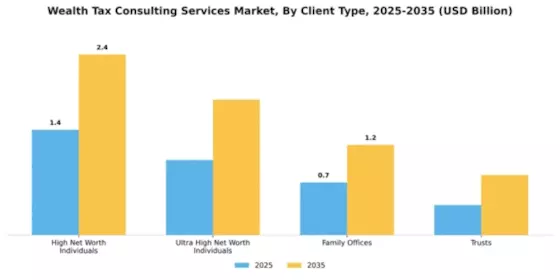
High Net Worth Individuals (Dominant) vs. Family Offices (Emerging)
High Net Worth Individuals (HNWIs) represent the dominant client base in the Wealth Tax Consulting Services Market, benefiting from established relationships with consulting firms that understand their intricate financial portfolios. Their focus tends to be on wealth preservation, estate planning, and strategic tax optimization. In contrast, Family Offices are an emerging segment, gaining traction as wealthy families seek comprehensive management of their investments and tax strategies under one roof. Family Offices provide a holistic approach to family wealth, addressing not only tax matters but also investment management, succession planning, and personal services. Together, these segments reflect the evolving landscape of wealth management, where personalized service and nuanced understanding of family dynamics are increasingly paramount.
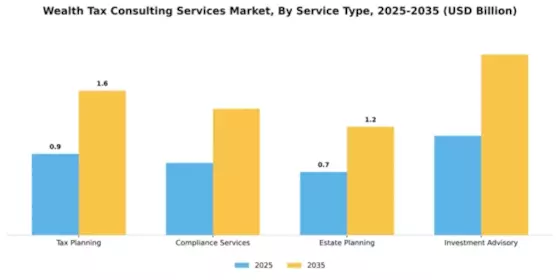
The Wealth Tax Consulting Services Market displays a diverse distribution among its service types. Tax Planning emerges as the largest segment, dominating the market due to its essential role in helping clients structure their finances effectively to minimize liabilities. Compliance Services, while smaller, is gaining traction rapidly as regulatory environments become increasingly complex, necessitating professional guidance to ensure adherence to tax regulations.
Tax Planning (Dominant) vs. Compliance Services (Emerging)
Tax Planning serves as the cornerstone of wealth tax consulting, as it assists clients in creating strategic plans that align with current legislation while maximizing tax benefits. This segment caters primarily to high-net-worth individuals and organizations seeking to optimize their tax burdens proactively. On the other hand, Compliance Services is emerging as a crucial player due to rising regulatory demands. As governments intensify scrutiny on tax adherence, the need for expert advisory to navigate the intricate compliance frameworks is driving growth in this area, establishing it as a preferred choice among clients looking for peace of mind.
Within the Wealth Tax Consulting Services Market, the Financial Services segment holds the largest share, driven by increasing demand for wealth management and tax optimization strategies among high-net-worth individuals. This segment encompasses various financial institutions and advisory services that cater to wealth distribution and planning, indicating a mature market presence that continues to solidify its position. Legal Services, in contrast, represents the fastest-growing segment. As individuals and families seek expert guidance on navigating complex tax laws and compliance issues, the demand for specialized legal advisors in wealth taxation is escalating. Recent legislative changes and heightened scrutiny over wealth taxes have propelled legal advisors into the forefront of this market, reflecting an evolving landscape that favors legal guidance in wealth management strategies.
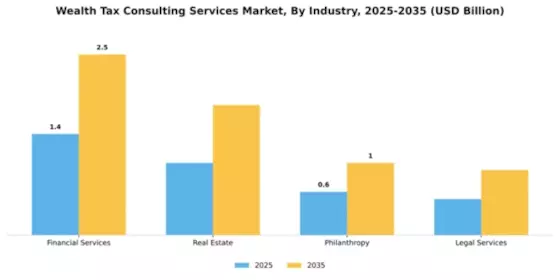
Financial Services: Dominant vs. Legal Services: Emerging
The Financial Services segment in the Wealth Tax Consulting Services Market is characterized by its established and comprehensive offerings that include investment advice, wealth management, and tax planning services tailored for affluent clients. This segment’s strength lies in its diverse range of services designed to optimize financial portfolios, ensuring clients are strategically positioned to navigate tax liabilities. Conversely, the Legal Services segment is emerging rapidly as clients increasingly recognize the importance of legal expertise in tax compliance and estate planning. This segment is evolving due to the ever-changing regulatory environment and the complexity of tax laws, prompting families to seek proactive legal assistance. The synergy between these segments fosters a competitive landscape, with Financial Services leveraging established relationships while Legal Services capitalize on the rising need for expert legal support.
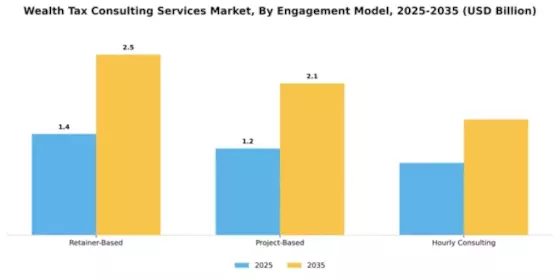
In the Wealth Tax Consulting Services Market, the engagement model segment showcases a diverse distribution between retainer-based, project-based, and hourly consulting services. Retainer-based models dominate the market, offering long-term stability and ongoing client relationships. In contrast, project-based models have gained traction, appealing to clients seeking flexibility and targeted assistance for specific tasks. Hourly consulting remains essential, often serving clients looking for immediate insights without a long-term commitment.
Retainer-Based (Dominant) vs. Project-Based (Emerging)
Retainer-based engagement models are characterized by consistent revenue streams and strong client retention, positioning them as a dominant force in the Wealth Tax Consulting Services Market. This model is favored by clients who prefer comprehensive, ongoing support and expertise over time. On the other hand, project-based models are emerging rapidly, attracting clients who desire targeted consulting for specific wealth tax challenges without the commitment of a long-term arrangement. These models thrive on agility and the ability to deliver specialized solutions, making them increasingly popular in a market that is evolving in response to changing client needs.
Get more detailed insights about Wealth Tax Consulting Services Market Request Free Sample
North America continues to lead the Wealth Tax Consulting Services Market, holding a significant market share of 1.75B in 2024. The region's growth is driven by increasing high-net-worth individuals (HNWIs) and evolving tax regulations that necessitate expert consulting services. Additionally, the demand for personalized wealth management strategies is on the rise, further propelling market expansion. Regulatory frameworks are becoming more complex, prompting clients to seek professional guidance to navigate these changes effectively. The competitive landscape in North America is robust, featuring key players such as Deloitte, PwC, and EY, which dominate the market with their extensive service offerings. The United States stands out as the leading country, supported by a strong financial services sector and a high concentration of wealth. The presence of established firms ensures a competitive environment, fostering innovation and high-quality service delivery. As the market evolves, these firms are likely to adapt their strategies to meet the changing needs of clients.
Europe's Wealth Tax Consulting Services Market is projected to reach 1.2B by 2025, driven by increasing wealth concentration and regulatory changes across member states. The demand for tailored tax strategies is rising as individuals and families seek to optimize their wealth management. Countries like Germany and France are leading this trend, with governments implementing new tax policies that require expert consulting services to ensure compliance and maximize tax efficiency. The competitive landscape in Europe is characterized by a mix of local and international firms, including PwC, EY, and KPMG. The presence of these key players enhances service offerings and fosters competition. Germany and the UK are notable leaders in this market, with a high density of HNWIs and a growing need for sophisticated tax planning. As regulations evolve, firms are expected to innovate their services to cater to the diverse needs of their clients.
The Asia-Pacific region is witnessing a burgeoning Wealth Tax Consulting Services Market, projected to reach 0.8B by 2025. This growth is fueled by a rising number of affluent individuals and increasing awareness of tax obligations. Countries like China and India are experiencing significant demand for wealth management services as their economies expand and wealth distribution becomes more pronounced. Regulatory changes are also prompting individuals to seek professional advice to navigate complex tax landscapes. The competitive environment in Asia-Pacific is evolving, with both local and international firms vying for market share. Key players such as Deloitte and KPMG are establishing a strong presence, while local firms are also gaining traction. China is emerging as a leader in this market, driven by its rapid economic growth and increasing number of HNWIs. As the market matures, firms will need to adapt their strategies to meet the unique needs of this diverse region.
The Middle East and Africa region is gradually developing its Wealth Tax Consulting Services Market, projected to reach 0.75B by 2025. The growth is driven by increasing wealth among individuals and families, particularly in Gulf Cooperation Council (GCC) countries. As tax regulations become more stringent, there is a growing need for professional consulting services to ensure compliance and optimize tax strategies. The region's unique economic landscape presents both challenges and opportunities for wealth management. Countries like the UAE and South Africa are at the forefront of this market, with a rising number of HNWIs seeking expert advice. The competitive landscape is still emerging, with both local and international firms, including Baker Tilly and Mazars, establishing their presence. As the market evolves, firms will need to innovate and tailor their services to meet the specific needs of clients in this diverse region.
The Wealth Tax Consulting Services Market is currently characterized by a dynamic competitive landscape, driven by increasing global wealth concentration and evolving tax regulations. Major players such as Deloitte (US), PwC (GB), and EY (GB) are strategically positioned to leverage their extensive expertise in tax advisory services. These firms are focusing on digital transformation and innovative solutions to enhance client engagement and streamline operations. Their collective strategies not only foster competition but also elevate service standards across the market, as they adapt to the complexities of wealth management and tax compliance.In terms of business tactics, firms are increasingly localizing their services to cater to diverse regulatory environments, which appears to be a response to the fragmented nature of the market. The competitive structure is moderately fragmented, with key players exerting substantial influence while also facing challenges from emerging boutique firms. This duality creates a landscape where established firms must continuously innovate to maintain their market share amidst growing competition.In November Deloitte (US) announced a strategic partnership with a leading fintech company to enhance its wealth tax consulting capabilities through advanced data analytics. This move is likely to bolster Deloitte's service offerings, enabling them to provide more tailored solutions to high-net-worth individuals. The integration of technology into their consulting practices may significantly improve efficiency and client satisfaction, positioning Deloitte favorably in a competitive market.Similarly, in October 2025, PwC (GB) launched a new digital platform aimed at simplifying wealth tax compliance for clients. This initiative reflects PwC's commitment to digitalization and innovation, potentially setting a new benchmark for client service in the industry. By streamlining processes and enhancing user experience, PwC may attract a broader client base, thereby strengthening its competitive position.In September EY (GB) expanded its global footprint by acquiring a boutique wealth management firm in Asia. This acquisition is indicative of EY's strategy to enhance its service portfolio and tap into emerging markets. The move not only diversifies EY's offerings but also positions the firm to capitalize on the growing demand for wealth tax consulting services in the region, suggesting a proactive approach to market expansion.As of December the Wealth Tax Consulting Services Market is witnessing trends such as digitalization, sustainability, and AI integration, which are reshaping competitive dynamics. Strategic alliances among firms are becoming increasingly prevalent, fostering innovation and enhancing service delivery. The shift from price-based competition to a focus on technology and supply chain reliability is evident, indicating that firms must differentiate themselves through innovative solutions and superior client service to thrive in this evolving landscape.





The Wealth Tax Consulting Services Market is projected to grow at a 5.34% CAGR from 2025 to 2035, driven by increasing wealth concentration and regulatory complexities.
New opportunities lie in:
By 2035, the market is expected to solidify its position as a vital service for wealth management.
| MARKET SIZE 2024 | 3.5(USD Billion) |
| MARKET SIZE 2025 | 3.69(USD Billion) |
| MARKET SIZE 2035 | 6.2(USD Billion) |
| COMPOUND ANNUAL GROWTH RATE (CAGR) | 5.34% (2025 - 2035) |
| REPORT COVERAGE | Revenue Forecast, Competitive Landscape, Growth Factors, and Trends |
| BASE YEAR | 2024 |
| Market Forecast Period | 2025 - 2035 |
| Historical Data | 2019 - 2024 |
| Market Forecast Units | USD Billion |
| Key Companies Profiled | Deloitte (US), PwC (GB), EY (GB), KPMG (NL), BDO (GB), Grant Thornton (GB), RSM (GB), Baker Tilly (GB), Mazars (FR) |
| Segments Covered | Client Type, Service Type, Industry, Engagement Model |
| Key Market Opportunities | Increasing demand for personalized wealth management strategies drives growth in the Wealth Tax Consulting Services Market. |
| Key Market Dynamics | Rising regulatory scrutiny and evolving consumer preferences drive demand for specialized wealth tax consulting services. |
| Countries Covered | North America, Europe, APAC, South America, MEA |
The market valuation reached 3.5 USD Billion in 2024.
The market is expected to grow to 6.2 USD Billion by 2035.
The expected CAGR for the market from 2025 to 2035 is 5.34%.
High Net Worth Individuals and Ultra High Net Worth Individuals are the largest segments, valued at 2.4 and 1.8 USD Billion respectively.
Investment Advisory services are projected to grow to 2.0 USD Billion, indicating strong demand.
Retainer-Based engagement is expected to reach 2.5 USD Billion, making it the most lucrative model.
Financial Services and Real Estate are leading industries, with valuations of 2.5 and 1.8 USD Billion respectively.
Key players include Deloitte, PwC, EY, KPMG, BDO, Grant Thornton, RSM, Baker Tilly, and Mazars.
Family Offices are expected to grow from 0.7 to 1.2 USD Billion by 2035.
The increasing complexity of tax regulations and wealth management needs appears to be driving market growth.


Kindly complete the form below to receive a free sample of this Report

“This is really good guys. Excellent work on a tight deadline. I will continue to use you going forward and recommend you to others. Nice job”


“Thanks. It’s been a pleasure working with you, please use me as reference with any other Intel employees.”


“Thanks for sending the report it gives us a good global view of the Betaïne market.”


“Thank you, this will be very helpful for OQS.”


“We found the report very insightful! we found your research firm very helpful. I'm sending this email to secure our future business.”


“I am very pleased with how market segments have been defined in a relevant way for my purposes (such as "Portable Freezers & refrigerators" and "last-mile"). In general the report is well structured. Thanks very much for your efforts.”


“I have been reading the first document or the study, ,the Global HVAC and FP market report 2021 till 2026. Must say, good info! I have not gone in depth at all parts, but got a good indication of the data inside!”


“We got the report in time, we really thank you for your support in this process. I also thank to all of your team as they did a great job.”


“The Automotive 48V ECU Components Procurement Intelligence Study” was a complex project, but the Market Research Future (MRFR) team handled it with quality, agility, and customer-centricity. They delivered all requested data on time and within the agreed scope. The team, including Shubhendra Anand and Rahul Gotadki, was always readily available to clarify questions and swiftly implement necessary adjustments, driving the project to a successful conclusion within a very demanding timeframe.
I would also like to specifically commend Akshay Agarwal for his responsiveness and support at every stage—from our initial inquiry on May 6th through to final delivery on June 18th. His dedication made the entire process seamless.”



