×
Request Free Sample ×

Kindly complete the form below to receive a free sample of this Report

* Please use a valid business email

Leading companies partner with us for data-driven Insights

clients tt-cursor
Hero Background

Web3 in Retail Market

ID: MRFR/ICT/10725-HCR
128 Pages
Shubham Munde
October 2025

Web3 in Retail Market Research Report: Information By Type (Public, Private, Consortium, Hybrid), By Application (Cryptocurrency, Conversational AI, Data & Transaction Storage, Payments, Smart Contracts, Others) And By Region (North America, Europe, Asia-Pacific, And Rest Of The World) –Market Forecast Till 2035.

Share:
Download PDF ×

We do not share your information with anyone. However, we may send you emails based on your report interest from time to time. You may contact us at any time to opt-out.

Web3 in Retail Market Infographic
Purchase Options

Web3 in Retail Market Summary

As per MRFR analysis, the Web3 in Retail Market Size was estimated at 7.83 USD Billion in 2024. The Web3 in Retail industry is projected to grow from 11.49 USD Billion in 2025 to 530.61 USD Billion by 2035, exhibiting a compound annual growth rate (CAGR) of 46.7 during the forecast period 2025 - 2035.

Key Market Trends & Highlights

The Web3 in Retail Market is experiencing transformative growth driven by innovative technologies and evolving consumer expectations.

  • North America remains the largest market for Web3 in retail, showcasing robust adoption of decentralized finance solutions.
  • Asia-Pacific is emerging as the fastest-growing region, with a notable increase in the use of non-fungible tokens for enhancing customer engagement.
  • Decentralized finance is the largest segment, while e-commerce platforms are rapidly adopting Web3 technologies to improve user experiences.
  • Key market drivers include decentralized supply chain management and the tokenization of assets, which are reshaping retail operations.

Market Size & Forecast

2024 Market Size 7.83 (USD Billion)
2035 Market Size 530.61 (USD Billion)
CAGR (2025 - 2035) 46.7%

Major Players

Amazon (US), Walmart (US), Alibaba (CN), Shopify (CA), eBay (US), Rakuten (JP), Zalando (DE), JD.com (CN), Target (US)

Web3 in Retail Market Trends

The Web3 in Retail Market is currently experiencing a transformative phase, characterized by the integration of decentralized technologies that enhance consumer engagement and streamline operations. Retailers are increasingly adopting blockchain solutions to improve transparency and security in transactions, which appears to foster greater trust among consumers. Additionally, the rise of non-fungible tokens (NFTs) is reshaping how brands interact with their customers, offering unique digital assets that can enhance brand loyalty and create new revenue streams. This shift towards a more decentralized retail environment suggests a potential redefinition of traditional business models, as companies explore innovative ways to leverage Web3 technologies. Moreover, the emphasis on data privacy and ownership is becoming paramount in the Web3 in Retail Market. Consumers are increasingly aware of their digital footprints and are seeking platforms that prioritize their privacy. This trend indicates a growing demand for solutions that empower users to control their personal information while engaging with brands. As the market evolves, it is likely that retailers will need to adapt their strategies to align with these consumer expectations, potentially leading to a more ethical and sustainable retail landscape in the future.

Decentralized Finance Integration

The integration of decentralized finance (DeFi) solutions within the Web3 in Retail Market is gaining traction. Retailers are exploring ways to utilize DeFi protocols to facilitate seamless transactions, enabling customers to engage in direct peer-to-peer exchanges without intermediaries. This trend may lead to reduced transaction costs and enhanced financial inclusivity for consumers.

Enhanced Customer Experience through NFTs

The utilization of non-fungible tokens (NFTs) is emerging as a key trend in the Web3 in Retail Market. Brands are leveraging NFTs to create unique digital experiences for consumers, such as exclusive access to products or events. This approach not only fosters brand loyalty but also opens new avenues for monetization.

Focus on Data Sovereignty

A growing emphasis on data sovereignty is evident in the Web3 in Retail Market. Consumers are increasingly concerned about their data privacy and ownership, prompting retailers to adopt solutions that allow users to control their personal information. This trend indicates a shift towards more ethical practices in data management, aligning with consumer expectations.

Web3 in Retail Market Drivers

Tokenization of Assets

The Global Web3 in Retail Market Industry is experiencing a surge in the tokenization of assets, which allows physical goods to be represented as digital tokens on a blockchain. This innovation facilitates fractional ownership and enhances liquidity for retail products. For instance, luxury brands are exploring tokenization to offer exclusive ownership experiences to consumers. As this trend gains traction, it is anticipated that the market will achieve a compound annual growth rate of 58.69% from 2025 to 2035. This growth may lead to a more dynamic retail landscape where consumers can invest in and trade tokenized assets seamlessly.

Market Growth Projections

The Global Web3 in Retail Market Industry is poised for remarkable growth, with projections indicating a rise from 3.3 USD Billion in 2024 to 530.6 USD Billion by 2035. This trajectory suggests a compound annual growth rate of 58.69% from 2025 to 2035, reflecting the increasing adoption of Web3 technologies across the retail sector. Factors contributing to this growth include the decentralization of transactions, enhanced customer experiences, and the integration of advanced technologies such as AI and blockchain. As retailers continue to innovate and adapt to changing consumer preferences, the market is likely to expand significantly in the coming years.

Supply Chain Transparency

Supply chain transparency is becoming increasingly critical in the Global Web3 in Retail Market Industry. By utilizing blockchain technology, retailers can provide consumers with verifiable information about product origins, manufacturing processes, and sustainability practices. This transparency not only builds consumer trust but also aligns with the growing demand for ethical consumption. As retailers adopt these technologies, they are likely to differentiate themselves in a competitive market. The emphasis on transparency is expected to contribute to the projected market growth, as consumers increasingly seek brands that prioritize ethical practices and sustainability.

Enhanced Customer Experience

In the Global Web3 in Retail Market Industry, enhancing customer experience is paramount. Retailers are increasingly leveraging Web3 technologies to create personalized shopping experiences through data ownership and privacy. For example, customers can control their data and choose how it is shared, fostering trust and loyalty. This shift is expected to drive market growth, with projections indicating a rise to 530.6 USD Billion by 2035. As retailers adopt immersive technologies such as augmented reality and virtual reality, they are likely to create engaging environments that resonate with consumers, thus enhancing overall satisfaction and retention.

Decentralization of Transactions

The Global Web3 in Retail Market Industry is witnessing a notable shift towards decentralized transactions. This transformation allows retailers to bypass traditional intermediaries, thereby reducing transaction costs and enhancing efficiency. For instance, blockchain technology enables peer-to-peer transactions, which can lead to faster settlements and increased trust among consumers. As a result, the market is projected to reach 3.3 USD Billion in 2024, reflecting a growing preference for decentralized solutions. This trend is likely to continue as more retailers adopt blockchain platforms, potentially revolutionizing the way transactions are conducted in the retail sector.

Integration of Artificial Intelligence

The integration of artificial intelligence within the Global Web3 in Retail Market Industry is reshaping how retailers operate. AI technologies are being employed to analyze consumer behavior, optimize inventory management, and enhance marketing strategies. This data-driven approach allows retailers to make informed decisions and tailor their offerings to meet consumer demands effectively. As AI continues to evolve, its synergy with Web3 technologies is likely to drive innovation in the retail sector. The combination of AI and blockchain could lead to more efficient operations and improved customer engagement, further propelling market growth.

Market Segment Insights

By Application: Decentralized Finance (Largest) vs. Non-Fungible Tokens (Fastest-Growing)

In the Web3 in Retail Market, Decentralized Finance (DeFi) holds the largest share, highlighting its critical role in transforming financial transactions within retail environments. This segment has revolutionized how consumers and retailers engage in financial exchanges, offering decentralized solutions that enhance accessibility and reduce costs. Meanwhile, Non-Fungible Tokens (NFTs) are the fastest-growing segment, rapidly gaining in popularity due to their unique ability to create digital scarcity and provenance for retail products. This trend reflects a shift towards personalized shopping experiences as consumers increasingly seek exclusive digital ownership. The growth of Decentralized Finance is driven by the demand for user autonomy and privacy in financial interactions, while the surge in Non-Fungible Tokens is fueled by their adoption in digital art, collectibles, and loyalty programs. Both applications are expected to reshape the retail landscape, emphasizing how technology can personalize shopping experiences and streamline financial operations, making them essential components of the Web3 ecosystem in retail.

Decentralized Finance (Dominant) vs. Loyalty Programs (Emerging)

Decentralized Finance (DeFi) represents a dominant force in the Web3 in Retail Market, establishing itself as an essential infrastructure for facilitating peer-to-peer transactions without intermediaries. This application appeals to retailers aiming to reduce transaction fees and enhance customer trust through transparency. Its established user base and extensive platform integrations reinforce its market leadership. Conversely, Loyalty Programs, emerging as a significant segment, leverage blockchain technology to create more engaging and personalized customer experiences. By utilizing tokens or crypto rewards, retailers can foster customer loyalty in innovative ways that conventional programs cannot match. These programs not only enhance customer retention but also utilize gamification techniques to incentivize consumer engagement, positioning them as a key player in shaping the future of customer relationship management in retail.

By End Use: Retailers (Largest) vs. E-commerce Platforms (Fastest-Growing)

In the Web3 in Retail Market, the distribution of market share reveals that retailers hold the largest segment, attributed to their established presence and customer base. They leverage Web3 technologies to enhance customer interactions and streamline operations. On the other hand, e-commerce platforms are witnessing rapid growth as they adopt decentralized technologies which significantly improve user experience and security, positioning them as key players in this evolving landscape. The growth trends indicate that while traditional retailers dominate the market, the expansion of e-commerce platforms showcases the shift towards digital transactions and customer-oriented solutions. Factors driving this growth include increased online shopping, the demand for personalized experiences, and the emergence of decentralized finance solutions, which promote trust and transparency in transactions.

Retailers (Dominant) vs. E-commerce Platforms (Emerging)

Retailers in the Web3 in Retail Market play a dominant role as they integrate blockchain and decentralized technologies into their operations, enhancing supply chain transparency and customer engagement. Traditional retailers benefit from established infrastructures and a loyal customer base, making them effective in channeling Web3 innovations to enhance operational efficiency. Conversely, e-commerce platforms are emerging as significant players, rapidly adapting to the Web3 environment. They prioritize user experience by offering decentralized applications that ensure secure transactions and data privacy. Their rapid adaptability and focus on innovative technologies position them as the fastest-growing segment, appealing to tech-savvy consumers seeking seamless online shopping experiences. This creates an exciting dynamic as both sectors evolve within the Web3 framework.

By Technology: Blockchain (Largest) vs. Tokenization (Fastest-Growing)

In the Web3 in Retail Market, the technology segment showcases a dynamic distribution of market share among its various components. Blockchain stands out as the largest segment, laying the foundation for secure and transparent transactions, while tokenization is rapidly gaining traction due to its innovative approach to digital asset representation. The growth trends in this segment are driven by increasing demand for decentralized technologies among retailers looking to enhance customer engagement and improve supply chain visibility. Smart Contracts and Decentralized Applications are also on the rise as integral components of this technology evolution, fostering automation and efficiency in retail operations. The push for data security further propels Cryptographic Security to be a crucial element in the adoption of Web3 technologies in retail, ensuring trustworthy transactions.

Blockchain (Dominant) vs. Tokenization (Emerging)

Blockchain technology is a dominant force in the Web3 in Retail Market, providing a robust framework for decentralized ledger systems that enhance transparency and trust among stakeholders. Its ability to record transactions securely makes it indispensable for retailers looking to streamline operations and elevate customer experiences. In contrast, tokenization emerges as a transformative trend that allows retailers to digitize assets, enable fractional ownership, and drive new revenue streams. This innovative form of asset management is especially appealing as it aligns with the growing interest in NFT marketplaces and loyalty programs, appealing to both traditional and tech-savvy consumers. Together, these technologies are redefining the landscape of retail, offering enhanced security, efficiency, and customer engagement.

By Business Model: Direct-to-Consumer (Largest) vs. Subscription-Based (Fastest-Growing)

In the Web3 in Retail Market, the Direct-to-Consumer (DTC) model holds a dominant position, capturing substantial market share. This model allows businesses to sell directly to consumers, fostering direct relationships and enhancing customer engagement. On the other hand, the Subscription-Based model is rapidly gaining traction, appealing to consumers' desire for convenience and value. As a recurring revenue model, it provides companies with predictable revenue streams and customer loyalty.

Direct-to-Consumer (Dominant) vs. Subscription-Based (Emerging)

The Direct-to-Consumer (DTC) model stands out as the dominant business strategy in the Web3 retail landscape. This model enables brands to have full control over their customer interactions, ensuring personalized experiences and direct feedback loops. With a focus on community building, DTC allows businesses to cultivate strong brand loyalty. In contrast, the Subscription-Based model is emerging rapidly, driven by consumer demand for curated experiences and continuous access to products and services. Its flexibility in pricing and offerings attracts a diverse customer base, fostering long-term relationships that benefit both parties.

By Consumer Behavior: Tech-Savvy Shoppers (Largest) vs. Privacy-Conscious Consumers (Fastest-Growing)

In the Web3 in Retail Market, Tech-Savvy Shoppers lead with a significant share, driven by their familiarity with blockchain and decentralized applications. This group is inclined towards utilizing new technologies to enhance their shopping experience, thus representing a substantial portion of the market. Conversely, Privacy-Conscious Consumers are emerging rapidly, capitalizing on the growing awareness around data security and personal privacy, reflecting a substantial shift in consumer priorities in the retail landscape.

Tech-Savvy Shoppers (Dominant) vs. Privacy-Conscious Consumers (Emerging)

Tech-Savvy Shoppers are characterized by their early adoption of technology and the willingness to engage with digital assets, NFTs, and decentralized marketplaces. They set trends in the retail sector and are crucial in driving innovation. Conversely, Privacy-Conscious Consumers are gaining traction as the importance of personal data protection climbs. This segment is increasingly advocating for transparency and control over their data, prompting retailers to adopt more privacy-focused strategies. Both segments play critical roles in shaping the dynamics of the Web3 retail environment, balancing innovation with privacy.

Get more detailed insights about Web3 in Retail Market

Regional Insights

North America : Leading Market Innovators

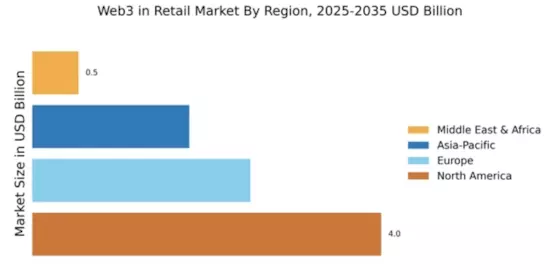
North America continues to lead the Web3 in Retail market, holding a significant share of 4.0 in 2025. The region's growth is driven by increasing consumer demand for decentralized platforms and enhanced data privacy. Regulatory support for blockchain technology and digital currencies further catalyzes this growth, as businesses adapt to evolving consumer preferences and technological advancements. The integration of Web3 solutions is becoming essential for retailers aiming to enhance customer engagement and streamline operations. The competitive landscape is robust, with key players like Amazon, Walmart, and Shopify spearheading innovation. These companies are leveraging Web3 technologies to create immersive shopping experiences and improve supply chain transparency. The presence of established e-commerce giants and a tech-savvy consumer base positions North America as a formidable force in the global Web3 retail market.

Europe : Regulatory Frameworks Evolving

Europe's Web3 in Retail market is projected to reach 2.5 by 2025, driven by a strong regulatory framework that encourages innovation while ensuring consumer protection. The European Union's initiatives to regulate digital assets and promote blockchain technology are pivotal in shaping market dynamics. As retailers increasingly adopt Web3 solutions, the demand for transparency and security in transactions is becoming paramount, aligning with the region's regulatory goals. Leading countries like Germany, France, and the UK are at the forefront of this transformation, with companies such as Zalando and Alibaba expanding their Web3 initiatives. The competitive landscape is characterized by a mix of established retailers and emerging startups, all vying to capture market share. The emphasis on sustainability and ethical practices further enhances the appeal of Web3 solutions in the European retail sector.

Asia-Pacific : Emerging Market Potential

The Asia-Pacific region is witnessing a burgeoning interest in the Web3 in Retail market, with a projected size of 1.8 by 2025. This growth is fueled by increasing internet penetration, a young demographic, and a rising middle class eager for innovative shopping experiences. Countries like China and Japan are leading the charge, with regulatory bodies beginning to recognize the potential of blockchain technology in enhancing retail operations and consumer engagement. Key players such as Alibaba and JD.com are actively investing in Web3 technologies to improve customer experiences and streamline supply chains. The competitive landscape is vibrant, with numerous startups emerging to offer unique solutions tailored to local markets. As the region embraces digital transformation, the Web3 retail market is set to expand significantly, driven by both consumer demand and technological advancements.

Middle East and Africa : Untapped Market Opportunities

The Middle East and Africa (MEA) region, with a market size of 0.53 in 2025, presents significant untapped opportunities in the Web3 in Retail sector. The growth is driven by increasing smartphone penetration and a young, tech-savvy population eager for innovative retail solutions. Governments in the region are beginning to recognize the potential of blockchain technology, leading to a gradual shift towards digital transformation in retail. Countries like South Africa and the UAE are emerging as leaders in adopting Web3 technologies, with local startups and established retailers exploring decentralized platforms. The competitive landscape is still developing, but the presence of key players and increasing investment in technology infrastructure are paving the way for future growth. As awareness of Web3 benefits grows, the MEA region is poised for a retail revolution.

Key Players and Competitive Insights

The Web3 in Retail Market is currently characterized by a dynamic competitive landscape, driven by rapid technological advancements and evolving consumer preferences. Major players such as Amazon (US), Alibaba (CN), and Shopify (CA) are at the forefront, each adopting distinct strategies to enhance their market positioning. Amazon (US) continues to innovate through its extensive logistics network and cloud computing capabilities, while Alibaba (CN) focuses on integrating blockchain technology to enhance transparency and security in transactions. Shopify (CA) emphasizes empowering small to medium-sized enterprises (SMEs) by providing them with tools to leverage Web3 technologies, thus fostering a decentralized retail ecosystem.

The market structure appears moderately fragmented, with a blend of established giants and emerging players. Key tactics such as localizing manufacturing and optimizing supply chains are prevalent among these companies, allowing them to respond swiftly to market demands. The collective influence of these major players shapes a competitive environment where agility and technological integration are paramount, suggesting that companies must continuously adapt to maintain their market share.

In November 2025, Amazon (US) announced the launch of its new decentralized marketplace, which utilizes blockchain technology to facilitate peer-to-peer transactions. This strategic move is likely to enhance customer trust and reduce transaction costs, positioning Amazon as a leader in the Web3 space. The implications of this initiative could be profound, as it may redefine how consumers interact with the platform, potentially increasing user engagement and loyalty.

In October 2025, Alibaba (CN) unveiled its latest initiative aimed at integrating non-fungible tokens (NFTs) into its e-commerce platform. This development is indicative of Alibaba's commitment to enhancing user experience and creating new revenue streams through digital collectibles. By leveraging NFTs, Alibaba (CN) appears to be tapping into the growing trend of digital ownership, which could attract a younger demographic and drive sales.

In September 2025, Shopify (CA) expanded its partnership with various blockchain developers to enhance its platform's capabilities. This collaboration aims to provide merchants with advanced tools for managing digital assets and cryptocurrencies. The strategic importance of this partnership lies in Shopify's ability to offer a more comprehensive service to its users, potentially increasing its market share in the Web3 retail sector.

As of December 2025, current trends in the Web3 in Retail Market are heavily influenced by digitalization, sustainability, and the integration of artificial intelligence (AI). Strategic alliances among key players are reshaping the competitive landscape, fostering innovation and collaboration. Looking ahead, it is anticipated that competitive differentiation will increasingly pivot from price-based strategies to a focus on technological innovation, supply chain reliability, and enhanced customer experiences. This shift underscores the necessity for companies to invest in cutting-edge technologies to remain competitive in an ever-evolving market.

Key Companies in the Web3 in Retail Market market include

Industry Developments

  • Q2 2024: Digital transformation in retail: How Web3 and blockchain are reshaping customer experience Major retailers such as Whole Foods and Starbucks began testing cryptocurrency payment systems and developing their own digital tokens for customer rewards, marking a significant shift in retail transaction processing and customer engagement.

Future Outlook

Web3 in Retail Market Future Outlook

The Web3 in Retail Market is projected to grow at a 46.7% CAGR from 2024 to 2035, driven by enhanced customer engagement, decentralized finance, and blockchain technology integration.

New opportunities lie in:

  • Development of decentralized marketplaces for direct-to-consumer sales.
  • Implementation of blockchain-based loyalty programs to enhance customer retention.
  • Utilization of NFTs for exclusive product offerings and brand collaborations.

By 2035, the Web3 in Retail Market is expected to be a transformative force in global retail.

Market Segmentation

Web3 in Retail Market End Use Outlook

  • Retailers
  • Consumers
  • Wholesalers
  • E-commerce Platforms
  • Marketplaces

Web3 in Retail Market Technology Outlook

  • Blockchain
  • Smart Contracts
  • Cryptographic Security
  • Decentralized Applications
  • Tokenization

Web3 in Retail Market Application Outlook

  • Decentralized Finance
  • Non-Fungible Tokens
  • Supply Chain Management
  • Digital Identity
  • Loyalty Programs

Web3 in Retail Market Business Model Outlook

  • Direct-to-Consumer
  • Subscription-Based
  • Freemium
  • Marketplace
  • Affiliate

Web3 in Retail Market Consumer Behavior Outlook

  • Tech-Savvy Shoppers
  • Privacy-Conscious Consumers
  • Value-Driven Buyers
  • Early Adopters
  • Sustainability-Focused Shoppers

Report Scope

MARKET SIZE 20247.83(USD Billion)
MARKET SIZE 202511.49(USD Billion)
MARKET SIZE 2035530.61(USD Billion)
COMPOUND ANNUAL GROWTH RATE (CAGR)46.7% (2024 - 2035)
REPORT COVERAGERevenue Forecast, Competitive Landscape, Growth Factors, and Trends
BASE YEAR2024
Market Forecast Period2025 - 2035
Historical Data2019 - 2024
Market Forecast UnitsUSD Billion
Key Companies ProfiledAmazon (US), Walmart (US), Alibaba (CN), Shopify (CA), eBay (US), Rakuten (JP), Zalando (DE), JD.com (CN), Target (US)
Segments CoveredApplication, End Use, Technology, Business Model, Consumer Behavior
Key Market OpportunitiesIntegration of decentralized finance solutions enhances customer engagement in the Web3 in Retail Market.
Key Market DynamicsEmerging decentralized platforms reshape consumer engagement and loyalty in the retail sector through enhanced transparency and security.
Countries CoveredNorth America, Europe, APAC, South America, MEA

Market Highlights

Author
Shubham Munde
Research Analyst Level II

With a technical background in information technology & semiconductors, Shubham has 4.5+ years of experience in market research and analytics with the tasks of data mining, analysis, and project execution. He is the POC for our clients, for their consulting projects running under the ICT/Semiconductor domain. Shubham holds a Bachelor’s in Information and Technology and a Master of Business Administration (MBA). Shubham has executed over 150 research projects for our clients under the brand name Market Research Future in the last 2 years. His core skill is building the research respondent relation for gathering the primary information from industry and market estimation for niche markets. He is having expertise in conducting secondary & primary research, market estimations, market projections, competitive analysis, analysing current market trends and market dynamics, deep-dive analysis on market scenarios, consumer behaviour, technological impact analysis, consulting, analytics, etc. He has worked on fortune 500 companies' syndicate and consulting projects along with several government projects. He has worked on the projects of top tech brands such as IBM, Google, Microsoft, AWS, Meta, Oracle, Cisco Systems, Samsung, Accenture, VMware, Schneider Electric, Dell, HP, Ericsson, and so many others. He has worked on Metaverse, Web 3.0, Zero-Trust security, cyber-security, blockchain, quantum computing, robotics, 5G technology, High-Performance computing, data centers, AI, automation, IT equipment, sensors, semiconductors, consumer electronics and so many tech domain projects.

Leave a Comment

FAQs

How much is the Web3 in Retail market?

The global Web3 in Retail market size was valued at USD 7.83 Billion in 2024.

What is the growth rate of the Web3 in Retail market?

The global market is projected to grow at a CAGR of 46.7% during the forecast period, 2025-2034.

Which region held the largest market share in the Web3 in Retail market?

North America had the largest share in the global market

Who are the key players in the Web3 in Retail market?

The key players in the market are Filecoin, Web3 Foundation, Zel Technologies Limited, Livepeer Inc, Brunswick Corporation, Helium Systems Inc, Kusama, Polygon Technology, Kadena LLC, Ocean Protocol Foundation Ltd, others.

Which type led the Web3 in Retail market?

The Hybrid category dominated the market in 2024.

Which Application had the largest market share in the Web3 in Retail market?

The Payments had the largest share in the global market.

Download Free Sample

Kindly complete the form below to receive a free sample of this Report

Compare Licence

×
Features License Type
Single User Multiuser License Enterprise User
Price $4,950 $5,950 $7,250
Maximum User Access Limit 1 User Upto 10 Users Unrestricted Access Throughout the Organization
Free Customization
Direct Access to Analyst
Deliverable Format
Platform Access
Discount on Next Purchase 10% 15% 15%
Printable Versions