×
Request Free Sample ×

Kindly complete the form below to receive a free sample of this Report

* Please use a valid business email

Leading companies partner with us for data-driven Insights

clients tt-cursor
Hero Background

Wet Tissue Wipes Market

ID: MRFR/CG/7321-CR
111 Pages
Snehal Singh
February 2021

Wet Tissue and Wipes Market Research Report Information by Technology (Spunlace, Airlaid, Wetlaid and others), End-Use (Personal Care, Home Care, and Industrial) and Region (North America, Europe, Asia-Pacific, South America, and the Middle East & Africa) - Forecast till 2032

Share:
Download PDF ×

We do not share your information with anyone. However, we may send you emails based on your report interest from time to time. You may contact us at any time to opt-out.

Wet Tissue Wipes Market Infographic
Purchase Options

Wet Tissue Wipes Market Summary

As per MRFR analysis, the Wet Tissue Wipes Market Size was estimated at 21600.0 USD Million in 2024. The Wet Tissue Wipes industry is projected to grow from 22780.0 in 2025 to 37850.0 by 2035, exhibiting a compound annual growth rate (CAGR) of 5.2 during the forecast period 2025 - 2035.

Key Market Trends & Highlights

The Wet Tissue Wipes Market is experiencing robust growth driven by sustainability and health awareness.

  • North America remains the largest market for wet tissue wipes, reflecting a strong consumer preference for convenience and hygiene.
  • The Asia-Pacific region is identified as the fastest-growing market, propelled by increasing urbanization and changing lifestyles.
  • The personal care segment dominates the market, while the household cleaning segment is witnessing rapid growth due to heightened cleanliness standards.
  • Key market drivers include rising demand for convenience products and increased awareness of hygiene practices, particularly in retail and healthcare sectors.

Market Size & Forecast

2024 Market Size 21600.0 (USD Million)
2035 Market Size 37850.0 (USD Million)
CAGR (2025 - 2035) 5.2%

Major Players

Procter & Gamble (US), Kimberly-Clark (US), Unicharm (JP), Reckitt Benckiser (GB), Johnson & Johnson (US), Sofidel (IT), Essity (SE), Pampers (US), Huggies (US)

Wet Tissue Wipes Market Trends

The Wet Tissue Wipes Market is currently experiencing a notable transformation, driven by evolving consumer preferences and increasing awareness regarding hygiene. As individuals become more health-conscious, the demand for convenient and effective cleaning solutions has surged. This trend is particularly evident in urban areas, where busy lifestyles necessitate products that offer both portability and efficiency. Furthermore, the rise in disposable income among consumers appears to correlate with a greater willingness to invest in premium wet tissue wipes, which often feature enhanced formulations and eco-friendly materials. In addition to changing consumer habits, the Wet Tissue Wipes Market is also influenced by regulatory frameworks that emphasize sustainability and environmental responsibility. Manufacturers are increasingly focusing on biodegradable and recyclable materials to meet these standards, which may enhance their market appeal. The integration of innovative technologies in product development, such as the incorporation of natural ingredients and advanced packaging solutions, suggests a shift towards more sustainable practices. Overall, the Wet Tissue Wipes Market is poised for growth, reflecting a blend of convenience, health awareness, and environmental consciousness.

Sustainability Initiatives

The Wet Tissue Wipes Market is witnessing a shift towards sustainability, with manufacturers increasingly adopting eco-friendly materials and production processes. This trend reflects a growing consumer preference for products that minimize environmental impact, leading to the development of biodegradable and compostable wipes.

Health and Hygiene Focus

There is a heightened emphasis on health and hygiene within the Wet Tissue Wipes Market, as consumers seek products that offer effective cleaning solutions. This trend is particularly pronounced in personal care and household segments, where wipes are perceived as essential for maintaining cleanliness.

Technological Advancements

Innovations in product formulation and packaging are shaping the Wet Tissue Wipes Market. Manufacturers are exploring advanced technologies to enhance the efficacy and user experience of wipes, such as incorporating natural ingredients and developing moisture-locking packaging.

Wet Tissue Wipes Market Drivers

Market Growth Projections

The Global Wet Tissue and Wipes Industry is poised for substantial growth, with projections indicating a market size of 4.01 USD Million in 2024 and an anticipated increase to 12.3 USD Million by 2035. This growth trajectory reflects a compound annual growth rate of 10.7% from 2025 to 2035, highlighting the increasing consumer demand for wet tissues and wipes across various applications. The market's expansion is driven by factors such as rising hygiene awareness, innovations in product formulations, and the growing preference for convenience among consumers. These projections suggest a robust future for the industry.

Expansion of Retail Channels

The Global Wet Tissue and Wipes Industry benefits from the expansion of retail channels, including supermarkets, hypermarkets, and online platforms. This diversification in distribution channels enhances product accessibility, allowing consumers to purchase wet tissues and wipes conveniently. The rise of e-commerce has particularly transformed purchasing behaviors, enabling consumers to access a wider range of products from the comfort of their homes. As a result, the market is expected to witness a compound annual growth rate of 10.7% from 2025 to 2035, indicating a robust growth trajectory fueled by improved distribution strategies.

Innovations in Product Formulation

Innovations in product formulation play a crucial role in the Global Wet Tissue and Wipes Industry, as manufacturers strive to meet evolving consumer preferences. The introduction of biodegradable and eco-friendly wipes caters to environmentally conscious consumers, reflecting a shift towards sustainable products. Additionally, the incorporation of natural ingredients and skin-friendly formulations enhances product appeal, attracting a broader customer base. This trend not only addresses environmental concerns but also aligns with the market's projected growth, potentially reaching 12.3 USD Million by 2035, as consumers increasingly seek products that align with their values.

Rising Demand for Hygiene Products

The Global Wet Tissue and Wipes Industry experiences a notable surge in demand for hygiene products, driven by increasing consumer awareness regarding personal cleanliness and sanitation. This trend is particularly evident in urban areas where lifestyles are fast-paced, leading to a preference for convenient hygiene solutions. The market is projected to reach 4.01 USD Million in 2024, reflecting a growing inclination towards wet wipes for personal and household use. As consumers prioritize health and hygiene, manufacturers are responding by innovating product formulations, which further propels market growth.

Consumer Preference for Convenience

Consumer preference for convenience significantly influences the Global Wet Tissue and Wipes Industry, as busy lifestyles drive the demand for easy-to-use hygiene products. Wet tissues and wipes offer a practical solution for on-the-go cleaning, appealing to consumers who prioritize efficiency. This trend is particularly pronounced among younger demographics who favor portable and disposable products. As a result, the market is likely to continue its upward trajectory, with innovations in packaging and product design further enhancing convenience. This consumer behavior underscores the importance of convenience in shaping market dynamics.

Growing Applications in Various Sectors

The Global Wet Tissue and Wipes Industry is witnessing growing applications across various sectors, including healthcare, hospitality, and personal care. In healthcare settings, the use of disinfectant wipes has become standard practice for maintaining hygiene and preventing infections. Similarly, the hospitality industry utilizes wet wipes for enhanced guest experiences. This diversification of applications contributes to the market's expansion, as businesses recognize the importance of hygiene in their operations. The increasing reliance on wet tissues and wipes across different sectors indicates a sustained demand that supports ongoing market growth.

Market Segment Insights

By Application: Personal Care (Largest) vs. Household Cleaning (Fastest-Growing)

The Wet Tissue Wipes Market is characterized by diverse applications, with the Personal Care segment holding the largest share. This segment includes products like facial wipes, makeup removers, and body hygiene wipes, which are gaining popularity due to increasing awareness of personal hygiene and convenience. The Household Cleaning segment follows closely, offering a variety of cleaning wipes designed for surfaces and kitchens, contributing significantly to household cleanliness and efficiency. In contrast, the Household Cleaning segment is emerging as the fastest-growing category within the market, driven by heightened cleanliness standards, particularly post-pandemic. The Medical segment, while smaller, is witnessing steadied growth due to increased hygiene protocols in healthcare settings. Additionally, the Industrial and Automotive sectors are slowly gaining attention, reflecting a trend towards specialized cleaning solutions in various industries.

Personal Care (Dominant) vs. Household Cleaning (Emerging)

The Personal Care segment remains dominant in the Wet Tissue Wipes Market, catering primarily to the growing consumer demand for convenient hygiene solutions. Products in this segment not only offer convenience but also promise skin-friendly formulations, appealing to health-conscious consumers. Major brands are continuously innovating in this space, introducing eco-friendly options and specialized formulations to meet consumer preferences for natural ingredients. On the other hand, the Household Cleaning segment is emerging strongly, reflecting a shift in consumer behavior towards maintaining heightened cleanliness in homes. With the momentum built during the pandemic, brands in this segment are focusing on multifunctional wipes that address various cleaning needs and promoting their effectiveness against germs, thus solidifying their market presence.

By End Use: Retail (Largest) vs. Healthcare (Fastest-Growing)

In the Wet Tissue Wipes Market, the distribution of market share among end-use segments reveals Retail as the largest segment, significantly driving overall market demand. Retail encompasses a wide range of products available through supermarkets, hypermarkets, and online platforms. Following Retail, the Healthcare sector emerges as a crucial player, catering to hospitals, clinics, and personal care, where hygiene and infection control are paramount. This diversity across end-use segments illustrates a balanced yet competitive market landscape. The growth trends in the Wet Tissue Wipes Market are driven primarily by increasing consumer demand for convenience and hygiene, particularly in the Healthcare sector, which is experiencing rapid expansion due to heightened awareness of sanitation post-pandemic. Retail remains a major contributor to market stability, while segments like Hospitality and Food Service are adapting by integrating high-performance wet wipes into their service offerings, thus contributing to incremental growth in these areas as well. Moreover, innovative product launches in these segments are set to enhance market penetration further.

Retail: (Dominant) vs. Healthcare: (Emerging)

The Retail segment stands out as the dominant player in the Wet Tissue Wipes Market, characterized by its widespread availability and extensive product variations tailored to consumer needs. Retail wet wipes cater to individual consumers, offering convenience and portability, which makes them highly popular for personal use. The segment benefits from aggressive marketing efforts and a vast distribution network, ensuring constant product availability. In contrast, the Healthcare segment is emerging rapidly, focusing on specialized wet tissue products designed to meet strict hygiene standards. This segment is supported by the increasing emphasis on health and sanitation, particularly in healthcare facilities, where the need for disinfectant wipes is growing. The integration of innovative and antimicrobial technologies in healthcare applications is further enhancing the market position of this segment, making it a vital area for future growth.

By Material Type: Non-Woven Fabric (Largest) vs. Cotton (Fastest-Growing)

In the Wet Tissue Wipes Market, the material type segment is diverse, with Non-Woven Fabric leading as the largest segment. Non-Woven Fabric holds a significant share due to its superior absorbency and strength, making it ideal for various applications. Cotton, on the other hand, is gaining traction as a fast-growing alternative thanks to its natural properties and increasing consumer preference for biodegradable products. Other materials like Viscose, Polyester, and Bamboo are present but in smaller shares, contributing to the overall landscape of the segment.

Non-Woven Fabric (Dominant) vs. Cotton (Emerging)

Non-Woven Fabric remains the dominant player in the Wet Tissue Wipes Market due to its high performance and versatility. This material offers exceptional strength and moisture retention, making it suitable for a wide range of personal care and cleaning applications. Conversely, Cotton, characterized by its softness and natural origin, is emerging as a popular choice among consumers seeking more eco-friendly products. Its rising popularity stems from changing consumer preferences toward sustainable materials, making Cotton a compelling option for manufacturers aiming to cater to environmentally-conscious markets. Both materials present unique attributes; hence their comparative dynamics are essential for market players to understand.

By Packaging Type: Single Pack (Largest) vs. Multi-Pack (Fastest-Growing)

In the Wet Tissue Wipes Market, packaging plays a crucial role in consumer choice. The largest segment, Single Pack, enjoys a significant market share due to its convenience and portability, making it a preferred choice for individual users. In contrast, the Multi-Pack segment is experiencing rapid growth as families and frequent travelers increasingly prefer bulk purchasing options that offer better value for money. Refill Packs, Travel Packs, and Bulk Packs also contribute to the market dynamics, but their shares remain smaller compared to Single and Multi-Packs.

Single Pack (Dominant) vs. Multi-Pack (Emerging)

The Single Pack segment stands out as the dominant force in the Wet Tissue Wipes Market, catering primarily to individual consumers seeking convenience and hygiene on-the-go. This packaging format is particularly popular among urban dwellers and working professionals who value efficiency. Conversely, the Multi-Pack segment is emerging rapidly, attracting families and consumers looking to save costs. Multi-Packs not only provide a better price point but also supply a longer-lasting option, making them ideal for households. As awareness of personal hygiene increases, both segments are likely to evolve, with innovations linking sustainability and design improvements.

By Distribution Channel: Online Retail (Largest) vs. Supermarkets (Fastest-Growing)

In the Wet Tissue Wipes Market, the distribution channels are diversely segmented, with Online Retail leading the market share due to the convenience it offers. This channel has significantly transformed consumer purchasing behavior, allowing easy access to a wide range of products. Supermarkets, while still maintaining a strong presence, are witnessing substantial growth as consumers increasingly prefer to buy wet tissue wipes alongside their regular grocery purchases, leading to a rising trend in-store promotions and availability. As consumers continue to seek convenience and efficiency, the trend toward Online Retail is expected to strengthen, fueled by the rise of e-commerce platforms and direct-to-consumer brands that cater specifically to hygiene products. Conversely, Supermarkets are adapting to this competition by expanding their product ranges and enhancing consumer experience, making them a rapidly growing channel. Other channels, such as Pharmacies and Specialty Stores, continue to play supporting roles, emphasizing specific use cases and catering to niche markets.

Online Retail (Dominant) vs. Pharmacies (Emerging)

Online Retail stands as the dominant distribution channel within the Wet Tissue Wipes Market, primarily due to its ability to reach a wide audience without the geographical limitations of physical stores. This channel is characterized by convenience, offering consumers the ability to purchase products anytime and from anywhere, often leading to higher sales volumes. In contrast, Pharmacies emerge as a vital distribution channel, focusing on health and hygiene. They cater to consumers seeking targeted wellness solutions, leveraging the trust associated with pharmacy brands. With the increasing consumer awareness of hygiene, pharmacies are enhancing their product offerings, thereby carving out a growing niche within the market. These two segments illustrate the juxtaposition of convenience and health-focused purchasing behaviors.

Get more detailed insights about Wet Tissue Wipes Market

Regional Insights

North America : Market Leader in Wet Wipes

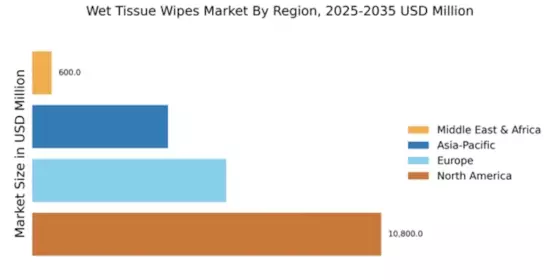
North America is poised to maintain its leadership in the Wet Tissue Wipes Market, holding a significant market share of $10,800.0M in 2025. The growth is driven by increasing consumer demand for convenience products, heightened awareness of hygiene, and regulatory support for safe and effective cleaning solutions. The region's robust retail infrastructure and e-commerce growth further bolster market expansion. The United States stands as the largest market, with key players like Procter & Gamble, Kimberly-Clark, and Johnson & Johnson leading the competitive landscape. These companies are innovating with eco-friendly products and expanding their distribution channels. The presence of established brands ensures a strong foothold in the market, catering to diverse consumer needs and preferences.

Europe : Emerging Trends in Hygiene

Europe's Wet Tissue Wipes Market is projected to reach $6,000.0M by 2025, driven by increasing consumer awareness regarding hygiene and convenience. Regulatory frameworks in the EU are promoting sustainable practices, encouraging manufacturers to innovate with biodegradable materials. The demand for personal care and household cleaning wipes is on the rise, reflecting changing consumer lifestyles and preferences. Leading countries such as Germany, France, and the UK are at the forefront of this market, with key players like Reckitt Benckiser and Unicharm actively participating. The competitive landscape is characterized by a mix of established brands and emerging players focusing on product differentiation and sustainability. This dynamic environment is expected to foster innovation and growth in the coming years.

Asia-Pacific : Rapid Growth in Emerging Markets

The Asia-Pacific Wet Tissue Wipes Market is anticipated to reach $4,200.0M by 2025, fueled by rising disposable incomes and urbanization. The growing awareness of hygiene, especially post-pandemic, has led to increased demand for wet wipes across various sectors, including personal care and healthcare. Regulatory support for product safety and quality is also a significant driver of market growth in this region. Countries like China, Japan, and India are leading the market, with key players such as Unicharm and Sofidel making substantial investments. The competitive landscape is evolving, with local manufacturers emerging alongside global brands, creating a diverse market. Innovations in product formulations and packaging are expected to enhance consumer appeal and drive further growth.

Middle East and Africa : Untapped Potential in Hygiene

The Middle East and Africa Wet Tissue Wipes Market is projected to reach $600.0M by 2025, reflecting significant growth potential. Factors such as increasing urbanization, rising disposable incomes, and a growing focus on hygiene are driving demand for wet wipes in the region. Regulatory initiatives aimed at improving public health standards are also contributing to market expansion. Countries like South Africa and the UAE are leading the market, with a mix of local and international players. The competitive landscape is characterized by increasing investments in product development and marketing strategies. Key players are focusing on expanding their product lines to cater to diverse consumer needs, thereby enhancing their market presence.

Key Players and Competitive Insights

The Wet Tissue Wipes Market is currently characterized by a dynamic competitive landscape, driven by increasing consumer demand for convenience and hygiene. Major players such as Procter & Gamble (US), Kimberly-Clark (US), and Reckitt Benckiser (GB) are strategically positioned to leverage innovation and sustainability in their product offerings. Procter & Gamble (US) has focused on enhancing its product line with eco-friendly materials, while Kimberly-Clark (US) emphasizes its commitment to sustainable sourcing and manufacturing practices. Reckitt Benckiser (GB) appears to be concentrating on expanding its market presence through strategic partnerships and acquisitions, thereby shaping a competitive environment that prioritizes both product quality and environmental responsibility.

In terms of business tactics, companies are increasingly localizing manufacturing to reduce supply chain vulnerabilities and optimize operational efficiency. The Wet Tissue Wipes Market is moderately fragmented, with key players exerting considerable influence over market dynamics. This fragmentation allows for niche players to emerge, yet the collective strength of major companies ensures that competition remains robust, particularly in terms of innovation and sustainability initiatives.

In November 2025, Procter & Gamble (US) announced the launch of a new line of biodegradable wet wipes, which underscores its commitment to sustainability. This strategic move not only aligns with growing consumer preferences for environmentally friendly products but also positions the company as a leader in sustainable innovation within the market. The introduction of biodegradable options is likely to attract eco-conscious consumers, thereby enhancing brand loyalty and market share.

In October 2025, Kimberly-Clark (US) unveiled a new manufacturing facility in Mexico, aimed at increasing production capacity for its Huggies brand. This expansion is significant as it allows for greater responsiveness to regional demand fluctuations and enhances supply chain efficiency. By localizing production, Kimberly-Clark (US) can reduce lead times and costs, which may provide a competitive edge in a market that increasingly values quick delivery and product availability.

In September 2025, Reckitt Benckiser (GB) entered into a strategic partnership with a leading technology firm to integrate AI into its product development processes. This collaboration is poised to enhance product innovation and consumer insights, allowing Reckitt Benckiser (GB) to tailor its offerings more effectively to market demands. The integration of AI could potentially streamline operations and improve customer engagement, thereby solidifying its competitive position in the Wet Tissue Wipes Market.

As of December 2025, current trends indicate a pronounced shift towards digitalization, sustainability, and technological integration within the Wet Tissue Wipes Market. Strategic alliances are increasingly shaping the competitive landscape, enabling companies to pool resources and expertise. The evolution of competitive differentiation appears to be moving away from price-based competition towards a focus on innovation, technology, and supply chain reliability. This shift suggests that companies that prioritize sustainable practices and technological advancements are likely to thrive in the future.

Key Companies in the Wet Tissue Wipes Market market include

Industry Developments

  • In 2023, Berry Global will introduce a sustainable line of professional wiping materials. Berry Global, a non-woven materials specialist, has launched a new line of products that will provide a diverse selection of materials and long-term solutions for hard surface disinfection.
  • In 2023,Ginni Filaments Ltd. will launch ultra-pure water wipes, a first for India in the baby care category. The pioneering product, which contains 99.9% water, is the most pure and gentle wipe with the fewest additives, created with an understanding of the special features of baby and infant skin. These high-water content wipes, marketed and registered as 'paaniwipes' under the brand name 'Adore Baby', gently cleanse babies' skin, giving a pleasant and refreshing experience for babies, including infants, during clean-ups.
  • In 2024, The Hygiene Co, a local business, will launch the first flushable wet wipes authorized in Australia. The first batch is now on Foodland's shelves, providing customers with a simple and environmentally friendly option. The Hygiene Co, headquartered in Woodville North, has accomplished the incredible achievement of receiving certification to the new Australian and New Zealand Flushable Products Standard.
  • In August 2021, Bey Bee announced about launching India's 1st toxin-free baby wipes. The wipes are prepared with purest pharmaceutical-grade purified water and enriched with Aloe Vera extracts and Vitamin E. 
  • On April 2021, 3M announced a new technology manufacturing instant microbe removing wipes in a dry state. When you moisten the wipes, they can remove up to 99.9% of microbes. 


Future Outlook

Wet Tissue Wipes Market Future Outlook

The Wet Tissue Wipes Market is projected to grow at a 5.2% CAGR from 2024 to 2035, driven by increasing consumer demand for convenience and hygiene.

New opportunities lie in:

  • Expansion into eco-friendly product lines
  • Development of subscription-based delivery services
  • Partnerships with healthcare facilities for bulk supply contracts

By 2035, the market is expected to solidify its position as a key player in personal care and hygiene.

Market Segmentation

Wet Tissue Wipes Market End Use Outlook

  • Retail
  • Institutional
  • Healthcare
  • Hospitality
  • Food Service

Wet Tissue Wipes Market Application Outlook

  • Personal Care
  • Household Cleaning
  • Medical
  • Industrial
  • Automotive

Wet Tissue Wipes Market Material Type Outlook

  • Non-Woven Fabric
  • Cotton
  • Viscose
  • Polyester
  • Bamboo

Wet Tissue Wipes Market Packaging Type Outlook

  • Single Pack
  • Multi-Pack
  • Refill Pack
  • Travel Pack
  • Bulk Pack

Wet Tissue Wipes Market Distribution Channel Outlook

  • Online Retail
  • Supermarkets
  • Pharmacies
  • Convenience Stores
  • Specialty Stores

Report Scope

MARKET SIZE 202421600.0(USD Million)
MARKET SIZE 202522780.0(USD Million)
MARKET SIZE 203537850.0(USD Million)
COMPOUND ANNUAL GROWTH RATE (CAGR)5.2% (2024 - 2035)
REPORT COVERAGERevenue Forecast, Competitive Landscape, Growth Factors, and Trends
BASE YEAR2024
Market Forecast Period2025 - 2035
Historical Data2019 - 2024
Market Forecast UnitsUSD Million
Key Companies ProfiledProcter & Gamble (US), Kimberly-Clark (US), Unicharm (JP), Reckitt Benckiser (GB), Johnson & Johnson (US), Sofidel (IT), Essity (SE), Pampers (US), Huggies (US)
Segments CoveredApplication, End Use, Material Type, Packaging Type, Distribution Channel
Key Market OpportunitiesGrowing demand for eco-friendly formulations in the Wet Tissue Wipes Market presents significant innovation opportunities.
Key Market DynamicsRising consumer preference for eco-friendly products drives innovation and competition in the wet tissue wipes market.
Countries CoveredNorth America, Europe, APAC, South America, MEA

Market Highlights

Author
Snehal Singh
Assistant Manager - Research

High acumen in analyzing complex macro & micro markets with more than 6 years of work experience in the field of market research. By implementing her analytical skills in forecasting and estimation into market research reports, she has expertise in Packaging, Construction, and Equipment domains. She handles a team size of 20-25 resources and ensures smooth running of the projects, associated marketing activities, and client servicing.

Leave a Comment

FAQs

What is the study period of this market?

The study period of the global wet tissue and wipes market is 2023-2032.

What is the growth rate of wet tissue and wipes market?

The wet tissue and wipes market is growing at a CAGR of 6.61% over the forecast period.

Which region has highest growth rate in wet tissue and wipes market?

North America is expected register the highest CAGR during 2024 to 2032.

Who are the key players in wet tissue and wipes market?

Johnson & Johnson Services Inc. (US), Procter & Gamble (US), Dr. Fischer Ltd. (Germany), Henkel Ag & Co. KGaA (Germany), Unilever (UK), Kimberly Clark Corporation (US), 3M (US), Edgewell Personal Care (US), Pigeon Corporation (Japan), Essity Aktiebolag (Publ) (Sweden), Nice-Pak Products, Inc. (US), Vinda International Holdings Limited (China), Beiersdorf AG (Germany), Unicharm Corporation (Japan), S.C. Johnson & Son, Inc. (US), Diamond Wipes International Inc. (US) are the major companies operating in wet tissue and wipes market.

Download Free Sample

Kindly complete the form below to receive a free sample of this Report

Compare Licence

×
Features License Type
Single User Multiuser License Enterprise User
Price $4,950 $5,950 $7,250
Maximum User Access Limit 1 User Upto 10 Users Unrestricted Access Throughout the Organization
Free Customization
Direct Access to Analyst
Deliverable Format
Platform Access
Discount on Next Purchase 10% 15% 15%
Printable Versions